|
ANCIENT CHINA
Emperor Gaozu of Tang (7 April 566 – 25 June 635)
1400 Years Old Chinese Coin Kai Yuan Tong Bao!
Tang Dynasty, White Copper
This coin is accompanied by a Certificate of
Authenticity!  
|


Tang Dynasty, the greatest emperor of ancient China.
| Tang, 621 A.D. |
Tang Dynasty |
唐 開元 |
Size: 24 mm Weight: 3.5 grams; Material: Bronze

Kai Yuan Tong Bao (The
Inaugural Currency).
This was the main coin issued by the Tang. It was cast for most of the
dynasty, a period of nearly 300 years. It was first issued by the Emperor
Gao Zu in the autumn of the 4th year of the Wu De period (August 621). Its
diameter was to be 8 fen. The weight was set at 2.4 zhu, ten to the liang.
1,000 coins weighed 6 jin 4 liang. The legend was written by the famous
calligrapher Ouyang Xun in a much admired mixture of the Bafen and Li
(official or clerkly) styles of writing. This is the first to include the
phrase tong bao, used on many subsequent coins. The inscription was used by
other regimes in later periods; such coins can be distinguished from Tang
coins by their workmanship. Minting and copper extraction were centrally
controlled, and private casting was punishable by death. For the first time
we find regulations giving the prescribed coinage alloy ¨C 83% copper, 15%
lead, and 2% tin. Previously the percentages used seem to have been on an ad
hoc basis. Actual analyses show rather less copper than this.
A crescent-shaped mark is often found on the reverse of Kai Yuans. The
legend is that the Empress Wende inadvertently stuck one of her fingernails
in a wax model of the coin when it was first presented to her, and the
resulting mark was reverentially retained. Other imperial ladies have also
been proposed as the source of these nail marks, especially the Imperial
Consort Yang. Peng explores the possibility of a foreign source for them.
More prosaically, they appear to be a control system operated by the mint
workers.
At first, mints were set up in Luoyang in Henan, and also in Peking, Chengdu,
Bingzhou (Taiyuan in Shanxi), and then Guilin in Guangxi. Minting rights
were also granted to some princes and officials. By 660, deterioration of
the coinage due to forgery had become a problem. The regulations were
reaffirmed in 718, and forgeries suppressed. In 737, the first commissioner
with overall responsibility for casting was appointed. In 739, ten mints
were recorded, with a total of 89 furnaces casting some 327,000 strings of
cash a year. 123 liang of metal were needed to produce a string of coins
weighing 100 liang. In the late 740s, skilled artisans were employed for
casting, rather than conscripted peasants. Despite these measures, the
coinage continued to deteriorate. In 808, a ban on hoarding coins was
proclaimed. This was repeated in 817. Regardless of the rank of a person,
they could not hold more than 5,000 strings of cash. Cash balances exceeding
this amount had to be expended within two months to purchase goods. This was
an attempt to compensate for the lack of cash in circulation. By 834, mint
output had fallen to 100,000 strings a year, mainly due to the shortage of
copper. Forgeries using lead and tin alloys were produced.
In 845, in the Huichang period, the Emperor Wu Zong, a fervent follower of
Taoism, destroyed the Buddhist monasteries and used the copper bells, gongs,
incense burners and statues to cast coins in various localities. These local
mints were under the control of the provincial governors. The New Tang
History states that Li Shen, governor of Huainan province, requested that
the empire might cast coins bearing the name of the prefecture in which they
were cast, and this was agreed. These coins with mint names on the reverses,
known as Huichang Kai Yuans, are of poor workmanship and size compared with
the early Kai Yuans. However, when Xuanzong ascended to the throne the next
year, this policy was reversed, and the new coins were recast to make
Buddhist statues.
Archaeological discoveries have assisted numismatists in dating various
varieties of the Kai Yuan more closely.
Tang Dynasty (618 - 907 AD)
The Tang Dynasty (18 June 618 - 4 June 907 AD) was
preceded by the Sui Dynasty and followed by the Five Dynasties and Ten
Kingdoms Period in China. The dynasty was founded by the Li (Àî) family, who
seized opportunity in the decline and collapse of the Sui Empire. The
dynasty was interrupted briefly by the Second Zhou Dynasty (16 October 690
¨C 3 March 705) when Empress Wu Zetian seized the throne (the first and only
Chinese Empress to rule in her own right). At its height in the 7th and
early part of the 8th century, the Tang Dynasty was the most powerful empire
in the world. The Tang Dynasty, with its capital at Chang'an (present-day
Xi'an), the most populous city in the world at the time, is regarded by
historians as a high point in Chinese civilization ¡ª equal to or surpassing
that of the Han Dynasty - as well as a golden age of cosmopolitan culture.
Its territory, acquired through the military campaigns of its early rulers,
was greater than that of the Han period, and rivaled that of the later Yuan
Dynasty and Qing Dynasty. The dynasty featured two of Chinese history's
major prosperity periods, the Zhen'guan Prosperity (Tang Taizong) and
Kaiyuan Prosperity (Tang Xuanzong's early rule). The enormous Grand Canal of
China (still the longest canal in the world) built during the previous Sui
Dynasty facilitated the rise of new urban settlements along its route, as
well as increased accessibility in mainland China to its own indigenous
commercial market. In Chinese history, the Tang Dynasty was largely a period
of progress and stability (except for the An Lushan Rebellion and decline of
central power during the 9th century). Chinese culture flourished and
matured further during the Tang era and it is also considered the greatest
age for Chinese poetry. Two of China's most famous historical poets, Du Fu
and Li Bai, belonged to this age, as well as Meng Haoran and Bai Juyi. There
were also many famous visual artists, such as the renowned painters Han Gan,
Wu Daozi, and Zhan Ziqian, although classic Chinese painting would not reach
its zenith until the Song and Ming dynasties. Although the dynasty and
central government were in decline by the 9th century, this did not mean art
and culture didn't continue to flourish. And although the weakened central
government withdrew largely from managing the economy, commercialism and
mercantile affairs continued to thrive regardless.
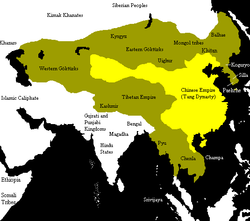
China 618 - 907 AD under the Tang Dynasty (yellow) and its sphere of
influence. |
|
|
*** AUTHENTICITY GUARANTEED FOR LIFE ***
Shipping policy:
Economy Regular mail shipping: 3.99 Euro worldwide (buyer's risk for
lost by post!)
If the total value is above 50 Euro, Registered mail is required for
safety reasons.
Registered mail shipping:
11.99 Euro within Europe, 15.99 Euro worldwide, Combined
shipping accepted. |