|
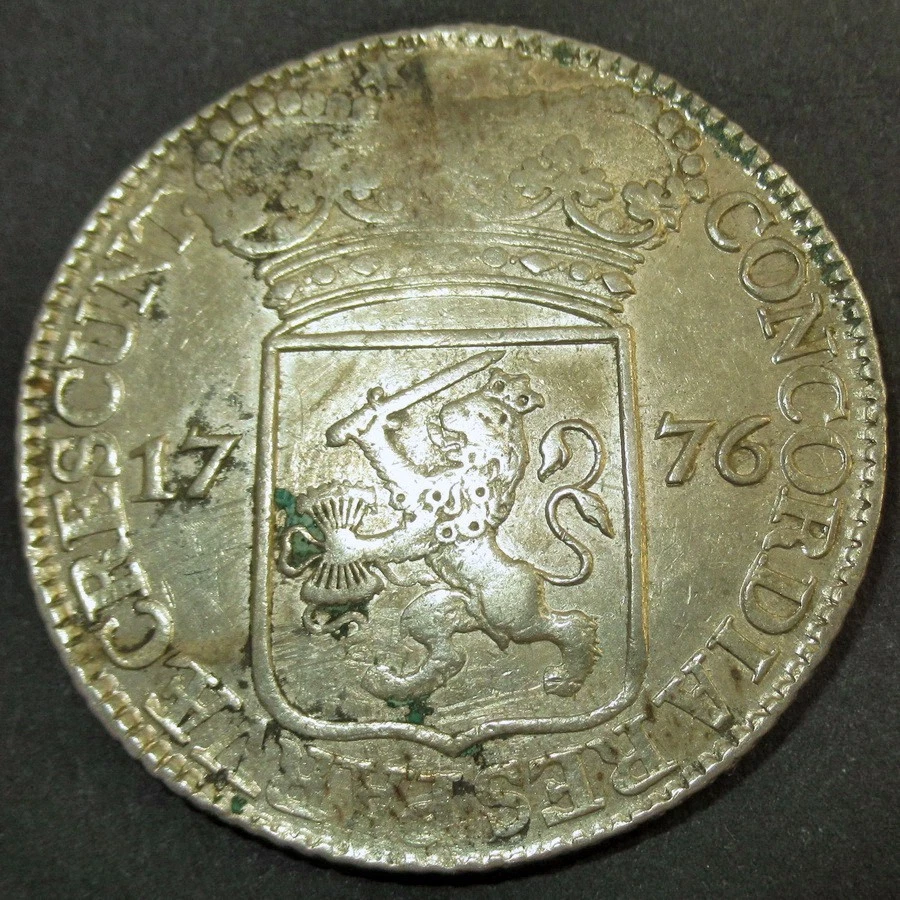
The Leg Dollar (Zilveren Dukaat)
The Leg Dollar
or silver ducat (Zilveren Dukaat), having a number of
varieties, was produced in all seven provinces, in the
region of West Frisia, and in three of the cities with
minting privileges as follows:
Leg Dollar Issues - Provinces:
Frisia: 1659-1698
Gelderland: 1659-1795
Groningen: 1683
Holland: 1659-1772
Overijssel: 1659-1795
Utrecht: 1659-1795
Zeeland: 1659-1795
Leg Dollar Issues - Regions
West Frisia: 1659-1795
Leg Dollar Issues - Cities
Deventer: 1662-1698
Kampen: 1659-1693
Zwolle: 1656-1669
Notes:
Zeeland - As with the 1597-1598 Lion Dollars and the Rix
Dollars from Zeeland, the lower half of the provincial
shield is covered by ocean waves.
Dutch Coinage Types
Found in the American Colonies
The seven United
Provinces of the Netherlands each had the right to mint
coins, these included: Holland, Overijssel, Zeeland,
Gelderland, Groningen, Utrecht and Frisia. Additionally
minting privileges were also extended to the region of West
Frisia (which was part of the province of Holland) and the
cities of Deventer, Groningen, Kampen, Nijmegen, Zutphen and
Zwolle.
Below are listed the
minting locations for the major Dutch coinage types found in
the American colonies: lion dollars, rix dollars, leg
dollars and silver rider ducatoons. Also appended is a
listing of other crown size silver coins minted in the
Netherlands during this era. The dates reflect the first and
last year of issue rather than a complete record of minting
years.
Although not as
prominent as the lion dollar, the ducatoon and the rix
dollar were often encountered in Seventeenth century
colonial America. They were regularly used in the Dutch
colony of New Amsterdam and spread outward as Dutch trade
with other colonies increased. On September 27, 1642 the
Massachusetts General Court decreed that due to the
frequency of trade with the Dutch colony they were
establishing a standard rate of exchange for the ducatoon
and rix dollar; the ducatoon would pass at a value of 6
shillings and the rix dollar would be put on par with the
Spanish eight reales at a value of 5 shillings. Similarly,
in 1686 the colony of Maryland standardized the ducatoon at
7s6d and put the rix dollar on par with the French ¨¦cu and
the Spanish eight reales at a value of 6 shillings.
A large silver coin
called a ducatone was first minted in the Spanish
Netherlands, in Brabant and Tournai, in 1618 and continued
to be produced throughout the century. The coin contained
501.23 grains of .944 fine silver, valued at 60 sols (which
was equivalent to three guilders or 60 stuivers), and
contained a a bust of the ruler on the obverse and the royal
heraldic shield on the reverse. From 1659 through 1794 a
coin of similar size and value was minted in each of the
seven northern United Provinces (what we call the
Netherlands). The Dutch coin, known as a Dukaton, was
slightly heavier at 505.86 grains but with slightly less
pure silver at .941 fineness. This Dukaton of Zilveren
Rijder was called a "silver rider" in the American colonies,
as the obverse depicted an soldier in full armor wielding a
sword on horseback with the provincial heraldic shield below
while on the reverse was the crowned arms of the United
Netherlands held up by two crowned lions. In the colonies
this coin was referred to as a ducatoon and became the
predominant coin of the Dutch East Indies during the
Eighteenth century.
The Nederlandse
Rijksdaalder, known in the colonies as the "rix dollar," was
actually a variety of different coins each averaging about
448 grains in weight of .885 fine silver. These coins were
independently minted by individual cities or provinces in
the United Netherlands and passed at a value of two and a
half guilders (50 stuivers). Usually the obverse of the coin
had a half portrait of the ruler (often with a drawn sword)
while the reverse displayed an heraldic shield.
Additionally, several German and Scandinavian cities minted
similar coins, known as thalers in their native areas but
called "rix dollars of the Empire" by the English. The
"Empire" refers to the loose confederation of German states
know jointly as the Holy Roman Empire. In 1702 Isaac Newton
assayed thirteen different rix dollars from German cities
and found they averaged 441.96 grains at .886 fine silver,
which was about the same as the Dutch coins. It appears all
of these various coins were called rix dollars in the
American colonies.
Starting in the 1650's
and continuing throughout 1795 another silver coin was
produced, a slightly smaller silver ducat of 28.25 grams at
.873 fine silver valued at 48 stuivers. This coin was
sometimes used in the American colonies where it passed at
the same rate as the rix dollar and was know as the "leg
dollar." The obverse depicted a standing soldier in full
armor with a sword in his right hand. In his left hand the
soldier held straps that were attached to the crowned
provincial shield which was displayed in front of him. The
shield completely obscured the soldier's left leg so the
picture looked like a soldier with one leg, hence the name
"leg dollar." The reverse displayed the crowned arms of the
United Netherlands.
Although not as
widespread as Spanish silver or the lion dollar, the silver
rider ducatoon and various rix dollars were certainly
familiar in the colonies throughout the Seventeenth and into
the early Eighteenth century, with the leg dollar seeing
some limited circulation during the Eighteenth century. |