The Silver Patagon
Numismatists may be surprised to read this
because patagons and shields are not only baked clay disks with
painted figures but also coins. Pure coincidence? It is possible
that the names refer to an ancient custom whereby the value of
party breads was increased by placing coins inside the breads or
just by laying them on top of them as a decorative element.
Unlike the origin of the coin to which the disk or patacon owes
(most likely) its name, the origin of the baked patagon still
remains a mystery. Let us return to the days in which the
Archdukes Albert and Isabella were in office (1598-1621). Due to
political and religious tensions at the end of the 16th century
they had to cope with high financial costs. On top of this, a
lot of often wealthy and influential merchants, talented
craftsmen and artists emigrated. The economic consequences of
the closing of the Schelde together with the sea blockade led to
a decrease in dynamism and finances. During the reign of the
Archdukes peace returned in the Southern Netherlands and the
introduction of a healthy and stable monetary system resulted in
an economic revival.
In 1612 a new series of gold coins as well as
a series of silver coins were put into circulation. Both series
were based on the sovereign but the silver sovereign soon became
known as the patagon. The half patagon, the quarter patagon, the
eighth patagon, the stiver, the half stiver and the farthing
were also part of this series. The silver series was later on
completed with the sixteenth patagon (1618), the ducaton and the
half ducaton (1618). These new coins formed a system that did
not change much until the middle of the 18th century. These new
coins excelled in quality, weight and fineness as well as in
design and finish.
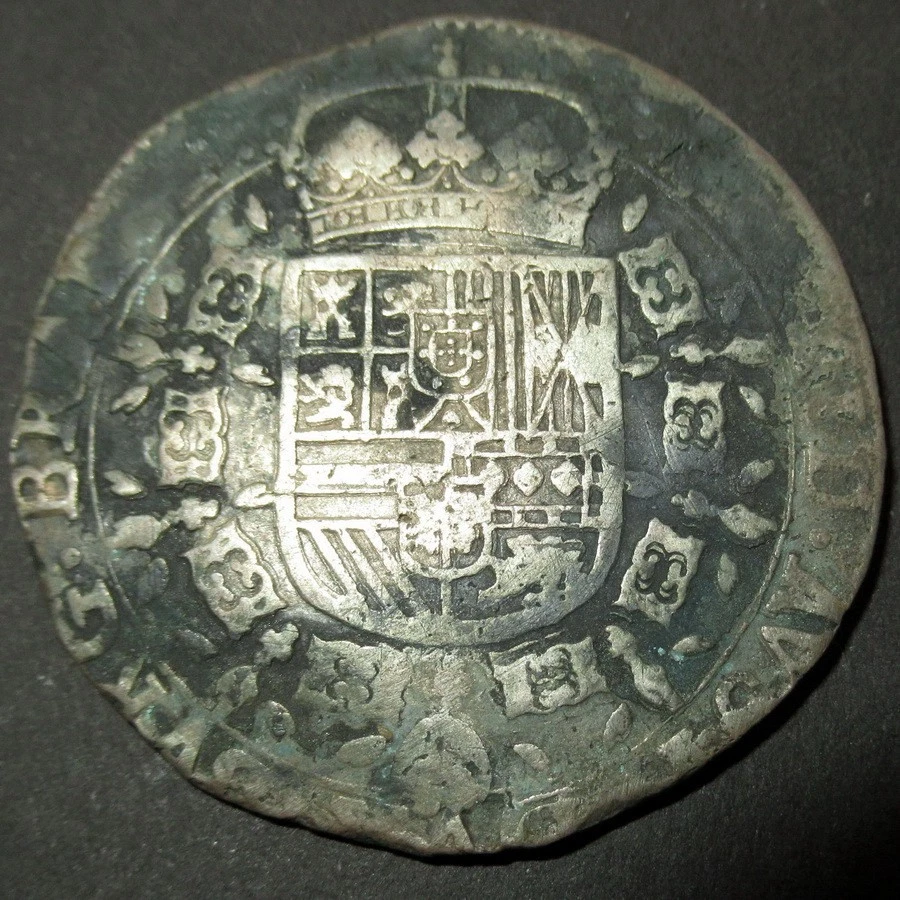
On the obverse is a crowned Saint-Andrew's-cross with the flint
and the collar of the Golden Fleece in the middle. Left and
right we recognize the crowned monograms of the archdukes and in
the legend ALBERTUS ET ELISABET DEI GRATIA. On the front side
there is also a cherub??s head at the top, which is the
Brussels?? mintmark. In fact, most of the patagons were minted
in Antwerp although Brussels was gaining importance as a new
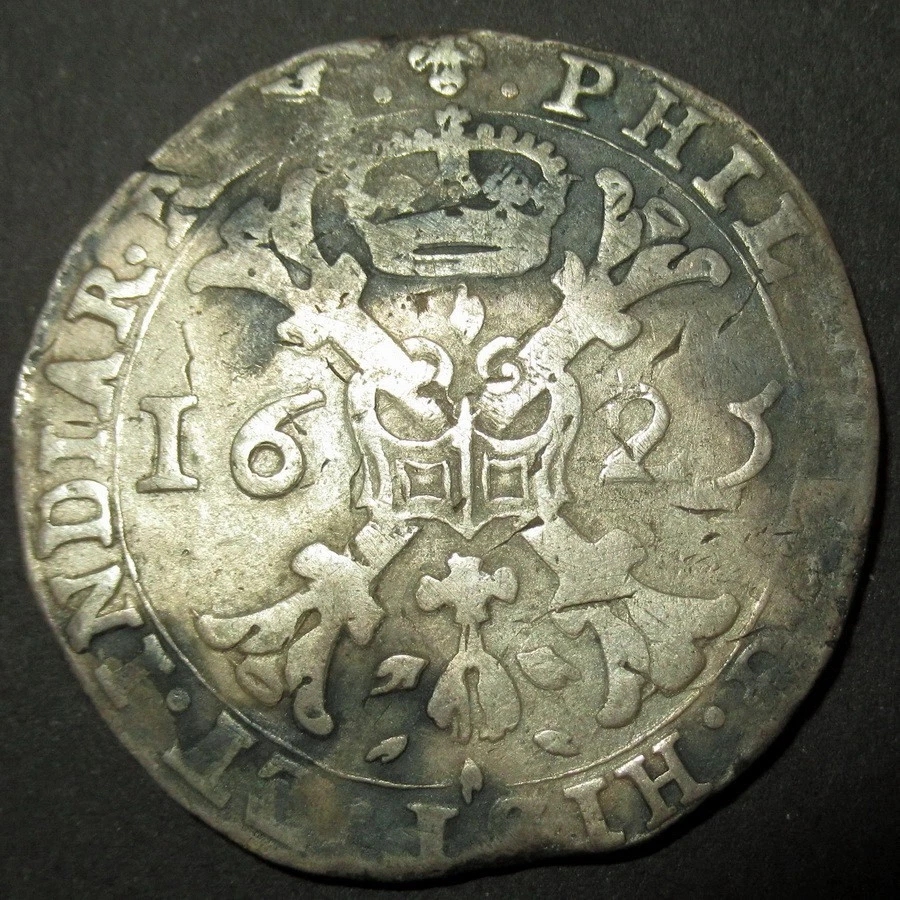
competitor. Next, on the reverse we can see the crowned
Burgundian weapon between the chain of the Golden Fleece and the
legend: AVST DVCES BVRG ET BRAB.
The patagon with a value of 48 stiver became
an important trade coin and enjoyed great international fame
until far beyond the borders of that time. In eastern Europe and
Russia the patagon was a popular means of payment for the
purchase of raw materials, amber, wheat, leather and fur. A
tangible proof of its international use is the jefimok . The
jefimok that is depicted here is originally a patagon from
Antwerp which had been adapted to the Russian monetary system by
adding two counterstamps. From then onwards the coin obtained a
value of 64 copecks. The two counterstamps consist of an oval
with the equestrian portrait of tsar Aleksej Michajlovitsj
(1645-1676) and a rectangle with the year 1655.
In this way the patagon was officially
admitted to the Russian circulation and in a further stage it
was used to pay the Russian troups. As a jefimok this patagon
stood alongside a number of other Dutch and German heavy silver
coins. Jefimok is in fact the Russian word for thaler and is
derived from ??Joachimthaler??.
Already in 1659 jefimki were withdrawn from
circulation, although they were still used in remote areas until
the beginning of the 18th century. So the patagons of Albert and
Isabella were granted a long life, not only in the Netherlands
but also elsewhere.
Also after the reign of the Archdukes the patagon was minted
although the mints were not able to uphold the same quantitative
and qualitative production level because of a decreased supply
of silver.
Spanish Silver in New World