|
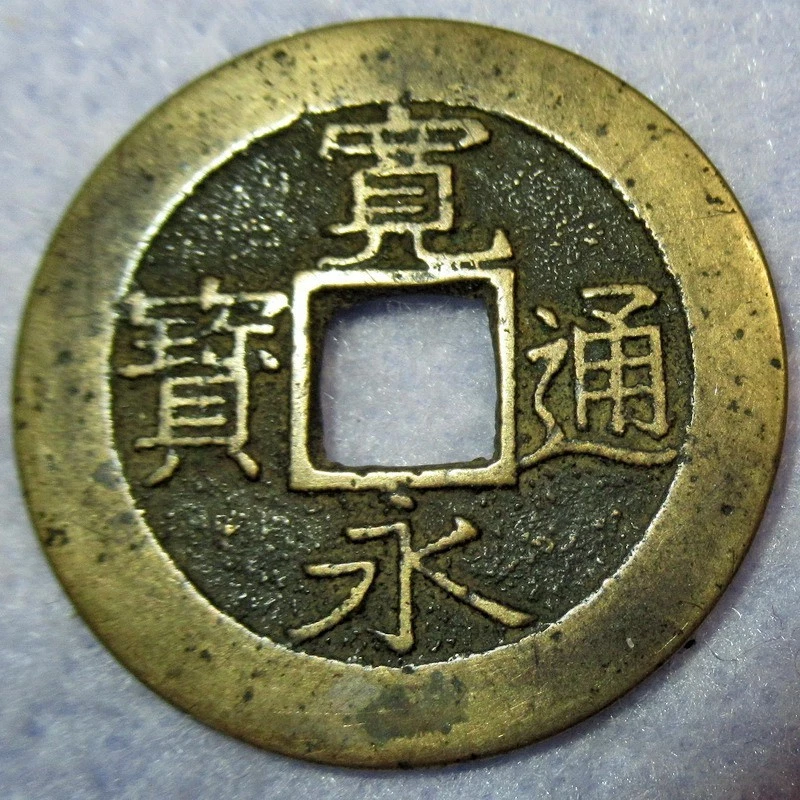
Weight: 5.0 grams
Size: 28.5 mm Material: Brass

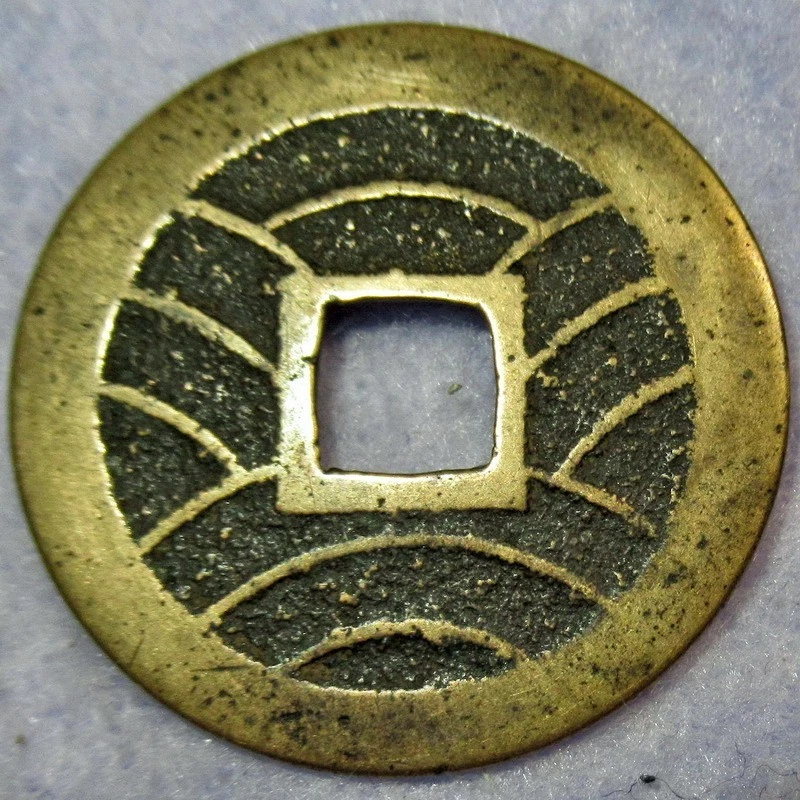
This is the second
type of 4 mon coin made. It has 11 waves on the back and
was first minted in 1769. Within the broader catagory of
1769 Meiwa coin, this coin is of the "fuei" type, which
means that the bottom "ei" character is large and
crouching. One way to easily identify this type is the
the nub at the top roof of the left "hou" character
protrudes a little down through the lid of that
character. This is the most common type of Meiwa era
coin. This coin was one of a number of 4 mon coins
kindly given to me by a good friend in Kochi, Japan.
明和11波俯永 |
  |
4 mon Kan'ei coins
The Tokugawa government
first commissioned in 1768 a Kan'ei
Tsuuhou coin valued at 4 mon. The first
version was made at the Fukagawa mint in
Edo and had a design of 21 waves on the
back of the coin (see image above). In
1769 the design of the reverse changed
to have only 11 waves and all subsequent
versions used the 11 wave design. It was
not much larger than a 1 mon coin (27-28
mm vs 25-26 mm) and so it was cost
effective to produce. This was desirable
in a time when there was a growing
scarcity of copper. Because the economy
itself was usually growing in this
period the coins were readily accepted
by users. The government ordered a new
batch of this same coin made in the
period 1821-1825. These are largely
identical but the quality is much moer
varied, which is to say that many of the
4 mon from this era are of poor
manufacture. The metal content of these
also tend to be more on the reddish side
than the earlier coins which have a
higher admixture of other metals than
copper. Because these coins were
manufactured in the Bunsei period
(1818-1829) They are called Bunsei coins
by collectors, in contrast to the
earlier ones which are called Meiwa
coins (from the Meiwa era 1764-1771).
The Bunsei coins are as common as the
Meiwa coins. One more period of minting
was in the Ansei era (1854-1859). There
is variation but they tend to be on the
yellowish brassy side and the file used
to smooth the face is very rough,
leaving clear file marks on the face. In
1860, under grave financial difficulties
the Tokugawa government began minting
the coin in iron but this was relatively
unsuccessful and the coins are
moderately uncommon.
Because the 4 mon coin was relatively profitable to make
there are many counterfeits produced by private mints, and/or
clandestine daimyo mints.From around the year 1866 many domains also officially
received permission to mint 4 mon coins to help with their own
finances. these were all made of iron and many of them have
special markings on the back, usually a character identifying
the name of the mint. Although the Tokugawa overlords gave some domains permission
to produce iron Kan'ei coins from 1866, The Tokugawa itself
started producing a 4 mon coin with a new legend in 1863. This
is the Bunkyuu eihou. Bunkyuu refers to the Bunkyuu era which
lasted from 1861-1863. Eihou means something like eternal cash
or eternally circulating cash. To Tokugawa government however
collapsed a mere 5 years after minting the coin and its hopeful
name did not come true. It is interesting that the government
chose to use a new and current era name for the coin, rather
than sticking with the tradition of the Kan'ei moniker. Perhaps
the rulers was hoping that a new era meant a reformation and
invigoration of Tokugawa rule, but the new era actually meant
collapse.
|
|
 Travel
back in time to storied feudal Japan - to the land of samurai,
daimyo (warlords) and shoguns! This much-mythologized period has been widely
celebrated in the popular media and arts. From NBC's Heroes to the novel and
miniseries Shōgun to the Tom Cruise big-screen epic The Last Samurai, feudal
Japan has captured our collective imagination for decades. The original
kanei tsuho coins were made at the Edo mint, which was most likely inside
Edo Castle proper, the main stronghold of the shogunate in Tokyo. Travel
back in time to storied feudal Japan - to the land of samurai,
daimyo (warlords) and shoguns! This much-mythologized period has been widely
celebrated in the popular media and arts. From NBC's Heroes to the novel and
miniseries Shōgun to the Tom Cruise big-screen epic The Last Samurai, feudal
Japan has captured our collective imagination for decades. The original
kanei tsuho coins were made at the Edo mint, which was most likely inside
Edo Castle proper, the main stronghold of the shogunate in Tokyo.
Japanese Numismatics
The mon was the main unit of currency in Japan until 1870, when it was
replaced by the yen. It resembles and was derived from the Chinese wenor
cash coin. The coins have a square hole in the middle, which allowed them to
be produced using less metal than a solid coin, but which more importantly
allowed them to be strung together on a piece of string, for easy transport
and payment.
The "bun" mint mark is the kanji character on the reverse of the coin (文).
It indicates that this coin was cast in Edo (modern-day Tokyo). The coins
are sometimes called bunsen, because of the "bun" character. The term "bun"
is the second syllable of the Japanese word kanbun (Japanese: 寛文). The
Kanbun era is the name for the Japanese era spanning the years 1661 to 1673,
during which the coins were made.
Kanei Tsuho coins are named after the era in which they were introduced.
Kanei (often written "Kan'ei" (Japanese: 寛永)) is the name of the Japanese
era spanning the years 1624 through 1643. Thus the term kanei tsuho
literally means "money of the Kan'ei era". Even though the Kan'ei era ended
in 1643, the term for the 1 Mon coins remained in use for over two hundred
years!
Despite their high grade and attractive appearance, these coins are not
reproductions. Each coin is guaranteed to be an original, solid copper
1668-Bun Square Hole 1 Mon, cast in Edo (Tokyo) and grading a very nice very
fine. A little bit of verdigris is typical on these coins, but they are much
nicer than usually found (when they can be found at all!).
For a more detailed exploration of the Tokugawa Shogunate, as well as the
city of Edo and the culture of the Floating World, please see the article
further down in this presentation.
|