Item Condition: **NOTE** : PAGES MAY SHOW AGE WEAR AND IMPERFECTIONS TO MARGINS, WITH CLOSED NICKS AND CUTS, WHICH DO NOT AFFECT AD IMAGE OR TEXT WHEN MATTED AND FRAMED.
DATE OF THIS ** ORIGINAL ** ADVERTISEMENT / ADVERT / AD:
DATE PRINTED ON ITEM: 1930
GREAT DECOR / ART FOR: HOME OFFICE BUSINESS SHOP STORE CASINO LOFT STUDIO GARAGE SHE SHED For several decades and multiple generations, the Imperial was the exclusive Chrysler and the favorite choice of luxurious transportation for senior executive leadership, government officials, royalty and various celebrities in comparison to the more affordable Chrysler New Yorker. Over the years the appearance, technological advancements and luxurious accommodations updated with the latest trends and fashionable appearances. Limousines, town cars and convertibles were the usual appearances, while special coachwork choices were provided by the industry's best providers, to include Derham, Fleetwood, LeBaron, and others. The Chrysler Imperial rose was cultivated in 1952 and used to promote the brand. In 1926, Walter P. Chrysler decided to compete with North American marques Cadillac, Lincoln, Packard, Pierce Arrow, Studebaker, Cord, and Duesenberg in the luxury car field, while the newly formed company only had a large displacement straight-six to offer. The new model, called Imperial, had a new engine that was slightly larger than the company's standard straight 6 installed in the Chrysler Six. It was a 288.6 cu in (4.7 L) six-cylinder with seven bearing blocks and pressure lubrication of 92 brake horsepower (69 kW). Large displacement engines provided the horsepower and torque clients wanted and due to the low quality of gasoline fuel at the time, and low compression ratios, 50 bhp was more than adequate. It is estimated that the rating equivalent of early gasoline available varied from 40 to 60 octane and that the "High-Test", sometimes referred to as "fighting grade", probably averaged 50 to 65 octane. The front axle was solid and the suspension consisted of semi-elliptic leaf springs while the rear suspension was a differential axle, and also using semi-elliptic leaf springs. The use of the "imperial" name being exclusively used on Chrysler's flagship had been previously used by Buick, Cadillac and Packard for top level limousines. The hood ornament/radiator cap was a stylized Viking Winged helmet. The car set a transcontinental speed record in the year it was introduced, driving more than 6,500 miles (10,460 km) in the week. The car was chosen as the pace car for the 1926 Indianapolis 500. The model was designated E-80, the 80 being after the "guaranteed" 80 miles per hour (129 km/h) all-day cruising speed. Acceleration was also brisk, breaking 20 seconds to 60 miles per hour (97 km/h). Four-speed manual transmission was added in 1930. The attention to luxury and multiple bodystyles was a similar approach to one Mr. Chrysler used as president of the Buick Motor Company, his employer from 1911 to 1919. Chrysler offered a variety of body styles: a two/four-passenger roadster (four passenger if car had the rumble seat), a four-seat coupé, five-passenger sedan and phaeton, and a seven-passenger top-of-the-line limousine. The limo had a glass partition between the front and rear passenger compartments. Imperials could be distinguished from Chrysler products by the use of a distinctive scalloped hood and radiator shell and a 120 in (3,048 mm) wheelbase, which shared an appearance with Packard and the Buick Master Six. The Berline Limousine was listed at US$3,595 ($61,872 in 2023 dollars ). The 1927 Imperial Series 80 saw minor engineering improvements, while the high compression "Red Head" 288.6 cu in (4.7 L) straight-six was the only engine available on a choice of 120 in (3,048 mm), 127 in (3,226 mm) or special order 133 in (3,378 mm) wheelbases. Five two-door coachwork choices included roadsters and convertible, while there were nine sedan, town car, phaeton and limousine choices. The top level Town Car was listed at US$5,495 ($96,384 in 2023 dollars ). Standard equipment on roadster and phaeton open-body coachwork selections included wind wings and leather exterior door trim panels, while many cars were painted in contrasting two-tone paint. The convertible was equipped with functioning landau irons. In 1927, an Imperial was driven at a high speed along the Lincoln Highway from San Francisco to New York to Los Angeles, covering a total distance of 6,726 mi (10,824.4 km) non-stop, with an average speed of 40 mph (64 km/h). 1928 offered a 136 in (3,454 mm) wheelbase with the designation Series 80L. Coachwork choices expanded with five provided by Briggs, and six choices from LeBaron, one Derham Convertible Sedan, one Phaeton from Locke, and four Dietrich convertible coupes and sedans, listing the Dietrich Convertible Sedan at US$6,795 ($120,572 in 2023 dollars ). Total Chrysler calendar year production was recorded at 160,670, their all-time high pre-war until decades later Model years 1929 and 1930 Series 80L were essentially unchanged from the 1928 version as engineering efforts were focusing on the 1931 Series CG Straight Eight, while there were some engineering advancements, to include thermostatically controlled automatic adjusting exterior radiator shutters, vertical hood louvers and a four-speed manual transmission. Coachbuilder Locke provided four convertible choices in both coupe and sedan configurations, and hydraulic four wheel brakes were now standard on all Chrysler products. The top level 1930 Series 80L Limousine was listed at US$3,575 ($65,205 in 2023 dollars ). Fred Cole (1893-1983) was an illustrator who seems to have specialized in automobile advertising. I could find little about him on the internet and nothing in my own reference library. Fortunately, the Web did have this link which provides useful information regarding his work and personality. It is hard to tell which artist did any given illustration, because the artistic style is similar for the entire ad campaign, something surely imposed by the art director. What's not clear is whether the art director had this appearance in mind from the start or else liked what he saw in the work created by the initial artist and ordered it continued. In any case, that series was very attractive — more so than Lincoln's cars of the time.
**For multiple purchases please wait for our combined invoice. Shipping discount are ONLY available with this method. Thank You.
SPECIAL CHARACTERISTICS/DESCRIPTIVE WORDS: ROADSTER COUPE SEDAN LIMOUSINE TOWN CAR PHAETON
The Chrysler Imperial, introduced in 1926, was Chrysler's top-of-the-line vehicle for much of its history. Models were produced under the Chrysler name until 1954, after which Imperial became a standalone make; and again from 1990–93. The company positioned the cars as a prestige marque to rival Cadillac, Continental, Lincoln, Duesenberg, Pierce Arrow, Cord, and Packard. According to Antique Automobile, "The adjective 'imperial' according to Webster's Dictionary means sovereign, supreme, superior or of unusual size or excellence. The word imperial thus justly befits Chrysler's highest priced model."
ILLUSTRATOR/ARTIST:
Among other things, Cole provided the illustration for what many in the advertising trade consider one of the greatest and most influential ads of all time: the Jordan Motor Car Company's "Somewhere West of Laramie."
The are two somewhat opposing advertising content strategies. One is to make a rational case for the product being advertised by dealing with its features. The other is the Jordan approach, eliciting positive emotion regarding a product or the company that makes the product. In practice, most advertisements offer some of each, though in recent decades the tendency is towards emotion, rather than rationality. A case in point are the TV commercials aired during the annual Super Bowl football game.
As for Cole, his car illustrations were unusual in that he left out parts of cars rather than being conventional and depicting the whole thing. That is, cars were suggested rather than portrayed. Even more interesting is that Cole did similar illustration for several carmakers, even during the same model year. One would expect that advertising managers and sales directors would want ads looking distinct from those of competitors. But that was 90 or so years ago, so perhaps the game was played differently then. Cole illustrated advertisements for the luxury Lincoln brand, this example from 1925. Here most of the car is shown, but not all. This approach works well with the vignette style of the advertisement where incompleteness is expected.
In the mid-1920s Lincoln had many advertisements using the general visual and content themes shown here. One factor that was not consistent was the artist doing the illustrations. Although Haddon Hubbard Sundblom (1899-1976) did some of this work, perhaps most were by Fred Cole.
ADVERT SIZE: SEE PHOTO FOR DIMENSIONS (ALL DIMENSIONS IN INCHES)
ALL items we sell are ORIGINAL and 100% guaranteed --- (we code all our items to insure authenticity) ---- we stand behind this.
As graphic collectors ourselves, we take great pride in doing the best job we can to preserve and extend the wonderful historic graphics of the past.
PLEASE LOOK AT OUR PHOTO CLOSELY AS IT IS (ALBEIT LOWER RESOLUTION) THE PRODUCT BEING SOLD.....NOT STOCK IMAGES
We ship via United States Postal Service. We have a 3 day handling time not including weekends or holidays.
A Note to our international buyers (Including Canada). Please read before placing a bid or buying an item:
**Import taxes, duties and charges are not included in the item price or shipping charges. These charges are the buyer's responsibility. Please check with your country's customs office to determine what these additional costs will be prior to bidding/buying on items. These charges are normally collected by the shipping company or when you pick the item up, this is not an additional shipping charge. We do not mark merchandise values below value or mark items as GIFTS, US and International government laws prohibit this so please don't ask us to. We are not responsible for shipping times to international buyer's. Your country's customs may hold the package for a month or more.
**We pride ourselves on quality products, great service, accurate gradations and fast shipping.**
BRANCHWATER BOOKS GRADING SCALE:
GOOD-->VERY GOOD-->FINE

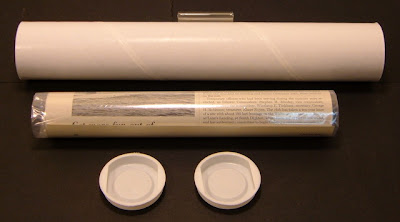
YOUR AD WILL BE SHIPPED ROLLED IN A PROTECTIVE PLASTIC BAG IN AN 80mm (TWICE USPS RECOMMENDED) THICK, 2 INCHES IN DIAMETER (SO AS NOT TO STRESS THE PAPER) SHIPPING TUBE WITH PRESS TIGHT PLASTIC END CAPS.
34738

Powered by SixBit's eCommerce Solution