


10Gbps USB 3.2 Gen2 Type-C to M.2 NVMe/ SATA 2-in-1 PCIe SSD Enclosure
M.2 SSD Enclosure: USB 3.1 Gen 2 Type-C to M.2 (NVMe + SATA) Dual-Protocol SSD Enclosure
Features
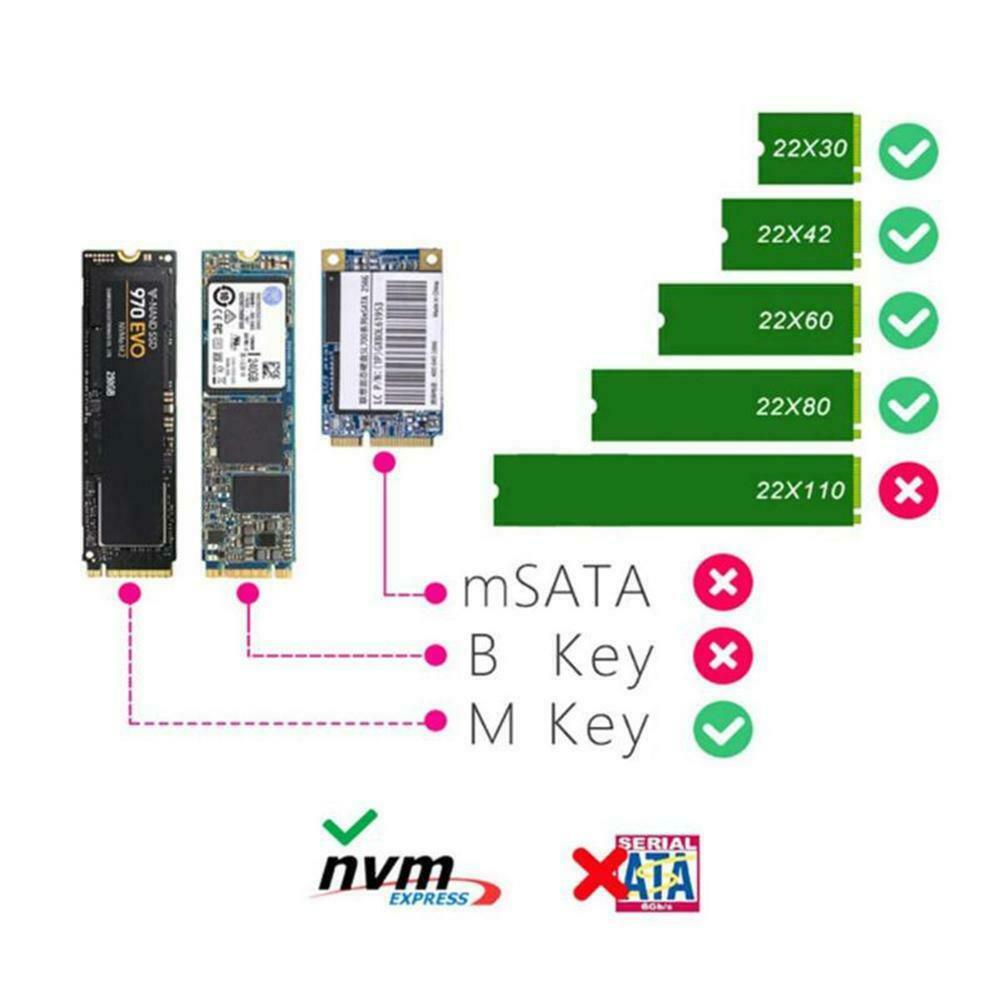
1. Dual-Protocol Compatibility:Works with M.2 NVMe SSDs (M-Key interface, compatible with PCIe 3.0/4.0) and M.2 SATA (NGFF) SSDs (B+M Key interface).
2. Size Support:Fits standard M.2 SSD form factors: 2230, 2242, 2260, 2280 (SSD not included).
3. Fast Transfer Speeds:Up to 10Gbps for NVMe SSDs (limited by USB 3.1 Gen 2; compatible with PCIe 3.0/4.0); up to 5Gbps for SATA SSDs (USB 3.1 Gen 1).
4. User-Friendly:Plug-and-play functionality with no driver installation required.
5. Efficient Cooling:Aluminum Alloy casing for effective heat dissipation.
Specifications
• Color: Black
• Material: Aluminum Alloy
• Transfer Speed: 10Gbps (NVMe, PCIe 3.0/4.0 compatible) / 5Gbps (SATA)
• Interface: USB 3.1 Gen 2 Type-C
• Compatible OS: Windows XP/Vista/7/8/10/11, macOS 8.6 or later, Linux
• Dimensions: Approx. 100 × 31 × 9 mm (3.93 × 1.22 × 0.35 inches)
• Material: Aluminum Alloy
• Transfer Speed: 10Gbps (NVMe, PCIe 3.0/4.0 compatible) / 5Gbps (SATA)
• Interface: USB 3.1 Gen 2 Type-C
• Compatible OS: Windows XP/Vista/7/8/10/11, macOS 8.6 or later, Linux
• Dimensions: Approx. 100 × 31 × 9 mm (3.93 × 1.22 × 0.35 inches)
Compatibility Notes
✅ Supported SSDs:
• M.2 NVMe SSD (M-Key interface, PCIe 3.0 & 4.0 compatible) – Applies to PCIe-labeled SSDs with NVMe protocol (mainstream type)
• M.2 SATA (NGFF) SSD (B+M Key interface)
(SSD not included)
• M.2 NVMe SSD (M-Key interface, PCIe 3.0 & 4.0 compatible) – Applies to PCIe-labeled SSDs with NVMe protocol (mainstream type)
• M.2 SATA (NGFF) SSD (B+M Key interface)
(SSD not included)
❌ Not Supported:
• Non-M.2 drives (e.g., 2.5-inch SATA, mSATA)
• M.2 B-Key only devices (e.g., wireless network cards)
• PCIe AHCI protocol M.2 SSDs – Excludes PCIe-labeled SSDs with AHCI protocol (rare early type)
• PCIe interface non-M.2 drives (e.g., PCIe add-in card SSDs)
• Non-M.2 drives (e.g., 2.5-inch SATA, mSATA)
• M.2 B-Key only devices (e.g., wireless network cards)
• PCIe AHCI protocol M.2 SSDs – Excludes PCIe-labeled SSDs with AHCI protocol (rare early type)
• PCIe interface non-M.2 drives (e.g., PCIe add-in card SSDs)
Package Contents
• 1 × USB 3.1 Gen 2 Type-C M.2 SSD Enclosure (NVMe & SATA Dual Protocol, PCIe 3.0/4.0 Compatible)
• 1 × 2-in-1 Dual-Connector 10Gbps USB-C Cable
• 1 × Screwdriver
• 1 × 2-in-1 Dual-Connector 10Gbps USB-C Cable
• 1 × Screwdriver
Note
"PCIe" refers to the interface bus – this enclosure supports PCIe 3.0/4.0 bus NVMe protocol M.2 SSDs (the mainstream type with PCIe labeling),but not PCIe-bus AHCI protocol M.2 SSDs (a rare early type with PCIe labeling) or PCIe interface non-M.2 drives. Verify your SSD via the "NVMe" or "SATA/M.2" label on the drive, and confirm it uses the M-Key (NVMe) or B+M Key (SATA) interface.

We accept Payoneer, PayPal, Mastercard, VISA, Google Pay, American Express etc.

We aim to dispatch all items within 48 hours of receiving full and cleared payment subject to stock availability. Please note that items purchased on weekends and public holidays are dispatched the next working day.
Delivery time and cost of shipment varies from one region to another.
If for any reason you do not receive your item please let us know without delay. We will investigate the matter immediately.
If you have any questions regarding any of our items, please do not hesitate to contact us via email. You will receive a prompt reply answering your question from one of our professional cycling experts.

Please use ebay's messaging service to contact us.
On 30-Dec-2025 at 03:33:33 GMT, seller added the following information:
On 30-Dec-2025 at 04:13:54 GMT, seller added the following information: