

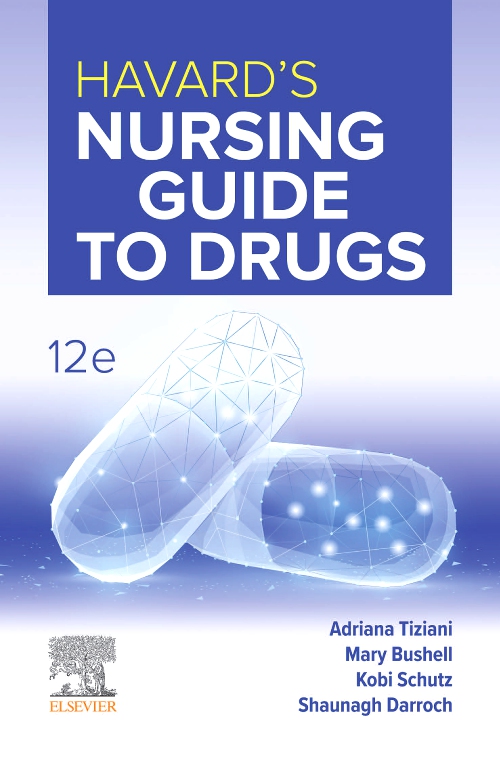
Havard’s Nursing Guide to Drugs is an indispensable guide for nurses and nursing students that can be used both as a quick reference for medicine information and to acquire a deeper understanding for safe and effective drug administration by nurses.
The guide is accessible and user friendly. It provides all the information you need for safe administration of medication, with drugs classified by both therapeutic class and body system for easy navigation.
The twelfth edition has been comprehensively reviewed and updated to ensure that usage, dose, side-effects, contraindications and precautions are consistent with current Australian pharmaceutical guidelines.
Havard’s Nursing Guide to Drugs 12e
Product Details
| ISBN | 9780729599238 |
| Author | By Adriana Tiziani, RN, BSc(Mon), Dip Ed(Melb), MEdSt(Mon), MRCNA, Mary Bushell, BPharm (Hons), GCLTHE, PhD, Kobi Schutz, BN, MPubHlth, GradCertEd and Shaunagh Darroch, BSc, MPharm,GradCertAcaPrac | Pub Date | 2026-03-06 |
Havard’s Nursing Guide to Drugs is an indispensable guide for nurses and nursing students that can be used both as a quick reference for medicine information and to acquire a deeper understanding for safe and effective drug administration by nurses.
The guide is accessible and user friendly. It provides all the information you need for safe administration of medication, with drugs classified by both therapeutic class and body system for easy navigation.
The twelfth edition has been comprehensively reviewed and updated to ensure that usage, dose, side-effects, contraindications and precautions are consistent with current Australian pharmaceutical guidelines.
Key Features
- Easy-to-use format – search for drugs by therapeutic class or body system
- All the important information nurses need – poisons information, formulae for calculations of drug doses and drip rates
- Nursing considerations such as patient safety, administration advice and cautions
- Drug monographs include active ingredient and trade names, available forms, action, use, dosage, adverse effects and interactions
- Patient education and advice notes to improve patient care and outcomes
- A separate durable pocket card suitable for attaching to a lanyard with formulae, useful units and concentrations, and common abbreviations
- Available in print and eBook
New to this edition
- Each drug reviewed to ensure its relevance for nurses in Australia
- Chapter introductions updated citing the latest evidence, in a language that promotes nurse and nursing student understanding
- Updated icons offering a quick visual guide, helping readers locate key drug information including pregnancy and breastfeeding safety, crushability, dosage adjustments, and considerations for older adults and in sports
- Therapeutic Goods Administration drug scheduling incorporated specifically for Schedule 8 medications
Table of Contents
1. Acne treatment
2. Analgesics and nonsteroidal anti‐inflammatory drugs NSAID
3. Anorectics and weight-loss agents
4. Anthelmintics
5. Antialzheimer's agents
6. Antianginal agents
7. Antianxiety agents
8. Antiarrhythmic agents
9. Antiasthma agents, bronchodilators and respiratory agents
10. Antibacterial agents
11. Anticoagulant and antithrombotic agents
12. Antidepressants
13. Antidiabetic agents
14. Antidiarrhoeal agents
15. Antidotes, antagonists and chelating agents
16. Antiemetic agents
17. Antiepileptics
18. Antifungal agents
19. Antiglaucoma agents
20. Antigout and uricolytic agents
21. Antihistamines
22. Antihypertensive agents
23. Antimalarial agents
24. Antimigraine agents
25. Antimycobacterial agents
26. Antineoplastic agents
27. Antineoplastic support agents
28. Antiparkinson's agents
29. Antiplatelet agents
30. Antiprotozoal agents
31. Antipsychotic and mood stabilising agents
32. Antiulcer agents
33. Antiviral agents
34. Bladder function disorder agents
35. Bone and calcium regulating agents
36. Cardiac glycosides
37. Cholinergic and anticholinergic agents
38. Corticosteroids
39. Cough suppressants, expectorants and mucolytics
40. Dermatological agents
41. Disease modifying antirheumatic drugs
42. Diuretics
43. Drug dependence
44. Erectile dysfunction agents
45. Eye, ear, nose and throat agents
46. Fibrinolytic agents
47. Gastrointestinal agents miscellaneous
48. General anaesthetics
49. Haemopoietic agents
50. Haemostatics
51. Hypothalamic and pituitary hormones
52. Immunomodifiers
53. Laxatives
54. Lipid regulating agents
55. Local anaesthetics
56. Metabolic disorders agents
57. Movement disorders agents
58. Muscle relaxants
59. Neuromuscularblocking agents
60. Opioid analgesics
61. Pregnancy, childbirth and breastfeeding
62. Pulmonary hypertension agents
63. Sedatives and hypnotics
64. Sex hormones
65. Stimulants
66. Sympathomimetic agents
67. Thyroid and antithyroid agents
68. Vaccines, immunoglobulins and antivenoms
69. Vasodilators
70. Vitamins, minerals and electrolytes
71. Antacids
Miscellaneous agents
Appendix
1. Poisoning and its treatment
2. Poisons information centres
3. Changes to drug names
About us
Elsevier, a global leader in information and analytics, helps researchers and healthcare professionals advance science and improve health outcomes for the benefit of society. Growing from our roots in publishing, we have supported the work of our research and health partners for more than 140 years. Elsevier offers knowledge and valuable analytics that help our users make breakthroughs and drive societal progress. Digital solutions such as ScienceDirect, Scopus, SciVal, ClinicalKey and Sherpath support strategic research management, R&D performance, clinical decision support, and health education. Elsevier publishes over 2,650 digitized journals, including The Lancet and Cell; our 42,000 eBook titles; and our iconic reference works, such as Gray's Anatomy. Elsevier is part of RELX, a global provider of information-based analytics and decision tools for professional and business customers.
Shipping
Goods will be dispatched when payment has been received. Delivery will then be made via our nominated courier. Anyone at the delivery address who accepts the goods will be presumed to be authorised to receive the goods. Delivery times stated on our website are estimated for guidance only and we are unable to state a specific day or time when delivery will be made.
Please note that we are unable to fulfil any orders that require delivery to a P.O. Box address. Deliveries to destinations outside Australia are made by international post. Charges for international delivery destinations are subject to the applicable freight charges determined by the destination point.
Please note that New Zealand customs may charge the recipient taxes, duties and fees on the 'import' of packages. The recipient is the importer of record and must comply with all laws and regulations of the destination country. Additional charges for customs clearance must be borne by the recipient; we have no control over these charges and can't predict what they may be. When customs clearance procedures are required, it can cause delays beyond our original delivery estimates. As these charges are the responsibility of the recipient, please check the customs service to see if charges are applicable. Elsevier Australia will not reimburse customers on these import costs or refund if a customer refuses to pay them or accept delivery due to these unforeseen instances.
