

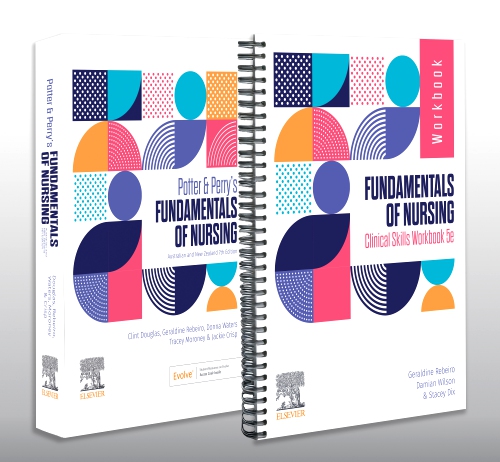
Potter & Perry’s Fundamentals of Nursing – ANZ, 7th Edition and Fundamentals of Nursing: Clinical Skills Workbook, 5th Edition Value Pack
Product Details
| ISBN | 9780729545280 |
| Author | By Clint Douglas, RN, BN, MClinEpi, MMedStat, PhD, FACN, Geraldine Rebeiro, RN, Midwife, B.AppSci (Adv Nsng), B.Ed Studs, M.Ed, PhD, MACN, Donna Waters, RN, Paed Cert, BA, MPH, PhD, FACN, Tracey Moroney, OAM, RN, PhD, BN (Hons), Grad Cert Ed Studies (Higher Ed), MACN, Damian Wilson, RN, BNurs, Grad Cert Emerg Nurs, Grad CertEd (HEd), MNurs (Emerg Care), MACN, MCENA, Stacey Dix, RN, BSc(Nurs), GradCert(CritCare), GradCert(HlthProfEd) and Jackie Crisp, RN, PhD | Pub Date | 2025-12-15 |
The leading fundamentals suite for nursing education in Australia and New Zealand
Equip tomorrow’s nurses with the region’s most trusted foundation in clinical practice. This comprehensive suite – Potter & Perry’s Fundamentals of Nursing ANZ 7e and the Fundamentals of Nursing: Clinical Skills Workbook 5e – brings together the essential knowledge, evidence-based care principles and hands‑on skill development required for confident, safe and person‑centred nursing.
The textbook delivers the core concepts, contemporary standards and critical thinking frameworks that underpin professional practice, while the workbook transforms learning into action with clear, step‑by‑step skill instructions, patient‑centred guidance and robust assessment tools. Together, they create an integrated learning experience that supports students from their first day in the classroom through to clinical placement and registration.
Designed by leading educators, clinicians and researchers, this suite sets the benchmark for foundational nursing education – reliable, relevant and ready for the realities of modern healthcare.
Key Features
What’s inside the suite
The flagship textbook is an essential bookshelf reference for every nursing student. It covers the full scope of knowledge required for registration, with clear explanations, evidence, scenarios and case studies that show exactly how to apply theory in real clinical settings. With an emphasis on clinical reasoning, critical thinking and reflection, each chapter guides students through Clinical Reasoning in Action processes, links to NSQHS Standards and key points that make learning stick.
The accompanying Clinical Skills Workbook brings the learning to life. Aligned to both the textbook and clinical skills videos, it offers step‑by‑step instructions, observation checklists and person‑centred prompts that help students focus not just on completing a task—but on caring for the patient in front of them. It’s a practical, supportive teaching tool for developing safe, effective clinical decision‑making.
Together, these resources form a complete learning ecosystem—ideal for lectures, tutorials, labs, placements and self‑directed study.
What’s new in this edition
Textbook
- New chapter on sustainability and planetary health
- Expanded focus on clinical reasoning through the Clinical Reasoning in Action Framework and new case studies
- New instructor resources on Evolve, including a Teaching Tool, test bank, critical reflection answers, PowerPoints and image collection
- Student access to clinical skills videos and case studies
Workbook
- Updated to align with the new Clinical Reasoning in Action Framework
- Revised Bondy Assessment Tool for clearer guidance on skill competency
Table of Contents
Section 1
1. Creating a proactive and dynamic nursing profession
Francine Douce
2. Building nursing practice: the Fundamentals of Care Framework
Tiffany Conroy, Alison Lydia Kitson, Rebecca Feo, Sylvie Rey and Jan Alderman
3. Engaging patients and keeping them safe
Rebecca Feo, Tiffany Conroy, Alison Lydia Kitson and Jan Alderman
4. Enabling cultural safety
Leonie Cox, Ali Drummond, Chris Taua and Jacquie Kidd
5. Partnering in care
Nicola Brown and Yun-Hee Jeon
6. Sustainable health care
Lorraine Fields and Suzanne Bowdler
Section 2
7. Developing clinical reasoning for nursing practice
Sally-Anne Bessell, Jan Alderman and Elyce Pate
8. Gathering relevant information and making decisions
Jan Alderman, Elyce Pate and Sally-Anne Bessell
9. Collaborative priority setting, delivering care and evaluating outcomes
Jan Alderman, Elyce Pate and Sally-Anne Bessell
10. Generating and using nursing knowledge
Lynn Sinclair
11. Collaborating for integrated care
Alexa Buliak, Keith Jones, Louise Connolly, Margaret Martin, Sally Peters and Suzanne Murray
12. Examining the ethical practice of nursing
Megan-Jane Johnstone
13. Practicing within regulatory frameworks
Elaine Papps and Sally Ann Robertson
14. Placing communication at the heart of person-centred care
Jane Stein-Parbury, Mark Andrew Goodhew and Fiona Orr
Section 3
15. The vital signs: Using a primary survey approach for patient assessment
Clint Douglas
16. Undertaking a focused assessment: Physical assessment of body systems
Clint Douglas
17. Preventing and controlling infection
Vanessa Sparke and Andrea Grimes
18. Optimising skin integrity and wound care
Christina Narelle Parker and Kim Kaim
19. Ensuring medication safety
Jacqueline Bloomfield and Astrid Frotjold
20. Promoting mobility
Evan Plowman and Krishna Lambert
21. Assessing and managing pain
Anthony Schoenwald
22. Supporting oxygenation and perfusion
Sharon Maclean
23. Balancing fluid, electrolyte and acid-base
Georgina Willetts and Laurina Schmidt
24. Meeting nutritional needs
Andrea P. Marshall and Shelley Roberts
25. Maintaining hygiene
Lise Duggan
26. Managing continence: urinary
Elizabeth Watt
27. Managing continence: bowel
Elizabeth Watt
28. Fostering sleep
Christopher Gordon
Section 4
29. Care across the lifespan: conception to adulthood
Donna Waters
30. Considering the older person
Samuel Lapkin and Lynette L. Chenoweth
31. Considering the person with disability
Julie Pryo, Murray John Fisher and Angela Davenport
32. Considering sexuality and sexual health
Donna Margaret Tilley and Jo Perks
33. Managing mental health and wellbeing
Deb O'Kane
34. Considering end of life care
Patsy Yates and John Patrick Rosenberg
Section 5
35. Working in the aged care sector
Lynette L. Chenoweth and Anna Williams
36. Working in primary and community health sectors
Ailsa Munns
37. Working in the acute care sector
Debbie Massey and Leisa Swift
38. Working in mental health
Anthony O'Brien
About us
Elsevier, a global leader in information and analytics, helps researchers and healthcare professionals advance science and improve health outcomes for the benefit of society. Growing from our roots in publishing, we have supported the work of our research and health partners for more than 140 years. Elsevier offers knowledge and valuable analytics that help our users make breakthroughs and drive societal progress. Digital solutions such as ScienceDirect, Scopus, SciVal, ClinicalKey and Sherpath support strategic research management, R&D performance, clinical decision support, and health education. Elsevier publishes over 2,650 digitized journals, including The Lancet and Cell; our 42,000 eBook titles; and our iconic reference works, such as Gray's Anatomy. Elsevier is part of RELX, a global provider of information-based analytics and decision tools for professional and business customers.
Shipping
Goods will be dispatched when payment has been received. Delivery will then be made via our nominated courier. Anyone at the delivery address who accepts the goods will be presumed to be authorised to receive the goods. Delivery times stated on our website are estimated for guidance only and we are unable to state a specific day or time when delivery will be made.
Please note that we are unable to fulfil any orders that require delivery to a P.O. Box address. Deliveries to destinations outside Australia are made by international post. Charges for international delivery destinations are subject to the applicable freight charges determined by the destination point.
Please note that New Zealand customs may charge the recipient taxes, duties and fees on the 'import' of packages. The recipient is the importer of record and must comply with all laws and regulations of the destination country. Additional charges for customs clearance must be borne by the recipient; we have no control over these charges and can't predict what they may be. When customs clearance procedures are required, it can cause delays beyond our original delivery estimates. As these charges are the responsibility of the recipient, please check the customs service to see if charges are applicable. Elsevier Australia will not reimburse customers on these import costs or refund if a customer refuses to pay them or accept delivery due to these unforeseen instances.
