

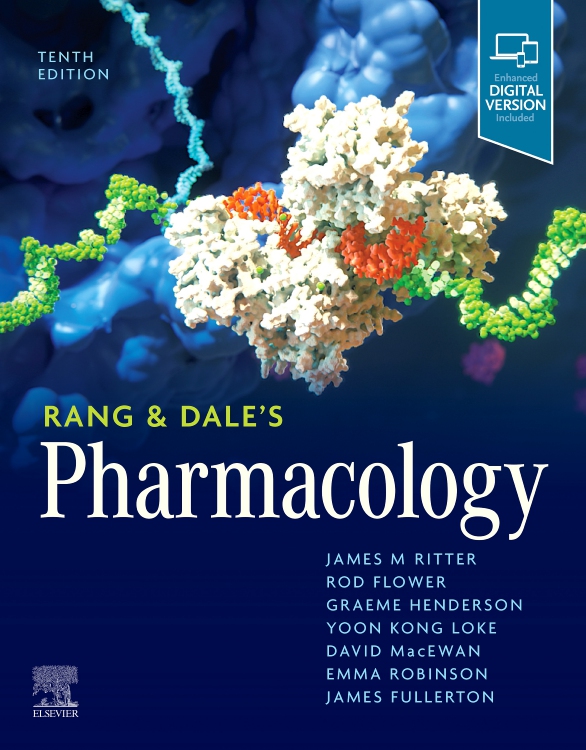
Rang & Dale's Pharmacology
Product Details
| ISBN | 9780323873956 |
| Author | By James M. Ritter, DPhil FRCP FBPhS FMedSci, Rod J. Flower, PhD DSc FBPhS FMedSci FRS, Graeme Henderson, BSc PhD FBPhS FSB, Yoon Kong Loke, MB, BS, MRCP, MD, David MacEwan, PhD, FRSB, FBPhS, SFHEA, Emma Robinson, PhD, FBPhS and James Fullerton, MA, MBChB, MRCP, PhD, FHEA. | Pub Date | 2023-05-24 |
Rang and Dale’s Pharmacology is internationally acknowledged as the core textbook for students of pharmacology, and has provided accessible, up-to-date information on drugs and their mechanism of action for more than 30 years.
Now in its tenth edition, it has been updated to include important new drugs such as gene therapies, personalised medicines and the new wave of RNA drugs. However it has not lost any of the elements that have contributed to its popularity, such as color coding and illustrations, making it reader-friendly while comprehensively covering the depth of detail required.
This essential book is recommended as the first-choice undergraduate text for science and medical students and junior doctors and will also be useful for students in other professional disciplines such as pharmacy, veterinary medicine and nursing.
Key Features
- Comprehensive information on drug mechanisms, basic physiology and biochemistry, and underlying pathophysiology of disease – suitable for students from many disciplines
- Clear figures to aid understanding, including data figures as well as mechanistic diagrams,
- Key points box summaries, clinical boxes and colour-coded chapters help to master difficult concepts
- Emphasis on therapeutic drugs to help apply theory to practice
- Over 150 questions and 12 clinical cases to test your knowledge
- An enhanced eBook version is included with purchase. The eBook allows you to access all the text, figures and references, with the ability to search, customise your content, make notes and highlights, and have content read aloud
Table of Contents
SECTION 1 GENERAL PRINCIPLES
1. What is pharmacology?
2. How drugs act: general principles
3. How drugs act: molecular aspects
4. How drugs act: cellular aspects - excitation, contraction and secretion
5. How drugs act: Biopharmaceuticals and gene therapy
6. Cell proliferation, apoptosis, repair and regeneration
7. Cellular mechanisms: host defence
8. Method and measurement in pharmacology
9. Absorption and distribution of drugs
10. Drug metabolism and elimination
11. Pharmacokinetics
12. Individual variation, pharmacogenomics and personalised medicine
SECTION 2 CHEMICAL MEDIATORS
13. Chemical mediators and the autonomic nervous system
14. Cholinergic transmission
15. Noradrenergic transmission
16. 5-Hydroxytryptamine and purines
17. Local hormones: histamine, lipids, peptides and proteins
18. Cannabinoids
19. Nitric oxide and related mediators
SECTION 3 DRUGS AFFECTING MAJOR ORGAN SYSTEMS
20. The heart
21. The vascular system
22. Atherosclerosis and lipoprotein metabolism
23. Haemostasis and thrombosis
24. Haemopoietic system and treatment of anaemia
25. Anti-inflammatory and immunosuppressant drugs
26. Skin
27. Eye
28. Respiratory system
29. The kidney and urinary system
30. The gastrointestinal tract
31. The control of blood glucose and drug treatment of diabetes mellitus
32. Obesity
33. The pituitary and the adrenal cortex
34. Thyroid
35. The reproductive system
36. Bone metabolism
SECTION 4 NERVOUS SYSTEM
37. Chemical transmission and drug action in the central nervous system
38. Amino acid transmitters
39. Other transmitters and modulators
40. Neurodegenerative diseases
41. General anaesthetic agents
42. Headache
43. Analgesic drugs
44. Local anaesthetics and other drugs affecting sodium channels
45. Anxiolytic and hypnotic drugs
46. Antiepileptic drugs
47. Antipsychotic drugs
48. Antidepressant drugs
49. Psychoactive drugs
50. Drug use and addiction
SECTION 5 DRUGS USED FOR THE TREATMENT OF INFECTIONS AND CANCER
51. Basic principles of antimicrobial chemotherapy
52. Antibacterial drugs
53. Antiviral drugs
54. Antifungal drugs
55. Antiprotozoal drugs
56. Antihelminthic drugs
57. Anticancer drugs
SECTION 6 SPECIAL TOPICS
58. Harmful effects of drugs
59. Lifestyle drugs and drugs in sport
60. Drug discovery and development
About us
Elsevier, a global leader in information and analytics, helps researchers and healthcare professionals advance science and improve health outcomes for the benefit of society. Growing from our roots in publishing, we have supported the work of our research and health partners for more than 140 years. Elsevier offers knowledge and valuable analytics that help our users make breakthroughs and drive societal progress. Digital solutions such as ScienceDirect, Scopus, SciVal, ClinicalKey and Sherpath support strategic research management, R&D performance, clinical decision support, and health education. Elsevier publishes over 2,650 digitized journals, including The Lancet and Cell; our 42,000 eBook titles; and our iconic reference works, such as Gray's Anatomy. Elsevier is part of RELX, a global provider of information-based analytics and decision tools for professional and business customers.
Shipping
Goods will be dispatched when payment has been received. Delivery will then be made via our nominated courier. Anyone at the delivery address who accepts the goods will be presumed to be authorised to receive the goods. Delivery times stated on our website are estimated for guidance only and we are unable to state a specific day or time when delivery will be made.
Please note that we are unable to fulfil any orders that require delivery to a P.O. Box address. Deliveries to destinations outside Australia are made by international post. Charges for international delivery destinations are subject to the applicable freight charges determined by the destination point.
Please note that New Zealand customs may charge the recipient taxes, duties and fees on the 'import' of packages. The recipient is the importer of record and must comply with all laws and regulations of the destination country. Additional charges for customs clearance must be borne by the recipient; we have no control over these charges and can't predict what they may be. Customs policies vary widely from country to country; you should contact your local customs office for more information. When customs clearance procedures are required, it can cause delays beyond our original delivery estimates. As these charges are the responsibility of the recipient, please check the customs service to see if charges are applicable. Elsevier Australia will not reimburse customers on these import costs or refund if a customer refuses to pay them or accept delivery due to these unforeseen instances.
Return policy
Products
- Elsevier Australia will exchange or refund products within 14 days provided:
(a) the product is in the original condition in which you received it, and products that are shrink-wrapped or sealed are in their original unbroken condition. This means that Elsevier Australia has the right to refuse return of a product which is not returned to us in the same condition as it was delivered to you, for example if it has been damaged in return transit by becoming soiled, scuffed or with torn pages, or bent page corners; and
(b) the product is accompanied by a copy of the proof of purchase. Elsevier Australia will not exchange or refund any electronic product (e.g. PDA software, DVD or CD-ROM) (or any Title containing an electronic product as a component) under this subclause. This includes VitalSource eBooks.
- Elsevier Australia will exchange or refund products if the product is faulty or damaged, has been incorrectly described or does not match the sample shown, is not of merchantable quality, or is not fit for a purpose or job you have made known to us or that is self-evident, provided the request for exchange or refund is made within a reasonable time in accordance with our obligations under the Trade Practices Act 1974 (Cth).
Claims must be made within 14 days of receipt when items are received by you in a damaged condition.
To request a return please contact Customer Service by visiting our Returns Policy page: https://www.elsevierhealth.com.au/return-policy
Our Customer Service representative will be able to provide you with details of our returns procedures.
