France
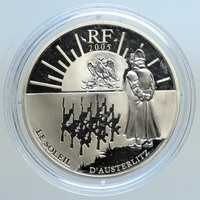
200th Anniversary of the Victory of Austerlitz
2005 Proof Silver 1 1/2 Euro 37mm (22.20 grams) 0.900 Silver (0.6424 oz. ASW)
Reference: KM# 1431
RF 2005 LE SOLEIL D'AUSTERLITZ, General views the Austerlitz radiant sunset, bird with arrows overlapping, war symbolism below.
LIBERTÉ ÉGALITÉ FRATERNITÉ 1 1/2 EURO, Men on battlefield raising bayonettes in victory, horses on field behind, hills in background. You are bidding on the exact item pictured, provided with a Certificate of Authenticity and Lifetime Guarantee of Authenticity.
.jpg/220px-La_bataille_d'Austerlitz._2_decembre_1805_(François_Gérard).jpg) The Battle of Austerlitz (2 December 1805/11 Frimaire An XIV FRC), also known as the Battle of the Three Emperors, was one of the most important and decisive engagements of the Napoleonic Wars. In what is widely regarded as the greatest victory achieved by Napoleon, the Grande Armée of France defeated a larger Russian and Austrian army led by Emperor Alexander I and Holy Roman Emperor Francis II. The battle occurred near the town of Austerlitz in the Austrian Empire (modern-day Slavkov u Brna in the Czech Republic). Austerlitz brought the War of the Third Coalition to a rapid end, with the Treaty of Pressburg signed by the Austrians later in the month. The battle is often cited as a tactical masterpiece, in the same league as other historic engagements like Cannae or Gaugamela. The Battle of Austerlitz (2 December 1805/11 Frimaire An XIV FRC), also known as the Battle of the Three Emperors, was one of the most important and decisive engagements of the Napoleonic Wars. In what is widely regarded as the greatest victory achieved by Napoleon, the Grande Armée of France defeated a larger Russian and Austrian army led by Emperor Alexander I and Holy Roman Emperor Francis II. The battle occurred near the town of Austerlitz in the Austrian Empire (modern-day Slavkov u Brna in the Czech Republic). Austerlitz brought the War of the Third Coalition to a rapid end, with the Treaty of Pressburg signed by the Austrians later in the month. The battle is often cited as a tactical masterpiece, in the same league as other historic engagements like Cannae or Gaugamela.
After eliminating an Austrian army during the Ulm Campaign, French forces seized Vienna in November 1805. The Austrians avoided further conflict until the arrival of the Russians bolstered Allied numbers. Napoleon sent his army north in pursuit of the Allies, but then ordered his forces to retreat so he could feign a grave weakness. Desperate to lure the Allies into battle, Napoleon gave every indication in the days preceding the engagement that the French army was in a pitiful state, even abandoning the dominant Pratzen Heights near Austerlitz. He deployed the French army below the Pratzen Heights and deliberately weakened his right flank, enticing the Allies to launch a major assault there in the hopes of rolling up the whole French line. A forced march from Vienna by Marshal Davout and his III Corps plugged the gap left by Napoleon just in time. Meanwhile, the heavy Allied deployment against the French right weakened the allied center on the Pratzen Heights, which was viciously attacked by the IV Corps of Marshal Soult. With the Allied center demolished, the French swept through both enemy flanks and sent the Allies fleeing chaotically, capturing thousands of prisoners in the process. The Allied disaster significantly shook the faith of Emperor Francis in the British-led war effort. France and Austria agreed to an armistice immediately and the Treaty of Pressburg followed shortly after, on 26 December. Pressburg took Austria out of both the war and the Coalition while reinforcing the earlier treaties of Campo Formio and of Lunéville between the two powers. The treaty confirmed the Austrian loss of lands in Italy and Bavaria to France, and in Germany to Napoleon's German allies. It also imposed an indemnity of 40 million francs on the defeated Habsburgs and allowed the fleeing Russian troops free passage through hostile territories and back to their home soil. Critically, victory at Austerlitz permitted the creation of the Confederation of the Rhine, a collection of German states intended as a buffer zone between France and Central Europe. The Confederation rendered the Holy Roman Empire virtually useless, so the latter collapsed in 1806 after Francis abdicated the imperial throne, keeping Francis I of Austria as his only official title. These achievements, however, did not establish a lasting peace on the continent. Prussian worries about growing French influence in Central Europe sparked the War of the Fourth Coalition in 1806.
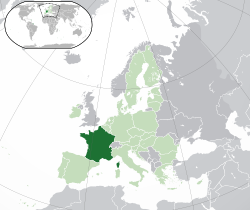
  France, officially the French Republic (French: République française), is a sovereign state comprising territory in western Europe and several overseas regions and territories. The European part of France, called Metropolitan France, extends from the Mediterranean Sea to the English Channel and the North Sea, and from the Rhine to the Atlantic Ocean. France spans 640,679 square kilometres (247,368 sq mi) and has a total population of 67 million. It is a unitary semi-presidential republic with the capital in Paris, the country's largest city and main cultural and commercial centre. The Constitution of France establishes the state as secular and democratic, with its sovereignty derived from the people. France, officially the French Republic (French: République française), is a sovereign state comprising territory in western Europe and several overseas regions and territories. The European part of France, called Metropolitan France, extends from the Mediterranean Sea to the English Channel and the North Sea, and from the Rhine to the Atlantic Ocean. France spans 640,679 square kilometres (247,368 sq mi) and has a total population of 67 million. It is a unitary semi-presidential republic with the capital in Paris, the country's largest city and main cultural and commercial centre. The Constitution of France establishes the state as secular and democratic, with its sovereignty derived from the people.
 During the Iron Age, what is now Metropolitan France was inhabited by the Gauls, a Celtic people. The Gauls were conquered in 51 BC by the Roman Empire, which held Gaul until 486. The Gallo-Romans faced raids and migration from the Germanic Franks, who dominated the region for hundreds of years, eventually creating the medieval Kingdom of France. France emerged as a major European power in the Late Middle Ages, with its victory in the Hundred Years' War (1337 to 1453) strengthening French state-building and paving the way for a future centralized absolute monarchy. During the Renaissance, France experienced a vast cultural development and established the beginning of a global colonial empire. The 16th century was dominated by religious civil wars between Catholics and Protestants (Huguenots). France became Europe's dominant cultural, political, and military power under Louis XIV. French philosophers played a key role in the Age of Enlightenment during the 18th century. In 1778, France became the first and the main ally of the new United States in the American Revolutionary War. In the late 18th century, the absolute monarchy was overthrown in the French Revolution. Among its legacies was the Declaration of the Rights of Man and of the Citizen, one of the earliest documents on human rights, which expresses the nation's ideals to this day. France became one of modern history's earliest republics until Napoleon took power and launched the First French Empire in 1804. Fighting against a complex set of coalitions during the Napoleonic Wars, he dominated European affairs for over a decade and had a long-lasting impact on Western culture. Following the collapse of the Empire, France endured a tumultuous succession of governments: the monarchy was restored, it was replaced in 1830 by a constitutional monarchy, then briefly by a Second Republic, and then by a Second Empire, until a more lasting French Third Republic was established in 1870. By the 1905 law, France adopted a strict form of secularism, called laïcité, which has become an important federative principle in the modern French society. France reached its territorial height during the 19th and early 20th centuries, when it ultimately possessed the second-largest colonial empire in the world. In World War I, France was one of the main winners as part of the Triple Entente alliance fighting against the Central Powers. France was also one of the Allied Powers in World War II, but came under occupation by the Axis Powers in 1940. Following liberation in 1944, a Fourth Republic was established and later dissolved in the course of the Algerian War. The Fifth Republic, led by Charles de Gaulle, was formed in 1958 and remains to this day. Following World War II, most of the empire became decolonized. Throughout its long history, France has been a leading global center of culture, making significant contributions to art, science, and philosophy. It hosts Europe's third-largest number of cultural UNESCO World Heritage Sites (after Italy and Spain) and receives around 83 million foreign tourists annually, the most of any country in the world. France remains a great power with significant cultural, economic, military, and political influence. It is a developed country with the world's sixth-largest economy by nominal GDP and eight-largest by purchasing power parity. According to Credit Suisse, France is the fourth wealthiest nation in the world in terms of aggregate household wealth. It also possesses the world's second-largest exclusive economic zone (EEZ), covering 11,035,000 square kilometres (4,261,000 sq mi). French citizens enjoy a high standard of living, and the country performs well in international rankings of education, health care, life expectancy, civil liberties, and human development. France is a founding member of the United Nations, where it serves as one of the five permanent members of the UN Security Council. It is a member of the Group of 7, North Atlantic Treaty Organization (NATO), Organisation for Economic Co-operation and Development (OECD), the World Trade Organization (WTO), and La Francophonie. France is a founding and leading member state of the European Union (EU).
|