Belgium
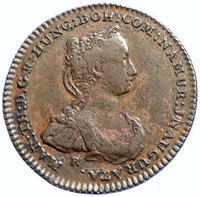
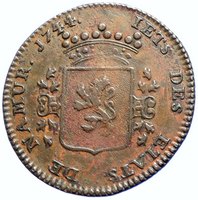
States of Namur - Queen Maria Theresia
1744 Bronze Jeton Medal 31mm (8.50
grams)
MAR:TH D.G. R: HUNG:BOH:COM:MANUR:JNAUGURATA R, Maria facing right.
IETS DES ETATS DE NAMUR 1744, Lion within crowned shield.
You are bidding on the exact item pictured,
provided with a Certificate of Authenticity and Lifetime Guarantee of
Authenticity.
 Namur
is a city and municipality in Wallonia, Belgium.
It is both the capital of the province of Namur
and of Wallonia, hosting the Parliament of
Wallonia, the Government of Wallonia and its
administration.
 Namur
stands at the confluence of the rivers Sambre
and Meuse and straddles three different regions
– Hesbaye to the north, Condroz to the
south-east, and Entre-Sambre-et-Meuse to the
south-west. The city of Charleroi is located to
the west. The language spoken is French.
The municipality consists of the following
districts: Beez, Belgrade, Boninne, Bouge,
Champion, Cognelée, Daussoulx, Dave, Erpent,
Flawinne, Gelbressée, Jambes, Lives-sur-Meuse,
Loyers, Malonne, Marche-les-Dames, Naninne,
Saint-Servais, Saint-Marc, Suarlée, Temploux,
Vedrin, Wépion, and Wierde.
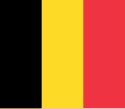 Belgium,
officially the Kingdom of Belgium, is a
sovereign state in Western Europe. It is a
small, densely populated country which covers an
area of 30,528 square kilometres (11,787 sq mi)
and has a population of about 11 million people.
 Straddling
the cultural boundary between Germanic and Latin
Europe, Belgium is home to two main linguistic
groups: the Dutch-speaking, mostly Flemish
community, which constitutes about 59% of the
population, and the French-speaking, mostly
Walloon population, which comprises 41% of all
Belgians. Additionally, there is a small group
of German-speakers who live in the East Cantons
located around the High Fens area, and bordering
Germany.
Belgium is a federal constitutional monarchy
with a parliamentary system of governance. It is divided into three
regions and three communities, that exist next to each other. Its two
largest regions are the Dutch-speaking region of Flanders in the north
and the French-speaking southern region of Wallonia. The
Brussels-Capital Region, officially bilingual, is a mostly
French-speaking enclave within the Flemish Region. A German-speaking
Community exists in eastern Wallonia. Belgium's linguistic diversity and
related political conflicts are reflected in its political history and
complex system of government. 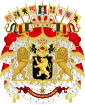 Historically,
Belgium, the Netherlands and Luxembourg were known as the Low Countries;
it once covered a somewhat larger area than the current Benelux group of
states. The region was called Belgica in Latin, after the Roman province
of Gallia Belgica. From the end of the Middle Ages until the 17th
century, the area of Belgium was a prosperous and cosmopolitan centre of
commerce and culture. From the 16th century until the Belgian Revolution
in 1830, when Belgium seceded from the Netherlands, the area of Belgium
served as the battleground between many European powers, causing it to
be dubbed the "Battlefield of Europe," a reputation strengthened by both
world wars.
Upon its independence, Belgium participated in the
Industrial Revolution and, during the course of the 20th century,
possessed a number of colonies in Africa. The second half of the 20th
century was marked by rising tensions between the Dutch-speaking and the
French-speaking citizens fueled by differences in language and the
unequal economic development of Flanders and Wallonia. This continuing
antagonism has led to several far-reaching reforms, resulting in a
transition from a unitary to a federal arrangement during the period
from 1970 to 1993. Despite the reforms, tensions between the groups
remain; the formation of a coalition government took 18 months following
the June 2010 federal election. Belgium is a founding member of
the European Union, Eurozone, NATO, OECD and WTO, and a part of the
trilateral Benelux Union. Its capital, Brussels, hosts several of the
EU's official seats as well as the headquarters of many major
international organizations such as NATO. Belgium is also a part of the
Schengen Area. Belgium is a developed country, with an advanced
high-income economy and is categorized as "very high" in the Human
Development Index.
|