|
Numerian -
Roman Emperor
: December 283 – November, 284 A.D.
-
Bronze Antoninianus 23mm (3.39 grams) Struck circa 283-284 A.D.
Reference: RIC 416f
IMPNVMERIANVSAVG - Radiate, draped and cuirassed bust right.
PIETASAVGG Exe: KAΔ - Mercury standing
left, holding purse and caduceus.
You are bidding on the exact item pictured,
provided with a Certificate of Authenticity and Lifetime Guarantee of
Authenticity.
Hermes was a god of transitions and boundaries. He was quick and cunning, and
moved freely between the worlds of the mortal and divine, as emissary and
messenger of the gods,[1]
intercessor between mortals and the divine, and
conductor of souls
into the afterlife.

He was protector and patron of travelers,
herdsmen
, thieves, orators and wit, literature
and poets, athletics and sports, invention and trade. In some myths he is a
trickster
, and outwits other gods for his own
satisfaction or the sake of humankind. His attributes and symbols include the
herma
, the
rooster
and the
tortoise
,
purse
or pouch,
winged sandals
,
winged cap
, and his main symbol was the
herald's staff, the Greek
kerykeion
or Latin
caduceus
which consisted of two snakes
wrapped around a winged staff.
In the Roman adaptation of the Greek pantheon (see
interpretatio romana
), Hermes was
identified with the Roman god
Mercury
, who, though inherited from the
Etruscans
, developed many similar
characteristics, such as being the patron of commerce.
Etymology
The earliest form of the name Hermes is the
Mycenaean Greek
*e-ma-a2 ,
written in Linear B
syllabic script. Most scholars derive
"Hermes" from Greek
herma
(a stone, roadside shrine or boundary
marker), dedicated to Hermes as a god of travelers and boundaries; the etymology
of herma itself is unknown. "Hermes" may be related to Greek hermeneus
("the interpreter"), reflecting Hermes' function as divine messenger.
Plato offers a Socratic folk-etymology for Hermes' name, deriving it
from the divine messenger's reliance on eirein (the power of speech).
Scholarly speculation that "Hermes" derives from a more primitive form meaning
"one cairn
" is disputed. The word "hermeneutics",
the study and theory of interpretation, is derived from hermeneus. In
Greek a lucky find was a hermaion.

Hermes with his mother Maia. Detail of the side B of an Attic
red-figure belly-amphora, c. 500 BC.
Mythology
Early Greek sources
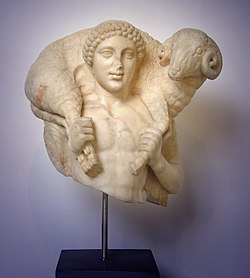
Kriophoros Hermes (which takes the lamb), late-Roman copy of Greek
original from the 5th century BC.
Barracco Museum
, Rome
Homer
and
Hesiod
portrayed Hermes as the author of
skilled or deceptive acts, and also as a benefactor of mortals. In the
Iliad
he was called "the bringer of good
luck," "guide and guardian" and "excellent in all the tricks." He was a divine
ally of the Greeks against the Trojans. However, he did protect
Priam
when he went to the Greek camp to
retrieve the body of his son
Hector
, and he accompanies them back to Troy.
Hermes stole Apollo's cattle when he was born. He jumped out of his crib and
and hid the cattle. Just when Apollo realized, Hermes jumped back into his crib
and pretended to be innocent. Apollo took Hermes by the scruff of the neck and
took him to his father, Zeus. Apollo said he was unhappy with he way he was
being treated. Instead of punishing young Hermes, Zeus just laughed and found
the matter funny.
He also rescued Ares
from a brazen vessel where he had been
imprisoned by Otus and Ephialtes
. In the
Odyssey
he helped his great-grand son, the
protagonist, Odysseus
, informing him about the fate of his
companions, who were turned into animals by the power of
Circe
, and instructed him to protect himself by
chewing
a magic herb
; he also told
Calypso
Zeus' order for her to free the same
hero from her island to continue his journey back home. When Odysseus killed the
suitors of his wife, Hermes led their souls to Hades. In
The Works and Days
, when Zeus ordered
Hephaestus
to create
Pandora
to disgrace humanity by punishing the
act of Prometheus giving fire to man, every god gave her a gift, and Hermes’
gift was lies and seductive words, and a dubious character. Then he was
instructed to take her as wife to
Epimetheus
.
Aeschylus
wrote in
The Eumenides
that Hermes helped
Orestes
kill
Clytemnestra
under a false identity and other
stratagems, and also said that he was the god of searches, and those who seek
things lost or stolen. In Philoctetes, Sophocles
invokes Hermes when Odysseus needs to convince Philoctetes to
join the Trojan
War on the side of the Greeks, and in Euripides' Rhesus Hermes
helps Dolon spy
on the Greek navy.
Aesop
featured him in several of his fables, as
ruler of the gate of prophetic dreams, as the god of athletes, of edible roots,
and of hospitality. He also said that Hermes had assigned each person his share
of intelligence.
The
Homeric hymn
to Hermes invokes him as the one
"of many shifts (polytropos), blandly cunning, a robber, a cattle driver,
a bringer of dreams, a watcher by night, a thief at the gates, one who was soon
to show forth wonderful deeds among the deathless gods." Hermes, as an inventor
of fire, is a parallel of the
Titan
Prometheus
. In addition to the
lyre, Hermes was believed to have invented many types of racing and
the sports of wrestling and boxing, and therefore was a patron of athletes.
Hellenistic Greek
sources
Several writers of the
Hellenistic period
expanded the list of Hermes’
achievements.
Callimachus
said he disguised himself as a
cyclops
to scare the
Oceanides
and was disobedient to his mother.
One of the Orphic Hymns Khthonios is dedicated to Hermes, indicating that he was
also a god of the underworld. Aeschylus had called him by this epithet several
times. Another is the Orphic Hymn to Hermes, where his association with the
athletic games held in tone is mystic.
Phlegon of Tralles
said he was invoked to ward
off ghosts, and Pseudo-Apollodorus reported several events involving Hermes. He
participated in the
Gigantomachy
in defense of Olympus; was given
the task of bringing baby
Dionysus
to be cared for by Ino and Athamas and
later by nymphs of Asia, followed
Hera, Athena
and
Aphrodite
in a beauty contest; favored the
young Hercules by giving him a sword when he finished his education and lent his
sandals to Perseus
. The Thracian princes identified him
with their god Zalmoxis
, considering his ancestor.
Anyte of Tegea
of the 3rd century BC, in
translation by
R Aldington
, wrote:
I Hermes stand here at the crossroads by the wind beaten orchard, near
the hoary grey coast; and I keep a resting place for weary men. And the
cool stainless spring gushes out.
called Hermes of the Ways after the patronage of travellers.
Epithets of Hermes
Argeiphontes
Hermes' epithet
Argeiphontes (Latin:
Argicida), meaning "Argus-slayer",
recalls his slaying of the hundred-eyed giant
Argus Panoptes
, who was watching over the
heifer-nymph
Io
in the sanctuary of Queen
Hera herself in Argos. Hermes placed a charm on Argus's eyes with the
caduceus to cause the giant to sleep, after this he slew the giant. Argus' eyes
were then put into the tail of the peacock, symbol of the goddess Hera.
Messenger and guide
- Diactoros, (angelos) the messenger, is in fact only seen
in this role, for Zeus, from within the pages of the Odyssey (Brown
1990).
... Oh mighty messenger of the gods of the upper and lower worlds ...
(Aeschylus).
Explicitly, at least in sources of classical writings, of Euripides
Electra and Iphigenia in Aulis and in Epictetus Discourses.
According to Blackwood's Edinburgh magazine (1849) the chief office of the God
was as messenger.
The messenger divine and herald of the Gods, he wears the gifts from his
father, the
Petasus
and
Talaria
...
Trade
-
Agoraeus
, of the
agora
; belonging to the market - (in
Aristophanes
[trans. Ehrenberg],) patron of
gymnasia
- Dolios (lit. tricky. [According to prominent
folklorist
Yeleazar Meletinsky
, Hermes is a deified
trickster
.] ) - god (or patron guidance)
and master of thieves ("a plunderer, a cattle-raider, a night-watching" - in
Homers' Hymns)...
and deception (Euripides)
and (possibly evil) tricks and trickeries, crafty (from lit. god of
craft), the cheat, god of stealth and of cunning, (see also to act
secretively as kleptein in reference - EL Wheeler), of treachery,
the schemer, wily, was worshipped at Pellene [Pausanias, vii. 27, 1]),
and invoked through Odysseus.
Hermes is amoral like a baby. although Zeus sent Hermes as a teacher
to humanity to teach them knowledge of and value of justice and to improve
inter-personal relationships ("bonding
between mortals").
- Empolaios "engaged in traffic and commerce"
Worship and cult
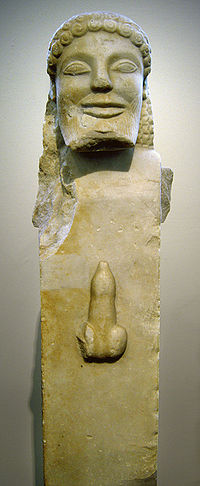
Archaic Greek herm, presumably of Hermes
Prior to being known as Hermes,
Frothingham
thought the god to have existed as
a snake-god. Angelo (1997) thinks Hermes to be based on the Thoth archetype. The
absorbing ("combining") of the attributes of Hermes to
Thoth
developed after the time of Homer amongst
Greek and Roman; Herodotus was the first to identify the Greek god with the
Egyptian (Hermopolis),
Plutarch and Diodorus also, although Plato thought the gods to be dis-similar
(Friedlander 1992).
A cult was established in Greece in remote regions, likely making him a god
of nature, farmers and shepherds. It is also possible that since the beginning
he has been a deity with
shamanic
attributes linked to
divination
,
reconciliation
,
magic
,
sacrifices
, and
initiation
and contact with other planes of
existence, a role of mediator between the worlds of the visible and invisible.
During the 3rd century BC, a communication between Petosiris (a priest) to
King Nechopso, probably written in Alexandria c. 150 BC, states Hermes is the
teacher of all secret wisdoms available to knowing by the experience of
religious ecstasy.[88]
Due to his constant mobility, he was considered the god of
commerce
and social intercourse, the wealth
brought in business, especially sudden or unexpected enrichment, travel, roads
and crossroads, borders and boundary conditions or transient, the changes from
the threshold, agreements and contracts, friendship, hospitality,
sexual intercourse
, games, data, the draw, good
luck, the sacrifices and the sacrificial animals, flocks and shepherds and the
fertility of land and cattle. In addition to serving as messenger to
Zeus, Hermes carried the souls of the dead to
Hades
, and directed the dreams sent by Zeus to
mortals.
Temples
One of the oldest places of worship for Hermes was Mount Cilene in Arcadia,
where the myth says that he was born. Tradition says that his first temple was
built by
Lycaon
. From there the cult would have been
taken to Athens, and then radiate to the whole of Greece, according to Smith,
and his temples and statues became extremely numerous. Lucian of Samosata said
he saw the temples of Hermes everywhere.
In many places, temples were
consecrated
in conjunction with Aphrodite, as
in Attica, Arcadia, Crete, Samos and in Magna Graecia. Several ex-votos found in
his temples revealed his role as initiator of young adulthood, among them
soldiers and hunters, since war and certain forms of hunting were seen as
ceremonial initiatory ordeals. This function of Hermes explains why some images
in temples and other vessels show him as a teenager. As a patron of the
gym
and
fighting
, Hermes had statues in gyms and he was
also worshiped in the sanctuary of the Twelve Gods in Olympia, where Greeks
celebrated the
Olympic Games
. His statue was held there on an
altar dedicated to him and Apollo together. A temple within the
Aventine
was consecrated in 495 BC.
Symbols of Hermes were the
palm tree
,
turtle
,
rooster
,
goat, the number four, several kinds of fish, incense. Sacrifices
involved honey, cakes, pigs, goats, and lambs. In the sanctuary of Hermes
Promakhos in Tanagra is a strawberry tree under which it was believed he had
created, and in the hills Phene ran three sources that were sacred to him,
because he believed that they had been bathed at birth.
Festival
Hermes’ feast was the special
Hermaea
was celebrated with sacrifices to the
god and with athletics and gymnastics, possibly having been established in the
6th century BC, but no documentation on the festival before the 4th century BC
survives. However, Plato said that Socrates attended a Hermaea. Of all the
festivals involving Greek games, these were the most like
initiations
because participation in them was
restricted to young boys and excluded adults.
Hermai/Herms

This circular Pyxis or box depicts two scenes. The one shown
presents Hermes awarding the golden apple of the Hesperides to
Aphrodite, whom he has selected as the most beautiful of the
goddesses. The Walters Art Museum.
In Ancient Greece, Hermes was a phallic god of boundaries. His name, in the
form herma
, was applied to a wayside marker pile
of stones; each traveller added a stone to the pile. In the 6th century BCE,
Hipparchos
, the son of
Pisistratus
, replaced the
cairns
that marked the midway point between
each village deme
at the central
agora
of Athens with a square or
rectangular pillar of stone or bronze topped by a bust of Hermes with a
beard
. An erect
phallus
rose from the base. In the more
primitive
Mount Kyllini
or Cyllenian herms, the standing
stone or wooden pillar was simply a carved phallus. In Athens, herms were placed
outside houses for good luck. "That a monument of this kind could be transformed
into an
Olympian
god is astounding,"
Walter Burkert
remarked.
In 415 BCE, when the Athenian fleet was about to set sail for
Syracuse
during the
Peloponnesian War
, all of the Athenian hermai
were vandalized one night. The Athenians at the time believed it was the work of
saboteurs, either from Syracuse or from the anti-war faction within Athens
itself. Socrates
' pupil
Alcibiades
was suspected of involvement, and
Socrates indirectly paid for the impiety with his life.
Hermes' possible
offspring
Pan
The satyr
-like Greek god of nature, shepherds and
flocks,
Pan
, could possibly be the son of Hermes
through the nymph Dryope
. In the
Homeric Hymn
to Pan, Pan's mother fled in
fright from her newborn son's goat-like appearance.
Priapus
Depending on the sources consulted, the god
Priapus
could be understood as a son of Hermes.
Autolycus
Autolycus
, the Prince of Thieves, was a son of
Hermes and
Chione
(mortal) and grandfather of
Odysseus.
Extended list of Hermes' lovers and children
-
Acacallis
- Cydon
-
Aglaurus
-
Eumolpus
- Amphion
[105]
- Alcidameia of
Corinth
- Bounos
-
Antianeira
/
Laothoe
-
Echion
, Argonaut
-
Erytus
, Argonaut
- Apemosyne
- Aphrodite
- Eros
(possibly)
-
Hermaphroditus
- Tyche
(possibly)
- Astabe, daughter of
Peneus
-
Astacus
-
Carmentis
-
Evander
-
Chione
/
Stilbe
/ Telauge
-
Autolycus
- Chryses
, priest of
Apollo
-
Chthonophyle
-
Polybus of Sicyon
-
Crocus
- Daeira the
Oceanid
-
Eleusis
- Dryope
, Arcadian nymph
-
Pan
(possibly)
- Erytheia (daughter of
Geryones
)
- Norax
- Eupolemeia (daughter of
Myrmidon
)
-
Aethalides
- Hecate
- three unnamed daughters
- Herse
-
Cephalus
- Ceryx
(possibly)
- Hiereia
- Gigas
- Iphthime
(daughter of Dorus)
- Lycus
- Pherespondus
- Pronomus
- Libye (daughter of
Palamedes
)
- Libys
- Ocyrhoe
- Caicus
- Odrysus
- Orsinoe, nymph
-
Pan
(possibly)
-
Palaestra
, daughter of Choricus
- Pandrosus
- Ceryx
(possibly)
- Peitho
- Penelope
-
Pan
(possibly)
-
Persephone
(unsuccessfully wooed her)
- Perseus
[113]
- Phylodameia
-
Pharis
-
Polydeuces
- Polymele
(daughter of
Phylas
)
-
Eudorus
-
Rhene
, nymph
-
Saon
of
Samothrace
- Sicilian
nymph
- Daphnis
- Sose, nymph
- Pan Agreus
- Tanagra, daughter of
Asopus
- Theobula
/ Clytie / Clymene /
Cleobule
/
Myrto
/ Phaethusa the
Danaid
-
Myrtilus
- Therses
- Thronia
- Arabus
- Urania
, Muse
-
Linus
(possibly)
- Unknown mothers
- Abderus
- Angelia
- Dolops
-
Palaestra
Genealogy of the Olympians in Greek mythology
Genealogy
of the
Olympians
in
Greek mythology
|
|
|
|
|
|
|
|
|
|
Uranus
|
|
Gaia
|
|
|
|
|
|
|
|
|
|
|
|
|
|
|
|
|
|
|
|
|
|
|
|
|
|
|
|
|
|
|
|
|
|
|
|
|
|
|
|
|
|
|
|
|
|
|
|
|
|
|
|
|
|
|
|
|
|
|
|
|
|
|
|
|
|
|
|
|
|
|
|
|
|
|
|
|
|
|
|
|
|
|
|
|
|
|
|
|
|
|
|
|
|
|
|
|
|
|
|
|
|
|
|
|
|
|
|
|
|
|
|
|
|
|
|
|
Oceanus
|
|
Hyperion
|
|
Coeus
|
|
Crius
|
|
Iapetus
|
|
Mnemosyne
|
|
|
|
|
| |
|
|
|
|
|
|
|
|
|
|
|
|
|
|
|
|
|
|
|
|
|
|
|
|
|
|
|
|
|
|
|
|
|
|
|
|
|
|
|
|
|
|
|
|
|
|
|
|
|
|
|
|
|
|
|
|
|
|
|
|
|
|
|
|
Cronus
|
|
Rhea
|
|
Tethys
|
|
Theia
|
|
Phoebe
|
|
Themis
|
|
|
|
|
|
|
|
|
|
|
|
|
|
|
|
|
|
|
|
|
|
|
|
|
|
|
|
|
|
|
|
|
|
|
|
|
|
|
|
|
|
|
|
|
|
|
|
|
|
|
|
|
|
|
|
|
|
|
|
|
|
|
|
|
Zeus
|
|
Hera
|
|
Hestia
|
|
Demeter
|
|
Hades
|
|
Poseidon
|
|
|
|
|
|
|
|
|
|
|
|
|
|
|
|
|
|
|
|
|
|
|
|
|
|
|
|
|
|
|
|
|
|
|
|
|
|
|
|
|
|
|
|
|
|
|
|
|
|
|
|
|
|
|
|
|
|
|
|
|
|
|
|
|
|
|
|
|
|
|
|
|
Ares
|
|
Hephaestus
|
|
Hebe
|
|
Eileithyia
|
|
Enyo
|
|
Eris
|
|
|
|
| |
|
|
|
|
|
|
|
|
|
|
|
|
|
|
|
|
|
|
|
|
|
|
|
|
|
|
|
|
|
|
|
|
|
|
|
|
|
|
|
|
|
|
|
|
|
|
|
|
|
|
|
|
|
|
|
|
|
|
|
|
Metis
|
|
|
|
Maia
|
|
|
|
|
Leto
|
|
|
|
|
Semele
|
|
|
|
|
|
|
|
|
|
|
|
|
|
|
|
|
|
|
|
|
|
|
|
|
|
|
|
|
|
|
|
|
|
|
|
|
|
|
|
|
|
|
|
|
|
|
|
|
|
|
|
|
|
|
|
|
|
|
|
|
|
Aphrodite
|
|
Athena
|
|
|
Hermes |
|
Apollo
|
|
Artemis
|
|
Dionysus
|
|
|
| |
|
|
|
|
|
|
|
|
|
|
|
|
|
|
|
|
|
|
|
|
|
|
|
|
|
|
|
|
|
| |
|
Art and iconography

Archaic bearded Hermes from a herm, early 5th century BC.
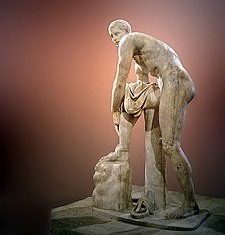
Hermes Fastening his Sandal
,
early Imperial Roman marble copy of a
Lysippan
bronze ( Louvre
Museum)
The image of Hermes evolved and varied according to Greek art and culture.
During
Archaic Greece
he was usually depicted as a
mature man, bearded, dressed as a traveler, herald, or pastor. During
Classical
and
Hellenistic Greece
he is usually depicted young
and nude, with athleticism, as befits the god of speech and of the gymnastics,
or a robe, a formula is set predominantly through the centuries. When
represented as Logios (speaker), his attitude is consistent with the attribute.
Phidias
left a statue of a famous Hermes Logios
and Praxiteles
another, also well known, showing
him with the baby
Dionysus
in his arms. At all times, however,
through the Hellenistic periods, Roman, and throughout Western history into the
present day, several of his characteristic objects are present as
identification, but not always all together.
Among these objects is a wide-brimmed hat, the
Petasos
, widely used by rural people of
antiquity to protect themselves from the sun, and that in later times was
adorned with a pair of small wings, sometimes the hat is not present, but may
then have wings rising from the hair. Another object is the Porta a stick,
called rhabdomyolysis (stick) or skeptron (scepter), which is referred to as a
magic wand. Some early sources say that this was the bat he received from
Apollo, but others question the merits of this claim. It seems that there may
have been two canes, with time in a cast, one of a shepherd's staff, as stated
in the Homeric Hymn, and the other a magic wand, according to some authors. His
bat also came to be called kerykeion, the
caduceus
, in later times. Early depictions of
the staff it show it as a baton stick topped by a golden way that resembled the
number eight, though sometimes with its top truncated and open. Later the staff
had two intertwined snakes and sometimes it was crowned with a pair of wings and
a ball, but the old form remained in use even when Hermes was associated with
Mercury by the Romans.
Hyginus
explained the presence of snakes,
saying that Hermes was traveling in Arcadia when he saw two snakes intertwined
in battle. He put the caduceus between them and parted, and so said his staff
would bring peace. The caduceus, historically, there appeared with Hermes, and
is documented among the Babylonians from about 3500 BC. The two snakes coiled
around a stick was a symbol of the god
Ningishzida
, which served as a mediator between
humans and the mother goddess
Ishtar
or the supreme
Ningirsu
. In Greece itself the other gods have
been depicted holding a caduceus, but it was mainly associated with Hermes. It
was said to have the power to make people fall asleep or wake up, and also made
peace between litigants, and is a visible sign of his authority, being used as a
sceptre.
He was represented in doorways, possibly as an
amulet
of good fortune, or as a symbol of
purification. The caduceus is not to be confused with the
Rod of Asclepius
, the patron of medicine and
son of Apollo
, which bears only one snake. The rod of
Asclepius
was adopted by most Western doctors
as a badge of their profession, but in several medical organizations of the
United States, the caduceus took its place since the 18th century, although this
use is declining. After the Renaissance the caduceus also appeared in the
heraldic crests of several, and currently is a symbol of commerce.
His sandals, called pédila by the Greeks and talaria by the
Romans were made of palm and myrtle branches, but were described as beautiful,
golden and immortal, made a sublime art, able to take the roads with the speed
of wind. Originally they had no wings, but late in the artistic representations,
they are depicted. In certain images, the wings spring directly from the ankles.
He has also been depicted with a purse or a bag in his hands, and wearing a robe
or cloak, which had the power to confer invisibility. His weapon was a sword of
gold, which killed Argos; lent to Perseus to kill
Medusa
.
In other religions
Christianity
In Acts 14,
Paul the Apostle
visited
Lystra
and was mistaken for Hermes.
Modern
psychological interpretation
For Carl Jung
Hermes was guide to the underworld is
become the god of the unconscious, the mediator of information between the
conscious and unconscious factors of the mind, and the archetypal messenger
conveying communication between realms. Hermes is seminally the guide for the
inner journey. Jung considered the gods Thoth and Hermes to be counterparts
(Yoshida 2006). In Jungian psychology especially (by Combs and Holland 1994 ),
Hermes is thought relevant to study of the phenomenon of
synchronicity
( together with Pan and Dionysus)

Mural representation of Hermes- Mercury
in an early 20th-century modernist building in
Vigo
( Galicia,
Spain).
In the context of psycho-therapy Hermes is our inner friendliness bringing
together the disparate and perhaps isolated core elements of our selves
belonging to the realms of the other gods;
...He does not fight with the other gods... it is Hermes in us who
befriends our psychological complexes centered by the other gods...
— López-Pedraza
He is for some identified as the archetype of healer (López-Pedraza 2003)...
in ancient Greece he healed through magic(McNeely 2011).
In the context of abnormal psychology Samuels (1986) states that Jung
considers Hermes the archetype for narcissistic disorder, but also lending the
disorder a "positive" (beneficious) aspect, that is Hermes is both the good and
bad of narcissism.
For López-Pedraza, Hermes is the protector of psychotherapy. For McNeely,
Hermes is a god of the healing arts(p. 88).
In a consideration of all the roles Hermes was understood to have fulfilled
in ancient Greece
Christopher Booker
gives the genius of the god
to be a guide or observer of
transition
.
Marcus Aurelius Numerius Numerianus (d. November, 284), known in
English as Numerian, was a
Roman
Emperor
(December 283 – November, 284), together with his brother
Carinus
. They
were sons of Carus
,
a Gaul
raised to
the office of
praetorian
prefect
under Emperor
Probus
in 282.
//
In 282, the legions of the upper Danube in
Raetia
and
Noricum
proclaimed Numerian's father, the
praetorian
prefect
Marcus Aurelius
Carus
, emperor,
beginning a rebellion against the emperor Probus. Probus' army, stationed in
Sirmium
(Sremska
Mitrovica, Serbia
), decided they did not wish to fight Carus, and assassinated Probus
instead. Carus, already sixty, wished to establish a dynasty; and immediately
elevated Carinus and Numerian to the rank of
Caesar
.
In 283, Carus raised Carinus to the title Caesar, left him in charge of the
West, and moved with Numerian and his praetorian prefect
Arrius Aper
to the East, to wage war against the
Sassanid Empire
.
(The Sassanids had been embroiled in a succession dispute since the death of
Shapur
, and
were in no position to oppose Carus' advance.) According to
Zonaras
, Eutropius
, and
Festus
, Carus won a major victory against the Persians, taking
Seleucia
and the Sassanid capital of
Ctesiphon
(near modern
Al-Mada'in
,
Iraq), cities on
opposite banks of the
Tigris
. In
celebration, Numerian, Carus, and Carinus all took the
title
Persici maximi. Carus died in July or early August, reportedly
due to a strike of lightning.
Carus' death left Numerian and Carinus as the new Augusti. Carinus quickly
made his way to Rome from Gaul, and arrived in January 284. Numerian lingered in
the East. The Roman retreat from Persia was orderly and unopposed, for the
Persian King, Bahram II
, was still struggling to establish his authority. By March 284
Numerian had only reached Emesa (Homs)
in Syria
; by
November, only Asia Minor. In Emesa he was apparently still alive and in good
health, as he issued the only extant
rescript
in
his name there. (Coins are issued in his name in
Cyzicus
at
some time before the end of 284, but it is impossible to know whether he was
still in the public eye by that point.) After Emesa, Numerian's staff, including
the prefect Aper, reported that Numerian suffered from an inflammation of the
eyes, and had to travel in a closed coach. When the army reached
Bithynia
,
some of Numerian's soldiers smelled an odor reminiscent of a decaying corpse
emanating from the coach. They opened its curtains. Inside, they found Numerian,
dead.
Aper officially broke the news in
Nicomedia
(İzmit) in
November. Numerian's generals and tribunes called a council for the succession,
and chose Diocles
, commander of the cavalry arm of the imperial bodyguard, emperor, in
spite of Aper's attempts to garner support. On November 20, 284, the army of the
east gathered on a hill 5 km
(3.1 mi) outside
Nicomedia. The army unanimously saluted their new Augustus, and Diocles accepted
the purple imperial vestments. He raised his sword to the light of the sun, and
swore an oath denying responsibility for Numerian's death. He asserted that Aper
had killed Numerian and concealed it. In full view of the army, Diocles drew his
blade and killed Aper.
According to
Historia Augusta
,
Numerian was a man of considerable literary attainments, remarkably amiable and
known as a great orator and poet. However, no other sources, apart from the
unreliable Historia, report anything about his personality.
|

