|
Tetricus II - Roman Caesar: 273-274 A.D. -
Bronze Antoninianus 17mm (1.89 grams)
Struck circa 273-274 A.D.
Reference: Possibly Unpublished
Radiate, cuirassed bust right.
SALVSAVGG - Salus standing left, feeding snake on altar and holding
rudder.
You are bidding on the exact
item pictured, provided with a Certificate of Authenticity and Lifetime
Guarantee of Authenticity.
In
Greek
and
Roman mythology
, Hygieia (also Hygiea
or Hygeia, Greek Ὑγιεία or
Ὑγεία, Latin Hygēa or Hygīa),
was the daughter of the god of medicine,
Asclepius
, and
Epione
. She was the goddess/personification of
health, cleanliness and sanitation.
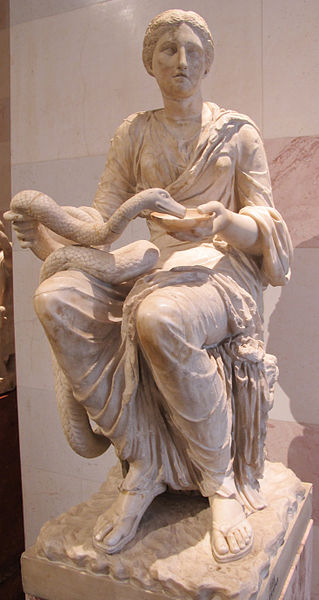 Hygieia
and her five sisters each performed a facet of
Apollo
's art: Hygieia ("Hygiene" the
goddess/personification of health, cleanliness, and sanitation),
Panacea
(the goddess of Universal remedy),
Iaso (the goddess of recuperation from illness),
Aceso
(the goddess of the healing process).
Hygieia
and her five sisters each performed a facet of
Apollo
's art: Hygieia ("Hygiene" the
goddess/personification of health, cleanliness, and sanitation),
Panacea
(the goddess of Universal remedy),
Iaso (the goddess of recuperation from illness),
Aceso
(the goddess of the healing process).
Hygieia also played an important part in her father's
cult
. While her father was more directly
associated with healing, she was associated with the prevention of sickness and
the continuation of good health. Her name is the source of the word "hygiene".
She was imported by the Romans as the Goddess Valetudo, the goddess of personal
health, but in time she started to be increasingly identified with the ancient
Italian goddess of social welfare,
Salus
..
History
At Athens, Hygieia was the subject of a local cult since at least the 7th
century BC. "Athena Hygieia" was one of the cult titles given to
Athena
, as Plutarch recounts of the building of
the Parthenon
(447-432 BC):
|
“ |
A strange accident happened in the course of building, which showed that
the goddess was not averse to the work, but was aiding and co-operating
to bring it to perfection. One of the artificers, the quickest and the
handiest workman among them all, with a slip of his foot fell down from
a great height, and lay in a miserable condition, the physicians having
no hope of his recovery. When Pericles was in distress about this, the
goddess [Athena] appeared to him at night in a dream, and ordered a
course of treatment, which he applied, and in a short time and with
great ease cured the man. And upon this occasion it was that he set up a
brass statue of Athena Hygieia, in the citadel near the altar, which
they say was there before. But it was
Phidias
who wrought the goddess's image
in gold, and he has his name inscribed on the pedestal as the workman of
it. |
” |
However, the cult of Hygieia as an independent goddess did not begin to
spread out until the
Delphic oracle
recognized her, and after the
devastating
Plague of Athens
(430-427 BC) and in Rome in
293 BC.
In the 2nd century AD,
Pausanias
noted the statues both of Hygieia and
of Athena Hygieia near the entrance to the
Acropoliss
of Athens.
<="" span="">
Hygieia's primary temples were in
Epidaurus
,
Corinth
,
Cos
and Pergamon
.
Pausanias
remarked that, at the Asclepieion
of Titane
in
Sicyon
(founded by
Alexanor
, Asclepius' grandson), statues of
Hygieia were covered by women's hair and pieces of
Babylonian
clothes. According to inscriptions,
the same sacrifices were offered at
Paros
.
Ariphron
, a Sicyonian artist from the 4th
century BC wrote a well-known
hymn celebrating her. Statues of Hygieia were created by
Scopas
,
Bryaxis
and
Timotheus
, among others, but there is no clear
description of what they looked like. She was often depicted as a young woman
feeding a large snake that was wrapped around her body or drinking from a jar
that she carried. These attributes were later adopted by the
Gallo-Roman
healing goddess,
Sirona
. Hygieia was accompanied by her brother,
Telesphorus
.
The
Pythagoreans
called the pentagram ὑγιεία Hugieia ("health"); also the Greek goddess of
health, Hygieia
and saw in the pentagram a mathematical perfection..
<>< p="">
Caius Pius Esuvius Tetricus (also seen as Gaius Pius Esuvius
Tetricus but better known in English as Tetricus II) was the son of
Tetricus I
,
Emperor of the
Gallic Empire
(270-274).
In 273, he was raised to the rank of
Caesar
,
with the title of
princeps iuventutis
, and in January 274 he started his first
consulship
,
together with his father. After the defeat and deposition of his father in the
autumn of 274, he appeared as a prisoner in
Aurelian
's
triumph
, but the emperor spared their lives.
According to some sources, he even kept his senatorial rank.
The Gallic Empire (Latin:
Imperium Galliarum) is the modern
name for a breakaway realm that existed from 260 to 274. It originated during
the Roman Empire
's
Crisis of the Third Century
.
It was founded by
Postumus
in
260 in the wake of
barbarian
invasions and instability in
Rome, and at its
height included the territories of
Germania
,
Gaul
,
Britannia
, and
Hispania
.
After Postumus' assassination in 268 it lost much of its territory, but
continued under a number of emperors and usurpers. It was retaken by
Roman
Emperor
Aurelian
after the
Battle of Châlons
in 274.
//
History
Origins
The Crisis of the Third Century began as Emperor
Valerian
was defeated and captured by the
Sassanid Empire
of
Persia
, leaving his son
Gallienus
in very shaky control. Shortly thereafter, the
Palmyrene Empire
, which came to encompass
Egypt
,
Syria
,
Judea
, and
Arabia Petraea
also broke away.
The governors in Pannonia staged unsuccessful local revolts. The emperor left
to the Danube to attend to their disruption. This left
Postumus
,
who was governor of
Germania Superior
and
Inferior
, in charge at the Rhine border. The imperial heir
Saloninus
and the praetorian prefect Silvanus remained at Colonia Agrippina (Cologne),
to keep the young heir out of danger and perhaps also as a control on Postumus'
ambitions. Before long, however, Postumus besieged Colonia Agrippina and put the
young heir and his guardian to death. Postumus established his capital at
Cologne.
The Gallic Empire had its own senate, two annually elected consuls (not all
of the names of the consuls have survived) and its own praetorian guard.
Postumus himself seems to have held the office of consul five times.
Postumus successfully fended off Gallienus in 263, and was never challenged
by him again. However, in early 268 he was challenged by
Laelianus
,
probably one of his commanders, who was declared emperor at
Mainz
by his
Legio XXII Primigenia
. Postumus quickly retook Mainz and Laelianus was
killed. However the success meant little and he was overthrown and killed by his
own troops, reportedly because he did not allow them to sack the city.
After
Postumus
After the death of Postumus, the Gallic Empire began to fall apart. Roman
Emperor
Claudius Gothicus
re-established Roman authority in
Gallia Narbonensis
and parts of
Gallia Aquitania
, and there is some evidence that the provinces of Hispania,
which did not recognize the subsequent Gallic Emperors, may have re-aligned with
Rome.
Marcus Aurelius Marius
was instated upon Postumus' death, but died very
shortly after; the literary sources say he reigned only two days, though it is
more likely he reigned for a few months.
Subsequently
Victorinus
came to power, being recognized as emperor in northern Gaul and Britania, but
not in Hispania.
Victorinus spent most of his reign dealing with insurgencies and attempting to
recover the Gaulish territories taken by Claudius Gothicus. He was assassinated
in 271, but his mother
Victoria
took control of his troops and used her power to influence the
selection of his successor.
With Victoria's support,
Tetricus I
was made emperor, and was recognized in Britannia and the parts of Gaul still
controlled by the Empire.
Tetricus fought off Germanic barbarians who had begun ravaging Gaul after the
death of Victorinus, and was able to re-take Gallia Aquitania and western Gallia
Narbonensis while Roman Emperor
Aurelian
was engaging Queen
Zenobia
's
Palmyrene Empire
in the east. He established the imperial court at
Trier
, and in 273
he elevated his son,
Tetricus
II
, to the rank of
Caesar
. The following year Tetricus II was made co-consul, but the Empire
grew weak from internal strife, including a mutiny led by the usurper
Faustinus
.
By that time Aurelian had defeated the Palmyrene Empire and had made plans to
re-conquer the west. He moved into Gaul and defeated Tetricus at the
Battle of Châlons
in 274; according to the sources, Tetricus, weary of the
in-fighting, offered to surrender in exchange for clemency for him and his son.
This detail may be later propaganda, but either way, Aurelius was victorious,
and the Gallic Empire was effectively dismantled.
Causes
Beyond a mere symptom of chaos in the third century crisis, the Gallic Empire
can be interpreted as a measure of provincial identification competing with the
traditional sense of romanitas, of the cohesive loyalties of individual
legions, and of the power accumulated by entrenched Romanized aristocratic
kinship networks whose local power bases ranged from the Rhine to Baetica,
although the extent of "Gaulish" self-identification that nationalist historians
have inferred is probably inflated. Postumus declared his sole intention was to
protect Gaul – this was his larger Imperial task – and in 261 he repelled mixed
groups of Franks
and Alamanni
to hold the Rhine limes
secure, though lands beyond the upper Rhine and Danube had to be
abandoned to the barbarians within a couple of years. <> |

