|
<="" font="" face="Times New Roman">
Probus
-
Roman Emperor
: 276-282
A.D. -
<="" font="">
VICTORY over GERMANIA
Bronze Antoninianus 21mm (3.49 grams) Rome mint: 280
A.D.
Reference: RIC 220
PROBVS P F AVG, Radiate and cuirassed bust right, slight
drapery on far shoulder.
VICTORIA GERM, trophy between two captives with hands
tied behind backs; R(thunderbolt)A in exergue.
You
are bidding on the exact item pictured, provided with a
Certificate of Authenticity and Lifetime Guarantee of
Authenticity.
Germania was the
Roman
and
Greek
term for the
geographical region inhabited mainly by the
Germanic people
. It
bordered to west on the
Rhine
river, to the
south on the
Danube
river, to the
north on the
Baltic Sea
, and to the
east on the
Vistula
river.
According to
Friedrich Engels
in his
book
The Origin of the Family, Private
Property and the State
(first published
in 1884) Germania covered an area of 500,000 km2
or 190,000 sq mi and had a population of 5,000,000 in
the 1st century BC. The areas west of the Rhine were
mainly
Celtic
(specifically
Gaulish
) and became
part of the
Roman Empire
in the
first century BC.
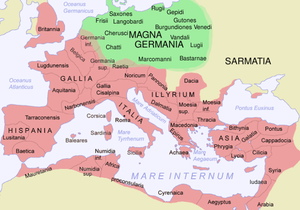
Map of the Roman Empire and Magna
Germania in the early 2nd century
Some Germani, perhaps the original people to
have been referred to by this name, had lived on the
west side of the Rhine. At least as early as the 2nd
century BC this area was considered to be in "Gaul",
and became part of the Roman empire in the course of the
Gallic Wars
(58-50 BC).
These so-called
Germani cisrhenani
lived in the region of present-day eastern
Belgium
, the
southeastern
Netherlands
, and
stretching into
Germany
towards the
Rhine. During the period of the Roman empire, more
tribes settled in areas of the empire near the Rhine, in
territories controlled by the Roman Empire. Eventually
these areas came to be known as Lesser Germania,
while Greater Germania (Magna
Germania; it is also referred to by names
referring to its being outside Roman control:
Germania libera,
"free Germania") formed the larger territory east of the
Rhine.
The Roman parts of Germania, "Lesser Germania",
eventually formed two
provinces
of the
empire,
Germania Inferior
,
"Lower Germania" (which came to eventually include the
region of the original germani cisrhenani) and
Germania Superior
(in
modern terms comprising an area of western
Switzerland
, the French
Jura
and
Alsace
regions, and
southwestern Germany). Important cities in Lesser
Germania included
Besançon
(Besontio),
Strasbourg
(Argentoratum),
Wiesbaden
(Aquae
Mattiacae), and
Mainz
(Mogontiacum).
A trophy is a reward for a specific
achievement, and serves as recognition or evidence of
merit.
A tropaion (Greek:
τρόπαιον,
Latin
:
tropaeum),
whence English "trophy"
is an
ancient Greek
and later
Roman
monument set up
to commemorate a victory over one's foes. Typically this
takes the shape of a tree, sometimes with a pair of
arm-like branches (or, in later times, a pair of stakes
set crosswise) upon which is hung the
armour
of a defeated
and dead foe. The tropaion is then dedicated to a
god
in thanksgiving for
the victory.

A Roman tropaeum from the
Dacian Wars
(Trajan's
Column 113 CE, note the tree
trunk with arm-like branches)
Greece
In the Greek
city-states
of the
Archaic
period, the
tropaion would be set up on the battlefield itself,
usually at the site of the "turning point" (Gk. tropê)
at which the routed enemy's
phalanx
broke, turned
and ran. It would be dressed in the typical
hoplite
panoply
of the period,
including (at different times), a
helmet
,
cuirass
(either of
bronze
or
linen
), and a number of
shields
,etc, would be
piled about the base. It remained on the battlefield
until the following season's campaigns (since battles
were often fought in the same, relatively few plains
amid Greece's numerous mountains), where it might be
replaced with a new trophy.
In later eras in the Greek world, these tropaia
might be vowed at the battle-site, but in fact erected
at
pan-Hellenic
sanctuaries such as
Olympia
or
Delphi
to further
increase the prestige of the victorious state.
The significance of the monument is a ritualistic
notification of "victory" to the defeated enemies. Since
warfare in the Greek world was largely a ritualistic
affair in the archaic hoplite-age (see
Hanson
, The Western
Way of War for further elaboration of this idea),
the monument is used to reinforce the
symbolic capital
of the
victory in the Greek community.
Ancient sources attest to the great deal of
significance that early Greek cities placed upon symbols
and ritual as linked to warfare--the story involving the
bones of
Orestes
, for example,
in
Herodotus
1 which go
beyond the ritualistic properties to even magically
'guaranteeing' the
Spartan
victory,
displays the same sort of interest in objects and
symbols of power as they relate to military success or
failure.
Rome
The tropaeum in Rome, on the other hand, would
probably not be set up on the battle-site itself,
but rather displayed prominently in the city of Rome.
Romans were less concerned about impressing foreign
powers or military rivals than they were in using
military success to further their own
political careers
inside the city, especially during the later years of
the
Republic
. A tropaeum
displayed on the battlefield does not win votes, but one
brought back and displayed as part of a
triumph
can impress the
citizens (who might then vote in future elections in
favor of the conqueror) or the nobles (with whom most
aristocratic Romans of the Republican period were in a
constant struggle for prestige).
The symbolism of the tropaeum became so well
known that in later eras, Romans began to simply display
images of them upon sculpted reliefs (see image and
Tropaeum Traiani
), to
leave a permanent trace of the victory in question
rather than the temporary monument of the tropaeum
itself.
Originally the word trophy, derived from the Latin
tropaion
, referred
to arms, standards, other property, or human captives
and body parts (e.g.
headhunting
) captured
in battle. These
war trophies
commemorated the military victories of a state, army or
individual combatant. In modern warfare trophy taking is
discouraged, but this sense of the word is reflected in
hunting trophies
and
human trophy collecting
by
serial killers
.
Trophies have marked victories since ancient times.
The word trophy coined in English in 1550, was
derived from the French trophée in 1513, "a prize
of war", from Old French trophee, from Latin
trophaeum, monument to victory, variant of
tropaeum, which in turn is the
latinisation
of the
Greek
τρόπαιον (tropaion),
the neuter of τροπαῖος (tropaios), "of defeat" or
"for defeat", but generally "of a turning" or "of a
change", from τροπή (tropē), "a turn, a change"
and that from the verb τρέπω (trepo), "to turn,
to alter".
In ancient Greece, trophies were made on the
battlefields of victorious battles, from captured arms
and standards, and were hung upon a tree or a large
stake made to resemble a warrior. Often, these ancient
trophies were inscribed with a story of the battle and
were dedicated to various gods. Trophies made about
naval victories sometimes consisted of entire ships (or
what remained of them) laid out on the beach. To destroy
a trophy was considered a sacrilege.
The ancient Romans kept their trophies closer to
home. The Romans built magnificent trophies in Rome,
including columns and arches atop a foundation. Most of
the stone trophies that once adorned huge stone
memorials in Rome have been long since stolen
Marcus
Aurelius Probus
(c. August 19,
232–September/October, 282) was a
Roman Emperor
(276–282).
 A native of
Sirmium
(now
Sremska Mitrovica
,
Serbia
), in
Pannonia
, at an early age he entered the army, where
he distinguished himself under the Emperors
Valerian
,
Aurelian
and
Tacitus
. He was appointed governor of the East by
Tacitus, at whose death he was immediately proclaimed
his successor by the soldiers (276).
A native of
Sirmium
(now
Sremska Mitrovica
,
Serbia
), in
Pannonia
, at an early age he entered the army, where
he distinguished himself under the Emperors
Valerian
,
Aurelian
and
Tacitus
. He was appointed governor of the East by
Tacitus, at whose death he was immediately proclaimed
his successor by the soldiers (276).
Florianus
, who had claimed to succeed his
half-brother Tacitus, was put to death by his own troops
after an indecisive campaign. Probus moved to the West,
defeated the Goths acquiring the title of Gothicus
(280), and saw his position ratified by the
Senate
.
The reign of Probus was mainly spent
in successful wars by which he re-established the
security of all the frontiers. The most important of
these operations were directed to clearing
Gaul
of German invaders (Franks,
Longiones
,
Alamanni
and
Burgundians
), allowing Probus to adopt the titles of
Gothicus Maximus and Germanicus Maximus.
One of his principles was never to allow the soldiers to
be idle, and to employ them in time of peace on useful
works, such as the planting of vineyards in Gaul,
Pannonia and other districts, in order to restart the
economy in these devastated lands.
In 279–280, Probus was, according to
Zosimus
, in
Raetia
,
Illyricum
and
Lycia
, where he fought the
Vandals
. In the same years, Probus' generals
defeated the
Blemmyes
in
Egypt
; Probus ordered the reconstruction of bridges
and canals along the Nile, where the production of grain
for the Empire was centered.
In 280–281, Probus had also put down
three usurpers,
Julius Saturninus
,
Proculus
and
Bonosus
. The extent of these revolts is not clear,
but there are clues that they were not just local
problems.
In 281, the emperor was in Rome, where he celebrated his
triumph
.
Probus was eager to start his eastern
campaign, delayed by the revolts in the west. He left
Rome in 282, moving first towards Sirmium, his birth
city, when the news that
Marcus Aurelius Carus
, commander of the
Praetorian Guard
, had been proclaimed emperor
reached him. Probus sent some troops against the new
usurper, but when those troops changed sides and
supported Carus, Probus's soldiers then assassinated him
(September/October 282). |

