|
Antoninus Pius
-
Roman Emperor
: 138-161 A.D.
Bronze Drachm 32mm (24.26 grams) Dated Regnal Year 12, 148/149 A.D.
Reference: Köln 1610; Dattari (Savio) 3048; K&G 35.437; Emmett 1587.12
Laureate, draped, and cuirassed bust right.
Isis seated right on throne, holding infant Harpokrates; all within distyle
Egyptian-style temple façade, disk in pediment; L ΔOΔЄKATOV (date) around.
Following Alexander's conquest of Egypt, the cult of Isis spread across the
Mediterranean, with its popularity reaching its zenith in the Roman period, when
the "goddess of a thousand names" became one of the Mediterranean's principal
deities. It is generally recognized that the iconography of Isis nursing
Harpocrates influenced Christian representations of the Madonna and Child,
particularly the Virgo lactans type popular in Medieval Europe.
You are bidding on the exact
item pictured, provided with a Certificate of Authenticity and Lifetime
Guarantee of Authenticity.
Isis or in original
more likely Aset was a goddess in
Ancient Egyptian
religious beliefs, whose
worship spread throughout the
Greco-Roman world
. She was worshiped as the
ideal mother and wife as well as the matron of nature and magic. She was the
friend of slaves, sinners, artisans, the downtrodden, as well as listening to
the prayers of the wealthy, maidens, aristocrats and rulers. Isis is the Goddess
of
motherhood
,
magic
and
fertility
.
 The
goddess Isis (the mother of
Horus
) was the first daughter of
Geb,
god of the Earth, and
Nut
, the goddess of the Overarching Sky, and
was born on the fourth
intercalary day
. At some time Isis and
Hathor
had the same headdress. In later myths
about Isis, she had a brother,
Osiris
, who became her husband, and she then
was said to have conceived
Horus
. Isis was instrumental in the
resurrection of Osiris when he was murdered by
Set
. Her magical skills restored his body to
life after she gathered the body parts that had been strewn about the earth by
Set. This myth became very important in later Egyptian religious beliefs.
The
goddess Isis (the mother of
Horus
) was the first daughter of
Geb,
god of the Earth, and
Nut
, the goddess of the Overarching Sky, and
was born on the fourth
intercalary day
. At some time Isis and
Hathor
had the same headdress. In later myths
about Isis, she had a brother,
Osiris
, who became her husband, and she then
was said to have conceived
Horus
. Isis was instrumental in the
resurrection of Osiris when he was murdered by
Set
. Her magical skills restored his body to
life after she gathered the body parts that had been strewn about the earth by
Set. This myth became very important in later Egyptian religious beliefs.
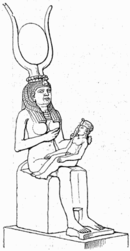
Isis nursing Horus, wearing the headdress of Hathor
Isis is also known as the goddess of
simplicity
, protector of the dead and goddess
of children from whom all beginnings arose. In later myths, the Ancient
Egyptians
believed that the
Nile River
flooded every year because of her
tears of sorrow for her dead husband, Osiris. This occurrence of his death and
rebirth was relived each year through rituals. The worship of Isis eventually
spread throughout the Greco-Roman world, continuing until the suppression of
paganism
in the Christian era.
In late
Greek mythology
as developed in
Ptolemaic Alexandria
, Harpocrates (Ancient Greek:
Ἁρποκράτης) is the
god
of silence. Harpocrates was adapted by the
Greeks
from the
Egyptian child god
Horus
. To the
ancient Egyptians
, Horus represented the
newborn Sun, rising each day at dawn. When the
Greeks
conquered Egypt under
Alexander the Great
, they transformed the
Egyptian Horus into their
Hellenistic
god
known as Harpocrates, a rendering
from Egyptian
Har-pa-khered
or Heru-pa-khered
(meaning "Horus the Child").
Horus
In Egyptian
mythology
,
Horus
was conceived by
Isis, the mother goddess, from
Osiris
, the original god-king of Egypt, who had
been murdered by his brother
Set
, and thus became the god of the underworld.
The Greeks melded Osiris with their underworld god, Hades, to produce the
essentially Alexandrian
syncretism
,
Serapis
.
Among the Egyptians
the full-grown
Horus
was considered the victorious god of the
Sun who each day overcomes darkness. He is often represented with the head of a
sparrowhawk
, which was sacred to him, as the
hawk flies high above the Earth. Horus fought battles against Set, until he
finally achieved victory and became the ruler of Egypt. All the Pharaohs of
Egypt were seen as reincarnations of the victorious Horus.
Stelae
depicting Heru-pa-Khered standing on the
back of a crocodile and holding snakes in his outstretched hands were erected in
Egyptian temple
courtyards, where they would be
immersed or lustrated in water; the water was then used for blessing and healing
purposes as the name of Heru-pa-Khered was itself attributed with many
protective and healing powers.

Isis, Serapis
and their child Harpocrates
(Louvre
Museum)
In the Alexandrian and Roman renewed vogue for
mystery cults
at the turn of the millennium —
mystery cults had already existed for almost a millennium — the worship of Horus
became widely extended, linked with
Isis (his mother) and
Serapis
(Osiris, his father).

Bronze statuette of Harpocrates,
Begram
,
Afghanistan
, 2nd century.
In this way Harpocrates, the child Horus, personifies the newborn sun each
day, the first strength of the winter sun, and also the image of early
vegetation. Egyptian statues represent the child Horus, pictured as a naked boy
with his finger on his chin with the fingertip just below the lips of his mouth,
a realization of the hieroglyph for "child" that is unrelated to the Greco-Roman
and modern gesture for "silence". Misunderstanding this sign, the later Greeks
and Roman poets made Harpocrates the god of Silence and Secrecy, taking their
cue from
Marcus Terentius Varro
, who asserted in De
lingua Latina of Caelum (Sky) and Terra (Earth)
"These gods are the same as those who in Egypt are called
Serapis
and
Isis
, though Harpocrates with his finger
makes a sign to me to be quiet. The same first gods were in Latium called
Saturn
and
Ops
."
Ovid
described Isis:
"Upon her Isis' brow stood the crescent moon-horns, garlanded with
glittering heads of golden grain, and grace of royal dignity; and at her
side the baying dog
Anubis
, dappled
Apis
, sacred
Bubastis
and the god who holds his finger
to his lips for silence sake."

Harpocratic Eros, terracotta figurine made in
Myrina
, ca. 100–50 BCE. (Louvre
Museum)
Inexpensive cast terracotta images of Harpocrates, suitable for house
shrines, are found scattered throughout the Roman Empire. Thus
Augustine of Hippo
was aware of the iconic
gesture of Harpocrates:
"And since in practically all the temples where Serapis and Isis were
worshiped there was also a figure that seemed to enjoin silence by a finger
pressed against its lips,
Varro
thinks this had the same meaning,
that no mention should be made of their having been human beings"
Martianus Capella
, author of an allegorizing
textbook that remained a standard through the Middle Ages recognized the image
of the "boy with his finger pressed to his lips" but neglected to mention
Harpocrates' name: "... quidam redimitus puer ad os compresso digito salutari
silentium commonebat". The boy was identified, however, as
Cupid
in glosses, a syncresis that had already
resulted in the figure of Harpocratic Cupid (illustration, right).
Plutarch
wrote that Harpocrates was the second
son of Isis and that he was born prematurely with lame legs. Horus the Child
became the special protector of children and their mothers. As he was healed of
a poisonous snake bite by Re
he became a symbol of hope in the gods
looking after suffering humanity.
Another solar cult, not directly connected with Harpocrates, was that of the
Sol
InvictusUnconquered Sun,
.
20th century reference
From the 1920s through the 1950s,
Harpo Marx
performed pantomime and wore either
a curly red or curly blonde wig in character. His brother Groucho jokingly said
he named himself in honour of Harpocrates, as a god of both silence and
childhood, or childish joy. In truth he was named Harpo because he played the
harp.
Modern occultist uses
Modern
occultists
display his image, loosely connected
now with Hermetic
gnosticism
. Typically, "Harpocrates is the Babe
in the Egg of Blue that sits upon the lotus flower in the Nile". He may be
termed the 'God of Silence' and said to represent the Higher Self and be the
'Holy Guardian Angel' and more in similar vein, adapted from
Aleister Crowley
's often-reprinted Magick.
Discordians consider
Harpo Marx
to have been a contemporary
avatar
of Harpocrates. Because of this,
Discordians often invoke
Harpocrates as a
Trickster godod
or God of Humor in addition to
his classical attribution of God of Silence.

Titus Aurelius Fulvus Boionius Arrius Antoninus (19 September 86 – 7
March 161), generally known in English as Antoninus Pius was
Roman emperor
from 138 to 161. He was the fourth of the
Five Good Emperors
and a member of the
Aurelii
. He
did not possess the
sobriquet
"Pius" until after
his accession to the throne. Almost certainly, he earned the name "Pius" because
he compelled the
Senate
to deify his adoptive father
Hadrian
; the
Historia Augusta
, however, suggests that he may have earned the name by
saving senators sentenced to death by Hadrian in his later years.
//
Early
life
Childhood
and family
He was the son and only child of
Titus Aurelius Fulvus
,
consul
in 89
whose family came from
Nemausus
(modern Nîmes
)
and was born near
Lanuvium
and his mother was Arria Fadilla. Antoninus’ father and paternal grandfather
died when he was young and he was raised by
Gnaeus Arrius Antoninus
, his maternal grandfather, a man of integrity and
culture and a friend of
Pliny the Younger
. His mother married to Publius Julius Lupus (a man of
consular rank),
Suffect
Consul
in 98, and bore him a daughter called Julia Fadilla.
Marriage
and children
As a private citizen between 110 and 115, he married Annia Galeria
Faustina the Elder
. They had a very happy marriage. She was the daughter of
consul
Marcus Annius Verus
and
Rupilia
Faustina (a half-sister to Roman Empress
Vibia
Sabina
). Faustina was a beautiful woman, renowned for her wisdom. She spent
her whole life caring for the poor and assisting the most disadvantaged Romans.
Faustina bore Antoninus four children, two sons and two daughters. They were:
- Marcus Aurelius Fulvus Antoninus (died before 138); his sepulchral
inscription has been found at the Mausoleum of Hadrian in Rome.
- Marcus Galerius Aurelius Antoninus (died before 138); his sepulchral
inscription has been found at the Mausoleum of Hadrian in Rome. His name
appears on a Greek Imperial coin.
- Aurelia Fadilla (died in 135); she married Lucius Lamia Silvanus, consul
145. She appeared to have no children with her husband and her sepulchral
inscription has been found in
Italy
.
- Annia Galeria Faustina Minor or
Faustina the Younger
(between 125-130-175), a future Roman Empress,
married her maternal cousin, future Roman Emperor
Marcus Aurelius
.
When Faustina died in 141, he was in complete mourning and did the following
in memory of his wife:
- Deified her as a goddess.
- Had a temple built in the Roman Forum in her name, with priestesses in
the temple.
- Had various coins with her portrait struck in her honor. These coins
were scripted ‘DIVAE FAUSTINA’ and were elaborately decorated.
- He created a charity which he founded and called it Puellae
Faustinianae or Girls of Faustina, which assisted orphaned girls.
- Created a new alimenta (see
Grain supply to the city of Rome
).
Favour
with Hadrian
Having filled with more than usual success the offices of
quaestor
and praetor
,
he obtained the consulship in 120; he was next appointed by the Emperor
Hadrian
as
one of the four
proconsuls
to administer
Italia
, then greatly increased his reputation by his conduct as
proconsul
of
Asia
. He acquired much favor with the Emperor Hadrian, who adopted him as
his son and successor on 25 February, 138, after the death of his first adopted
son Lucius Aelius
, on the condition that Antoninus would in turn adopt Marcus
Annius Verus, the son of his wife's brother, and Lucius, son of Aelius Verus,
who afterwards became the emperors
Marcus Aurelius
and
Lucius
Verus
(colleague of Marcus Aurelius).
Emperor
On his accession, Antoninus' name became "Imperator Caesar Titus Aelius
Hadrianus Antoninus Augustus Pontifex Maximus". One of his first acts as Emperor
was to persuade the
Senate
to grant divine honours to Hadrian, which they had at first refused; his efforts
to persuade the Senate to grant these honours is the most likely reason given
for his title of Pius (dutiful in affection; compare
pietas
). Two other reasons for this title are that he would support his
aged father-in-law with his hand at Senate meetings, and that he had saved those
men that Hadrian, during his period of ill-health, had condemned to death. He
built temples, theaters, and mausoleums, promoted the arts and sciences, and
bestowed honours and financial rewards upon the teachers of
rhetoric
and philosophy
.
In marked contrast to his predecessors
Trajan
and
Hadrian
,
Antoninus was not a military man. One modern scholar has written "It is almost
certain not only that at no time in his life did he ever see, let alone command,
a Roman army, but that, throughout the twenty-three years of his reign, he never
went within five hundred miles of a legion".[2]
His reign was the most peaceful in the entire history of the
Principate
;
while there were several military disturbances throughout the Empire in his
time, in Mauretania
,
Iudaea
, and amongst the
Brigantes
in Britannia
, none of them are considered serious. The unrest in Britannia is
believed to have led to the construction of the
Antonine Wall
from the
Firth of Forth
to the
Firth of Clyde
, although it was soon abandoned. He was virtually unique
among emperors in that he dealt with these crises without leaving Italy once
during his reign, but instead dealt with provincial matters of war and peace
through their governors or through imperial letters to the cities such as
Ephesus (of which some were publicly displayed). This style of government was
highly praised by his contemporaries and by later generations.
Of the public transactions of this period we have scant information, but, to
judge by what we possess, those twenty-two years were not remarkably eventful in
comparison to those before and after his; the surviving evidence is not complete
enough to determine whether we should interpret, with older scholars, that he
wisely curtailed the activities of the Roman Empire to a careful minimum, or
perhaps that he was uninterested in events away from Rome and
Italy
and his
inaction contributed to the pressing troubles that faced not only Marcus
Aurelius but also the emperors of the third century. German historian Ernst
Kornemann has had it in his Römische Geschichte [2 vols., ed. by H. Bengtson,
Stuttgart 1954] that the reign of Antoninus comprised "a succession of grossly
wasted opportunities," given the upheavals that were to come. There is more to
this argument, given that the Parthians in the East were themselves soon to make
no small amount of mischief after Antoninus' passing. Kornemann's brief is that
Antoninus might have waged preventive wars to head off these outsiders.
Scholars place Antoninus Pius as the leading candidate for fulfilling the
role as a friend of Rabbi
Judah
the Prince
. According to the
Talmud
(Avodah
Zarah 10a-b), Rabbi Judah was very wealthy and greatly revered in Rome. He had a
close friendship with "Antoninus", possibly Antoninus Pius,
who would consult Rabbi Judah on various worldly and spiritual matters.

Temple of Antoninus and
Faustina
in the
Roman forum
(now the church of
San Lorenzo in Miranda
). The emperor and his
Augusta
were deified after their death by
Marcus Aurelius
.
After the longest reign since Augustus (surpassing
Tiberius
by
a couple of months), Antoninus died of fever at
Lorium
in
Etruria
,
about twelve miles (19 km) from Rome, on 7 March 161, giving the keynote to his
life in the last word that he uttered when the
tribune
of
the night-watch came to ask the password—"aequanimitas" (equanimity). His body
was placed in
Hadrian's mausoleum
, a
column
was dedicated to him on the
Campus Martius
, and the
temple
he had built in the Forum in 141 to his deified wife Faustina was
rededicated to the deified Faustina and the deified Antoninus.
Historiography
The only account of his life handed down to us is that of the
Augustan History
, an unreliable and mostly fabricated work. Antoninus is
unique among Roman emperors in that he has no other biographies. Historians have
therefore turned to public records for what details we know.
In
later scholarship
Antoninus in many ways was the ideal of the landed gentleman praised not only
by ancient Romans, but also by later scholars of classical history, such as
Edward Gibbon
or the author of the article on Antoninus Pius in the ninth
edition of the
Encyclopedia Britannicaca:
A few months afterwards, on Hadrian's death, he was enthusiastically
welcomed to the throne by the Roman people, who, for once, were not
disappointed in their anticipation of a happy reign. For Antoninus came
to his new office with simple tastes, kindly disposition, extensive
experience, a well-trained intelligence and the sincerest desire for the
welfare of his subjects. Instead of plundering to support his
prodigality, he emptied his private treasury to assist distressed
provinces and cities, and everywhere exercised rigid economy (hence the
nickname κυμινοπριστης "cummin-splitter"). Instead of exaggerating into
treason whatever was susceptible of unfavorable interpretation, he
spurned the very conspiracies that were formed against him into
opportunities for demonstrating his clemency. Instead of stirring up
persecution against the Christians, he extended to them the strong hand
of his protection throughout the empire. Rather than give occasion to
that oppression which he regarded as inseparable from an emperor's
progress through his dominions, he was content to spend all the years of
his reign in Rome, or its neighborhood.
|

