|
Valerian I
-
Roman Emperor
: 253-260 A.D. -
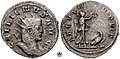
Silver Antoninianus 24mm (2.80 grams) Rome mint: 253-260 A.D.
Reference: RIC 446a, C 793
IMPCPLICGALLIENVSPFAVG - Radiate, draped bust right.
PIETASAVGG - Gallienus and Valerian standing, facing each other, sacrificing
over altar.
You are bidding on the exact item pictured,
provided with a Certificate of Authenticity and Lifetime Guarantee of
Authenticity.
Publius Licinius Valerianus
(c. 200 - after 260), commonly known in
English
as Valerian or Valerian I, was the
Roman
Emperor
from 253 to 260.
Origins and rise to power
Unlike the majority of the pretenders during the
Crisis of the Third Centuryy
, Valerian was of a noble and traditional
senatorial
family. Details of his early life are elusive, but for his
marriage to Egnatia Mariniana
, who gave him two sons: later emperor
Publius
Licinius Egnatius Gallienus
and
Valerianus Minor
.
In 238 he was
princeps senatus
, and
Gordian I
negotiated through him for Senatorial acknowledgement for his claim as emperor.
In 251, when Decius
revived the censorship with legislative and executive powers so extensive that
it practically embraced the civil authority of the emperor, Valerian was chosen
censor
by the Senate, though he declined to accept the post. Under Decius he
was nominated governor of the
Rhine
provinces
of Noricum
and Raetia
and
retained the confidence of his successor,
Trebonianus Gallus
, who asked him for reinforcements to quell the rebellion
of Aemilianus
Rule and fall
Valerian's first act as emperor was to make his son Gallienus
his colleague. In the beginning of his reign the affairs in Europe went from bad
to worse and the whole West fell into disorder. In the East,
Antioch
had
fallen into the hands of a
Sassanid
vassal,
Armenia
was occupied by
Shapur I
(Sapor).
Valerian and Gallienus split the problems of the empire between the two, with
the son taking the West and the father heading East to face the
Persian
threat.
By 257, Valerian had already recovered Antioch and returned
the province of
Syria
to Roman control but in the following year, the
Goths
ravaged
Asia Minor
. Later in 259, he moved to
Edessa
, but an outbreak of
plague
killed a critical number of
legionaries
,
weakening the Roman position in Edessa which was then besieged by the Persians.
At the beginning of 260, Valerian was defeated in the
Battle of Edessa
and he arranged a meeting with Shapur to negotiate a peace
settlement. The ceasefire was betrayed by Shapur who seized him and held him
prisoner for the remainder of his life. Valerian's capture was a humiliating
defeat for the Romans.
Gibbon
, in
The History of the Decline and Fall of the Roman Empire
describes
Valerian's fate:
The voice of history, which is often little more than the
organ of hatred or flattery, reproaches Sapor with a proud abuse of the rights
of conquest. We are told that Valerian, in chains, but invested with the
Imperial purple, was exposed to the multitude, a constant spectacle of fallen
greatness; and that whenever the Persian monarch mounted on horseback, he placed
his foot on the neck of a Roman emperor. Notwithstanding all the remonstrances
of his allies, who repeatedly advised him to remember the vicissitudes of
fortune, to dread the returning power of Rome, and to make his illustrious
captive the pledge of peace, not the object of insult, Sapor still remained
inflexible. When Valerian sunk under the weight of shame and grief, his skin,
stuffed with straw, and formed into the likeness of a human figure, was
preserved for ages in the most celebrated temple of Persia; a more real monument
of triumph, than the fancied trophies of brass and marble so often erected by
Roman vanity.
The tale is moral and pathetic, but the truth of it may very fairly be called in
question. The letters still extant from the princes of the East to Sapor are
manifest forgeries;
nor is it natural to suppose that a jealous monarch should, even in the person
of a rival, thus publicly degrade the majesty of kings. Whatever treatment the
unfortunate Valerian might experience in Persia, it is at least certain that the
only emperor of Rome who had ever fallen into the hands of the enemy, languished
away his life in hopeless captivity.
Valerian's massacre of 258
According to the
Catholic Encyclopedia
article on
Valerian
:
Pope Sixtus
was seized on 6 August, 258, in one of the Catacombs and was put
to death;
Cyprian of Carthage
suffered martyrdom on 14 September. Another celebrated
martyr was the Roman deacon
St. Lawrence
. In Spain Bishop
Fructuosus of Tarragona
and his two deacons were put to death on 21 January,
259. There were also executions in the eastern provinces (Eusebius, VII, xii).
Taken altogether, however, the repressions were limited to scattered spots and
had no great success..
Death in captivity
An early Christian source,
Lactantius
,
maintained that for some time prior to his death Valerian was subjected to the
greatest insults by his captors, such as being used as a human footstool by
Shapur when mounting his horse. According to this version of events, after a
long period of such treatment Valerian offered Shapur a huge ransom for his
release. In reply, according to one version, Shapur was said to have forced
Valerian to swallow molten gold (the other version of his death is almost the
same but it says that Valerian was killed by being flayed alive) and then had
the unfortunate Valerian skinned and his skin stuffed with straw and preserved
as a trophy in the main Persian temple. It was further alleged by Lactantius
that it was only after a later Persian defeat against Rome that his skin was
given a cremation and burial.
The role of a Chinese prince held hostage by Shapur I, in the events following
the death of Valerian has been frequently debated by historians, without
reaching any definitive conclusion.

The Humiliation of
Emperor Valerianrian
Shapur I, pen and ink,
Hans Holbein the Younger
, ca. 1521
Some modern scholars
believe that, contrary to Lactantius' account,
Shapur I
sent Valerian and some of his army to the city of
Bishapur
where they lived in relatively good condition. Shapur used the remaining
soldiers in engineering and development plans. Band-e Kaisar (Caesar's
dam) is one of the remnants of Roman engineering located near the ancient city
of Susa
.
In all the stone carvings on Naghshe-Rostam, in Iran, Valerian is respected by
holding hands with Shapur I, in sign of submission.
It is generally supposed that some of
Lactantius
'
account is motivated by his desire to establish that persecutors of the
Christians died fitting deaths;
the story was repeated then and later by authors in the Roman Near East
"fiercely hostile" to Persia.
Other modern scholars tend to give at least some credence to
Lactantius' account.
Valerian and Gallienus' joint rule was threatened several
times by
usurpers
. Despite several usurpation attempts, Gallienus secured the throne
until his own assassination in 268.
Owing to imperfect and often contradictory sources, the
chronology and details of this reign are very uncertain..
Gallienus (Latin:
Publius Licinius Egnatius Gallienus Augustus;
c. 218 – 268) was
Roman Emperor
with his father
Valerian
from 253 to 260 and alone from 260 to
268. He ruled during the
Crisis of the Third Century
that nearly caused
the collapse of the empire. While he won a number of military victories, he was
unable to prevent the secession of important provinces.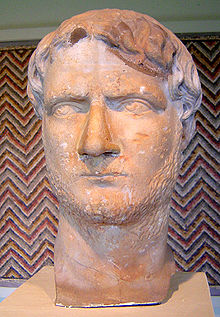
Life
Rise to power
The exact birth date of Gallienus is unknown. The Greek chronicler
John Malalas
and the Epitome de Caesaribus
report that he was about 50 years old at the time of his death, meaning he was
born around 218. He was the son of emperor
Valerian
and
Mariniana
, who may have been of senatorial
rank, possibly the daughter of
Egnatius Victor Marinianus
, and his brother was
Valerianus Minor
. Inscriptions on coins connect
him with Falerii
in
Etruria
, which may have been his birthplace; it
has yielded many inscriptions relating to his mother's family, the Egnatii.[3]
Gallienus married
Cornelia Salonina
about ten years before his
accession to the throne. She was the mother of three princes:
Valerian II
, who died in 258;
Saloninus
, who was named co-emperor but was
murdered in 260 by the army of general Postumus; and
Marinianus
, who was killed in 268, shortly
after his father was assassinated.
When
Valerian
was proclaimed Emperor on 22 October
253, he asked the
Senate
to ratify the elevation of Gallienus to
Caesar and
Augustus
. He was also designated
Consul Ordinarius
for 254. As
Marcus Aurelius
and his adopted brother
Lucius Verus
had done a century earlier,
Gallienus and his father divided the Empire. Valerian left for the East to stem
the Persian threat, and Gallienus remained in Italy to repel the Germanic tribes
on the Rhine
and
Danube
.
Division of the empire
had become necessary due
to its sheer size and the numerous threats it faced, and it facilitated
negotiations with enemies who demanded to communicate directly with the emperor.
Early
reign and the revolt of Ingenuus
Gallienus spent most of his time in the provinces of the Rhine area (Germania
Inferior,
Germania Superior
,
Raetia
, and
Noricum
), though he almost certainly visited
the Danube
area and
Illyricum
during 253 to 258. According to
Eutropius and Aurelius Victor, he was particularly energetic and successful in
preventing invaders from attacking the German provinces and Gaul, despite the
weakness caused by Valerian's march on Italy against
Aemilianus
in 253. According to numismatic
evidence, he seems to have won many victories there, and a victory in
Roman Dacia
might also be dated to that period.
Even the hostile Latin tradition attributes success to him at this time.
In 255 or 257, Gallienus was made Consul again, suggesting that he briefly
visited Rome on those occasions, although no record survives. During his Danube
sojourn (Drinkwater suggests in 255 or 256), he proclaimed his elder son
Valerian II
Caesar and thus official heir to
himself and Valerian I; the boy probably joined Gallienus on campaign at that
time, and when Gallienus moved west to the Rhine provinces in 257, he remained
behind on the Danube as the personification of Imperial authority.
Sometime between 258 and 260 (the exact date is unclear), while Valerian was
distracted with the ongoing invasion of Shapur in the East, and Gallienus was
preoccupied with his problems in the West,
Ingenuus
, governor of at least one of the
Pannonian provinces, took advantage and declared himself emperor. Valerian II
had apparently died on the Danube, most likely in 258. Ingenuus may have been
responsible for that calamity. Alternatively, the defeat and capture of Valerian
at the
battle of Edessa
may have been the trigger for
the subsequent revolts of Ingenuus,
Regalianus
, and
Postumus
. In any case, Gallienus reacted with
great speed. He left his son
Saloninus
as Caesar at
Cologne
, under the supervision of Albanus (or
Silvanus) and the military leadership of Postumus. He then hastily crossed the
Balkans
, taking with him the new cavalry corps
(comitatus) under the command of
Aureolus
and defeated Ingenuus at
Mursa
or
Sirmium
.The victory must be attributed mainly
to the cavalry and its brilliant commander. Ingenuus was killed by his own
guards or committed suicide by drowning himself after the fall of his capital,
Sirmium.
Invasion of the
Alamanni
A major invasion by the
Alemanni
and other Germanic tribes occurred
between 258 and 260 (it is hard to fix the precise date of these
events),probably due to the vacuum left by the withdrawal of troops supporting
Gallienus in the campaign against Ingenuus.
Franks
broke through the lower Rhine, invading
Gaul, some reaching as far as southern Spain, sacking Tarraco (modern
Tarragona
).The Alamanni invaded, probably
through
Agri Decumates
(an area between the upper Rhine
and the upper Danube), likely followed by the
Juthungi
. After devastating Germania Superior
and Raetia (parts of southern
France
and
Switzerland
), they entered Italy, the first
invasion of the Italian peninsula, aside from its most remote northern regions,
since Hannibal
500 years before. When invaders
reached the outskirts of Rome, they were repelled by an improvised army
assembled by the Senate, consisting of local troops (probably prǣtorian guards)
and the strongest of the civilian population.On their retreat through northern
Italy, they were intercepted and defeated in the
battle of Mediolanum
(near present day
Milan
) by Gallienus' army, which had advanced
from Gaul, or from the Balkans after dealing with the Franks.The battle of
Mediolanum was decisive, and the Alamanni didn't bother the empire for the next
ten years. The Juthungi managed to cross the Alps with their valuables and
captives from Italy. An historian in the 19th century suggested that the
initiative of the Senate gave rise to jealousy and suspicion by Gallienus, thus
contributing to his exclusion of senators from military commands.
The revolt of
Regalianus
Around the same time,
Regalianus
, a military commander of
Illyricum
, was proclaimed Emperor. The reasons
for this are unclear, and the Historia Augusta (almost the sole resource
for these events) does not provide a credible story. It is possible the seizure
can be attributed to the discontent of the civilian and military provincials,
who felt the defense of the province was being neglected.
Regalianus held power for some six months and issued coins bearing his image.
After some success against the
Sarmatians
, his revolt was put down by the
invasion of Roxolani
into
Pannonia
, and Regalianus himself was killed
when the invaders took the city of
Sirmium
. There is a suggestion that Gallienus
invited Roxolani to attack Regalianus, but other historians dismiss the
accusation.It is also suggested that the invasion was finally checked by
Gallienus near Verona
and that he directed the restoration of
the province, probably in person.
Capture of Valerian, revolt of Macrianus
In the East, Valerian was confronted with serious troubles. A band of
Scythians
set a naval raid against
Pontus
, in the northern part of modern Turkey.
After ravaging the province, they moved south into
Cappadocia
. Valerian led troops to intercept
them but failed, perhaps because of a plague that gravely weakened his army, as
well as the contemporary invasion of northern
Mesopotamia
by
Shapur I
, ruler of the
Sassanid Empire
.
In 259 or 260, the Roman army was defeated in the
Battle of Edessa
, and Valerian was taken
prisoner. Shapur's army raided
Cilicia
and
Cappadocia
(in present day
Turkey
), sacking, as Shapur's inscriptions
claim, 36 cities. It took a rally by an officer
Callistus
(Balista), a fiscal official named
Fulvius Macrianus
, the remains of the Eastern
Roman legions, and
Odenathus
and his
Palmyrene
horsemen to turn the tide against
Shapur. The Persians were driven back, but Macrianus proclaimed his two sons
Quietus
and
Macrianus
(sometimes misspelled Macrinus) as
emperors. Coins struck for them in major cities of the East indicate
acknowledgement of the usurpation. The two Macriani left Quietus, Ballista, and,
presumably, Odenathus to deal with the Persians while they invaded Europe with
an army of 30,000 men, according to the Historia Augusta. At first they
met no opposition. The Pannonian legions joined the invaders, being resentful of
the absence of Gallienus. He sent his successful commander Aureolus against the
rebels, however, and the decisive battle was fought in the spring or early
summer of 261, most likely in Illyricum, although
Zonaras
locates it in Pannonia. In any case,
the army of the usurpers surrendered, and their two leaders were killed.
In the aftermath of the battle, the rebellion of Postumus had already
started, so Gallienus had no time to deal with the rest of the usurpers, namely
Balista and Quietus. He came to an agreement with Odenathus, who had just
returned from his victorious Persian expedition. Odenathus received the title of
dux Romanorum and besieged the usurpers, who were based at
Emesa
. Eventually, the people of Emesa killed
Quietus, and Odenathus arrested and executed Balista about November 261.
The revolt of Postumus
After the defeat at Edessa, Gallienus lost control over the provinces of
Britain, Spain, parts of Germania, and a large part of Gaul when another
general, Postumus
, declared his own realm (usually known
today as the
Gallic Empire
). The revolt partially coincided
with that of
Macrianus
in the East. Gallienus had installed
his son Saloninus and his guardian,
Silvanus
, in Cologne in 258. Postumus, a
general in command of troops on the banks of the Rhine, defeated some raiders
and took possession of their spoils. Instead of returning it to the original
owners, he preferred to distribute it amongst his soldiers. When news of this
reached Silvanus, he demanded the spoils be sent to him. Postumus made a show of
submission, but his soldiers mutinied and proclaimed him Emperor. Under his
command, they besieged Cologne, and after some weeks the defenders of the city
opened the gates and handed Saloninus and Silvanus to Postumus, who had them
killed. The dating of these events is not accurate, but they apparently occurred
just before the end of 260. Postumus claimed the consulship for himself and one
of his associates, Honoratianus, but according to D.S. Potter, he never tried to
unseat Gallienus or invade Italy.
Upon receiving news of the murder of his son, Gallienus began gathering
forces to face Postumus. The invasion of the Macriani forced him to dispatch
Aureolus with a large force to oppose them, however, leaving him with
insufficient troops to battle Postumus. After some initial defeats, the army of
Aureolus, having defeated the Macriani, rejoined him, and Postumus was expelled.
Aureolus was entrusted with the pursuit and deliberately allowed Postumus to
escape and gather new forces. Gallienus returned in 263 or 265 and surrounded
Postumus in an unnamed Gallic city. During the siege, Gallenus was severely
wounded by an arrow and had to leave the field. The standstill persisted until
the death of Gallienus, and the
Gallic Empire
remained independent until 274.
The revolt of
Aemilianus
In 262, the mint in
Alexandria
started to again issue coins for
Gallienus, demonstrating that Egypt had returned to his control after
suppressing the revolt of the Macriani. In spring of 262, the city was wrenched
by civil unrest as a result of a new revolt. The rebel this time was the prefect
of Egypt,
Lucius Mussius Aemilianus
, who had already
given support to the revolt of the Macriani. The correspondence of bishop
Dionysius of Alexandria
provides a colourful
commentary on the sombre background of invasion, civil war, plague, and famine
that characterized this age.
Knowing he could not afford to lose control of the vital Egyptian granaries,
Gallienus sent his general Theodotus against Aemilianus, probably by a naval
expedition. The decisive battle probably took place near Thebes, and the result
was a clear defeat of Aemilianus. In the aftermath, Gallienus became Consul
three more times in 262, 264, and 266.
Herulian invasions, revolt of Aureolus, conspiracy and death
In the years 267–269, Goths and other barbarians invaded the empire in great
numbers. Sources are extremely confused on the dating of these invasions, the
participants, and their targets. Modern historians are not even able to discern
with certainty whether there were two or more of these invasions or a single
prolonged one. It seems that, at first, a major naval expedition was led by the
Heruli
starting from north of the
Black Sea
and leading in the ravaging of many
cities of Greece (among them,
Athens
and
Sparta
). Then another, even more numerous army
of invaders started a second naval invasion of the empire. The Romans defeated
the barbarians on sea first. Gallienus' army then won a battle in
Thrace
, and the Emperor pursued the invaders.
According to some historians, he was the leader of the army who won the great
Battle of Naissus
, while the majority believes
that the victory must be attributed to his successor,
Claudius II
.
In 268, at some time before or soon after the battle of Naissus, the
authority of Gallienus was challenged by
Aureolus
, commander of the cavalry stationed in
Mediolanum
(Milan),
who was supposed to keep an eye on
Postumus
. Instead, he acted as deputy to
Postumus until the very last days of his revolt, when he seems to have claimed
the throne for himself. The decisive battle took place at what is now
Pontirolo Nuovo
near Milan; Aureolus was
clearly defeated and driven back to Milan. Gallienus laid siege to the city but
was murdered during the siege. There are differing accounts of the murder, but
the sources agree that most of Gallienus' officials wanted him dead. According
to the
Historia Augusta
, an unreliable source compiled
long after the events it describes, a conspiracy was led by the commander of the
guard
Aurelius Heraclianus
and Marcianus.
Cecropius, commander of the Dalmatians, spread the word that the forces of
Aureolus were leaving the city, and Gallienus left his tent without his
bodyguard, only to be struck down by Cecropius.One version has Claudius selected
as Emperor by the conspirators, another chosen by Gallienus on his death bed;
the Historia Augusta was concerned to substantiate the descent of the
Constantinian dynasty
from Claudius, and this
may explain its accounts, which do not involve Claudius in the murder. The other
sources (Zosimus
i.40 and
Zonaras
xii.25) report that the conspiracy was
organized by Heraclianus, Claudius, and
Aurelian
.
According to Aurelius Victor and Zonaras, on hearing the news that Gallienus
was dead, the Senate in Rome ordered the execution of his family (including his
brother Valerianus and son Marinianus) and their supporters, just before
receiving a message from Claudius to spare their lives and deify his
predecessor.
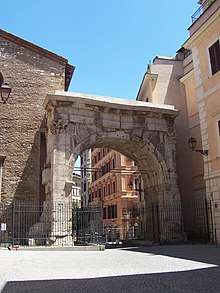
Arch of Gallienus
in Rome, 262 –
dedicated to, rather than built by, Gallienus.
Legacy
Gallienus was not treated favorably by ancient historians, partly due to the
secession of Gaul and
Palmyra
and his inability to win them back.
According to modern scholar Pat Southern, some historians now see him in a more
positive light.Gallienus produced some useful reforms. He contributed to
military history as the first to commission primarily
cavalry
units, the
Comitatenses
, that could be dispatched anywhere
in the Empire in short order. This reform arguably created a precedent for the
future emperors
Diocletian
and
Constantine I
.
The biographer
Aurelius Victor
reports that Gallienus forbade
senators
from becoming military commanders.
This policy undermined senatorial power, as more reliable
equestrian
commanders rose to prominence. In
Southern's view, these reforms and the decline in senatorial influence not only
helped Aurelian to salvage the Empire, but they also make Gallienus one of the
emperors most responsible for the creation of the
Dominate
, along with
Septimius Severus
, Diocletian, and Constantine
I.
By portraying himself with the attributes of the gods on his coinage,
Gallienus began the final separation of the Emperor from his subjects.A late
bust of Gallienus (see above) depicts him with a largely blank face, gazing
heavenward, as seen on the famous stone head of
Constantine I
. One of the last rulers of Rome
to be theoretically called "Princeps", or First Citizen, Gallienus' shrewd
self-promotion assisted in paving the way for those who would be addressed with
the words "Dominus et Deus" (Lord and God).
-
Antoninianus
issued to celebrate
LEG II ITAL VII P VII F, "ItalicaLegio
II seven
times faithful and loyal."
-
Antoninianus issued to celebrate LEG III ITAL VI P VI F,
"ItalicaLegio
III six times
faithful and loyal."
-
Antoninianus issued to celebrate LEG VII MAC VI P VI F,
"MacedonicaLegio
VII six
times faithful and loyal."
-
Antoninianus issued to celebrate LEG VII CLA VI P VI F,
"ClaudiaLegio
VII six
|