|
Greek city of
Larissa
in
Thessaly
under
Thesssalian League
Bronze Trichalkon 18mm (8.23 grams) Struck Mid-late 2nd
century B.C.
Kra–, magistrate.
Reference: Rogers 7; BCD Thessaly 898.5
Laureate head of Apollo right.
ΘEΣΣA–ΛΩN, Athena Itonia striding right, hurling spear
held in her right hand, shield on her left arm; KPA
monogram to inner right.
Following the great victory of the
Roman general ip V of Macedon, in
197 B.C., the freedom of the Greeks was proclaimed at
Corinth and a number of new autonomous coinages were
initiated. Those in the name of the Thessali were struck
probably at Larissa. The Thessalian League was a
loose confederacy of feudal-like city-states and tribes
in the Thessalian valley in Northern
Greece
and was run by a
few aristocratic Thessalian families (Aleuadae
and Skopadae). The seat of the Thessalian diet was
Larissa
.
You
are bidding on the exact item pictured, provided with a
Certificate of Authenticity and Lifetime Guarantee of
Authenticity.
 In
Greek
and
Roman mythology
, Apollo
,
is one of the most important and diverse of the
Olympian deities
. The ideal of the
kouros
(a
beardless youth), Apollo has been variously recognized as a god of light and the
sun; truth and prophecy;
archery
;
medicine and healing; music, poetry, and the arts; and more. Apollo is the son
of Zeus
and
Leto, and has a
twin
sister, the chaste huntress
Artemis
.
Apollo is known in Greek-influenced
Etruscan mythology
as Apulu. Apollo was worshiped in both
ancient Greek
and
Roman religion
, as well as in the modern
Greco
-Roman
Neopaganism
.
In
Greek
and
Roman mythology
, Apollo
,
is one of the most important and diverse of the
Olympian deities
. The ideal of the
kouros
(a
beardless youth), Apollo has been variously recognized as a god of light and the
sun; truth and prophecy;
archery
;
medicine and healing; music, poetry, and the arts; and more. Apollo is the son
of Zeus
and
Leto, and has a
twin
sister, the chaste huntress
Artemis
.
Apollo is known in Greek-influenced
Etruscan mythology
as Apulu. Apollo was worshiped in both
ancient Greek
and
Roman religion
, as well as in the modern
Greco
-Roman
Neopaganism
.
As the patron of Delphi
(Pythian Apollo), Apollo was an
oracular
god — the prophetic deity of the
Delphic Oracle
.
Medicine and healing were associated with Apollo, whether through the god
himself or mediated through his son
Asclepius
,
yet Apollo was also seen as a god who could bring ill-health and deadly
plague
as well as one who had the ability to cure. Amongst the god's
custodial charges, Apollo became associated with dominion over
colonists
, and as the patron defender of herds and flocks. As the leader of
the Muses
(Apollon
Musagetes) and director of their choir, Apollo functioned as the patron god
of music and poetry
.
Hermes
created
the lyre
for him,
and the instrument became a common
attribute
of Apollo. Hymns sung to Apollo were called
paeans
.
In Hellenistic times, especially during the third century BCE, as Apollo
Helios he became identified among Greeks with
Helios
,
god of
the sun
, and his sister Artemis similarly equated with
Selene
,
goddess
of the moon
.
In Latin texts, on the other hand, Joseph Fontenrose declared himself unable to
find any conflation of Apollo with
Sol
among the
Augustan poets
of the first century, not even in the conjurations of
Aeneas
and
Latinus
in
Aeneid
XII
(161–215).
Apollo and Helios/Sol remained separate beings in literary and mythological
texts until the third century CE.
Athena
or Athene
(Latin:
Minerva
), also referred to as
Pallas Athena, is the goddess of war, civilization, wisdom, strength,
strategy, crafts, justice and skill in
Greek mythology
.
Minerva
,
Athena's Roman
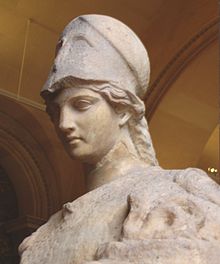 incarnation,
embodies similar attributes. Athena is also a shrewd companion of
heroes and the
goddess
of
heroic endeavour. She is the
virgin
patron of
Athens
. The Athenians built the
Parthenon
on the Acropolis of her namesake
city, Athens, in her honour (Athena Parthenos). Athena's cult as the patron of
Athens seems to have existed from the earliest times and was so persistent that
archaic myths about her were recast to adapt to cultural changes. In her role as
a protector of the city (polis),
many people throughout the Greek world worshiped Athena as Athena Polias
("Athena of the city").
Athens
and Athena bear etymologically connected
names.
incarnation,
embodies similar attributes. Athena is also a shrewd companion of
heroes and the
goddess
of
heroic endeavour. She is the
virgin
patron of
Athens
. The Athenians built the
Parthenon
on the Acropolis of her namesake
city, Athens, in her honour (Athena Parthenos). Athena's cult as the patron of
Athens seems to have existed from the earliest times and was so persistent that
archaic myths about her were recast to adapt to cultural changes. In her role as
a protector of the city (polis),
many people throughout the Greek world worshiped Athena as Athena Polias
("Athena of the city").
Athens
and Athena bear etymologically connected
names.
Larissa, sometimes written Larisa on
ancient coins and inscriptions, is near the site of the
Homeric Argissa. It appears in early times, when
Thessaly
was mainly governed by a few aristocratic
families, as an important city under the rule of the
Aleuadae
, whose authority extended over the whole
district of
Pelasgiotis
. This powerful family possessed for many
generations before 369 BC the privilege of furnishing
the tagus, the local term for the
strategos
of the combined Thessalian forces. The
principal rivals of the Aleuadae were the
Scopadac
of
Crannon
, the remains of which (called by the Turks
Old Larissa) are about 14 miles south west. The
inhabitants sided with
Athens
during the Peloponnesian War.
As the chief city of ancient
Thessaly, Larissa was directly annexed by Philip II of
Macedon in 344, and from then on Larissa was under
Macedonian control; in 196 B.C. Larissa became an ally
of Rome and was the headquarters of the
Thessalian League
.
Coordinates
 39°38.5′N
22°25′E 39°38.5′N
22°25′E
|


