Why are your prices so low? How do you manufacture your foam?
Between our buying power, machining capabilities, and warehouse space, we are able to purchase massive, industrial-size blocks of foam called "buns" and cut them down into products at our location. There is no middle man, as we cut and sell our own products. This gives you factory-direct pricing, unlike the marked-up rates you're used to seeing elsewhere online and in stores.
Is this foam's fire retardant specification sufficient for my application?
Because local building and fire codes vary from region to region, we are unable to answer this question. Always check with local regulation authorities before installing materials in residential or commercial structures.
How does California TB117 flame retardancy compare to UL94HF1 or MVSS302?
California TB117 is actually a more stringent assessment than UL94HF1 or MVSS302. In addition to the Cal TB117 test, our acoustical foam has also been tested by the ASTM E 84 standard. Test results show that our acoustical foam meets Class A criteria. ASTM E 84 is the technical equivalent of NFPA No. 255 and UL No. 723.
How do I install the foam?
We suggest spray adhesive for most mounting applications (available from us for purchase). When using spray adhesive to form a temporary bond, apply a light amount of adhesive on just the foam. For more permanent bonds, apply the adhesive liberally to both the back of the foam and the mounting surface. For either method, allow the adhesive to become tacky before applying the foam to the mounting surface. If you need to cut or trim the foam, you may use an electric knife, or a sharp serrated blade using a slow, back-and-forth cutting motion.
IMPORTANT: Spray adhesive is ineffective at bonding acoustic foam to painted or bare concrete or cinderblock walls. For permanently adhering acoustic foam directly to these surfaces, heavy-duty construction adhesive is suggested. Note that this will damage the foam and leave residue on the wall if removed. For non-permanent installation, we suggest mounting the foam to a substrate, such as plywood or sturdy cardboard, and hanging the mounted tile(s). Our spray adhesives may be used to form the foam-to-substrate bond.


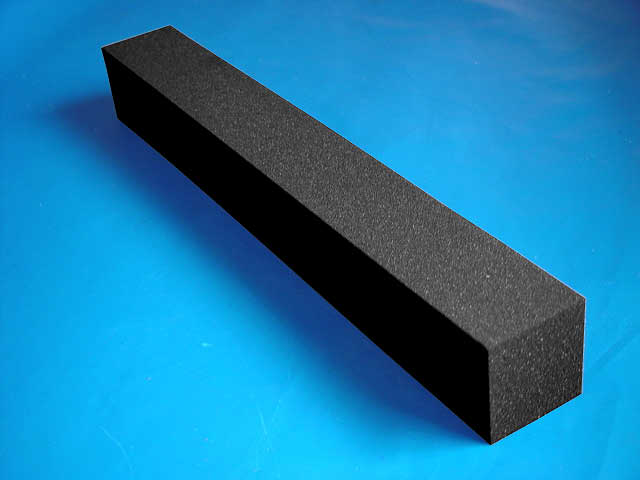

 Covers - 16 Lineal Feet


 retardant, self-extinguishing