|
Greek city of Klazomenai in Ionia
Bronze 9mm (1.03 grams)
Struck circa 400-380 B.C.
Reference: Sear 4322; B.M.C. 14.21,32-3; SNGCop 31cf
Head of Athena right, wearing crested helmet.
KΛA, Ram's head right.
Situated on the southern shores
of the Gulf of Smyrna, Klazomenai was the birthplace of the philosopher
Anaxagoras.
You are bidding on the exact item pictured,
provided with a Certificate of Authenticity and Lifetime Guarantee of
Authenticity.
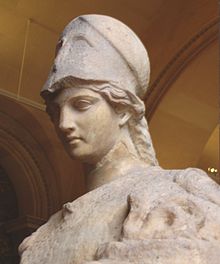
Helmeted Athena with the cista and Erichthonius in his serpent form.
Roman, first century (Louvre
Museum)
In
Greek religion and
mythology, Athena or Athene, also
referred to as Pallas Athena/Athene , is the goddess of wisdom, courage,
inspiration, civilization, law and justice, just warfare, mathematics, strength,
strategy, the arts, crafts, and skill.
Minerva is the
Roman goddess
identified with Athena.
Athena is also a shrewd companion of
heroes and is the
goddess of heroic endeavour. She is the
virgin patroness of
Athens. The Athenians founded the
Parthenon on the Acropolis of her namesake
city, Athens (Athena Parthenos), in her honour.
Athena's veneration as the patron of Athens seems to have existed from the
earliest times, and was so persistent that archaic myths about her were recast
to adapt to cultural changes. In her role as a protector of the city (polis),
many people throughout the Greek world worshiped Athena as Athena Polias
(Ἀθηνᾶ Πολιάς "Athena of the city"). The city of
Athens and the goddess Athena essentially bear
the same name,
"Athenai" meaning "[many] Athenas".
Patroness
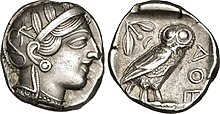
Athenian
tetradrachm representing the
goddess Athena
 Athena as the goddess of philosophy became an aspect of the cult in Classical
Greece during the late 5th century B.C. She is the patroness of various crafts, especially of
weaving, as Athena Ergane, and was
honored as such at festivals such as
Chalceia. The metalwork of weapons also fell
under her patronage. She led battles (Athena
Promachos or the warrior maiden Athena Parthenos)
as the disciplined, strategic side of war, in contrast to her brother
Ares, the patron of violence, bloodlust and slaughter-"the raw force
of war".
Athena's wisdom includes the cunning intelligence (metis) of such figures
as
Odysseus. Not only was this version of Athena
the opposite of Ares in combat, it was also the polar opposite of the serene
earth goddess version of the deity, Athena Polias. Athena as the goddess of philosophy became an aspect of the cult in Classical
Greece during the late 5th century B.C. She is the patroness of various crafts, especially of
weaving, as Athena Ergane, and was
honored as such at festivals such as
Chalceia. The metalwork of weapons also fell
under her patronage. She led battles (Athena
Promachos or the warrior maiden Athena Parthenos)
as the disciplined, strategic side of war, in contrast to her brother
Ares, the patron of violence, bloodlust and slaughter-"the raw force
of war".
Athena's wisdom includes the cunning intelligence (metis) of such figures
as
Odysseus. Not only was this version of Athena
the opposite of Ares in combat, it was also the polar opposite of the serene
earth goddess version of the deity, Athena Polias.
Athena appears in Greek mythology as the patron and helper of many heroes,
including
Odysseus,
Jason, and
Heracles. In
Classical Greek myths, she never consorts with
a lover, nor does she ever marry,earning the title Athena Parthenos. A remnant of archaic myth depicts her
as the adoptive mother of
Erechtheus/Erichthonius
through the foiled rape by
Hephaestus.
Other variants relate that Erichthonius, the serpent that accompanied Athena,
was born to
Gaia: when the rape failed, the semen landed on
Gaia and impregnated her. After Erechthonius was born, Gaia gave him to Athena.
Though Athena is a goddess of war strategy, she disliked fighting
without
purpose and preferred to use wisdom to settle predicaments.The goddess
only encouraged fighting for a reasonable cause or to resolve
conflict. As patron of Athens she fought in the Trojan war on the side
of the
Achaeans.
Mythology
Lady of Athens
Athena competed with
Poseidon to be the patron deity of Athens,
which was yet unnamed, in a version of one
founding myth. They agreed that each would give
the Athenians one gift and that the Athenians would choose the gift they
preferred. Poseidon struck the ground with his
trident and a salt water spring sprang up; this
gave them a means of trade and water-Athens at its height was a significant sea
power, defeating the
Persian fleet at the
Battle of Salamis-but the water was salty and
not very good for drinking.
Athena, however, offered them the first domesticated
olive tree. The Athenians (or their king,
Cecrops) accepted the olive tree and with it
the patronage of Athena, for the olive tree brought wood, oil, and food.
Robert Graves was of the opinion that
"Poseidon's attempts to take possession of certain cities are political myths"
which reflect the conflict between matriarchal and patriarchal religions.
Other sites of cult
Athena also was the patron goddess of several other Greek cities, notably
Sparta, where the archaic cult of
Athena Alea had its sanctuaries in the
surrounding villages of
Mantineia and, notably,
Tegea. In Sparta itself, the temple of Athena
Khalkíoikos (Athena "of the Brazen House", often
latinized as Chalcioecus) was the
grandest and located on the Spartan acropolis; presumably it had a roof of
bronze. The forecourt of the Brazen House was the place where the most solemn
religious functions in Sparta took place.
Tegea was an important religious center of ancient Greece,
containing the Temple of
Athena Alea. The temenos was founded by
Aleus,
Pausanias was informed.
Votive bronzes at the site from the Geometric and Archaic periods take the forms
of horses and deer; there are
sealstone and
fibulae. In the Archaic period the nine
villages that underlie Tegea banded together in a
synoecism to form one city.
Tegea was listed in
Homer's
Catalogue of Ships as one of the cities that
contributed ships and men for the
Achaean assault on Troy.
Judgment of Paris

Aphrodite is being surveyed by Paris, while Athena (the leftmost
figure) and Hera stand nearby.
El Juicio de Paris by
Enrique Simonet, ca. 1904
All the gods and goddesses as well as various mortals were invited to the
marriage of
Peleus and
Thetis (the eventual parents of
Achilles). Only
Eris, goddess of discord, was not invited. She
was annoyed at this, so she arrived with a golden apple inscribed with the word
καλλίστῃ (kallistēi, "for the fairest"), which she threw among the goddesses.
Aphrodite, Hera, and Athena all claimed to be the fairest, and thus the rightful
owner of the apple.
The goddesses chose to place the matter before Zeus, who, not wanting to
favor one of the goddesses, put the choice into the hands of Paris, a
Trojan prince. After bathing in the spring of
Mount Ida (where Troy was situated), the
goddesses appeared before Paris. The goddesses undressed and presented
themselves to Paris naked, either at his request or for the sake of winning.

Paris is awarding the apple to Aphrodite, while Athena makes a face.
Urteil des Paris by
Anton Raphael Mengs, ca. 1757
Still, Paris could not decide, as all three were ideally beautiful, so they
resorted to bribes. Hera tried to bribe Paris with control over all
Asia and
Europe, while Athena offered wisdom, fame and
glory in battle, but Aphrodite came forth and whispered to Paris that if he were
to choose her as the fairest he would have the most beautiful mortal woman in
the world as a wife, and he accordingly chose her. This woman was
Helen, who was, unfortunately for Paris,
already married to King
Menelaus of
Sparta. The other two goddesses were enraged by
this and through Helen's abduction by Paris they brought about the
Trojan War.

The Parthenon, Temple of Athena
Parthenos
Masculinity and
feminism
Athena had an "androgynous compromise" that allowed her traits and what she
stood for to be attributed to male and female rulers alike over the course of
history (such as Marie de' Medici, Anne of Austria, Christina of Sweden, and
Catherine the Great)
J.J. Bachofen advocated that Athena was originally a maternal figure stable
in her security and poise but was caught up and perverted by a patriarchal
society; this was especially the case in Athens. The goddess adapted but could
very easily be seen as a god. He viewed it as "motherless paternity in the place
of fatherless maternity" where once altered, Athena's character was to be
crystallized as that of a patriarch.
Whereas Bachofen saw the switch to paternity on Athena's behalf as an
increase of power, Freud on the contrary perceived Athena as an "original mother
goddess divested of her power". In this interpretation, Athena was demoted to be
only Zeus's daughter, never allowed the expression of motherhood. Still more
different from Bachofen's perspective is the lack of role permanency in Freud's
view: Freud held that time and differing cultures would mold Athena to stand for
what was necessary to them.
Klazomenai (also spelled Clazomenae,
Greek:
Κλαζομεναί, modern-day Kilizman in
Urla
near
İzmir in
Turkey) was an
ancient Greek city of
Ionia and a member of the
Ionian Dodecapolis (Confederation of Twelve Cities), it was one of the first
cities to issue silver coinage.
//

Map of Aegean side of Anatolia showing the location of Klazomenai
Klazomenai is located in modern Urla (Vourla in Greek) on the western
coast of
Anatolia, on the southern coast of the
Gulf
of İzmir, at about 20 miles west of İzmir. The city was originally located
on the mainland, but probably during the early fifth-century
Ionian Revolt from the
Persians, it was moved to an island just off the coast, which
Alexander the Great eventually connected to the mainland with a causeway.
The location of the city-around a harbour, backed by a coastal plain and low
hills to the south provided a number of locations for settlement, and as such,
settlements did shift from location to location over time. This can be shown by
the island of Karantina, located to the north of the settlement area-which
became settled at certain points in the history of Klazomenai.
Mythology
The principal god of the city was
Apollo.
According to myth, swans drew the chariot in which Apollo every year flew south
from his winter home in the land of the
Hyperboreans. But Klazomenai was also home to large numbers of swans, and it
is thought that the verb klazo was used to describe the call of the wild
birds. The swan on the obverse is both an attribute of
Apollo and a
pun on the name Klazomenai.
Ancient
times
Though not in existence before the arrival of the
Ionians in
Asia, its original founders were largely settlers from
Phlius and
Cleonae. It
stood originally on the
isthmus
connecting the mainland with the peninsula on which
Erythrae
stood; but the inhabitants, alarmed by the encroachments of the
Persians, removed to one of the small islands of the bay, and there
established their city. This island was connected with the mainland by
Alexander the Great by means of a pier, the remains of which are still
visible.
During the 5th century it was for some time subject to the
Athenians, but
about the middle of the
Peloponnesian War (412 BC) it revolted. After a brief resistance, however,
it again acknowledged the Athenian supremacy, and repelled a
Lacedaemonian attack. In 387 BC Klazomenai and other cities in Asia were
taken over by
Persia, but the city continued to issue its own coins.
Under the Romans Clazomenae was included in the province of Asia, and enjoyed
an immunity from
taxation.
Klazomenai is today perhaps best-known as the birthplace of the philosopher
Anaxagoras,
often styled "Anaxagoras of Clazomenae".
Archaeology
The site of Liman Tepe, which lies near an old harbor contains very important
Bronze Age excavations, the most prominent and remarkable of which is the amount
of varying archaic burial sites, as well as evidence of the practises associated
with them close by. One possible explanation for this is that these sites were
used by different social groups within society.
The city was famous for production and exports of olive oil and its painted
terracotta
sarcophagi, which are the finest monuments of Ionian painting in the 6th
century BC.
It was also prized for its variety of
garum.
Ancient
olive press
Olive oil extraction installation (işlik) dating back to the third
quarter of the 6th century BC uncovered in Klazomenai is the only surviving
example of a level and weights press from an ancient Greek city and precedes by
at least two centuries the next securely datable earliest presses found in
Greece. It
was restored and reconstructed in 2004-2005 through collaboration between
Ege
University, a Turkish olive-oil exporter and a
German
natural building components company, as well as by local artisans, on the basis
of the clearly visible
millstone
with a cylindrical roller and three separation pits. The olive oil obtained
turned out to be quite a success in business terms as well.
|
|
restoration and reconstruction
|
|
general view after completion of works
|
Financial
pioneers
In an event noted by
Aristotle,
Klazomenians also appear as financial pioneers in
economic history, for having used one
commodity
(olive oil), in an organized manner and on a city-scale, to purchase
another (wheat), with
interests refundable on the value of the first. Around 350 B.C., suffering
from a shortage of grain and scarcity of funds, the rulers of the city passed a
resolution calling on citizens who had stores of olive oil to lend to the city
at interest. The loan arranged, they hired vessels and sent them to ports of
exportation of grain and bought a
consignment on the pledged security of the value of the oil.
|


