|
Greek city of Gargara in Troas
Bronze 17mm (2.79 grams) Struck circa 350 B.C.
Reference: Sear 4089; B.M.C. 17.52,5
Laureate head of Apollo right.
ΓAΡ above horse galloping right; thunderbolt beneath.
On the Gulf of Adramytteion, between Antandros and Assos, the
territory of Gargara was famed for the fertility of its soil.
You are bidding on the exact item pictured,
provided with a Certificate of Authenticity and Lifetime Guarantee of
Authenticity.
Gargara was a
Greekk city on the southern coast of the
Troad region of
Anatolia. It was initially located beneath
Mount Gargaron, one of the three peaks of
Mount Ida, today known as Koca Kaya At
some point in the 4th century BCE the settlement moved approximately 5.8 km
south of Koca Kaya to a site on the small coastal plain near the modern villages
of
Arıklı and
Nusratlı, at which point the previous site came
to be known as Old Gargara (Ancient
Greek Παλαιγάργαρος).
Both sites are located in the
Ayvacık district of
Çanakkale Province in
Turkey.
Mount Gargaron
Mount Gargaron has been identified with the mountain today called Koca Kaya (Turkish
Great Rock), a western spur of Mount Ida with a maximum elevation of 780
m. The poet
Epicharmus (fl. 540 - 450 BCE) refers to
the mountain as "snowcapped" (ἀγάννιφα), and the
Etymologicum Magnum (ca. 1150 CE) knew a
tradition according to which the inhabitants of Old Gargara moved to their new
site to escape the cold of their old home. In
Homer's
Iliad it is said to have had an altar to
Zeus at its summit, and hence is a place the god frequently visits.
In one passage Zeus is said to have come to Mount Gargaron from
Mount Olympos to view the battle between the
Trojans and the
Acahaeans, about 50 km NE of here. In writers
of the 1st and 2nd century AD such as
Statius and
Lucian Zeus is said to have abducted the Trojan
prince
Ganymede from Mount Gargaron while he was
hunting in the nearby forests. Lucian also represents the
Judgement of Paris as taking place on Mount
Gargaron rather than in its more traditional location further to the east above
Antandrus. The anonymous author of On Rivers
thought that Gargara was Mount Ida's previous name, while the Latin poet
Valerius Flaccus used it as a learned way of
referring to Ida. The Etymologicum Magnum explains the name of Gargaron
either as deriving from the verb γαργαρίζειν ('to gargle') on account of the
springs thought to bubble up on the summit (an inference taken from Homer's
reference to 'many-fountained Ida' in conjunction with Gargaron), or as deriving
from γαργαρέων ('uvula')
on account of the mountain's shape.
The poet
Aratus of
Soli wrote an epigram about his friend Diotimos,
who used to teach the children of Gargara their letters up on Mount Gargaron:
αἰάζω Διότιμον, ὃς ἐν πέτρῃσι κάθηται
παισὶν Γαργαρέων βῆτα καὶ ἄλφα λέγων.
I bewail Diotimos, who would sit among the rocks
Teaching the children of the Gargarians their alpha and beta.
History
Foundation
There is no indication in the relevant passages of the Iliad that
Homer considered Mount Gargaron inhabited. This is partly confirmed by the fact
that the earliest archaeological remains found at the site (fortification walls
around the acropolis and the foundations of a temple) date no later than the 6th
century BCE. In the 7th century BCE the poet
Alcman said that the settlement was inhabited
by
Leleges, an Anatolian people, but this may
simply be an inference from Homer's remark elsewhere in the Iliad that
the whole southern coast of the Troad was inhabited by Leleges.[14]
Hecataeus of Miletus (ca. 550 - 476 BCE) and
Hellanicus of Mytilene (ca. 490 - 405 BCE) say
that Gargara was inhabited by
Aeolian Greeks originally from nearby
Assos and Myrsilos of
Methymna (first half of the 3rd century BCE)
that Assos was a foundation of Methymna, hence the Aeolian ethnicity of Assos
and the secondary foundations of Gargara and
Lamponeia. If Alcman was correct to indicate
the existence of an Anatolian settlement named Gargara in the 7th century BCE,
then this fact could be harmonized with the apparently contradictory story of
Gargara instead being a Greek foundation by noting that many settlements in this
region had a mixed Greco-Anatolian heritage in which the local Anatolian
population became assimilated with the Greek newcomers. With respect to how the
early settlement came to adopt the name of the mountain, John Cook, the
archaeologist who identified the site of Old Gargara on Koca Kaya, remarked
that: "What we can believe is that the people of Methymna across the strait
pointed to this bold peak as the Homeric Γάργαρον ἄκρον and that the settlers
there felt themselves entitled to appropriate the name".
Classical
In the 5th century BCE Gargara was a member of the
Delian League and paid a tribute to Athens of
between 4,500 and 4,600
drachmas as part of the Hellespontine district.
It is currently thought that the Gargarians moved from the site at Koca Kaya
down to the coast in the 4th century BCE, although this has not been confirmed
by excavation. A long inscription found at
Ilion indicates that by ca. 306 Gargara was a
member of the
koinon of Athena Ilias, a regional
association of cities in the Troad which held an annual festival at Ilion. The
inscription records a series of honorific decrees passed by the koinon
which praise a prominent and wealthy citizen, Malousios of Gargara, for
providing interest free loans to finance the annual festival.
Hellenistic
The local antiquarian writer
Demetrius of Scepsis (ca. 205-130 BCE) relates
that Gargara received an influx of settlers who were forcibly moved their home
in
Mysia,
Miletoupolis, by 'the kings' (presumably those
of
Bithynia) in the late 3rd or early 2nd century
BCE. Miletoupolis was a semi-Greek settlement, and so Demetrius relates that as
a result of this influx of immigrants there are hardly any Aeolians left in
Gargara. This episode should perhaps be connection with the invasion of this
region by
Prusias II of Bithynia in 156 - 154 BCE.
Elsewhere in the Hellenistic period, citizens of Gargara are found serving as
proxenoi at
Chios and as mercenaries at
Athens, participating in a private association
of resident foreigners on
Rhodes, making dedications to
Ptolemy III Euergetes and his family in Egypt,
receiving honours at Ilion, and making dedications on
Delos. In the 230s or 220s BCE Gargara was one
of the places at which
Theorodokoi of
Delphi were received, and in the 120s BCE it is
attested as a port at which customs dues was being paid soon after
Attalus III had bequeathed the
Asia to Rome in 133 BCE.
Roman
While Gargara continued to exist in the Roman period, we hear about it
primarily in the context of Latin literature, since it became a by-word for
agricultural prosperity in Latin poetry following
Virgil's reference to it in the
Georgics:
humida solstitia atque hiemes orate serenas,
agricolae; hiberno laetissima pulvere farra,
laetus ager: nullo tantum se Mysia cultu
iactat et ipsa suas mirantur Gargara messis.
Pray for wet summer, farmers, and for clear skies in winter
(since after winter dust most joyous is the corn and joyous the
fields); never else than after such seasons does
Mysia take such
pride in its tillage, and Gargara itself marvel so at its
harvests.
Gargara is likewise used as an expression of proverbial fertility in
Ovid's
Ars Amatoria,
Seneca's tragedy The Phoenician Women,
and as late as the 5th century CE in the odes of
Sidonius Apollinaris.
Macrobius in his
Saturnalia (early 5th century CE) devoted a
chapter to the question of what had given Virgil the idea of using Gargara this
way in the first place, concluding that it was an inference firstly from Mount
Ida's reputation for being well-watered in Homer, secondly from Mysia's general
reputation for fertility, and thirdly from the use of γάργαρα (gargara)
in
Old Comedy to express an immense quantity of
anything.
Byzantine
Gargara appears to have been continuously occupied until at least the 9th
century CE, and perhaps as late as the 14th century CE. It was a
suffragan bishopric of the
metropolis of
Ephesus for which we know the names of three of
its bishops: John (518 CE), Theodorus (553 CE), and Ephraim (878 CE). In
addition to possible middle Byzantine remains seen at Gargara by John Cook,
other documents such as the Epistulae Dogmaticae of
Patriarch Germanus I of Constantinople (715-730
CE) and the
Notitiae Episcopatuum also attest Gargara's
continued existence throughout this period. Finally, four documents from the
Monastery of Great Lavra on
Mount Athos dating to 1284 and 1304 CE attest a
Constantine of Gargara and his family. The latest period of occupation at the
site may be represented by the nearby castles of Menteşe and Şahin Kale which
Cook thought could be either Byzantine or
Genoese
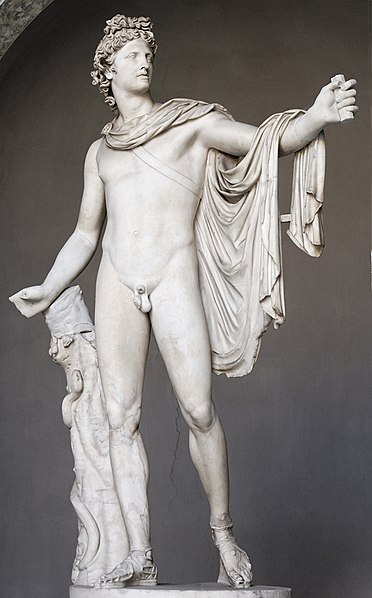
Apollo Belvedere,
ca. 120-140 CE
Apollo
is one of the most important and complex of the
Olympian deities in
ancient Greek and
Roman religion,
Greek and
Roman mythology, and
Greco-Roman
Neopaganism. The ideal of the
kouros (a beardless, athletic youth),
Apollo has been variously recognized as a god of light and the sun, truth and
prophecy, healing, plague, music, poetry, and more. Apollo is the son of
Zeus and
Leto, and has a twin sister, the chaste
huntress
Artemis. Apollo is known in Greek-influenced
Etruscan mythology as Apulu.
As
the patron of
Delphi (Pythian Apollo), Apollo was an
oracular god-the prophetic deity of the
Delphic Oracle. Medicine and healing are
associated with Apollo, whether through the god himself or mediated through his
son
Asclepius, yet Apollo was also seen as a god
who could bring ill-health and deadly
plague. Amongst the god's custodial charges,
Apollo became associated with dominion over
colonists, and as the patron defender of herds
and flocks. As the leader of the
Muses (Apollon Musegetes) and director of their choir, Apollo
functioned as the patron god of music and poetry.
Hermes created the
lyre for him, and the instrument became a common
attribute of Apollo. Hymns sung to Apollo were
called
paeans.
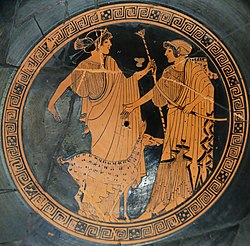
Apollo (left) and
Artemis.
Brygos (potter signed), Tondo of an
Attic red-figure cup c. 470 BC,
Musée du Louvre.
In Hellenistic times, especially during the 3rd century BCE, as Apollo
Helios he became identified among Greeks with
Helios,
Titan
god of the sun, and his sister Artemis
similarly equated with
Selene, Titan
goddess of the moon
In Latin texts, on the other hand,
Joseph Fontenrose declared himself unable to
find any conflation of Apollo with
Sol among the
Augustan poets of the 1st century, not even in
the conjurations of
Aeneas and
Latinus in
Aeneid XII (161-215).
Apollo and Helios/Sol remained separate beings in literary and mythological
texts until the 3rd century CE.
Etymology

Statuette of the Apollo Lykeios type,
Museum of the Ancient Agora of Athens
(inv. BI 236).
Apollo was worshipped throughout the
Roman Empire. In the traditionally
Celtic lands he was most often seen as a
healing and sun god. He was often equated with
Celtic gods of similar character.
-
Apollo Atepomarus ("the great horseman"
or "possessing a great horse"). Apollo was worshipped at
Mauvières (Indre).
Horses were, in the Celtic world, closely linked to the sun.
-
Apollo Belenus ('bright' or
'brilliant'). This epithet was given to Apollo in parts of
Gaul, Northern Italy and
Noricum (part of modern Austria). Apollo
Belenus was a healing and sun god.
-
Apollo Cunomaglus ('hound lord'). A
title given to Apollo at a shrine in
Wiltshire. Apollo Cunomaglus may have been
a god of healing. Cunomaglus himself may originally have been an independent
healing god.
-
Apollo Grannus. Grannus was a healing
spring god, later equated with Apollo.
- Apollo Maponus. A god known from inscriptions in Britain. This
may be a local fusion of Apollo and
Maponus.
-
Apollo Moritasgus ('masses of sea
water'). An epithet for Apollo at Alesia, where he was worshipped as god of
healing and, possibly, of physicians.
-
Apollo Vindonnus ('clear light').
Apollo Vindonnus had a temple at
Essarois, near
Châtillon-sur-Seine in
Burgundy. He was a god of healing,
especially of the eyes.
-
Apollo Virotutis ('benefactor of
mankind?'). Apollo Virotutis was worshipped, among other places, at Fins
d'Annecy (Haute-Savoie)
and at
Jublains (Maine-et-Loire).
Origins

The
Omphalos in the Museum of
Delphi.
The cult centers of Apollo in Greece,
Delphi and
Delos, date from the 8th century BCE. The Delos
sanctuary was primarily dedicated to
Artemis, Apollo's twin sister. At Delphi,
Apollo was venerated as the slayer of
Pytho. For the Greeks, Apollo was all the Gods
in one and through the centuries he acquired different functions which could
originate from different gods. In
archaic Greece he was the
prophet, the oracular god who in older times
was connected with "healing". In
classical Greece he was the god of light and of
music, but in popular religion he had a strong function to keep away evil.
From his eastern-origin Apollo brought the art of inspection from "symbols
and
omina" (σημεία και τέρατα : semeia kai
terata), and of the observation of the
omens of the days. The inspiration oracular-cult was probably
introduced from
Anatolia. The
ritualism belonged to Apollo from the
beginning. The Greeks created the
legalism, the supervision of the orders of the
gods, and the demand for moderation and harmony. Apollo became the god of
shining youth, the protector of music, spiritual-life, moderation and
perceptible order. The improvement of the old
Anatolian god, and his elevation to an
intellectual sphere, may be considered an achievement of the
Greek people.
Healer and
god-protector from evil
The function of Apollo as a "healer" is connected with
Paean , the physician of the Gods
in the
Iliad, who seems to come from a more
primitive religion. Paeοn is probably connected with the
Mycenean Pa-ja-wo, but the etymology is the
only evidence. He did not have a separate cult, but he was the personification
of the holy magic-song sung by the magicians that was supposed to cure disease.
Later the Greeks knew the original meaning of the relevant song "paean".
The magicians were also called "seer-doctors", and they used an
ecstatic prophetic art which was used exactly by the god Apollo at the oracles.
In the Iliad, Apollo is the healer under the gods, but he is also the
bringer of disease and death with his arrows, similar to the function of the
terrible
Vedic god of disease
Rudra.He sends a terrible plague to the
Achaeans. The god who sends a disease can also
prevent from it, therefore when it stops they make a purifying ceremony and
offer him an "hecatomb" to ward off evil. When the oath of his priest appeases,
they pray and with a song they call their own god, the beautiful Paean.
Some common epithets of Apollo as a healer are "paion" , "epikourios", "oulios", and "loimios" . In
classical times, his strong function in popular religion was to keep away evil,
and was therefore called "apotropaios" and "alexikakos" ,
throw away the evil).
In later writers, the word, usually spelled "Paean", becomes a mere epithet of
Apollo in his capacity as a god of
healing.
Homer illustrated Paeon the god, and the song both of
apotropaic thanksgiving or triumph. Such songs were originally addressed to
Apollo, and afterwards to other gods: to
Dionysus, to Apollo
Helios, to Apollo's son
Asclepius the healer. About the 4th century
BCE, the paean became merely a formula of adulation; its object was either to
implore protection against disease and misfortune, or to offer thanks after such
protection had been rendered. It was in this way that Apollo had become
recognised as the god of music. Apollo's role as the slayer of the
Python led to his association with battle and
victory; hence it became the
Roman custom for a paean to be sung by an army
on the march and before entering into battle, when a fleet left the harbour, and
also after a victory had been won.
Dorian origin
The connection with Dorians and their initiation festival
apellai is reinforced by the month
Apellaios in northwest Greek calendars,
but it can explain only the Doric type of the name, which is connected with the
Ancient Macedonian word "pella" (Pella),
stone. Stones played an important part in the cult of the god, especially
in the oracular shrine of Delphi (Omphalos).
The "Homeric hymn" represents Apollo as a Northern intruder. His arrival must
have occurred during the "dark ages" that followed the destruction of the
Mycenaean civilization, and his conflict with
Gaia (Mother Earth) was represented by the
legend of his slaying her daughter the serpent
Python.
The earth deity had power over the ghostly world, and it is believed that she
was the deity behind the oracle.
The older tales mentioned two dragons who were perhaps intentionally conflated.
A female dragon named
Delphyne who is obviously
connected with Delphi and Apollo Delphinios, and a male serpent
Typhon , the adversary of
Zeus in the
Titanomachy, who the narrators confused with
Python.
Python was the good daemon of the temple as it appears in
Minoan religion,
but she was represented as a dragon, as often happens in Northern European
folklore as well as in the East.
Apollo and his sister
Artemis can bring death with their arrows. The
conception that diseases and death come from invisible shots sent by
supernatural beings, or magicians is common in
Germanic and
Norse mythology.[35]
In
Greek mythology Artemis was the leader of the
nymphs, who had similar functions with the
Nordic
Elves.The "elf-shot" originally indicated disease or death attributed to the elves,
but it was later attested denoting
arrow-heads which were used by witches to harm
people, and also for healing rituals.
The
Vedic Rudra has some similar functions with
Apollo. The terrible god is called "The Archer", and the bow is also an
attribute of
Shiva.
Rudra could bring diseases with his arrows, but he was able to free people of
them, and his alternative Shiba, is a healer physician god.
However the
Indo-European component of Apollo, does not
explain his strong relation with omens, exorcisms, and with the oracular cult.
Minoan origin
It seems an oracular cult existed in Delphi from the
Mycenaean ages.
In historical times, the priests of Delphi were called
Labryaden, "the double-axe men", which
indicates
Minoan origin. The double-axe (λάβρυς:labrys)
was the holy symbol of the
Cretan
labyrinth.
The Homeric hymn adds that Apollo appeared as a dolphin and carried Cretan
priests to Delphi, where they evidently transferred their religious practices.
Apollo Delphinios was a sea-god especially worshiped in Crete and in the
islands, and his name indicates his connection with Delphi
and the holy serpent
Delphyne (womb). Apollo's sister
Artemis, who was the Greek goddess of hunting,
is identified with
Britomartis (Diktynna),
the
Minoan "Mistress of the animals". In her
earliest depictions she is accompanied by the "Mister of the animals", a male
god of hunting who had the bow as his attribute. We don't know his original
name, but it seems that he was absorbed by the more powerful Apollo, who stood
by the "Mistress of the animals", becoming her brother.
The old oracles in Delphi seem to be connected with a local tradition of the
priesthood, and there is not clear evidence that a kind of inspiration-prophecy
existed in the temple. This led some scholars to the conclusion that Pythia
carried on the rituals in a consistent procedure through many centuries,
according to the local tradition. In that regard, the mythical seeress
Sibyl of
Anatolian origin, with her ecstatic art, looks
unrelated to the oracle itself.However, the Greek tradition is referring to the existence of vapours and
chewing of laurel-leaves, which seem to be confirmed by recent studies.
Plato describes the priestesses of Delphi and
Dodona as frenzied women, obsessed by "mania" (μανία:frenzy),
a Greek word connected with "mantis" (μάντις:prophet). Frenzied women like
Sibyls from whose lips the god speaks are recorded in the
Near East as
Mari in the second millennium BC.Although Crete had contacts with Mari from 2000 BC,
there is no evidence that the ecstatic prophetic art existed during the Minoan
and Mycenean ages. It is more probable that this art was introduced later from
Anatolia and regenerated an existing oracular
cult that was local to Delphi and dormant in several areas of Greece.
Anatolian origin
A non-Greek origin of Apollo has long been assumed in scholarship.The name of Apollo's mother
Leto has
Lydian origin, and she was worshipped on the
coasts of
Asia Minor. The inspiration oracular cult was
probably introduced into Greece from
Anatolia, which is the origin of
Sibyl, and where existed some of the oldest
oracular shrines. Omens, symbols, purifications, and exorcisms appear in old
Assyro-Babylonian
texts, and these rituals were spread into the empire of the
Hittites. In a Hittite text is mentioned that
the king invited a Babylonian priestess for a certain "purification".
A similar story is mentioned by
Plutarch. He writes that the
Cretan-
seer
Epimenides, purified
Athens after the pollution brought by the
Alcmeonidae, and that the seer's expertise in
sacrifices and reform of funeral practices were
of great help to
Solon in his reform of the Athenian state.
The story indicates that Epimenides was probably heir to the shamanic religions
of Asia, and proves together with the
Homeric hymn, that Crete had a resisting
religion up to the historical times. It seems that these rituals were dormant in
Greece, and they were reinforced when the Greeks migrated to
Anatolia.
Homer pictures Apollo on the side of the
Trojans, fighting against the
Achaeans, during the
Trojan War. He is pictured as a terrible god,
less trusted by the Greeks than other gods. The god seems to be related to
Appaliunas, a tutelary god of
Wilusa (Troy)
in Asia Minor, but the word is not complete.
The stones found in front of the gates of
Homeric Troy were the symbols of Apollo. The
Greeks gave to him the name αγυιεύς
agyieus as the protector god of public places
and houses who wards off evil, and his symbol was a tapered stone or column.
However, while usually Greek festivals were celebrated at the
full moon, all the feasts of Apollo were
celebrated at the seventh day of the month, and the emphasis given to that day (sibutu)
indicates a
Babylonian origin.
The
Late Bronze Age (from 1700 to 1200 BCE)
Hittite and
Hurrian Aplu was a god of
plague, invoked during plague years. Here we
have an
apotropaic situation, where a god originally
bringing the plague was invoked to end it. Aplu, meaning the son of, was
a title given to the god
Nergal, who was linked to the
Babylonian god of the sun
Shamash.
Homer interprets Apollo as a terrible god (δεινός θεός) who brings death and
disease with his arrows, but who can also heal, possessing a magic art that
separates him from the other Greek gods.
In
Iliad, his priest prays to Apollo
Smintheus,
the mouse god who retains an older agricultural function as the protector from
field rats.
All these functions, including the function of the healer-god
Paean, who seems to have Mycenean origin, are
fused in the cult of Apollo.
Oracular cult

Columns of the
Temple of Apollo at Delphi, Greece.
Unusually among the Olympic deities, Apollo had two cult sites that had
widespread influence:
Delos and
Delphi. In cult practice,
Delian Apollo and
Pythian Apollo (the Apollo of Delphi) were so
distinct that they might both have shrines in the same locality.Apollo's
cult was already fully established when written
sources commenced, about 650 BCE. Apollo became extremely important to the Greek
world as an oracular deity in the
archaic period, and the frequency of
theophoric names such as Apollodorus or
Apollonios and cities named Apollonia testify to his popularity.
Oracular sanctuaries to Apollo were established in other sites. In the 2nd and
3rd century CE, those at
Didyma and
Clarus pronounced the so-called "theological
oracles", in which Apollo confirms that all deities are aspects or servants of
an
all-encompassing, highest deity. "In the 3rd
century, Apollo fell silent.
Julian the Apostate (359 - 61) tried to revive
the Delphic oracle, but failed
|

