|
Greek city of Syracuse in Sicily
Time of Timoleon 344-336 B.C.
Bronze Trias 20mm (8.22 grams)
Reference: Sear 1193; B.M.C. 2. 289
ΣYPA - Head of Athena left, wearing
Corinthian helmet bound with olive-wreath, dolphins,
before and behind.
Hippocamp left, with curled wing.
You are bidding on the exact item pictured,
provided with a Certificate of Authenticity and Lifetime Guarantee of
Authenticity.
The hippocamp or hippocampus (plural: hippocamps or hippocampi;
Greek
: ἱππόκαμπος,
from ἵππος, "horse" and
κάμπος, "monster"), often called a
sea-horse in
English
, is a mythological creature shared by
Phoenician
[3]
and
Greek mythology
, though the name by which it is
recognised is purely Greek; it became part of
Etruscan mythology
. It has typically been
depicted as a horse in its forepart with a coiling, scaly, fishlike
hindquarter
.
Mythology

Hippocamp in Roman mosaic in the
thermae
at
Aquae Sulis
(Bath)
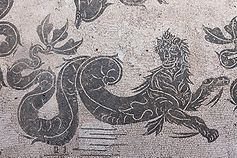
A sea-lion mosaic in the Baths of Neptune,
Ostia Antica
Homer
describes
Poseidon
, who was god of horses (Poseidon
Hippios), earthquakes, and the sea, drawn by "brazen-hoofed"
horses over the sea's surface, and
Apollonius of Rhodes
, being consciously archaic
in Argonautica
(iv.1353ff), describes the
horse of Poseidon emerging from the sea and galloping away across the
Libyan
sands.[4]
In
Hellenistic
and
Roman
imagery, however, Poseidon (or Roman
Neptune
) often drives a sea-chariot
drawn by hippocampi. Thus hippocamps sport with this god in both ancient
depictions and much more modern ones, such as in the waters of the 18th-century
Trevi Fountain
in Rome surveyed by Neptune from
his
niche
above. (illustration, right)
The appearance of hippocamps in both
freshwater
and
saltwater
is counter-intuitive to a modern
audience, though not to an ancient one. The Greek picture of the natural
hydrological cycle
did not take account of the
condensation of atmospheric water as rain to replenish the
water table
, but imagined the refreshening of
the waters of the sea oozing back landwards through vast underground
caverns
and
aquifers
, rising replenished and freshened in
springs.
Thus it was natural for a temple at
Helike
in the coastal plain of
Achaea
to be dedicated to Poseidon
Helikonios, (the Poseidon of Helicon), the sacred spring of
Boeotian Helikon
.[6]
When an earthquake suddenly submerged the city, the temple's bronze Poseidon
accompanied by hippocamps continued to snag fishermens' nets.[7]
Likewise, the hippocamp was considered an appropriate decoration for
mosaics
in Roman
thermae
or public baths, as at
Aquae Sulis
modern day
Bath
in Britannia (illustration, below).
Poseidon's horses, which were included in the elaborate sculptural program of
gilt-bronze and ivory
, added by a Roman client to the temple of
Poseidon at Corinth
, are likely to have been hippocamps;
the Romanised Greek
Pausanias
described the rich ensemble in the
later 2nd century CE (Geography of Greece ii.1.7-.8):
Within the sanctuary of the god stand on the one side portrait statues of
athletes
who have won victories at the
Isthmian games
, on the other side pine
trees growing in a row, the greater number of them rising up straight. On
the temple, which is not very large, stand bronze
Tritons
. In the fore-temple are images, two
of Poseidon, a third of
Amphitrite
, and a Sea, which also is of
bronze. The offerings inside were dedicated in our time by
Herodes Atticus
, four horses, gilded except
for the hoofs, which are of ivory, and two gold
Tritons
beside the horses, with the parts
below the waist of ivory. On the car stand Amphitrite and Poseidon, and
there is the boy
Palaemon
upright upon a
dolphin
. These too are made of ivory and
gold. On the middle of the base on which the car is has been wrought a Sea
holding up the young
Aphrodite
, and on either side are the
nymphs called
Nereids
.

Hippocamp
Art Deco
fountain,
Kansas City, Missouri
,
(1937)
|
Hippocamps appear with the first Orientalising phase of
Etruscan civilization
: they remain a theme in
Etruscan tomb wall-paintings and reliefs, where they are sometimes provided with
wings, as they are in the Trevi fountain. Katharine Shepard found in the theme
an Etruscan belief in a sea-voyage to the other world.[8]
Aside from aigikampoi, the fish-tailed
goats representing
Capricorn
or
Aegeus
("goat-man")[9]
other fish-tailed animals rarely appearing in Greek art but more characteristic
of the Etruscans included leokampoi (fish-tailed
lions), taurokampoi (fish-tailed
bulls) or pardalokampoi (fish-tailed
leopards
).[10]
The mythic hippocamp has been used as a
heraldic charge
, particularly since the
Renaissance, most often in the
armorial bearings
of people and places with
maritime associations. However, in a
blazon
, the terms hippocamp and
hippocampus now refer to the real animal called a seahorse, and the
terms seahorse and sea-horse refer to the mythological creature.
The above-mentioned fish hybrids are seen less frequently
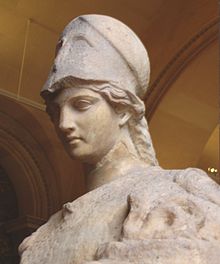
Helmeted Athena with the cista and Erichthonius in his serpent form.
Roman, first century (Louvre
Museum)
In
Greek religion
and
mythology
, Athena or Athene, also
referred to as Pallas Athena/Athene , is the goddess of wisdom, courage,
inspiration, civilization, law and justice, just warfare, mathematics, strength,
strategy, the arts, crafts, and skill.
Minerva
is the
Roman goddess
identified with
Athena.
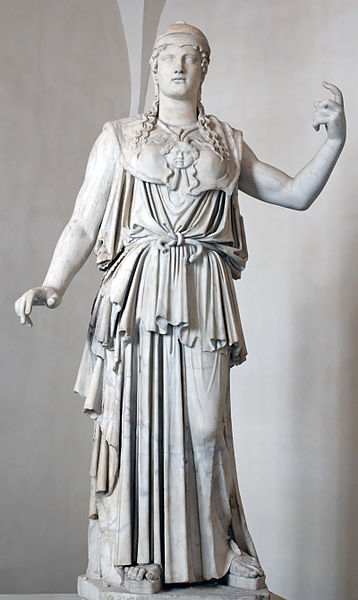
Marble Greek copy signed "Antiokhos", a first century BC variant of
Phidias
'
fifth-century
Athena Promachos
that stood on the
Acropolis
Athena is also a shrewd companion of
heroes and is the
goddess
of heroic endeavour. She is the
virgin
patroness of
Athens
. The Athenians founded the
Parthenon
on the Acropolis of her namesake
city, Athens (Athena Parthenos), in her honour.
Athena's veneration as the patron of Athens seems to have existed from the
earliest times, and was so persistent that archaic myths about her were recast
to adapt to cultural changes. In her role as a protector of the city (polis),
many people throughout the Greek world worshiped Athena as Athena Polias
(Ἀθηνᾶ Πολιάς "Athena of the city"). The city of
Athens
and the goddess Athena essentially bear
the same name, "Athenai" meaning "[many] Athenas".
Patroness
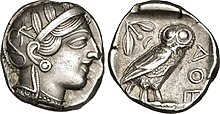
Athenian
tetradrachm
representing the
goddess Athena
Athena as the goddess of philosophy became an aspect of the cult in Classical
Greece during the late 5th century B.C. She is the patroness of various crafts,
especially of weaving
, as Athena Ergane, and was
honored as such at festivals such as
Chalceia
. The metalwork of weapons also fell
under her patronage. She led battles (Athena
Promachos or the warrior maiden Athena Parthenos) as the
disciplined, strategic side of war, in contrast to her brother
Ares, the patron of violence, bloodlust and slaughter—"the raw force
of war". Athena's wisdom includes the cunning intelligence (metis) of
such figures as Odysseus
. Not only was this version of Athena
the opposite of Ares in combat, it was also the polar opposite of the serene
earth goddess version of the deity, Athena Polias.
Athena appears in Greek mythology as the patron and helper of many heroes,
including Odysseus
,
Jason
, and
Heracles
. In
Classical Greek
myths, she never consorts with
a lover, nor does she ever marry,earning the title Athena Parthenos. A
remnant of archaic myth depicts her as the adoptive mother of
Erechtheus
/Erichthonius
through the foiled rape by
Hephaestus
. Other variants relate that
Erichthonius, the serpent that accompanied Athena, was born to
Gaia
: when the rape failed, the semen landed on
Gaia and impregnated her. After Erechthonius was born, Gaia gave him to Athena.
Though Athena is a goddess of war strategy, she disliked fighting without
purpose and preferred to use wisdom to settle predicaments.The goddess only
encouraged fighting for a reasonable cause or to resolve conflict. As patron of
Athens she fought in the Trojan war on the side of the Achaeans.
Mythology
Birth
Olympian version
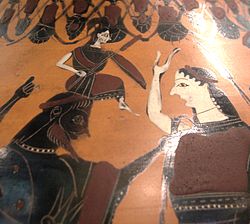
After he swallowed her pregnant mother,
Metis
, Athena is "born" from Zeus'
forehead as he grasps the clothing of
Eileithyia
on the right —black-figured
amphora
, 550–525 BC, Louvre.
Although Athena appears before
Zeus at
Knossos
—in
Linear B
, as, "Mistress Athena"—in the
Classical
Olympian pantheon
, Athena was remade as the
favorite daughter of Zeus, born fully armed from his forehead. The story of her
birth comes in several versions. In the one most commonly cited, Zeus lay with
Metis, the goddess of crafty thought and wisdom, but he immediately feared the
consequences. It had been prophesied that Metis would bear children more
powerful than the sire, even Zeus himself. In order to forestall these dire
consequences, after lying with Metis, Zeus "put her away inside his own belly;"
he "swallowed her down all of a sudden." He was too late: Metis had already
conceived.
Eventually Zeus experienced an enormous headache;
Prometheus
,
Hephaestus
,
Hermes
,
Ares, or Palaemon (depending on the sources examined) cleaved Zeus's
head with the double-headed
Minoan
axe,
the labrys
. Athena leaped from Zeus's head,
fully grown and armed, with a shout— "and pealed to the broad sky her clarion
cry of war. And Ouranos trembled to hear, and Mother Gaia..." (Pindar,
Seventh Olympian Ode). Plato, in the
Laws
, attributes the cult of Athena to the
culture of Crete
, introduced, he thought, from Libya
during the dawn of Greek culture.
Classical myths thereafter note that
Hera was so annoyed at Zeus for having produced a child that she
conceived and bore
Hephaestus
by
herself
.
Plato, in
Cratylus
(407B) gave the etymology of her
name as signifying "the mind of god", theou noesis. The Christian
apologist of the 2nd century
Justin Martyr
takes issue with those pagans who
erect at springs images of
Kore
, whom he interprets as Athena:
"They said that Athena was the daughter of Zeus not from intercourse, but
when the god had in mind the making of a world through a word (logos)
his first thought was Athena".
Other origin tales
Some origin stories tell of Athena having been born outside of Olympus and
raised by the god Triton. Fragments attributed by the Christian
Eusebius of Caesarea
to the semi-legendary
Phoenician
historian
Sanchuniathon
, which Eusebius thought had been
written before the
Trojan war
, make Athena instead the daughter of
Cronus
, a king of
Byblos
who visited 'the inhabitable world' and
bequeathed Attica
to Athena. Sanchuniathon's account would
make Athena the sister of Zeus and Hera, not Zeus' daughter.
Pallas Athena
The major competing tradition regarding Athena's parentage involves some of
her more mysterious
epithets
: Pallas, as in the ancient-Greek
Παλλάς Άθήνη (also Pallantias) and
Tritogeneia (also Trito, Tritonis, Tritoneia, Tritogenes). A distant archaic
separate entity named
Pallas
is invoked as Athena's father, sister,
foster sister, companion, or opponent in battle. Pallas is often a nymph, a
daughter of
Triton
(a sea god), and a childhood friend of
Athena.
In every case, Athena kills Pallas, accidentally, and thereby gains the name
for herself. In one telling, they practice the arts of war together until one
day they have a falling out. As Pallas is about to strike Athena, Zeus
intervenes. With Pallas stunned by a blow from Zeus, Athena takes advantage and
kills her. Distraught over what she has done, Athena takes the name Pallas for
herself.
When Pallas is Athena's father the events, including her birth, are located
near a body of water named Triton or
Tritonis
. When Pallas is Athena's sister or
foster-sister, Athena's father or foster-father is
Triton
, the son and herald of
Poseidon
. But Athena may be called the daughter
of Poseidon and a nymph named Tritonis, without involving Pallas. Likewise,
Pallas may be Athena's father or opponent, without involving Triton. On this
topic, Walter Burkert says "she is the Pallas of Athens, Pallas Athenaie,
just as Hera of Argos is Here Argeie. For the Athenians, Burkert notes,
Athena was simply "the Goddess", hē theós, certainly an ancient title.
Athena
Parthenos: Virgin Athena
Athena never had a consort or lover and is thus known as
Athena Parthenos
, "Virgin Athena". Her most
famous temple, the
Parthenon
, on the
Acropolis
in
Athens
takes its name from this title. It is
not merely an observation of her virginity, but a recognition of her role as
enforcer of rules of sexual modesty and ritual mystery. Even beyond recognition,
the Athenians allotted the goddess value based on this pureness of virginity as
it upheld a rudiment of female behavior in the patriarchal society. Kerenyi's
study and theory of Athena accredits her virginal toponym to be a result of the
relationship to her father Zeus and a vital, cohesive piece of her character
throughout the ages.
This role is expressed in a number of stories about Athena.
Marinus of Neapolis
reports that when
Christians removed the statue of the Goddess from the
Parthenon
, a beautiful woman appeared in a
dream to Proclus
, a devotee of Athena, and announced
that the "Athenian Lady" wished to dwell with him.
Erichthonius
Hephaestus
attempted to
rape Athena, but she eluded him. His
semen
fell to the earth and impregnated the
soil, and
Erichthonius
was born from the Earth,
Gaia
. Athena then raised the baby as a foster
mother.
Athena puts the infant Erichthonius into a small box (cista) which she
entrusts to the care of three sisters,
Herse
,
Pandrosus
, and
Aglaulus
of Athens. The goddess does not tell
them what the box contains, but warns them not to open it until she returns. One
or two sisters opens the cista to reveal Erichthonius, in the form (or
embrace) of a
serpent
. The serpent, or insanity induced by
the sight, drives Herse and Aglaulus to throw themselves off the
Acropolis
. Jane Harrison (Prolegomena)
finds this to be a simple cautionary tale directed at young girls carrying the
cista in the
Thesmophoria
rituals, to discourage them from
opening it outside the proper context.
Another version of the myth of the Athenian maidens is told in
Metamorphoses
by the Roman poet
Ovid (43 BC – 17 AD); in this late variant
Hermes
falls in love with Herse. Herse,
Aglaulus, and Pandrosus go to the temple to offer sacrifices to Athena. Hermes
demands help from Aglaulus to seduce Herse. Aglaulus demands money in exchange.
Hermes gives her the money the sisters have already offered to Athena. As
punishment for Aglaulus's greed, Athena asks the goddess
Envy
to make Aglaulus jealous of Herse. When
Hermes arrives to seduce Herse, Aglaulus stands in his way instead of helping
him as she had agreed. He turns her to stone.
With this mythic origin, Erichthonius became the founder-king
of Athens, and many beneficial changes to Athenian culture were
ascribed to him. During this time, Athena frequently protected him.
Medusa and Tiresias
In a late myth, Medusa
, unlike her sister Gorgons, came to be
viewed by the Greeks of the 5th century as a beautiful mortal that served as
priestess in Athena's temple. Poseidon liked Medusa, and decided to rape her in
the temple of Athena, refusing to allow her vow of chastity to stand in his
way.Upon discovering the desecration of her temple, Athena changed Medusa's form
to match that of her sister Gorgons as punishment. Medusa's hair turned into
snakes, her lower body was transformed also, and meeting her gaze would turn any
living man to stone. In the earliest myths, there is only one
Gorgon
, but there are two snakes that form a
belt around her waist.
In one version of the
Tiresias
myth, Tiresias stumbled upon Athena
bathing, and he was struck blind by her to ensure he would never again see what
man was not intended to see. But having lost his eyesight, he was given a
special gift—to be able to understand the language of the birds (and thus to
foretell the future).
Lady of Athens
Athena competed with
Poseidon
to be the patron deity of Athens,
which was yet unnamed, in a version of one
founding myth
. They agreed that each would give
the Athenians one gift and that the Athenians would choose the gift they
preferred. Poseidon struck the ground with his
trident
and a salt water spring sprang up; this
gave them a means of trade and water—Athens at its height was a significant sea
power, defeating the
Persian
fleet at the
Battle of Salamis
—but the water was salty and
not very good for drinking.
Athena, however, offered them the first domesticated
olive tree
. The Athenians (or their king,
Cecrops
) accepted the olive tree and with it
the patronage of Athena, for the olive tree brought wood, oil, and food.
Robert Graves
was of the opinion that
"Poseidon's attempts to take possession of certain cities are political myths"
which reflect the conflict between matriarchal and patriarchal religions.
Other sites of cult
Athena also was the patron goddess of several other Greek cities, notably
Sparta, where the archaic cult of
Athena Alea
had its sanctuaries in the
surrounding villages of
Mantineia
and, notably,
Tegea
. In Sparta itself, the temple of Athena
Khalkíoikos (Athena "of the Brazen House", often
latinized
as Chalcioecus) was the
grandest and located on the Spartan acropolis; presumably it had a roof of
bronze. The forecourt of the Brazen House was the place where the most solemn
religious functions in Sparta took place.
Tegea was an important religious center of ancient Greece, containing the
Temple of Athena Alea
. The temenos was founded by
Aleus
,
Pausanias
was informed. Votive bronzes at the
site from the Geometric and Archaic periods take the forms of horses and deer;
there are
sealstone
and
fibulae
. In the Archaic period the nine
villages that underlie Tegea banded together in a
synoecism
to form one city. Tegea was listed in
Homer
's
Catalogue of Ships
as one of the cities that
contributed ships and men for the
Achaean assault on Troy
.
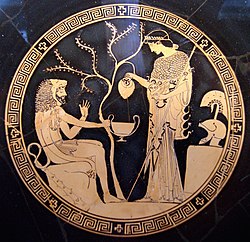
Athena and Herakles on an
Attic
red-figure
kylix
, 480–470 BC.
Counselor
Later myths of the Classical Greeks relate that Athena guided
Perseus
in his quest to behead
Medusa
. She instructed
Heracles
to skin the
Nemean Lion
by using its own claws to cut
through its thick hide. She also helped Heracles to defeat the
Stymphalian Birds
, and to navigate the
underworld so as to capture
Cerberus
.
In
The Odyssey
,
Odysseus
' cunning and shrewd nature quickly won
Athena's favour. In the realistic epic mode, however, she largely is confined to
aiding him only from afar, as by implanting thoughts in his head during
his journey home from Troy. Her guiding actions reinforce her role as the
"protectress of heroes" or as mythologian
Walter Friedrich Otto
dubbed her the "goddess
of nearness" due to her mentoring and motherly probing. It is not until he
washes up on the shore of an island where
Nausicaa
is washing her clothes that Athena
arrives personally to provide more tangible assistance. She appears in
Nausicaa's dreams to ensure that the princess rescues Odysseus and plays a role
in his eventual escort to Ithaca.
Athena appears in disguise to Odysseus upon his arrival, initially lying and
telling him that Penelope, his wife, has remarried and that he is believed to be
dead; but Odysseus lies back to her, employing skillful prevarications to
protect himself. Impressed by his resolve and shrewdness, she reveals herself
and tells him what he needs to know in order to win back his kingdom. She
disguises him as an elderly man or beggar so that he cannot be noticed by the
suitors or Penelope, and helps him to defeat the suitors.
She also plays a role in ending the resultant feud against the suitors'
relatives. She instructs Laertes to throw his spear and to kill the father of
Antinous, Eupeithes.
Judgment of Paris

Aphrodite is being surveyed by Paris, while Athena (the leftmost
figure) and Hera stand nearby.
El Juicio de Paris
by
Enrique Simonet
, ca. 1904
All the gods and goddesses as well as various mortals were invited to the
marriage of Peleus
and
Thetis
(the eventual parents of
Achilles
). Only
Eris
, goddess of discord, was not invited. She
was annoyed at this, so she arrived with a golden apple inscribed with the word
καλλίστῃ (kallistēi, "for the fairest"), which she threw among the goddesses.
Aphrodite, Hera, and Athena all claimed to be the fairest, and thus the rightful
owner of the apple.
The goddesses chose to place the matter before Zeus, who, not wanting to
favor one of the goddesses, put the choice into the hands of Paris, a
Trojan prince. After bathing in the spring of
Mount Ida
(where Troy was situated), the
goddesses appeared before Paris. The goddesses undressed and presented
themselves to Paris naked, either at his request or for the sake of winning.

Paris is awarding the apple to Aphrodite, while Athena makes a face.
Urteil des Paris by
Anton Raphael Mengs
, ca. 1757
Still, Paris could not decide, as all three were ideally beautiful, so they
resorted to bribes. Hera tried to bribe Paris with control over all
Asia and Europe
, while Athena offered wisdom, fame and
glory in battle, but Aphrodite came forth and whispered to Paris that if he were
to choose her as the fairest he would have the most beautiful mortal woman in
the world as a wife, and he accordingly chose her. This woman was
Helen
, who was, unfortunately for Paris,
already married to King
Menelaus
of
Sparta
. The other two goddesses were enraged by
this and through Helen's abduction by Paris they brought about the
Trojan War
.
Roman fable of Arachne
The fable
of
Arachne
is a late Roman addition to Classical
Greek mythology
but does not appear in the myth
repertoire of the Attic vase-painters. Arachne's name simply means spider
(αράχνη). Arachne was the daughter of a famous dyer in
Tyrian purple
in Hypaipa of
Lydia
, and a weaving student of Athena. She
became so conceited of her skill as a weaver that she began claiming that her
skill was greater than that of Athena herself.
Athena gave Arachne a chance to redeem herself by assuming the form of an old
woman and warning Arachne not to offend the deities. Arachne scoffed and wished
for a weaving contest, so she could prove her skill.
Athena wove the scene of her victory over
Poseidon
that had inspired her patronage of
Athens. According to Ovid's Latin narrative, Arachne's tapestry featured
twenty-one episodes of the infidelity of the deities, including
Zeus being unfaithful with
Leda
, with
Europa
, and with
Danaë
. Athena admitted that Arachne's work was
flawless, but was outraged at Arachne's offensive choice of subjects that
displayed the failings and transgressions of the deities. Finally, losing her
temper, Athena destroyed Arachne's tapestry and loom, striking it with her
shuttle.
Athena then struck Arachne with her staff, which changed her into a spider.
In some versions, the destruction of her loom leads Arachne to hang herself in
despair; Athena takes pity on her, and transforms her into a spider. In the
aforementioned version, Arachne weaved scenes of joy while Athena weaved scenes
of horror.
The fable suggests that the origin of weaving lay in imitation of spiders and
that it was considered to have been perfected first in
Asia Minor
.
Cult and attributes
In poetry from Homer, an oral tradition of the eighth or seventh century BC,
onward, Athena's most common
epithet
is glaukopis (γλαυκώπις), which
usually is translated as, bright-eyed or with gleaming eyes.The
word is a combination of glaukos (γλαύκος, meaning gleaming,
silvery, and later, bluish-green or gray) and ops (ώψ,
eye, or sometimes, face). It is interesting to note that glaux
(γλαύξ, "owl") is from the same root, presumably because of the bird's own
distinctive eyes. The bird which sees well in the night is closely associated
with the goddess of wisdom
: in archaic images, Athena is frequently
depicted with an owl named the
Glaucus
(or "owl of Athena" and later under the
Roman Empire
, "owl of
Minerva
") perched on her hand. This pairing
evolved in tangent so that even in present day the owl is upheld as a symbol of
perspicacity and erudition.
Unsurprisingly, the owl became a sort of Athenian mascot. The
olive
tree is likewise sacred to her. In
earlier times, Athena may well have been a
bird goddess
, similar to the unknown goddess
depicted with owls, wings, and bird talons on the
Burney relief
, a Mesopotamian terracotta relief
of the early second millennium BC.
Other epithets include: Aethyta under which she was worshiped in
Megara
. The word aithyia (αἴθυια)
signifies a diver, and figuratively, a ship, so the name must
reference Athena teaching the art of shipbuilding or navigation.In a temple at
Phrixa in Elis
, which was reportedly built by Clymenus,
she was known as Cydonia.
The various Athena subgroups, or cults, all branching from the central
goddess herself often proctored various initiation rites of Grecian youth, for
example, the passage into citizenship by young men and for women the elevation
to the status of citizen wife. Her various cults were portals of a uniform
socialization, even beyond mainland Greece.
Epithets
In the Iliad
(4.514), the
Homeric Hymns
, and in
Hesiod
's
Theogony
, Athena is given the curious
epithet Tritogeneia. The meaning of this term is unclear. It seems to
mean "Triton-born",
perhaps indicating that the sea-deity was her parent according to some early
myths. In Ovid's Metamorphoses Athena is occasionally referred to as
"Tritonia".
Another possible meaning may be triple-born or third-born,
which may refer to a triad or to her status as the third daughter of Zeus or the
fact she was born from Metis, Zeus, and herself; various legends list her as
being the first child after Artemis and Apollo, though other legends identify
her as Zeus' first child. The latter would have to be drawn from Classical
myths, however, rather than earlier ones.
In her role as judge at
Orestes'
trial on the murder of his mother,
Clytemnestra
(which he won), Athena won the
epithet Athena Areia.
Other epithets were
Ageleia
and
Itonia
.

The Parthenon
, Temple of Athena
Parthenos
Athena was given many other cult titles. She has the epithet Athena Ergane
as the patron of craftsmen and artisans. With the epithet
Athena Parthenos
("virgin") she was
especially worshipped in the festivals of the
Panathenaea
and
Pamboeotia
where both militaristic and athletic
displays took place.With the epithet
Athena Promachos
she led in battle (see
Promachos
). With the epithet Athena Polias
("of the city"), Athena was the protector of not only Athens but also of many
other cities, including
Argos
,
Sparta
,
Gortyn
,
Lindos
, and
Larisa
.
She was given the epithet
Athena Hippeia
or Athena Hippia
("horse"), as the inventor of the
chariot
, and was worshiped under this title at
Athens, Tegea
and
Olympia
. As Athena Hippeia she was given an
alternative parentage:
Poseidon
and
Polyphe
, daughter of
Oceanus
.In each of these cities her temple
frequently was the major temple on the acropolis.Athena often was equated with
Aphaea
, a local goddess of the island of
Aegina
, located near
Athens
, once Aegina was under Athenian's power.
The Greek historian
Plutarch
(46–120 AD) also refers to an instance
during the Parthenon's construction of her being called Athena
Hygieia
("healer"):
A strange accident happened in the course of building, which showed that
the goddess was not averse to the work, but was aiding and co-operating
to bring it to perfection. One of the artificers, the quickest and the
handiest workman among them all, with a slip of his foot fell down from
a great height, and lay in a miserable condition, the physicians having
no hope of his recovery. When
Pericles
was in distress about this,
the goddess [Athena] appeared to him at night in a dream, and ordered a
course of treatment, which he applied, and in a short time and with
great ease cured the man. And upon this occasion it was that he set up a
brass statue of Athena Hygeia, in the citadel near the altar, which they
say was there before. But it was
Phidias
who wrought the goddess's image
in gold, and he has his name inscribed on the pedestal as the workman of
it.
In classical times the
Plynteria
, or “Feast of Adorning”, was observed
every May, it was a festival lasting five days. During this period the
Priestesses of Athena, or “Plyntrides”, performed a cleansing ritual within “the
Erecththeum”, the personal sanctuary of the goddess. Here Athena's statue was
undressed, her clothes washed, and body purified.
In Arcadia
, she was assimilated with the ancient
goddess Alea and worshiped as
Athena Alea
.
In Classical art

The
Athena Giustiniani
, a Roman
copy of a Greek statue of Pallas Athena with her serpent,
Erichthonius
Classically, Athena is portrayed wearing a full- length
chiton
, and sometimes in armor, with her helmet
raised high on the forehead to reveal the image of
Nike
. Her shield bears at its centre the aegis
with the head of the gorgon (gorgoneion) in the center and snakes around the
edge. It is in this standing posture that she was depicted in
Phidias
's famous lost
gold and ivory
statue of her, 36 m tall, the
Athena Parthenos
in the
Parthenon
. Athena also often is depicted with
an
owl sitting on one of her shoulders.
The
Mourning Athena
is a relief sculpture that
dates around 460 BC and portrays a weary Athena resting on a staff. In earlier,
archaic portraits of Athena in
Black-figure pottery
, the goddess retains some
of her Minoan-Mycenaean character, such as great bird wings although this is not
true of archaic sculpture such as those of
Aphaean Athena
, where Athena has subsumed an
earlier, invisibly numinous—Aphaea—goddess
with Cretan connections in her mythos.
Other commonly received and repeated types of Athena in sculpture may be
found in
this list
.
Apart from her attributes, there seems to be a relative consensus in late
sculpture from the Classical period, the 5th century onward, as to what Athena
looked like. Most noticeable in the face is perhaps the full round strong,
masculine chin with a high nose that has a high bridge as a natural extension of
the forehead. The eyes typically are somewhat deeply set. The unsmiling lips are
usually full, but the mouth is depicted fairly narrow, usually just slightly
wider than the nose. The neck is somewhat long. The net result is a serene,
serious, somewhat aloof, and very masculine beauty.
Name,
etymology, and origin
Athena had a special relationship with
Athens
, as is shown by the etymological
connection of the names of the goddess and the city. The citizens of Athens
built a statue of Athena as a temple to the goddess, which had piercing eyes, a
helmet on her head, attired with an
aegis
or
cuirass
, and an extremely long spear. It also
had a crystal shield with the head of the Gorgon on it. A large snake
accompanied her and she held the goddess of victory in her hand.
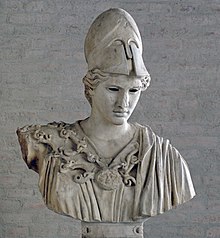
Bust of Athena in the
Glyptothek
Athena is associated with
Athens
, a plural name because it was the place
where she presided over her sisterhood, the Athenai, in earliest times:
Mycenae
was the city where the Goddess was
called Mykene, and Mycenae is named in the plural for the sisterhood of females
who tended her there. At
Thebes
she was called Thebe, and the city again
a plural, Thebae (or Thebes, where the "s" is the plural formation). Similarly,
at Athens she was called Athena, and the city Athenae (or Athens, again a
plural)."Whether her name is attested in
Eteocretan
or not will have to wait for
decipherment of Linear A
.
Günther Neumann has suggested that Athena's name is possibly of
Lydian
origin; it may be a compound word
derived in part from
Tyrrhenian
"ati", meaning mother and the
name of the
Hurrian
goddess "Hannahannah"
shortened in various places to "Ana". In
Mycenaean Greek
, at
Knossos
a single inscription A-ta-na
po-ti-ni-ja /Athana potniya/ appears in the
Linear B
tablets from the Late Minoan II-era
"Room of the Chariot Tablets"; these comprise the earliest Linear B archive
anywhere.
Although Athana potniya often is translated Mistress Athena, it
literally means "the potnia of At(h)ana", which perhaps, means the
Lady of Athens;[Any
connection to the city of Athens in the Knossos inscription is uncertain. We
also find A-ta-no-dju-wa-ja /Athana diwya/, the final part being
the Linear B spelling of what we know from Ancient Greek as Diwia :
divine Athena also was a weaver and the deity of crafts (see
dyeus
).
In his dialogue
Cratylus
, the Greek philosopher
Plato
, 428/427 BC – 348/347 BC, gives the
etymology of Athena's name, based on the view of the ancient Athenians:
That is a graver matter, and there, my friend, the modern interpreters
of Homer may, I think, assist in explaining the view of the ancients.
For most of these in their explanations of the poet, assert that he
meant by Athena "mind" [nous]
and "intelligence" [dianoia], and the maker of names appears to
have had a singular notion about her; and indeed calls her by a still
higher title, "divine intelligence" [Theian noesis], as though he
would say: This is she who has the mind better than others. Nor shall we
be far wrong in supposing that the author of it wished to identify this
Goddess with moral intelligence [en ethei noesin], and therefore
gave her the name etheonoe; which, however, either he or his successors
have altered into what they thought a nicer form, and called her Athena.
—Plato, Cratylus, 407b
Thus for Plato her name was to be derived from Greek Ἀθεονόα, Atheonóa—which
the later Greeks rationalised as from the deity's (theos) mind (nous).
Plato noted that the Egyptian citizens of
Sais
in Egypt worshipped a goddess whose
Egyptian name was Neith
; and they identified her with Athena. (Timaeus
21e), (Histories
2:170–175).
Some authors[citation
needed] believe that, in early times, Athena was
either an owl
herself or a
bird goddess
in general: in Book 3 of the
Odyssey
, she takes the form of a
sea-eagle
. These authors argue that she dropped
her prophylactic owl-mask before she lost her wings. "Athena, by the time she
appears in art," Jane Ellen Harrison had remarked, "has completely shed her
animal form, has reduced the shapes she once wore of snake and bird to
attributes, but occasionally in
black-figure vase-paintings
she still appears
with wings."Some Greek authors have derived natural symbols from the
etymological roots of Athena's names to be aether, air, earth, and moon. This
was one of the primary developments of scholarly exploration in the ancient
world.
Post-classical culture

A
neoclassical
variant of
Athena Promachos
stands in
front of the
Austrian Parliament Building
in
Vienna.
A brief summary of Athena's evolution of myriad motifs after her dominance in
Greece may be seen as follows: The rise of Christianity in Greece largely ended
the worship of Greek deities and polytheism in general, but she resurfaced in
the Middle Ages as a defender of sagacity and virtue so that her masculine
warrior status was still intact. (She may be found on some family crests of
nobility.) During the Renaissance she donned the mantle of patron of the arts
and human endeavor and finally although not ultimately, Athena personified the
miracles of freedom and republic during the French Revolution. (A statue of the
goddess was centered on the Place de la Revolution in Paris.)
For over a century
a full-scale replica of the Parthenon
has stood
in
Nashville, Tennessee
, which is known as the
Athens of the South. In 1990, a gilded 41 feet (12.5 m) tall
replica of Phidias' statue
of Athena Parthenos
was added. The state
seal of California
features an image of Athena
(or Minerva) kneeling next to a brown grizzly bear.
Athena is a natural patron of universities: she is the symbol of the
Darmstadt University of Technology
, in Germany,
and the
Federal University of Rio de Janeiro
, in
Brazil. Her image can be found in the shields of the Faculty of Philosophy and
Letters and the Faculty of Sciences of the
National Autonomous University of Mexico
, where
her owl is the symbol of the Faculty of Chemistry. At
Bryn Mawr College
in Pennsylvania a statue of
Athena (a replica of the original bronze one in the arts and archaeology
library) resides in the Great Hall. It is traditional at exam time for students
to leave offerings to the goddess with a note asking for good luck, or to repent
for accidentally breaking any of the college's numerous other traditions.
Athena's owl also serves as the mascot of the college, and one of the college
hymns is "Pallas Athena". Pallas Athena is the tutelary goddess of the
international social fraternity
Phi Delta Theta
. Her owl is also a symbol of
the fraternity.
The title character in
Edgar Allan Poe
's
The Raven
famously sits upon "a Bust of
Pallas".
Athena's Helmet is the central feature on the
United States Military Academy
crest
.
Athena is reported as a source of influence for feminist theologians such as
Carol P. Christ
.
Jean Boucher
's statue of the seated skeptical
thinker Ernest Renan
, shown to the left, caused great
controversy when it was installed in Tréguier,
Brittany
in 1902. Renan's 1862 biography of
Jesus had denied his divinity, and he had written the "Prayer
on the Acropolis" addressed to the goddess Athena. The statue was
placed in the square fronted by the cathedral. Renan's head was turned away from
the building, while Athena, beside him, was depicted raising her arm, which was
interpreted as indicating a challenge to the church during an anti-clerical
phase in French official culture. The installation was accompanied by a mass
protest from local Roman Catholics and a religious service against the growth of
skepticism
and
secularism
.
Athena has been used numerous times as a symbol of a republic by different
countries and appears on currency as she did on the ancient
drachma
of Athens. Athena (Minerva) is the
subject of the $50 1915-S Panama-Pacific
commemorative coin
. At 2.5 troy oz (78 g) gold,
this is the largest (by
weight
) coin ever produced by the
U.S. Mint
. This was the first $50 coin issued
by the U.S. Mint and no higher was produced until the production of the $100
platinum coins in 1997. Of course, in terms of face-value in adjusted dollars,
the 1915 is the highest denomination ever issued by the U.S. Mint.
Athena was depicted on the
obverse
of the Greek 100
drachmas
banknote of 1978-2001. Another recent
example is the
60 Years of the Second Republic commemorative coin
issued by Austria in 2005. Athena is depicted in the obverse of the coin,
representing the Austrian Republic.
She appears briefly in Disney's
Hercules
, but has a more dominant role in
the television series.
Athena
is an active character in
Marvel Comics
' main continuity, the
Marvel Universe
, most recently in the
Incredible Hercules
series. She acts as a
guide to
Hercules
and his sidekick, boy genius
Amadeus Cho
.
Athena appears in
Rick Riordan
's
Percy Jackson & the Olympians
book series.
Her daughter, born from her head as she was from Zeus's,
demigod
Annabeth Chase
is one of the principal
characters. Annabeth's father found her (Annabeth) lying in a golden cradle at
the doorstep.
The Roman name for Athena is Minerva. In the video game Assassin's Creed II,
Minerva appears in an ancient vault underneath the Vatican at the end of the
game. She explains the origin of mankind within the story to the game's main
protagonist, Desmond Miles, through his ancestor, Ezio Auditore.
Athena appears in the television series
Stargate SG-1
when she kidnaps
Vala Mal Doran
to gain information on the
Clava Thessara Infinitas
(The Key to Infinite
Treasure).
Masculinity and
feminism
Athena had an "androgynous compromise" that allowed her traits and what she
stood for to be attributed to male and female rulers alike over the course of
history (such as Marie de' Medici, Anne of Austria, Christina of Sweden, and
Catherine the Great)
J.J. Bachofen advocated that Athena was originally a maternal figure stable
in her security and poise but was caught up and perverted by a patriarchal
society; this was especially the case in Athens. The goddess adapted but could
very easily be seen as a god. He viewed it as "motherless paternity in the place
of fatherless maternity" where once altered, Athena's character was to be
crystallized as that of a patriarch.
Whereas Bachofen saw the switch to paternity on Athena's behalf as an
increase of power, Freud on the contrary perceived Athena as an "original mother
goddess divested of her power". In this interpretation, Athena was demoted to be
only Zeus's daughter, never allowed the expression of motherhood. Still more
different from Bachofen's perspective is the lack of role permanency in Freud's
view: Freud held that time and differing cultures would mold Athena to stand for
what was necessary to them.
Timoleon (Greek:
Τιμολέων), son of Timodemus, of
Corinth
(ca.
411–337 BC) was a Greek statesman and general.
As the champion of
Greece
against
Carthage
he
is closely connected with the history of
Sicily
,
especially
Syracuse
.
//
Early
life
When his brother
Timophanes
,
whose life he had saved in battle, took possession of the acropolis of Corinth
and made himself master of the city, Timoleon, after an ineffectual protest,
tacitly acquiesced while the friends who accompanied him put Timophanes to
death. Public opinion approved his conduct as patriotic; but the curses of his
mother and the indignation of some of his kinsfolk drove him into retirement for
twenty years.
Sicily

Sicily 431 BC
Because of the political problems of Syracuse and the threat from Sparta, a
group of Syracusans sent an appeal for help to Corinth which reached Corinth in
344 BC
Corinth
could not refuse help, though her chief citizens declined the responsibility of
attempting to establish a settled government in factious and turbulent Syracuse.
Timoleon, being named by an unknown voice in the popular assembly, was chosen
by a unanimous vote to undertake the mission, and set sail for Sicily with a few
of the leading citizens of Corinth and a small troop of Greek mercenaries. He
eluded a Carthaginian squadron and landed at
Tauromenium
(now Taormina), where he met with a friendly reception. At this
time
Hicetas
, tyrant of
Leontini
, was master of Syracuse, with the exception of the island of
Ortygia
,
which was occupied by
Dionysius
, still nominally tyrant.
Hicetas was defeated at Adranum, an inland town, and driven back to Syracuse.
In 343 Dionysius surrendered Ortygia on condition of being granted a safe
conduct to Corinth. Hicetas now received help from Carthage (60,000 men), but
ill-success roused mutual suspicion; the Carthaginians abandoned Hicetas, who
was besieged in Leontini, and who was then compelled to surrender. Timoleon was
thus master of Syracuse.
He at once began the work of restoration, bringing new settlers from the
mother-city and from Greece generally, and establishing a popular government on
the basis of the democratic laws of
Diocles
. The
citadel was razed to the ground, and a court of justice erected on its site. The
amphi-polos, or priest of Olympian
Zeus, who was
annually chosen by lot out of three clans, was invested with the chief
magistracy. The impress of Timoleon's reforms seems to have lasted to the days
of Augustus
.
Hicetas again induced Carthage to send (340–339) a great army (70,000), which
landed at Lilybaeum (now Marsala). With a miscellaneous levy of about 12,000
men, most of them mercenaries, Timoleon marched westwards across the island into
the neighbourhood of
Selinus
and won a great and decisive
victory on the Crimissus
. The general himself led his infantry, and the
enemy's discomfiture was completed by a blinding storm of rain and hail. This
victory gave the Greeks of Sicily many years of peace and safety from Carthage.
Carthage made, however, one more effort and despatched some mercenaries to
prolong the conflict between Timoleon and the tyrants. But it ended in the
defeat of Hicetas, who was taken prisoner and put to death. Carthage then agreed
to a treaty in 338
BC
by which, in Sicily, Carthage was confined to the west of the Halycus (Platani)
and undertook to give no further help to tyrants.
Retirement
Timoleon then retired into private life without assuming any title or office,
though he remained practically supreme, not only at Syracuse, but throughout the
island. Notwithstanding the many elements of discord Sicily seems to have been
during Timoleon's lifetime tranquil and contented. He became blind some time
before his death, but when important issues were under discussion he was carried
to the assembly to give his opinion, which was usually accepted. He was buried
at the cost of the citizens of Syracuse, who erected a monument to his memory in
their market-place, afterwards surrounded with porticoes, and a gymnasium called
Timoleonteum.
Tyrant
or Democrat?
The ancient historian
Timaeus
gave Timoleon an excellent write up; however, Polybios laid into
Timaeus for bias in favor of Timoleon and many modern historians have sided with
Polybios. Peter Green shares this skepticism but thinks it has gone too far.
While he concedes that Timoleon tended to play the democrat while using the
methods of a tyrant (albeit benevolent), he did make an effort to maintain the
outward forms of democracy. Further, he reformed Syracuse in a democratic
direction and demolished the stronghold of the island that had been so useful to
tyrants in the past.
Syracuse pronounced,
Sicilian
: Sarausa,
Ancient Greek
: Συράκουσαι –
transliterated: Syrakousai) is a historic
city in
southern Italy
, the
capital
of the
province of Syracuse
. The city is famous for its rich Greek history,
culture
,
amphitheatres
,
architecture
and association to
Archimedes
,
playing an important role in ancient times as one of the top powers of the
Mediterranean
world; it is over 2,700 years old. Syracuse is located in the
south-east corner of the island of
Sicily
, right
by the Gulf of Syracuse next to the
Ionian Sea
.
The city was founded by
Ancient Greek
Corinthians
and became a very powerful
city-state
.
Syracuse was allied with
Sparta
and
Corinth
,
exerting influence over the entire
Magna Grecia
area of which it was the most important city. Once
described by Cicero
as "the greatest Greek city and the most beautiful of them all", it later became
part of the
Roman Republic
and
Byzantine Empire
. After this
Palermo
overtook it in importance, as the capital of the
Kingdom of Sicily
. Eventually the kingdom would be united with the
Kingdom of Naples
to form the
Two Sicilies
until the
Italian unification
of 1860.
In the modern day, the city is listed by
UNESCO
as a
World Heritage Site
along with the
Necropolis of Pantalica
. In the central area, the city itself has a
population of around 125,000 people. The inhabitants are known as Siracusans,
and the local language spoken by its inhabitants is the
Sicilian language
. Syracuse is mentioned in the
Bible
in the
Acts of the Apostles
book at 28:12 as
Paul
stayed there.[2]
The patron saint
of the city is
Saint Lucy
;
she was born in Syracuse and her feast day,
Saint Lucy's Day
, is celebrated on 13 December.
Greek period
Syracuse and its surrounding area have been inhabited since ancient times, as
shown by the findings in the villages of Stentinello, Ognina, Plemmirio,
Matrensa, Cozzo Pantano and Thapsos, which already had a relationship
with
Mycenaean Greece
.
Syracuse was founded in 734 or 733 BC by Greek settlers from
Corinth
and Tenea
,
led by the oecist (colonizer)
Archias
, who called it Sirako, referring to a nearby salt marsh. The
nucleus of the ancient city was the small island of Ortygia. The settlers
found the land fertile and the native tribes to be reasonably well-disposed to
their presence. The city grew and prospered, and for some time stood as the most
powerful Greek city anywhere in the
Mediterranean
. Colonies were founded at
Akrai
(664 BC),
Kasmenai
(643 BC),
Akrillai
(VII century BC), Helorus
(VII century BC) and
Kamarina
(598 BC). The descendants of the first colonist, called Gamoroi, held the
power until they were expelled by the Killichiroi, the lower class of the
city. The former, however, returned to power in 485 BC, thanks to the help of
Gelo, ruler of
Gela. Gelo himself
became the despot of the city, and moved many inhabitants of Gela, Kamarina and
Megera to Syracuse, building the new quarters of
Tyche
and
Neapolis
outside the walls. His program of new constructions included a new
theater, designed by
Damocopos
, which gave the city a flourishing cultural life: this in turn
attracted personalities as
Aeschylus
,
Ario of
Metimma
, Eumelos of
Corinth
and
Sappho
, who had
been exiled here from
Mytilene
.
The enlarged power of Syracuse made unavoidable the clash against the
Carthaginians
, who ruled western Sicily. In the
Battle of Himera
, Gelo, who had allied with Theron of
Agrigento
,
decisively defeated the African force led by
Hamilcar
. A
temple
,
entitled to Athena
(on the site of the today's Cathedral), was erected in the city to commemorate
the event
Gelon was succedeed by his brother
Hiero
, who
fought
against the
Etruscans
at Cumae
in 474 BC. His rule was eulogized by poets like
Simonides of Ceos
,
Bacchylides
and Pindar
, who visited his court. A democratic regime was introduced by
Thrasybulos
(467 BC). The city continued to expand in
Sicily
,
fighting against the rebellious
Siculi
, and on the
Tyrrhenian Sea
, making expeditions up to
Corsica
and
Elba. In the late
5th century BC, Syracuse found itself at war with
Athens
, which
sought more resources to fight the
Peloponnesian War
. The Syracusans enlisted the aid of a general from
Sparta
, Athens'
foe in the war, to defeat the Athenians, destroy their ships, and leave them to
starve on the island (see
Sicilian Expedition
). In 401 BC, Syracuse contributed a force of 3,000
hoplites
and a general to
Cyrus the Younger
's
Army of the Ten Thousand
.
Then in the early 4th century BC, the
tyrant
Dionysius the Elder
was again at war against
Carthage
and, although losing Gela and Camarina, kept that power from capturing the whole
of Sicily. After the end of the conflict Dionysius built a massive fortress on
the Ortygia
island of the city and 22 km-long walls around all of Syracuse. Another period
of expansion saw the destruction of
Naxos
, Catania
and Lentini
, then Syracuse entered again in war against Carthage (397 BC). After
various changes of fortune, the Carthaginians managed to besiege Syracuse
itself, but were eventually pushed back by a pestilence. A treaty in 392 BC
allowed Syracuse to enlarge further its possessions, founding the cities of
Adrano, Ancona
,
Adria
, Tindari
and Tauromenos, and conquering
Reggio Calabria
on the continent. Apart from his battle deeds, Dionysius was
famous as a patron of art, and
Plato
himself
visited Syracuse several times.
His successor was
Dionysius the Younger
, who was however expelled by
Dion
in 356 BC. But the latter's despotic rule led in turn to his expulsion,
and Dionysius reclaimed his throne in 347 BC. A democratic government was
installed by Timoleon
in 345 BC. The long series of internal struggles had weakened
Syracuse's power on the island, and Timoleon tried to remedy this, defeating the
Carthaginians in 339 BC near the
Krimisos
river. But the struggle among the city's parties restarted after
his death and ended with the rise of another tyrant,
Agathocles
,
who seized power with a coup in 317 BC. He resumed the war against Carthage,
with alternate fortunes. He however scored a moral success, bringing the war to
the Carthaginians' native African soil, inflicting heavy losses to the enemy.
The war ended with another treaty of peace which did not prevent the
Carthaginians interfering in the politics of Syracuse after the death of
Agathocles (289 BC). The citizens called
Pyrrhus of Epirus
for help. After a brief period under the rule of Epirus,
Hiero II
seized power in 275 BC.
Hiero inaugurated a period of 50 years of peace and prosperity, in which
Syracause became one of the most renowned capitals of Antiquity. He issued the
so-called Lex Hieronica, which was later adopted by the Romans for their
administration of Sicily; he also had the theater enlarged and a new immense
altar
, the "Hiero's
Ara", built. Under his rule lived the most famous Syracusan, the
natural philosopher
Archimedes
.
Among his many inventions were various military engines including the
claw of Archimedes
, later used to resist the
Roman
siege of 214 BC–212 BC. Literary figures included
Theocritus
and others.
Hiero's successor, the young
Hieronymus
(ruled from 215 BC), broke the alliance with the Romans after
their defeat at the
Battle of Cannae
and accepted
Carthage
's
support. The Romans, led by consul
Marcus Claudius Marcellus
,
besieged the city
in 214 BC. The city held out for three years, but fell in
212 BC. It is believed to have fallen due to a peace party opening a small door
in the wall to negotiate a peace, but the Romans charged through the door and
took the city, killing Archimedes in the process.
From
Roman domination to the Middle Ages
Though declining slowly by the years, Syracuse maintained the status of
capital of the Roman government of Sicily and seat of the
praetor
. It
remained an important port for the trades between the Eastern and the Western
parts of the Empire.
Christianity
spread in the city through the efforts of
Paul of Tarsus
and Saint Marziano, the first bishop of the city, who made it
one of the main centres of
proselytism
in the West. In the age of the persecutions massive
catacombs
were carved, whose size is second only to those of Rome.
After a period of
Vandal
rule, Syracuse and the island was recovered by
Belisarius
for the
Byzantine Empire
(31 December 535). From 663 to 668 Syracuse was the seat of
Emperor Constans II
, as well as metropolis of the whole Sicilian Church.
Another siege in 878, resulted in the city coming under two centuries of
Muslim
rule. The
capital was moved from Syracuse to
Palermo
. The
Cathedral was converted into a
mosque
and the
quarter on the Ortygia island was gradually rebuilt along Islamic styles. The
city, nevertheless, maintained important trade relationships, and housed a
relatively flourishing cultural and artistic life: several Arab poets, including
Ibn Hamdis
,
the most important Sicilian poet of the 12th century, flourished in the city.
In 1038, the Byzantine general
George Maniaces
reconquered the city, sending the relics of St. Lucy to
Constantinople
. The eponymous castle on the cape of Ortygia bears his name,
although it was built under the
Hohenstaufen
rule. In 1085 the
Normans
entered Syracuse, one of the last
Arab
strongholds, after a summer-long siege by
Roger I of Sicily
and his son
Jordan of Hauteville
, who was given the city as count. New quarters were
built, and the cathedral was restored, as well as other churches.
In 1194
Henry VI
of Swabia
occupied Syracuse. After a short period of
Genoese
rule (1205–1220), which favoured a rise of trades, Syracuse was
conquered back by emperor
Frederick II
. He began the construction of the
Castello Maniace
, the Bishops' Palace and the Bellomo Palace. Frederick's
death brought a period of unrest and feudal anarchy. In the struggle between the
Anjou
and
Aragonese
monarchies, Syracuse sided with the Aragonese and defeated the
Anjou in 1298, receiving from the Spanish sovereigns great privileges in reward.
The pre-eminence of baronal families is also shown by the construction of the
palaces of Abela
,
Chiaramonte
, Nava
,
Montalto
.
|

