IMAGE IS MUCH SHARPER AND BRIGHTER THAN SCAN SHOWS !! A HIGH QUALITY STEEL ENGRAVING BOOKPLATE FROM THE 1830'S!! PERFECT FOR FRAMING AS AN ART PRINT FOR YOUR DEN !! VERY ANTIQUE & OLD WORLD LOOKING. ITEM(s) OVER 160 YEARS OLD!!
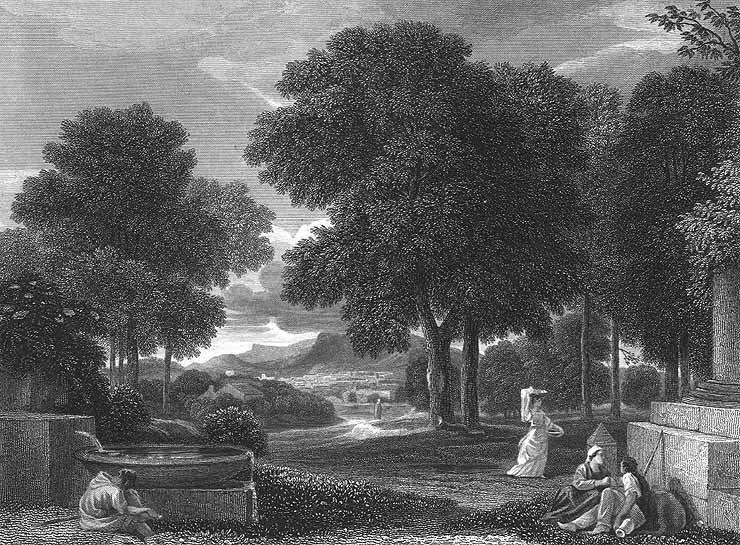
In the thirtieth year of his age he arrived at Rome, but being unknown and destitute, he was obliged to sell his pictures for a while at very low prices. Two battle pieces, containing a great number of figures, produced him but seven crowns; and a Prophet, but eight francs! Still, in his ardent love for the arts, and his native strength of mind, he sought and found the means of braving adversity. He also found in Fiamingo the sculptor, and in his countryman, Jaques Dughet, sympathy, both with his pleasures and his sufferings. The latter, during a severe illness with which Poussin was visited, took him home to his house, where the great artist was attentively nursed by his wife and daughters. Finally, Poussin married one of his friend's daughters, and adopted and instructed in painting his son Gasparo. His wife's dowry now enabled him to purchase a small house, and devote himself to the study of his art. Patronage, with its usual concomitants, flowed in upon him, and he shone forth till the radiance of his fame reached every part of Europe. Pressingly invited by Cardinal Richelieu, he visited Paris, where the king received him with distinction; but those whom he could far overmatch with his pencil, he could not successfully meet in the lists-the labyrinths rather-of court intrigue. He sighed for Italy and domestic quiet, and after battling and counter-plotting awhile with Vouet and Fouquieres, returned to Rome, where he continued to live and paint, and teach others, profoundly respected by all who knew him, till he attained the age of seventy-one years and five months. In the present Landscape, Poussin has depicted the venerated precinct of some ancient and classic city, Thebes, Argos, or Sparta, where the traveler on his arrival finds the means of ablution, and is bathing his feet near the brink of a simple but superb fountain, before he enters a grove sacred to the protecting deity of the district. A suburb is at a distance, and beyond are lofty mountains, one of them cloud-capped. The other figures, who are conversing near the foot of a monumental column, are most judiciously introduced. From the Beaumont Collection: 3 feet, 4 inches, by 2 feet, 5 inches.
SIZE: Image size in inches is 4 3/4" x 6 1/2", overall page size is 7 " x 10". CONDITION: Good condition. Nothing on reverse. Printed on thick rag stock paper. Thick quality rag stock paper. SHIPPING: Buyers to pay shipping/handling, domestic orders receives priority mail, international orders receive regular mail.
We pack properly to protect your item! An engraving is an intaglio process of printing, with the design to be produced is cut below the surface of the plate (made of copper, steel or wood), and the incised lines are filled with ink that is then transferred to paper. The portraits on our currency are good examples of engraved images. A Photogravure is an intaglio process in which the plate is produced photographically. Please note: the terms used in our auctions for engraving, heliogravure, lithograph, line drawing, photogravure etc. are ALL images on paper. THIS IS AN ACTUAL STEEL ENGRAVING FROM THE 1830's! NOT A REPRODUCTION! | |