Lot of 3 Genuine Ancient Roman Antoninianus coins Probus Aurelian & Diocletian
Marcus Aurelius Probus, 276-282 ADDiocletian -
Roman Emperor
: 284-305 A.D. Aurelian, AD 270-275.
Measuring 20-23.5mm. Original patina tone and earthen encrustation. Gently cleaned. Better in hand.
Exactly as pictured.
Bidding is for the items pictured in this listing. Authenticity guaranteed. Original ancient Roman coin as pictured and described above.
|
|
COINS ARE IN GOOD CONDITION AND VERY RARE AND NICE INCLUSIONS TO THE FINEST COLLECTION!
|
|
Authenticity guaranteed!!
Husband of Severina Aurelian (Latin: Lucius Domitius Aurelianus Augustus;
9 September 214 or 215 - September or October 275) was Roman Emperor
from 270 to 275. Born in humble circumstances, he rose through the
military ranks to become emperor. During his reign, he defeated the
Alamanni after a devastating war. He also defeated the Goths, Vandals,
Juthungi, Sarmatians, and Carpi. Aurelian restored the Empire's eastern
provinces after his conquest of the Palmyrene Empire in 273. The
following year he conquered the Gallic Empire in the west, reuniting the
Empire in its entirety. He was also responsible for the construction of
the Aurelian Walls in Rome, and the abandonment of the province of
Dacia.His successes were instrumental in ending the Roman Empire's Crisis of the Third Century, earning him the title Restitutor Orbis or 'Restorer of the World'. Although Domitian was the first emperor who had demanded to be officially hailed as dominus et deus (master and god), these titles never occurred in written form on official documents until the reign of Aurelian. Early lifeAurelian
was born on 9 September, most likely in 214 AD, although 215 AD is also
possible. The ancient sources are not agreed on his place of birth,
although he was generally accepted as being a native of Illyricum.
Sirmium in Pannonia Inferior (now Sremska Mitrovica, Serbia) is the
preferred location, which was created by Aurelian as Emperor when he
abandoned the old trans-Danubian territory of Dacia. The academic
consensus is that he was of humble birth and that his father was a
peasant-farmer who took his Roman nomen from his landlord, a
senator of the clan Aurelius. Saunders suggests that his family might in
fact have been of Roman settler origin and of much higher social
status; however, his suggestion has not been taken up by his more recent
academic colleagues such as Southern and Watson. Using the
evidence of the ancient sources, it was at one time suggested that
Aurelian's mother was a freedwoman of a member of the clan Aurelius and
that she herself was a priestess of the Sun-God in her native village.
These two propositions, together with the tradition that the clan
Aurelius had been entrusted with the maintenance of that deity's cult in
Rome, inspired the notion that this could explain the devotion to the
sun-god that Aurelian was to manifest as Emperor - see below. However,
it seems that this pleasant extrapolation of dubious facts is now
generally accepted as being no more than just that. Military careerIt
is commonly accepted that Aurelian probably joined the army in 235 AD
at around age twenty. It is also generally assumed that, as a member of
the lowest rank of society - albeit a citizen - he would have enlisted
in the ranks of the legions. Idiosyncratically, Saunders suggests that
his career is more easily understood if it is assumed that his family
was of Roman settler origins with a tradition of military service and
that he enlisted as an equestrian. This would have opened up for him the
tres militia - the three steps of the equestrian military career
- one of the routes to higher equestrian office in the Imperial
Service. This could be a more expeditious route to senior military and
procuratorial offices than that pursued by ex-rankers, although not
necessarily less laborious. However, Saunders's conjecture as to
Aurelian's early career is not supported by any evidence other than his nomen
which could indicate Italian settler ancestry - although even this is
contested - and his rise to the highest ranks which is more easily
understood if he did not have to start from the bottom. His suggestion
has not been taken up by other academic authorities. Whatever his
origins, Aurelian certainly must have built up a very solid reputation
for military competence during the tumultuous mid-decades of the
century. To be sure, the exploits detailed in the Historia Augusta vita Divi Aureliani,
while not always impossible, are not supported by any independent
evidence and one at least is demonstrably an invention typical of that
author. However, he was probably associated with Gallienus's cavalry
army and shone as an officer of that corps d'élite because, when
he finally emerged in a historically reliable context in the early part
of the reign of Claudius II, he seems to have been its commander. Service under GallienusHis
successes as a cavalry commander ultimately made him a member of
emperor Gallienus' entourage. In 268, Aurelian and his cavalry
participated in general Claudius' victory over the Goths at the Battle
of Naissus. Later that year Gallienus traveled to Italy and fought
Aureolus, his former general and now usurper for the throne. Driving
Aureolus back into Mediolanum, Gallienus promptly besieged his adversary
in the city. However, while the siege was ongoing the Emperor was
assassinated. One source says Aurelian, who was present at the siege,
participated and supported general Claudius for the purple - which is
plausible. Aurelian was married to Ulpia Severina, about whom
little is known. Like Aurelian she was from Dacia. They are known to
have had a daughter together. Service under ClaudiusClaudius
was acclaimed Emperor by the soldiers outside Mediolanum. The new
Emperor immediately ordered the senate to deify Gallienus. Next, he
began to distance himself from those responsible for his predecessor's
assassination, ordering the execution of those directly involved.
Aureolus was still besieged in Mediolanum and sought reconciliation with
the new emperor, but Claudius had no sympathy for a potential rival.
The emperor had Aureolus killed and one source implicates Aurelian in
the deed, perhaps even signing the warrant for his death himself. During
the reign of Claudius, Aurelian was promoted rapidly: he was given
command of the elite Dalmatian cavalry, and was soon promoted to overall
Magister equitum, effectively the head of the army after the
Emperor - the Emperor's position before his acclamation. The war against
Aureolus and the concentration of forces in Italy allowed the Alamanni
to break through the Rhaetian limes along the upper Danube. Marching
through Raetia and the Alps unhindered, they entered northern Italy and
began pillaging the area. In early 269, emperor Claudius and Aurelian
marched north to meet the Alamanni, defeating them decisively at the
Battle of Lake Benacus. While still dealing with the defeated
enemy, news came from the Balkans reporting large-scale attacks from the
Heruli, Goths, Gepids, and Bastarnae. Claudius immediately dispatched
Aurelian to the Balkans to contain the invasion as best he could until
Claudius could arrive with his main army. The Goths were besieging
Thessalonica when they heard of emperor Claudius' approach, causing them
to abandon the siege and pillage north-eastern Macedonia. Aurelian
intercepted the Goths with his Dalmatian cavalry and defeated them in a
series of minor skirmishes, killing as many as three thousand of the
enemy. Aurelian continued to harass the enemy, driving them northward
into Upper Moesia where emperor Claudius had assembled his main army.
The ensuing battle was indecisive: the northward advance of the Goths
was halted but Roman losses were heavy. Claudius could not afford
another pitched battle, so he instead laid a successful ambush, killing
thousands. However, the majority of the Goths escaped and began
retreating south the way they had come. For the rest of year, Aurelian
harassed the enemy with his Dalmatian cavalry. Now stranded in
Roman territory, the Goths' lack of provisions began to take its toll.
Aurelian, sensing his enemies' desperation, attacked them with the full
force of his cavalry, killing many and driving the remainder westward
into Thrace. As winter set in, the Goths retreated into the Haemus
Mountains, only to find themselves trapped and surrounded. The harsh
conditions now exacerbated their shortage of food. However, the Romans
underestimated the Goths and let their guard down, allowing the enemy to
break through their lines and escape. Apparently emperor Claudius
ignored advice, perhaps from Aurelian, and withheld the cavalry and sent
in only the infantry to stop their break-out. The determined
Goths killed many of the oncoming infantry and were only prevented from
slaughtering them all when Aurelian finally charged in with his
Dalmatian cavalry. The Goths still managed to escape and continued their
march through Thrace. The Roman army continued to follow the Goths
during the spring and summer of 270. Meanwhile, a devastating plague
swept through the Balkans, killing many soldiers in both armies. Emperor
Claudius fell ill on the march to the battle and returned to his
regional headquarters in Sirmium, leaving Aurelian in charge of
operations against the Goths. Aurelian used his cavalry to great effect,
breaking the Goths into smaller groups which were easier to deal with.
By late summer the Goths were defeated: any survivors were stripped of
their animals and booty and were levied into the army or settled as
farmers in frontier regions. Aurelian had no time to relish his
victories; in late August news arrived from Sirmium that emperor
Claudius was dead. Opposition to QuintillusWhen Claudius
died, his brother Quintillus seized power with support of the Senate.
With an act typical of the Crisis of the Third Century, the army refused
to recognize the new Emperor, preferring to support one of its own
commanders: Aurelian was proclaimed emperor in September 270 by the
legions in Sirmium. Aurelian defeated Quintillus' troops, and was
recognized as Emperor by the Senate after Quintillus' death. The claim
that Aurelian was chosen by Claudius on his death bed can be dismissed
as propaganda; later, probably in 272, Aurelian put his own dies imperii the day of Claudius' death, thus implicitly considering Quintillus a usurper. With
his base of power secure, he now turned his attention to Rome's
greatest problems - recovering the vast territories lost over the
previous two decades, and reforming the res publica. EmperorThe Roman Empire in the 270sIn
248, Emperor Philip the Arab had celebrated the millennium of the city
of Rome with great and expensive ceremonies and games, and the Empire
had given a tremendous proof of self-confidence. In the following years,
however, the Empire had to face a huge pressure from external enemies,
while, at the same time, dangerous civil wars threatened the empire from
within, with usurpers weakening the strength of the state. Also, the
economic substrate of the state, agriculture and commerce, suffered from
the disruption caused by the instability. On top of this an epidemic
swept through the Empire around 250, greatly diminishing manpower both
for the army and for agriculture. The end result was that the
Empire could not endure the blow of the capture of Emperor Valerian in
260. The eastern provinces found their protectors in the rulers of the
city of Palmyra, in Syria, whose autonomy grew until the formation of
the Palmyrene Empire, which was more successful against the Persian
threat. The western provinces, those facing the limes of the
Rhine, seceded to form a third, autonomous state within the territories
of the Roman Empire, which is now known as the Gallic Empire. In
Rome, the Emperor was occupied with the internal menaces to his power
and with the defense of Italia and the Balkans. This was the situation
faced by Gallienus and Claudius, and the problems Aurelian had to deal
with at the beginning of his rule. Reunification of the empireThe
first actions of the new Emperor were aimed at strengthening his own
position in his territories. Late in 270, Aurelian campaigned in
northern Italia against the Vandals, Juthungi, and Sarmatians, expelling
them from Roman territory. To celebrate these victories, Aurelian was
granted the title of Germanicus Maximus. The authority of the
Emperor was challenged by several usurpers - Septimius, Urbanus,
Domitianus, and the rebellion of Felicissimus - who tried to exploit the
sense of insecurity of the empire and the overwhelming influence of the
armies in Roman politics. Aurelian, being an experienced commander, was
aware of the importance of the army, and his propaganda, known through
his coinage, shows he wanted the support of the legions. Defending Italy Against the IuthungiThe
burden of the northern barbarians was not yet over, however. In 271,
the Alamanni moved towards Italia, entering the Po plain and sacking the
villages; they passed the Po River, occupied Placentia and moved
towards Fano. Aurelian, who was in Pannonia to control the Vandals'
withdrawal, quickly entered Italia, but his army was defeated in an
ambush near Placentia (January 271). When the news of the defeat arrived
in Rome, it caused great fear for the arrival of the barbarians. But
Aurelian attacked the Alamanni camping near the Metaurus River,
defeating them in the Battle of Fano, and forcing them to re-cross the
Po river; Aurelian finally routed them at Pavia. For this, he received
the title Germanicus Maximus. However, the menace of the Germanic
people remained high as perceived by the Romans, so Aurelian resolved
to build the walls that became known as the Aurelian Walls around Rome. Defeat of the Goths and abandonment of DaciaThe
emperor led his legions to the Balkans, where he defeated and routed
the Goths beyond the Danube, killing the Gothic leader Cannabaudes, and
assuming the title of Gothicus Maximus. However, he decided to
abandon the province of Dacia, on the exposed north bank of the Danube,
as too difficult and expensive to defend. He reorganized a new province
of Dacia south of the Danube, inside the former Moesia, called Dacia Aureliana, with Serdica as the capital. Conquest of the Palmyrene EmpireIn
272, Aurelian turned his attention to the lost eastern provinces of the
empire, the so-called "Palmyrene Empire" ruled by Queen Zenobia from
the city of Palmyra. Zenobia had carved out her own empire, encompassing
Syria, Palestine, Egypt and large parts of Asia Minor. The Syrian queen
cut off Rome's shipments of grain, and in a matter of weeks, the Romans
started running low on bread. In the beginning, Aurelian had been
recognized as Emperor, while Vaballathus, the son of Zenobia, held the
title of rex and imperator ("king" and "supreme military
commander"), but Aurelian decided to invade the eastern provinces as
soon as he felt his army to be strong enough. Asia Minor was
recovered easily; every city but Byzantium and Tyana surrendered to him
with little resistance. The fall of Tyana lent itself to a legend:
Aurelian to that point had destroyed every city that resisted him, but
he spared Tyana after having a vision of the great 1st-century
philosopher Apollonius of Tyana, whom he respected greatly, in a dream. Apollonius
implored him, stating, "Aurelian, if you desire to rule, abstain from
the blood of the innocent! Aurelian, if you will conquer, be merciful!"
Whatever the reason, Aurelian spared Tyana. It paid off; many more
cities submitted to him upon seeing that the Emperor would not exact
revenge upon them. Within six months, his armies stood at the gates of
Palmyra, which surrendered when Zenobia tried to flee to the Sassanid
Empire. The "Palmyrene Empire" was no more. Eventually Zenobia and
her son were captured and made to walk on the streets of Rome in his
triumph, the woman in golden chains. With the grain stores once again
shipped to Rome, Aurelian's soldiers handed out free bread to the
citizens of the city, and the Emperor was hailed a hero by his subjects.
After a brief clash with the Persians and another in Egypt against the
usurper Firmus, Aurelian was obliged to return to Palmyra in 273 when
that city rebelled once more. This time, Aurelian allowed his soldiers
to sack the city, and Palmyra never recovered. More honors came his way;
he was now known as Parthicus Maximus and Restitutor Orientis ("Restorer of the East"). The
rich province of Egypt was also recovered by Aurelian. The Brucheion
(Royal Quarter) in Alexandria was burned to the ground. This section of
the city once contained the Library of Alexandria, although the extent
of the surviving Library in Aurelian's time is uncertain. Conquest of the Gallic EmpireIn
274, the victorious emperor turned his attention to the west, and the
"Gallic Empire" which had already been reduced in size by Claudius II.
Aurelian won this campaign largely through diplomacy; the "Gallic
Emperor" Tetricus was willing to abandon his throne and allow Gaul and
Britain to return to the Empire, but could not openly submit to
Aurelian. Instead, the two seem to have conspired so that when the
armies met at Châlons-en-Champagne that autumn, Tetricus simply deserted
to the Roman camp and Aurelian easily defeated the Gallic army facing
him.[citation needed] Tetricus was rewarded for his part in the conspiracy with a high-ranking position in Italy itself. Aurelian returned to Rome and won his last honorific from the Senate - Restitutor Orbis
("Restorer of the World"). This title was first assumed by Aurelian in
late summer of 272, and had been carried previously by both Valerian and
Gallienus. In four years, Aurelian had secured the frontiers of the
Empire and reunified it, effectively giving the Empire a new lease on
life that lasted 200 years. ReformsAurelian was a
reformer, and settled many important functions of the imperial
apparatus, dealing with the economy and religion. He restored many
public buildings, re-organized the management of the food reserves, set
fixed prices for the most important goods, and prosecuted misconduct by
the public officers. Religious reformAurelian strengthened the
position of the Sun god Sol Invictus as the main divinity of the Roman
pantheon. His intention was to give to all the peoples of the Empire,
civilian or soldiers, easterners or westerners, a single god they could
believe in without betraying their own gods. The center of the cult was a
new temple, built in 274 and dedicated on December 25 of that year in
the Campus Agrippae in Rome, with great decorations financed by the spoils of the Palmyrene Empire. During
his short rule, Aurelian seemed to follow the principle of "one faith,
one empire", which would not be made official until the Edict of
Thessalonica. He appears with the title deus et dominus natus
("God and born ruler") on some of his coins, a style also later adopted
by Diocletian. Lactantius argued that Aurelian would have outlawed all
the other gods if he had had enough time. He was recorded by Christian
historians as having organized persecutions. Felicissimus' rebellion and coinage reformAurelian's reign records the only uprising of mint workers. The rationalis
Felicissimus, a senior public financial official whose responsibilities
included supervision of the mint at Rome, revolted against Aurelian.
The revolt seems to have been caused by the fact that the mint workers,
and Felicissimus first, were accustomed to stealing the silver for the
coins and producing coins of inferior quality. Aurelian wanted to
eliminate this, and put Felicissimus on trial. The rationalis
incited the mintworkers to revolt: the rebellion spread in the streets,
even if it seems that Felicissimus was killed immediately, presumably
executed. The Palmyrene rebellion in Egypt had probably reduced
the grain supply to Rome, thus disaffecting the population to the
emperor. This rebellion also had the support of some senators, probably
those who had supported the election of Quintillus, and thus had
something to fear from Aurelian. Aurelian ordered the urban
cohorts, reinforced by some regular troops of the imperial army, to
attack the rebelling mob: the resulting battle, fought on the Caelian
hill, marked the end of the revolt, even if at a high price (some
sources give the figure, probably exaggerated, of 7,000 casualties).
Many of the rebels were executed; also some of the supporting senators
were put to death. The mint of Rome was closed temporarily, and the
institution of several other mints caused the main mint of the empire to
lose its hegemony. His monetary reformation included the introduction of antoniniani
containing 5% silver. They bore the mark XXI (or its Greek numerals
form KA), which meant that twenty of such coins would contain the same
silver quantity of an old silver denarius. Considering that this
was an improvement over the previous situation gives an idea of the
severity of the economic situation Aurelian faced. The Emperor struggled
to introduce the new "good" coin by recalling all the old "bad" coins
prior to their introduction. DeathIn 275, Aurelian
marched towards Asia Minor, preparing another campaign against the
Sassanids: the deaths of Kings Shapur I (272) and Hormizd I (273) in
quick succession, and the rise to power of a weakened ruler (Bahram I),
set the possibility to attack the Sassanid Empire. On his way, the
Emperor suppressed a revolt in Gaul - possibly against Faustinus, an
officer or usurper of Tetricus - and defeated barbarian marauders in
Vindelicia (Germany). However, Aurelian never reached Persia, as
he was murdered while waiting in Thrace to cross into Asia Minor. As an
administrator, Aurelian had been very strict and handed out severe
punishments to corrupt officials or soldiers. A secretary of Aurelian
(called Eros by Zosimus) had told a lie on a minor issue. In fear of
what the Emperor might do, he forged a document listing the names of
high officials marked by the emperor for execution and showed it to
collaborators. The notarius Mucapor and other high-ranking
officers of the Praetorian Guard, fearing punishment from the Emperor,
murdered him in September 275, in Caenophrurium, Thrace (modern Turkey). Aurelian's enemies in the Senate briefly succeeded in passing damnatio memoriae
on the Emperor, but this was reversed before the end of the year and
Aurelian, like his predecessor Claudius II, was deified as Divus Aurelianus. There is substantial evidence that Aurelian's wife Ulpia Severina, who had been declared Augusta
in 274, may have ruled the Empire by her own power for some time after
his death. The sources indicate that there was an interregnum between
Aurelian's death and the election of Marcus Claudius Tacitus as his
successor. Additionally, some of Ulpia's coins appear to have been
minted after Aurelian's death. LegacyAurelian's short
reign reunited a fragmented Empire while saving Rome from barbarian
invasions that had reached Italy itself. His death prevented a full
restoration of political stability and a lasting dynasty that could end
the cycle of assassination of emperors and civil war that marked this
period. Even so, he brought the Empire through a very critical period in
its history, and without Aurelian it never would have survived the
invasions and fragmentation of the decade in which he reigned. Much hard
fighting remained for his successors before the Empire finally regained
the initiative against the Persians and the northern barbarian peoples,
and it would be another twenty years or more before Diocletian fully
restored stability and ended the Crisis of the third century. However,
after that the Western half of the Empire would survive another two
hundred years, while the East would last another millennium, and for
that Aurelian must be allowed much of the credit. The city of Orléans in France is named after Aurelian. Originally named Cenabum, Aurelian rebuilt and named it Aurelianum or Aureliana Civitas ("city of Aurelian", cité d'Aurélien), which evolved into Orléans. The city of New Orleans (in French, La Nouvelle-Orléans), in Louisiana, United States is named after the commune of Orléans, and therefore by extension, Aurelian.
Diocletian (Latin:
Gaius Aurelius Valerius Diocletianus Augustus;
c. 22 December 244 – 3 December 311), was a
Roman Emperor
from 284 to 305. Born to a family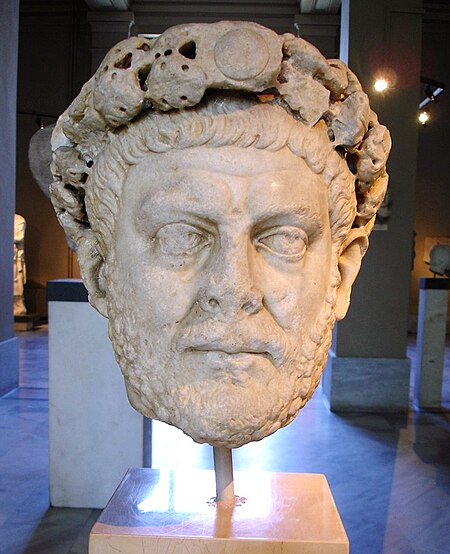 of low status in the
Roman province of Dalmatia
, Diocletian rose
through the ranks of the military to become cavalry commander to the Emperor
Carus
. After the deaths of Carus and his son
Numerian
on campaign in Persia, Diocletian was
proclaimed Emperor. The title was also claimed by Carus' other surviving son,
Carinus
, but Diocletian defeated him in the
Battle of the Margus
. Diocletian's reign
stabilized the Empire and marks the end of the
Crisis of the Third Century
. He appointed
fellow officer Maximian
Augustus
his senior co-emperor in 285.
Diocletian delegated further on 1 March 293, appointing
Galerius
and
Constantius
as
Caesars
, junior co-emperors. Under this "Tetrarchy",
or "rule of four", each emperor would rule over a quarter-division of the
Empire. Diocletian secured the Empire's borders and purged it of all threats to
his power. He defeated the
Sarmatians
and
Carpi
during several campaigns between 285 and
299, the
Alamanni
in 288, and usurpers in
Egypt
between 297 and 298. Galerius, aided by
Diocletian, campaigned successfully against
Sassanid Persia
, the Empire's traditional
enemy. In 299 he sacked their capital,
Ctesiphon
. Diocletian led the subsequent
negotiations and achieved a lasting and favorable peace. Diocletian separated
and enlarged the Empire's civil and military services and reorganized the
Empire's provincial divisions, establishing the largest and most
bureaucratic
government in the history of the
Empire. He established new administrative centers in
Nicomedia
,
Mediolanum
,
Antioch
, and
Trier
, closer to the Empire's frontiers than
the traditional capital at Rome had been. Building on third-century trends
towards absolutism
, he styled himself an autocrat,
elevating himself above the Empire's masses with imposing forms of court
ceremonies and architecture. Bureaucratic and military growth, constant
campaigning, and construction projects increased the state's expenditures and
necessitated a comprehensive tax reform. From at least 297 on, imperial taxation
was standardized, made more equitable, and levied at generally higher rates.
Not all of Diocletian's plans were successful: the
Edict on Maximum Prices
(301), his attempt
to curb inflation
via
price controls
, was counterproductive and
quickly ignored. Although effective while he ruled, Diocletian's Tetrarchic
system collapsed after his abdication under the competing dynastic claims of
Maxentius
and
Constantine
, sons of Maximian and Constantius
respectively. The
Diocletianic Persecution
(303–11), the Empire's
last, largest, and bloodiest official persecution of
Christianity
, did not destroy the Empire's
Christian community; indeed, after 324 Christianity became the empire's
preferred religion under its first Christian emperor,
Constantine
.
In spite of his failures, Diocletian's reforms fundamentally changed the
structure of Roman imperial government and helped stabilize the Empire
economically and militarily, enabling the Empire to remain essentially intact
for another hundred years despite being near the brink of collapse in
Diocletian's youth. Weakened by illness, Diocletian left the imperial office on
1 May 305, and became the only Roman emperor to voluntarily abdicate the
position. He lived out his retirement in
his palace
on the Dalmatian coast, tending to
his vegetable gardens. His palace eventually became the core of the modern-day
city of
Split
.
Early life
Diocletian was probably born near
Salona
in
Dalmatia
(Solin
in modern Croatia
), some time around 244. His parents
named him Diocles, or possibly Diocles Valerius. The modern historian
Timothy Barnes
takes his official birthday, 22
December, as his actual birthdate. Other historians are not so certain. Diocles'
parents were of low status, and writers critical of him claimed that his father
was a scribe
or a
freedman
of the senator Anullinus, or even that
Diocles was a freedman himself. The first forty years of his life are mostly
obscure. The
Byzantine
chronicler
Joannes Zonaras
states that he was
Dux
Moesiae
, a commander of forces on the lower
Danube
. The often-unreliable
Historia Augusta
states that he served in
Gaul, but this account is not corroborated by other sources and is ignored by
modern historians of the period.
Death of Numerian
Emperor Carus
' death left his unpopular sons Numerian
and Carinus as the new Augusti. Carinus quickly made his way to Rome from
Gaul and arrived by January 284. Numerian lingered in the east. The Roman
withdrawal from Persia was orderly and unopposed. The
Sassanid
king
Bahram II
could not field an army against them
as he was still struggling to establish his authority. By March 284, Numerian
had only reached Emesa (Homs)
in
Syria
; by November, only Asia Minor. In Emesa
he was apparently still alive and in good health: he issued the only extant
rescript
in his name there, but after he left
the city, his staff, including the prefect
Aper
, reported that he suffered from an
inflammation of the eyes. He traveled in a closed coach from then on. When the
army reached Bithynia
, some of the soldiers smelled an odor
emanating from the coach. They opened its curtains and inside they found
Numerian dead.
Aper officially broke the news in
Nicomedia
(İzmit)
in November. Numerianus' generals and tribunes called a council for the
succession, and chose Diocles as Emperor, in spite of Aper's attempts to garner
support. On 20 November 284, the army of the east gathered on a hill 5
kilometres (3.1 mi) outside Nicomedia. The army unanimously saluted Diocles as
their new Augustus, and he accepted the purple imperial vestments. He raised his
sword to the light of the sun and swore an oath disclaiming responsibility for
Numerian's death. He asserted that Aper had killed Numerian and concealed it. In
full view of the army, Diocles drew his sword and killed Aper. According to the
Historia Augusta, he quoted from
Virgil
while doing so. Soon after Aper's death,
Diocles changed his name to the more Latinate "Diocletianus", in full Gaius
Aurelius Valerius Diocletianus.
Conflict with Carinus
After his accession, Diocletian and Lucius Caesonius Bassus were named as
consuls and assumed the
fasces
in place of Carinus and Numerianus.
Bassus was a member of a
senatorial
family from
Campania
, a former consul and proconsul of
Africa, chosen by Probus for signal distinction. He was skilled in areas of
government where Diocletian presumably had no experience. Diocletian's elevation
of Bassus as consul symbolized his rejection of Carinus' government in Rome, his
refusal to accept second-tier status to any other emperor, and his willingness
to continue the long-standing collaboration between the Empire's senatorial and
military aristocracies. It also tied his success to that of the Senate, whose
support he would need in his advance on Rome.
Diocletian was not the only challenger to Carinus' rule: the usurper
M. Aurelius Julianus
, Carinus' corrector
Venetiae, took control of northern
Italy
and
Pannonia
after Diocletian's accession. Julianus
minted coins from the mint at Siscia (Sisak,
Croatia) declaring himself as Emperor and promising freedom. It was all good
publicity for Diocletian, and it aided in his portrayal of Carinus as a cruel
and oppressive tyrant. Julianus' forces were weak, however, and were handily
dispersed when Carinus' armies moved from Britain to northern Italy. As leader
of the united East, Diocletian was clearly the greater threat. Over the winter
of 284–85, Diocletian advanced west across the
Balkans
. In the spring, some time before the
end of May, his armies met Carinus' across the river Margus (Great
Morava) in
Moesia
. In modern accounts, the site has been
located between the Mons Aureus (Seone, west of
Smederevo
) and
Viminacium
, near modern
Belgrade
, Serbia.
Despite having the stronger army, Carinus held the weaker position. His rule
was unpopular, and it was later alleged that he had mistreated the Senate and
seduced his officers' wives. It is possible that
Flavius Constantius
, the governor of Dalmatia
and Diocletian's associate in the household guard, had already defected to
Diocletian in the early spring. When the
Battle of the Margus
began, Carinus' prefect
Aristobulus also defected. In the course of the battle, Carinus was killed by
his own men. Following Diocletian's victory, both the western and the eastern
armies acclaimed him Augustus. Diocletian exacted an oath of allegiance from the
defeated army and departed for Italy.
Early rule
Diocletian may have become involved in battles against the
Quadi
and
Marcomanni
immediately after the Battle of the
Margus. He eventually made his way to northern Italy and made an imperial
government, but it is not known whether he visited the city of Rome at this
time. There is a contemporary issue of coins suggestive of an imperial
adventus
(arrival) for the city, but some
modern historians state that Diocletian avoided the city, and that he did so on
principle, as the city and its Senate were no longer politically relevant to the
affairs of the Empire and needed to be taught as much. Diocletian dated his
reign from his elevation by the army, not the date of his ratification by the
Senate, following the practice established by Carus, who had declared the
Senate's ratification a useless formality. If Diocletian ever did enter Rome
shortly after his accession, he did not stay long; he is attested back in the
Balkans by 2 November 285, on campaign against the
Sarmatians
.
Diocletian replaced the
prefect
of Rome with his consular colleague
Bassus. Most officials who had served under Carinus, however, retained their
offices under Diocletian. In an act of clementia denoted by the
epitomator
Aurelius Victor
as unusual, Diocletian did not
kill or depose Carinus' traitorous praetorian prefect and consul Ti. Claudius
Aurelius Aristobulus, but confirmed him in both roles. He later gave him the
proconsulate of Africa and the rank of urban prefect. The other figures who
retained their offices might have also betrayed Carinus.
Maximian made
co-emperor

Maximian's consistent loyalty to Diocletian proved an important
component of the Tetrarchy's early successes.
The assassinations of
Aurelian
and Probus demonstrated that sole
rulership was dangerous to the stability of the Empire. Conflict boiled in every
province, from Gaul to Syria, Egypt to the lower Danube. It was too much for one
person to control, and Diocletian needed a lieutenant. At some time in 285 at
Mediolanum
(Milan),
Diocletian raised his fellow-officer
Maximian
to the office of
Caesar
, making him co-emperor.
The concept of dual rulership was nothing new to the Roman Empire.
Augustus
, the first Emperor, had nominally
shared power with his colleagues, and more formal offices of co-Emperor had
existed from
Marcus Aurelius
on. Most recently, the emperor
Carus and his sons had ruled together, albeit unsuccessfully. Diocletian was in
a less comfortable position than most of his predecessors, as he had a daughter,
Valeria, but no sons. His co-ruler had to be from outside his family, raising
the question of trust. Some historians state that Diocletian adopted Maximian as
his filius Augusti, his "Augustan son", upon his appointment to the
throne, following the precedent of some previous emperors. This argument has not
been universally accepted.
The relationship between Diocletian and Maximian was quickly couched in
religious terms. Around 287 Diocletian assumed the title Iovius, and
Maximian assumed the title Herculius. The titles were probably meant to
convey certain characteristics of their associated leaders. Diocletian, in
Jovian
style, would take on the dominating
roles of planning and commanding; Maximian, in
Herculian
mode, would act as Jupiter's
heroic subordinate. For all their religious connotations, the
emperors were not "gods" in the tradition of the
Imperial cult
—although they may have been
hailed as such in Imperial
panegyrics
. Instead, they were seen as the
gods' representatives, effecting their will on earth. The shift from military
acclamation to divine sanctification took the power to appoint emperors away
from the army. Religious legitimization elevated Diocletian and Maximian above
potential rivals in a way military power and dynastic claims could not.
Conflict
with Sarmatia and Persia
After his acclamation, Maximian was dispatched to fight the rebel
Bagaudae
in Gaul. Diocletian returned to the
East, progressing slowly. By 2 November, he had only reached Citivas Iovia (Botivo,
near Ptuj
,
Slovenia
). In the Balkans during the autumn of
285, he encountered a tribe of
Sarmatians
who demanded assistance. The
Sarmatians requested that Diocletian either help them recover their lost lands
or grant them pasturage rights within the Empire. Diocletian refused and fought
a battle with them, but was unable to secure a complete victory. The nomadic
pressures of the
European Plain
remained and could not be solved
by a single war; soon the Sarmatians would have to be fought again.
Diocletian wintered in
Nicomedia
. There may have been a revolt in the
eastern provinces at this time, as he brought settlers from
Asia
to populate emptied farmlands in
Thrace
. He visited
Syria Palaestina
the following spring, His stay
in the East saw diplomatic success in the conflict with Persia: in 287,
Bahram II
granted him precious gifts, declared
open friendship with the Empire, and invited Diocletian to visit him. Roman
sources insist that the act was entirely voluntary.
Around the same time, perhaps in 287, Persia relinquished claims on
Armenia
and recognized Roman authority over
territory to the west and south of the Tigris. The western portion of Armenia
was incorporated into the Empire and made a province.
Tiridates III
,
Arsacid
claimant to the Armenian throne and
Roman client, had been disinherited and forced to take refuge in the Empire
after the Persian conquest of 252-53. In 287, he returned to lay claim to the
eastern half of his ancestral domain and encountered no opposition. Bahram II's
gifts were widely recognized as symbolic of a victory in the ongoing
conflict with Persia
, and Diocletian was hailed
as the "founder of eternal peace". The events might have represented a formal
end to Carus' eastern campaign, which probably ended without an acknowledged
peace. At the conclusion of discussions with the Persians, Diocletian
re-organized the Mesopotamian frontier and fortified the city of
Circesium
(Buseire, Syria) on the
Euphrates
.
Maximian made
Augustus
Maximian's campaigns were not proceeding as smoothly. The Bagaudae had been
easily suppressed, but
Carausius
, the man he had put in charge of
operations against Saxon
and
Frankish
pirates
on the
Saxon Shore
, had begun keeping the goods seized
from the pirates for himself. Maximian issued a death-warrant for his larcenous
subordinate. Carausius fled the Continent, proclaimed himself Augustus, and
agitated Britain and northwestern Gaul into open revolt against Maximian and
Diocletian. Spurred by the crisis, on 1 April 286, Maximian took up the title of
Augustus
. His appointment is unusual in that it
was impossible for Diocletian to have been present to witness the event. It has
even been suggested that Maximian usurped the title and was only later
recognized by Diocletian in hopes of avoiding civil war. This suggestion is
unpopular, as it is clear that Diocletian meant for Maximian to act with a
certain amount of independence.
Maximian realized that he could not immediately suppress the rogue commander,
so in 287 he campaigned solely against tribes beyond the
Rhine
instead. The following spring, as
Maximian prepared a fleet for an expedition against Carausius, Diocletian
returned from the East to meet Maximian. The two emperors agreed on a joint
campaign against the
Alamanni
. Diocletian invaded Germania through
Raetia while Maximian progressed from Mainz. Each emperor burned crops and food
supplies as he went, destroying the Germans' means of sustenance. The two men
added territory to the Empire and allowed Maximian to continue preparations
against Carausius without further disturbance. On his return to the East,
Diocletian managed what was probably another rapid campaign against the
resurgent Sarmatians. No details survive, but surviving inscriptions indicate
that Diocletian took the title Sarmaticus Maximus after 289.
In the East, Diocletian engaged in diplomacy with desert tribes in the
regions between Rome and Persia. He might have been attempting to persuade them
to ally themselves with Rome, thus reviving the old, Rome-friendly,
Palmyrene
sphere of influence
, or simply attempting to
reduce the frequency of their incursions. No details survive for these events.
Some of the princes of these states were Persian client kings, a disturbing fact
in light of increasing tensions with the Sassanids. In the West, Maximian lost
the fleet built in 288 and 289, probably in the early spring of 290. The
panegyrist
who refers to the loss suggests that
its cause was a storm, but this might simply be the an attempt to conceal an
embarrassing military defeat. Diocletian broke off his tour of the Eastern
provinces soon thereafter. He returned with haste to the West, reaching Emesa by
10 May 290, and Sirmium on the Danube by 1 July 290.
Diocletian met Maximian in Milan in the winter of 290–91, either in late
December 290 or January 291. The meeting was undertaken with a sense of solemn
pageantry. The Emperors spent most of their time in public appearances. It has
been surmised that the ceremonies were arranged to demonstrate Diocletian's
continuing support for his faltering colleague. A deputation from the Roman
Senate met with the Emperors, renewing its infrequent contact with the Imperial
office. The choice of Milan over Rome further snubbed the capital's pride. But
then it was already a long established practice that Rome itself was only a
ceremonial capital, as the actual seat of the Imperial administration was
determined by the needs of defense. Long before Diocletian,
Gallienus
(r. 253–68) had chosen Milan as the
seat of his headquarters. If the panegyric detailing the ceremony implied that
the true center of the Empire was not Rome, but where the Emperor sat ("...the
capital of the Empire appeared to be there, where the two emperors met"), it
simply echoed what had already been stated by the historian
Herodian
in the early third century: "Rome is
where the emperor is". During the meeting, decisions on matters of politics and
war were probably made in secret. The Augusti would not meet again until 303.
Tetrarchy
Foundation of the
Tetrarchy
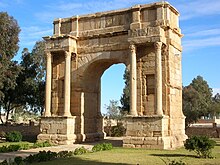
Triumphal Arch of the Tetrarchy,
Sbeitla
,
Tunisia
Some time after his return, and before 293, Diocletian transferred command of
the war against Carausius from Maximian to
Constantius Chlorus
, a former governor of
Dalmatia and a man of military experience stretching back to
Aurelian
's campaigns against
Zenobia
(272–73). He was Maximian's praetorian
prefect in Gaul, and the husband to Maximian's daughter,
Theodora
. On 1 March 293 at Milan, Maximian
gave Constantius the office of Caesar. In the spring of 293, in either
Philippopolis (Plovdiv,
Bulgaria
) or Sirmium, Diocletian would do the
same for Galerius
, husband to Diocletian's daughter
Valeria, and perhaps Diocletian's praetorian prefect. Constantius was assigned
Gaul and Britain. Galerius was assigned Syria, Palestine, Egypt, and
responsibility for the eastern borderlands.
This arrangement is called the Tetrarchy, from a
Greek
term meaning "rulership by four". The
Tetrarchic Emperors were more or less sovereign in their own lands, and they
travelled with their own imperial courts, administrators, secretaries, and
armies. They were joined by blood and marriage; Diocletian and Maximian now
styled themselves as brothers. The senior co-Emperors formally adopted Galerius
and Constantius as sons in 293. These relationships implied a line of
succession. Galerius and Constantius would become Augusti after the departure of
Diocletian and Maximian. Maximian's son
Maxentius
and Constantius' son
Constantine
would then become Caesars. In
preparation for their future roles, Constantine and Maxentius were taken to
Diocletian's court in Nicomedia.
Conflict in
the Balkans and Egypt
Diocletian spent the spring of 293 traveling with Galerius from Sirmium (Sremska
Mitrovica,
Serbia
) to
Byzantium
(Istanbul,
Turkey
). Diocletian then returned to Sirmium,
where he would remain for the following winter and spring. He campaigned against
the Sarmatians again in 294, probably in the autumn, and won a victory against
them. The Sarmatians' defeat kept them from the Danube provinces for a long
time. Meanwhile, Diocletian built forts north of the Danube, at
Aquincum
(Budapest,
Hungary
), Bononia (Vidin,
Bulgaria), Ulcisia Vetera, Castra Florentium, Intercisa (Dunaújváros,
Hungary), and Onagrinum (Begeč,
Serbia). The new forts became part of a new defensive line called the Ripa
Sarmatica. In 295 and 296 Diocletian campaigned in the region again, and won
a victory over the Carpi in the summer of 296. Afterwards, during 299 and 302,
as Diocletian was then residing in the East, it was Galerius' turn to campaign
victoriously on the Danube. By the end of his reign, Diocletian had secured the
entire length of the Danube, provided it with forts, bridgeheads, highways, and
walled towns, and sent fifteen or more legions to patrol the region; an
inscription at
Sexaginta Prista
on the Lower Danube extolled
restored tranquilitas at the region. The defense came at a heavy cost,
but was a significant achievement in an area difficult to defend.
Galerius, meanwhile, was engaged during 291–293 in disputes in
Upper Egypt
, where he suppressed a regional
uprising. He would return to Syria in 295 to fight the revanchist Persian
Empire. Diocletian's attempts to bring the Egyptian tax system in line with
Imperial standards stirred discontent, and a revolt swept the region after
Galerius' departure. The usurper
L. Domitius Domitianus
declared himself
Augustus in July or August 297. Much of Egypt, including
Alexandria
, recognized his rule. Diocletian
moved into Egypt to suppress him, first putting down rebels in the
Thebaid
in the autumn of 297, then moving on to
besiege Alexandria. Domitianus died in December 297, by which time Diocletian
had secured control of the Egyptian countryside. Alexandria, whose defense was
organized under Diocletian's former
corrector
Aurelius Achilleus
, held out until a later
date, probably March 298.
Bureaucratic affairs were completed during Diocletian's stay: a census took
place, and Alexandria, in punishment for its rebellion, lost the ability to mint
independently. Diocletian's reforms in the region, combined with those of
Septimus Severus
, brought Egyptian
administrative practices much closer to Roman standards. Diocletian travelled
south along the Nile the following summer, where he visited
Oxyrhynchus
and
Elephantine
. In Nubia, he made peace with the
Nobatae
and
Blemmyes
tribes. Under the terms of the peace
treaty Rome's borders moved north to
Philae
and the two tribes received an annual
gold stipend. Diocletian left Africa quickly after the treaty, moving from Upper
Egypt in September 298 to Syria in February 299. He met up with Galerius in
Mesopotamia.
War with Persia
Invasion, counterinvasion
In 294, Narseh
, a son of Shapur who had been passed
over for the Sassanid succession, came to power in Persia. Narseh eliminated
Bahram III
, a young man installed in the wake
of Bahram II's death in 293. In early 294, Narseh sent Diocletian the customary
package of gifts between the empires, and Diocletian responded with an exchange
of ambassadors. Within Persia, however, Narseh was destroying every trace of his
immediate predecessors from public monuments. He sought to identify himself with
the warlike kings
Ardashir
(r. 226–41) and
Shapur I
(r. 241–72), who had sacked Roman
Antioch and skinned the Emperor
Valerian
(r. 253–260) to decorate his war
temple.
Narseh declared war on Rome in 295 or 296. He appears to have first invaded
western Armenia, where he seized the lands delivered to Tiridates in the peace
of 287. Narseh moved south into Roman Mesopotamia in 297, where he inflicted a
severe defeat on Galerius in the region between Carrhae (Harran,
Turkey) and Callinicum (Ar-Raqqah,
Syria) (and thus, the historian
Fergus Millar
notes, probably somewhere on the
Balikh River
). Diocletian may or may not have
been present at the battle, but he quickly divested himself of all
responsibility. In a public ceremony at Antioch, the official version of events
was clear: Galerius was responsible for the defeat; Diocletian was not.
Diocletian publicly humiliated Galerius, forcing him to walk for a mile at the
head of the Imperial caravan, still clad in the purple robes of the Emperor.
Galerius was reinforced, probably in the spring of 298, by a new contingent
collected from the Empire's Danubian holdings. Narseh did not advance from
Armenia and Mesopotamia, leaving Galerius to lead the offensive in 298 with an
attack on northern Mesopotamia via Armenia. It is unclear if Diocletian was
present to assist the campaign; he might have returned to Egypt or Syria. Narseh
retreated to Armenia to fight Galerius' force, to Narseh's disadvantage; the
rugged Armenian terrain was favorable to Roman infantry, but not to Sassanid
cavalry. In two battles, Galerius won major victories over Narseh. During the
second encounter
, Roman forces seized Narseh's
camp, his treasury, his harem, and his wife. Galerius continued moving down the
Tigris, and took the Persian capital Ctesiphon before returning to Roman
territory along the Euphrates.
Peace negotiations
Narseh sent an ambassador to Galerius to plead for the return of his wives
and children in the course of the war, but Galerius had dismissed him. Serious
peace negotiations began in the spring of 299. The magister memoriae
(secretary) of Diocletian and Galerius, Sicorius Probus, was sent to Narseh to
present terms. The conditions of the resulting
Peace of Nisibis
were heavy: Armenia returned
to Roman domination, with the fort of Ziatha as its border;
Caucasian Iberia
would pay allegiance to Rome
under a Roman appointee; Nisibis, now under Roman rule, would become the sole
conduit for trade between Persia and Rome; and Rome would exercise control over
the five satrapies between the Tigris and Armenia: Ingilene, Sophanene (Sophene),
Arzanene (Aghdznik),
Corduene
(Carduene), and Zabdicene (near modern
Hakkâri
, Turkey). These regions included the
passage of the Tigris through the
Anti-Taurus
range; the
Bitlis
pass, the quickest southerly route into
Persian Armenia; and access to the
Tur Abdin
plateau.
A stretch of land containing the later strategic strongholds of Amida (Diyarbakır,
Turkey) and Bezabde came under firm Roman military occupation. With these
territories, Rome would have an advance station north of Ctesiphon, and would be
able to slow any future advance of Persian forces through the region. Many
cities east of the Tigris came under Roman control, including
Tigranokert
,
Saird
,
Martyropolis
,
Balalesa
,
Moxos
,
Daudia
, and Arzan – though under what status is
unclear. At the conclusion of the peace, Tiridates regained both his throne and
the entirety of his ancestral claim. Rome secured a wide zone of cultural
influence, which led to a wide diffusion of
Syriac Christianity
from a center at Nisibis in
later decades, and the eventual Christianization of Armenia.
Religious persecutions
Early persecutions
At the conclusion of the
Peace of Nisibis
, Diocletian and Galerius
returned to Syrian Antioch. At some time in 299, the Emperors took part in a
ceremony of sacrifice
and
divination
in an attempt to predict the future.
The haruspices
were unable to read the entrails of
the sacrificed animals and blamed Christians in the Imperial household. The
Emperors ordered all members of the court to perform a sacrifice to purify the
palace. The Emperors sent letters to the military command, demanding the entire
army perform the required sacrifices or face discharge. Diocletian was
conservative in matters of religion, a man faithful to the traditional Roman
pantheon and understanding of demands for religious purification, but
Eusebius
,
Lactantius
and
Constantine
state that it was Galerius, not
Diocletian, who was the prime supporter of the purge, and its greatest
beneficiary. Galerius, even more devoted and passionate than Diocletian, saw
political advantage in the politics of persecution. He was willing to break with
a government policy of inaction on the issue.
Antioch was Diocletian's primary residence from 299 to 302, while Galerius
swapped places with his Augustus on the Middle and Lower Danube. He visited
Egypt once, over the winter of 301–2, and issued a grain dole in Alexandria.
Following some public disputes with
Manicheans
, Diocletian ordered that the leading
followers of
Mani
be burnt alive along with their
scriptures. In a 31 March 302 rescript from Alexandria, he declared that
low-status Manicheans must be executed by the blade, and high-status Manicheans
must be sent to work in the quarries of Proconnesus (Marmara
Island, Turkey) or the mines of Phaeno in southern
Palestine
. All Manichean property was to be
seized and deposited in the imperial treasury. Diocletian found much to be
offended by in Manichean religion: its novelty, its alien origins, the way it
corrupted the morals of the Roman race, and its inherent opposition to
long-standing religious traditions. Manichaeanism was also supported by Persia
at the time, compounding religious dissent with international politics.
Excepting Persian support, the reasons he disliked Manichaenism were equally
applicable, if not more so, to Christianity, his next target.
Great Persecution
Diocletian returned to Antioch in the autumn of 302. He ordered that the
deacon
Romanus of Caesarea
have his tongue removed for
defying the order of the courts and interrupting official sacrifices. Romanus
was then sent to prison, where he was executed on 17 November 303. Diocletian
believed that Romanus of Caesarea was arrogant, and he left the city for
Nicomedia in the winter, accompanied by Galerius. According to Lactantius,
Diocletian and Galerius entered into an argument over imperial policy towards
Christians while wintering at Nicomedia in 302. Diocletian argued that
forbidding Christians from the bureaucracy and military would be sufficient to
appease the gods, but Galerius pushed for extermination. The two men sought the
advice of the oracle
of
Apollo
at
Didyma
. The oracle responded that the impious
on Earth hindered Apollo's ability to provide advice. Rhetorically Eusebius
records the Oracle as saying "The just on Earth..." These impious, Diocletian
was informed by members of the court, could only refer to the Christians of the
Empire. At the behest of his court, Diocletian acceded to demands for universal
persecution.
On 23 February 303, Diocletian ordered that the newly built church at
Nicomedia be razed. He demanded that its scriptures be burned, and seized its
precious stores for the treasury. The next day, Diocletian's first "Edict
against the Christians" was published. The edict ordered the destruction of
Christian scriptures and places of worship across the Empire, and prohibited
Christians from assembling for worship. Before the end of February, a fire
destroyed part of the Imperial palace. Galerius convinced Diocletian that the
culprits were Christians, conspirators who had plotted with the
eunuchs
of the palace. An investigation was
commissioned, but no responsible party was found. Executions followed anyway,
and the palace eunuchs Dorotheus and
Gorgonius
were executed. One individual,
Peter Cubicularius
, was stripped, raised high,
and scourged. Salt and vinegar were poured in his wounds, and he was
slowly boiled
over an open flame. The
executions continued until at least 24 April 303, when six individuals,
including the bishop
Anthimus
, were
decapitated
. A second fire occurred sixteen
days after the first. Galerius left the city for Rome, declaring Nicomedia
unsafe. Diocletian would soon follow.
Although further persecutionary edicts followed, compelling the arrest of the
Christian clergy and universal acts of sacrifice, the persecutionary edicts were
ultimately unsuccessful; most Christians escaped punishment, and pagans too were
generally unsympathetic to the persecution. The
martyrs
' sufferings strengthened the resolve of
their fellow Christians. Constantius and Maximian did not apply the later
persecutionary edicts, and left the Christians of the West unharmed. Galerius
rescinded the edict in 311, announcing that the persecution had failed to bring
Christians back to traditional religion. The temporary apostasy of some
Christians, and the surrendering of scriptures, during the persecution played a
major role in the subsequent
Donatist
controversy. Within twenty-five years
of the persecution's inauguration, the Christian Emperor Constantine would rule
the empire alone. He would reverse the consequences of the edicts, and return
all confiscated property to Christians. Under Constantine's rule, Christianity
would become the Empire's preferred religion. Diocletian was demonized by his
Christian successors: Lactantius intimated that Diocletian's ascendancy heralded
the apocalypse, and in
Serbian mythology
, Diocletian is remembered as
Dukljan
, the
adversary
of
God.
Later life
Illness and abdication
Diocletian entered the city of Rome in the early winter of 303. On 20
November, he celebrated, with Maximian, the twentieth anniversary of his reign (vicennalia),
the tenth anniversary of the Tetrarchy (decennalia),
and a triumph for the war with Persia. Diocletian soon grew impatient with the
city, as the Romans acted towards him with what
Edward Gibbon
, following
Lactantius
, calls "licentious familiarity". The
Roman people did not give enough deference to his supreme authority; it expected
him to act the part of an aristocratic ruler, not a monarchic one. On 20
December 303, Diocletian cut short his stay in Rome and left for the north. He
did not even perform the ceremonies investing him with his ninth consulate; he
did them in Ravenna
on 1 January 304 instead. There are
suggestions in the
Panegyrici Latini
and Lactantius' account
that Diocletian arranged plans for his and Maximian's future retirement of power
in Rome. Maximian, according to these accounts, swore to uphold Diocletian's
plan in a ceremony in the
Temple of Jupiter
.
From Ravenna, Diocletian left for the Danube. There, possibly in Galerius'
company, he took part in a campaign against the Carpi. He contracted a minor
illness while on campaign, but his condition quickly worsened and he chose to
travel in a
litter
. In the late summer he left for
Nicomedia. On 20 November, he appeared in public to dedicate the opening of the
circus beside his palace. He collapsed soon after the ceremonies. Over the
winter of 304–5 he kept within his palace at all times. Rumors alleging that
Diocletian's death was merely being kept secret until Galerius could come to
assume power spread through the city. On 13 December, he seemed to have finally
died. The city was sent into a mourning from which it was only retrieved by
public declarations of his survival. When Diocletian reappeared in public on 1
March 305, he was emaciated and barely recognizable.
Galerius arrived in the city later in March. According to Lactantius, he came
armed with plans to reconstitute the Tetrarchy, force Diocletian to step down,
and fill the Imperial office with men compliant to his will. Through coercion
and threats, he eventually convinced Diocletian to comply with his plan.
Lactantius also claims that he had done the same to Maximian at Sirmium. On 1
May 305, Diocletian called an assembly of his generals, traditional companion
troops, and representatives from distant legions. They met at the same hill, 5
kilometres (3.1 mi) out of Nicomedia, where Diocletian had been proclaimed
emperor. In front of a statue of Jupiter, his patron deity, Diocletian addressed
the crowd. With tears in his eyes, he told them of his weakness, his need for
rest, and his will to resign. He declared that he needed to pass the duty of
Empire on to someone stronger. He thus became the first Roman Emperor to
voluntarily abdicate his title.
Most in the crowd believed they knew what would follow;
Constantine
and Maxentius, the only adult sons
of a reigning Emperor, men who had long been preparing to succeed their fathers,
would be granted the title of Caesar. Constantine had traveled through Palestine
at the right hand of Diocletian, and was present at the palace in Nicomedia in
303 and 305. It is likely that Maxentius received the same treatment. In
Lactantius' account, when Diocletian announced that he was to resign, the entire
crowd turned to face Constantine. It was not to be:
Severus
and
Maximin
were declared Caesars. Maximin appeared
and took Diocletian's robes. On the same day, Severus received his robes from
Maximian in Milan. Constantius succeeded Maximian as Augustus of the West, but
Constantine and Maxentius were entirely ignored in the transition of power. This
did not bode well for the future security of the Tetrarchic system.
Retirement and death
Diocletian retired to his homeland,
Dalmatia
. He moved into the expansive
Diocletian's Palace
, a heavily fortified
compound located by the small town of Spalatum on the shores of the
Adriatic Sea
, and near the large provincial
administrative center of
Salona
. The palace is preserved in great part
to this day and forms the historic core of the largest city of modern
Split
,
Croatia
.
Maximian retired to villas in
Campania
or
Lucania
. Their homes were distant from
political life, but Diocletian and Maximian were close enough to remain in
regular contact with each other. Galerius assumed the consular fasces in
308 with Diocletian as his colleague. In the autumn of 308, Galerius again
conferred with Diocletian at
Carnuntum
(Petronell-Carnuntum,
Austria
). Diocletian and Maximian were both
present on 11 November 308, to see Galerius appoint
Licinius
to be Augustus in place of Severus,
who had died at the hands of Maxentius. He ordered Maximian, who had attempted
to return to power after his retirement, to step down permanently. At Carnuntum
people begged Diocletian to return to the throne, to resolve the conflicts that
had arisen through Constantine's rise to power and Maxentius' usurpation.
Diocletian's reply: "If you could show the
cabbage
that I planted with my own hands to
your emperor, he definitely wouldn't dare suggest that I replace the peace and
happiness of this place with the storms of a never-satisfied greed."
He lived on for three more years, spending his days in his palace gardens. He
saw his Tetrarchic system fail, torn by the selfish ambitions of his successors.
He heard of Maximian's third claim to the throne, his forced suicide, his
damnatio memoriae
. In his own palace,
statues and portraits of his former companion emperor were torn down and
destroyed. Deep in despair and illness, Diocletian may have committed
suicide
. He died on 3 December 311.
Reforms
Tetrarchic and
ideological

Modern view of
Diocletian's Palace
near
Salona
(in
Split
,
Croatia
)
Diocletian saw his work as that of a restorer, a figure of authority whose
duty it was to return the empire to peace, to recreate stability and justice
where barbarian hordes had destroyed it. He arrogated, regimented and
centralized political authority on a massive scale. In his policies, he enforced
an Imperial system of values on diverse and often unreceptive provincial
audiences. In the Imperial propaganda from the period, recent history was
perverted and minimized in the service of the theme of the Tetrarchs as
"restorers". Aurelian's achievements were ignored, the revolt of Carausius was
backdated to the reign of Gallienus, and it was implied that the Tetrarchs
engineered Aurelian's defeat of the
Palmyrenes
; the period between Gallienus and
Diocletian was effectively erased. The history of the empire before the
Tetrarchy was portrayed as a time of civil war, savage despotism, and imperial
collapse. In those inscriptions that bear their names, Diocletian and his
companions are referred to as "restorers of the whole world", men who succeeded
in "defeating the nations of the barbarians, and confirming the tranquility of
their world". Diocletian was written up as the "founder of eternal peace". The
theme of restoration was conjoined to an emphasis on the uniqueness and
accomplishments of the Tetrarchs themselves.
The cities where Emperors lived frequently in this period—Milan,
Trier
,
Arles
, Sirmium,
Serdica
,
Thessaloniki
, Nicomedia, and
Antioch
—were treated as alternate imperial
seats, to the exclusion of Rome and its senatorial elite. A new style of
ceremony was developed, emphasizing the distinction of the Emperor from all
other persons. The quasi-republican ideals of Augustus'
primus inter pares
were abandoned for all
but the Tetrarchs themselves. Diocletian took to wearing a gold crown and
jewels, and forbade the use of
purple cloth
to all but the Emperors. His
subjects were required to prostrate themselves in his presence (adoratio);
the most fortunate were allowed the privilege of kissing the hem of his robe (proskynesis,
προσκύνησις). Circuses and basilicas were designed to keep the face of the
Emperor perpetually in view, and always in a seat of authority. The emperor
became a figure of transcendent authority, a man beyond the grip of the masses.
His every appearance was stage-managed. This style of presentation was not
new—many of its elements were first seen in the reigns of Aurelian and Severus—but
it was only under the Tetrarchs that it was refined into an explicit system.
Administrative
In keeping with his move from an ideology of republicanism to one of
autocracy, Diocletian's council of advisers, his consilium, differed from
those of earlier Emperors. He destroyed the Augustan illusion of imperial
government as a cooperative affair between Emperor, Army, and Senate. In its
place he established an effectively autocratic structure, a shift later
epitomized in the institution's name: it would be called a consistorium
("consistory"),
not a council. Diocletian regulated his court by distinguishing separate
departments (scrina) for different tasks. From this structure came the
offices of different magistri, like the Magister officiorum
("Master of offices"), and associated secretariats. These were men suited to
dealing with petitions, requests, correspondence, legal affairs, and foreign
embassies. Within his court Diocletian maintained a permanent body of legal
advisers, men with significant influence on his re-ordering of juridical
affairs. There were also two finance ministers, dealing with the separate bodies
of the public treasury and the private domains of the Emperor, and the
praetorian prefect, the most significant person of the whole. Diocletian's
reduction of the Praetorian Guards to the level of a simple city garrison for
Rome lessened the military powers of the prefect, but the office retained much
civil authority. The prefect kept a staff of hundreds and managed affairs in all
segments of government: in taxation, administration, jurisprudence, and minor
military commands, the praetorian prefect was often second only to the emperor
himself.
Altogether, Diocletian effected a large increase in the number of bureaucrats
at the government's command; Lactantius was to claim that there were now more
men using tax money than there were paying it. The historian Warren Treadgold
estimates that under Diocletian the number of men in the
civil service
doubled from 15,000 to 30,000.
The classicist
Roger Bagnall
estimated that there was one
bureaucrat for every 5–10,000 people in Egypt based on 400 or 800 bureaucrats
for 4 million inhabitants (no one knows the population of the province in 300
AD; Strabo 300 years earlier put it at 7.5 million, excluding Alexandria). (By
comparison, the ratio in
twelfth-century China
was one bureaucrat for
every 15,000 people.) Jones estimated 30,000 bureaucrats for an empire of 50–65
million inhabitants, which works out to approximately 1,667 or 2,167 inhabitants
per imperial official as averages empire-wide. The actual numbers of officials
and ratios per inhabitant varied, of course, per diocese depending on the number
of provinces and population within a diocese. Provincial and diocesan paid
officials (there were unpaid supernumeraries) numbered about 13–15,000 based on
their staff establishments as set by law. The other 50% were with the emperor(s)
in his or their Comitatus, with the praetorian prefects, with the grain supply
officials in the capital (later, the capitals, Rome and Constantinople),
Alexandria, and Carthage and officials from the central offices located in the
provinces.
To avoid the possibility of local usurpations, to facilitate a more efficient
collection of taxes and supplies, and to ease the enforcement of the law,
Diocletian doubled the number of
provinces
from fifty to almost one hundred. The
provinces were grouped into twelve
dioceses
, each governed by an appointed
official called a
vicarius
, or "deputy of the praetorian
prefects". Some of the provincial divisions required revision, and were modified
either soon after 293 or early in the fourth century. Rome herself (including
her environs, as defined by a 100 miles (160 km)-radius
perimeter
around the City itself) was not under
the authority of the praetorian prefect, as she was to be administered by a City
Prefect of senatorial rank – the sole prestigious post with actual power
reserved exclusively for senators, except for some governors in Italy with the
titles of corrector and the proconsuls of Asia and Africa. The dissemination of
imperial law to the provinces was facilitated under Diocletian's reign, because
Diocletian's reform of the Empire's provincial structure meant that there were
now a greater number of governors (praesides)
ruling over smaller regions and smaller populations. Diocletian's reforms
shifted the governors' main function to that of the presiding official in the
lower courts: whereas in the early Empire military and judicial functions were
the function of governor, and
procurators
had supervised taxation; under the
new system vicarii and governors were responsible for justice and
taxation, and a new class of
duces ("dukes"),
acting independently of the civil service, had military command. These dukes
sometimes administered two or three of the new provinces created by Diocletian,
and had forces ranging from two thousand to more than twenty thousand men. In
addition to their roles as judges and tax collectors, governors were expected to
maintain the postal service (cursus
publicus) and ensure that town councils fulfilled their duties.
This curtailment of governors' powers as the Emperors' representatives may
have lessened the political dangers of an all-too-powerful class of Imperial
delegates, but it also severely limited governors' ability to oppose local
landed elites. On one occasion, Diocletian had to exhort a proconsul of Africa
not to fear the consequences of treading on the toes of the local magnates of
senatorial rank. If a governor of senatorial rank himself felt these pressures,
one can imagine the difficulties faced by a mere praeses.
Legal
As with most Emperors, much of Diocletian's daily routine rotated around
legal affairs—responding to appeals and petitions, and delivering decisions on
disputed matters. Rescripts, authoritative interpretations issued by the Emperor
in response to demands from disputants in both public and private cases, were a
common duty of second- and third-century Emperors. Diocletian was awash in
paperwork, and was nearly incapable of delegating his duties. It would have been
seen as a dereliction of duty to ignore them. Diocletian's praetorian prefects—Afranius
Hannibalianus, Julius Asclepiodotus, and
Aurelius Hermogenianus
—aided in regulating the
flow and presentation of such paperwork, but the deep legalism of Roman culture
kept the workload heavy. Emperors in the forty years preceding Diocletian's
reign had not managed these duties so effectively, and their output in attested
rescripts is low. Diocletian, by contrast, was prodigious in his affairs: there
are around 1,200 rescripts in his name still surviving, and these probably
represent only a small portion of the total issue. The sharp increase in the
number of edicts and rescripts produced under Diocletian's rule has been read as
evidence of an ongoing effort to realign the whole Empire on terms dictated by
the imperial center.
Under the governance of the
jurists
Gregorius, Aurelius Arcadius Charisius,
and Hermogenianus, the imperial government began issuing official books of
precedent
, collecting and listing all the
rescripts that had been issued from the reign of
Hadrian
(r. 117–38) to the reign of Diocletian.
The
Codex Gregorianus
includes rescripts up to 292,
which the
Codex Hermogenianus
updated with a
comprehensive collection of rescripts issued by Diocletian in 293 and 294.
Although the very act of codification was a radical innovation, given the
precedent-based design of the Roman legal system, the jurists were generally
conservative, and constantly looked to past Roman practice and theory for
guidance. They were probably given more free rein over their codes than the
later compilers of the
Codex Theodosianus
(438) and
Codex Justinianus
(529) would have.
Gregorius and Hermogenianus' codices lack the rigid structuring of later codes,
and were not published in the name of the emperor, but in the names of their
compilers.
After Diocletian's reform of the provinces, governors were called iudex,
or judge
. The governor became responsible for his
decisions first to his immediate superiors, as well as to the more distant
office of the Emperor. It was most likely at this time that judicial records
became verbatim accounts of what was said in trial, making it easier to
determine bias or improper conduct on the part of the governor. With these
records and the Empire's universal right of
appeal
, Imperial authorities probably had a
great deal of power to enforce behavior standards for their judges. In spite of
Diocletian's attempts at reform, the provincial restructuring was far from
clear, especially when citizens appealed the decisions of their governors.
Proconsuls, for example, were often both judges of first instance and appeal,
and the governors of some provinces took appellant cases from their neighbors.
It soon became impossible to avoid taking some cases to the Emperor for
arbitration and judgment. Diocletian's reign marks the end of the classical
period of Roman law. Where Diocletian's system of rescripts shows an adherence
to classical tradition, Constantine's law is full of Greek and eastern
influences.
Military
It is archaeologically difficult to distinguish Diocletian's fortifications
from those of his successors and predecessors. The Devil's Dyke, for example,
the Danubian earthworks traditionally attributed to Diocletian, cannot even be
securely dated to a particular century. The most that can be said about built
structures under Diocletian's reign is that he rebuilt and strengthened forts at
the Upper Rhine frontier (where he followed the works made under
Probus
's reign, both along the
Lake Constance
-Basel
as well as along the Rhine–Iller–Danube
line), in Egypt, and on the frontier with Persia. Beyond that, much discussion
is speculative, and reliant on the broad generalizations of written sources.
Diocletian and the Tetrarchs had no consistent plan for frontier advancement,
and records of raids and forts built across the frontier are likely to indicate
only temporary claims. The
Strata Diocletiana
, which ran from the
Euphrates to Palmyra and northeast Arabia, is the classic Diocletianic frontier
system, consisting of an outer road followed by tightly spaced forts followed by
further fortifications in the rear. In an attempt to resolve the difficulty and
slowness of transmitting orders to the frontier, the new capitals of the
Tetrarchic era were all much closer to the Empire's frontiers than Rome had
been: Trier sat on the Rhine, Sirmium and Serdica were close to the Danube,
Thessaloniki was on the route leading eastward, and Nicomedia and Antioch were
important points in dealings with Persia.
Lactantius criticized Diocletian for an excessive increase in troop sizes,
declaring that "each of the four [Tetrarchs] strove to have a far larger number
of troops than previous emperors had when they were governing the state alone".
The fifth-century pagan
Zosimus
, by contrast, praised Diocletian for
keeping troops on the borders, rather than keeping them in the cities, as
Constantine was held to have done. Both these views had some truth to them,
despite the biases of their authors: Diocletian and the Tetrarchs did greatly
expand the army, and the growth was mostly in frontier regions, although it is
difficult to establish the precise details of these shifts given the weakness of
the sources. The army expanded to about 580,000 men from a 285 strength of
390,000, of which 310,000 men were stationed in the East, most of whom manned
the Persian frontier. The navy's forces increased from approximately 45,000 men
to approximately 65,000 men.
Diocletian's expansion of the army and civil service meant that the Empire's
tax burden grew. Since military upkeep took the largest portion of the imperial
budget, any reforms here would be especially costly. The proportion of the adult
male population, excluding slaves, serving in the army increased from roughly 1
in 25 to 1 in 15, an increase judged excessive by some modern commentators.
Official troop allowances were kept to low levels, and the mass of troops often
resorted to extortion or the taking of civilian jobs. Arrears became the norm
for most troops. Many were even given payment in kind in place of their
salaries. Were he unable to pay for his enlarged army, there would likely be
civil conflict, potentially open revolt. Diocletian was led to devise a new
system of taxation.
Economic
Taxation
In the early Empire (30 BC- AD 235) the Roman government paid for what it
needed in gold and silver. The coinage was stable. Requisition, forced purchase,
was used to supply armies on the march. During the third century crisis
(235–285), the government resorted to requisition rather than payment in debased
coinage, since it could never be sure of the value of money. Requisition was
nothing more or less than seizure. Diocletian made requisition into tax. He
introduced an extensive new tax system based on heads (capita) and land (iuga)
and tied to a new, regular census of the Empire's population and wealth. Census
officials traveled throughout the Empire, assessed the value of labor and land
for each landowner, and joined the landowners' totals together to make city-wide
totals of capita and iuga. The iugum was not a consistent
measure of land, but varied according to the type of land and crop, and the
amount of labor necessary for sustenance. The caput was not consistent
either: women, for instance, were often valued at half a caput, and
sometimes at other values. Cities provided animals, money, and manpower in
proportion to its capita, and grain in proportion to its iuga.
Most taxes were due on each year on 1 September, and levied from individual
landowners by
decuriones
(decurions). These decurions,
analogous to city councilors, were responsible for paying from their own pocket
what they failed to collect. Diocletian's reforms also increased the number of
financial officials in the provinces: more rationales and magistri
privatae are attested under Diocletian's reign than before. These officials
managed represented the interests of the fisc, which collected taxes in gold,
and the Imperial properties. Fluctuations in the value of the currency made
collection of taxes in kind the norm, although these could be converted into
coin. Rates shifted to take inflation into account. In 296, Diocletian issued an
edict reforming census procedures. This edict introduced a general five-year
census for the whole Empire, replacing prior censuses that had operated at
different speeds throughout the Empire. The new censuses would keep up with
changes in the values of capita and iuga.
Italy, which had long been exempt from taxes, was included in the tax system
from 290/291 as other provinces. The city of Rome itself and the surrounding
Suburbicarian diocese
(where Roman senators
held the bulk of their landed property), however, remained exempt.
Diocletian's edicts emphasized the common liability of all taxpayers. Public
records of all taxes were made public. The position of decurion, member
of the city council, had been an honor sought by wealthy aristocrats and the
middle classes who displayed their wealth by paying for city amenities and
public works. Decurions were made liable for any shortfall in the amount of tax
collected. Many tried to find ways to escape the obligation.
Currency and inflation
Aurelian's attempt to reform the currency had failed; the denarius was dead.
Diocletian restored the three-metal coinage and issued better quality pieces.
The new system consisted of five coins: the aureus/solidus,
a gold coin weighing, like its predecessors, one-sixtieth of a pound; the
argenteus
, a coin weighing one ninety-sixth
of a pound and containing ninety-five percent pure silver; the
follis
, sometimes referred to as the
laureatus A, which is a copper coin with added silver struck at the rate of
thirty-two to the pound; the radiatus, a small copper coin struck at the
rate of 108 to the pound, with no added silver; and a coin known today as the
laureatus B, a smaller copper coin struck at the rate of 192 to the pound.
Since the nominal values of these new issues were lower than their intrinsic
worth as metals, the state was minting these coins at a loss. This practice
could be sustained only by requisitioning precious metals from private citizens
in exchange for state-minted coin (of a far lower value than the price of the
precious metals requisitioned).
By 301, however, the system was in trouble, strained by a new bout of
inflation. Diocletian therefore issued his Edict on Coinage, an act re-tariffing
all debts so that the
nummus
, the most common coin in
circulation, would be worth half as much. In the edict, preserved in an
inscription from the city of
Aphrodisias
in
Caria
(near
Geyre
, Turkey), it was declared that all debts
contracted before 1 September 301 must be repaid at the old standards, while all
debts contracted after that date would be repaid at the new standards. It
appears that the edict was made in an attempt to preserve the current price of
gold and to keep the Empire's coinage on silver, Rome's traditional metal
currency. This edict risked giving further momentum to inflationary trends, as
had happened after Aurelian's currency reforms. The government's response was to
issue a price freeze.
The
Edict on Maximum Prices
(Edictum De
Pretiis Rerum Venalium) was issued two to three months after the coinage
edict, somewhere between 20 November and 10 December 301. The best-preserved
Latin inscription surviving from the
Greek East
,[
the edict survives in many versions, on materials as varied as wood, papyrus,
and stone. In the edict, Diocletian declared that the current pricing crisis
resulted from the unchecked greed of merchants, and had resulted in turmoil for
the mass of common citizens. The language of the edict calls on the people's
memory of their benevolent leaders, and exhorts them to enforce the provisions
of the edict, and thereby restore perfection to the world. The edict goes on to
list in detail over one thousand goods and accompanying retail prices not to be
exceeded. Penalties are laid out for various pricing transgressions.
In the most basic terms, the edict was ignorant of the law of
supply and demand
: it ignored the fact that
prices might vary from region to region according to product availability, and
it ignored the impact of transportation costs in the retail price of goods. In
the judgment of the historian David Potter, the edict was "an act of economic
lunacy". Inflation, speculation, and monetary instability continued, and a black
market arose to trade in goods forced out of official markets. The edict's
penalties were applied unevenly across the empire (some scholars believe they
were applied only in Diocletian's domains), widely resisted, and eventually
dropped, perhaps within a year of the edict's issue. Lactantius has written of
the perverse accompaniments to the edict; of goods withdrawn from the market, of
brawls over minute variations in price, of the deaths that came when its
provisions were enforced. His account may be true, but it seems to modern
historians exaggerated and hyperbolic, and the impact of the law is recorded in
no other ancient source.
Legacy
The historian
A.H.M. Jones
observed that "It is perhaps
Diocletian's greatest achievement that he reigned twenty-one years and then
abdicated voluntarily, and spent the remaining years of his life in peaceful
retirement." Diocletian was one of the few Emperors of the third and fourth
centuries to die naturally, and the first in the history of the Empire to retire
voluntarily. Once he retired, however, his Tetrarchic system collapsed. Without
the guiding hand of Diocletian, the Empire fell into civil wars. Stability
emerged after the defeat of Licinius by Constantine in 324. Under the Christian
Constantine, Diocletian was maligned. Constantine's rule, however, validated
Diocletian's achievements and the autocratic principle he represented: the
borders remained secure, in spite of Constantine's large expenditure of forces
during his civil wars; the bureaucratic transformation of Roman government was
completed; and Constantine took Diocletian's court ceremonies and made them even
more extravagant.
Constantine ignored those parts of Diocletian's rule that did not suit him.
Diocletian's policy of preserving a stable silver coinage was abandoned, and the
gold
solidus
became the Empire's primary
currency instead. Diocletian's
persecution of Christians
was repudiated and
changed to a policy of toleration and then favoritism. Christianity eventually
became the official religion in 381. Constantine would claim to have the same
close relationship with the Christian God as Diocletian claimed to have with
Jupiter. Most importantly, Diocletian's tax system and administrative reforms
lasted, with some modifications, until the advent of the Muslims in the 630s.
The combination of state autocracy and state religion was instilled in much of
Europe, particularly in the lands which adopted Orthodox Christianity.
In addition to his administrative and legal impact on history, the Emperor
Diocletian is considered to be the founder of the city of
Split
in modern-day
Croatia
. The city itself grew around the
heavily fortified
Diocletian's Palace
the Emperor had built in
anticipation of his retirement.
In the
ancient Greek
religion
, Zeus
zews
zooss
;
Ancient Greek
: Ζεύς;
Modern
Greek
: Δίας, Dias) was the "Father of Gods and men" (πατὴρ
ἀνδρῶν τε θεῶν τε)
who ruled the Olympians of
Mount
Olympus
as a father ruled the family. He was the
god of sky
and
thunder
in
Greek mythology
. His
Roman
counterpart is
Jupiter
and
Etruscan
counterpart is
Tinia
.
Zeus was the child of
Cronus
and
Rhea
, and the youngest of his siblings. In most
traditions he was married to
Hera, although, at the oracle of
Dodona
, his consort was
Dione
: according to the
Iliad
, he is the father of
Aphrodite
by Dione.
He is known for his erotic escapades. These resulted in many godly and heroic
offspring, including
Athena
,
Apollo
and
Artemis
,
Hermes
,
Persephone
(by
Demeter
),
Dionysus
,
Perseus
,
Heracles
,
Helen of Troy
,
Minos
, and the
Muses (by
Mnemosyne
); by Hera, he is usually said to have
fathered Ares
,
Hebe
and
Hephaestus
.
As
Walter Burkert
points out in his book, Greek
Religion, "Even the gods who are not his natural children address him as
Father, and all the gods rise in his presence."
For the Greeks, he was the
King of the Gods
, who oversaw the universe. As
Pausanias
observed, "That Zeus is king in
heaven is a saying common to all men".
In Hesiod's Theogony
Zeus assigns the various gods
their roles. In the
Homeric Hymns
he is referred to as the
chieftain of the gods.
His symbols are the
thunderbolt
,
eagle
,
bull
, and
oak.
In addition to his Indo-European inheritance, the classical "cloud-gatherer"
also derives certain iconographic traits from the cultures of the
Ancient Near East
, such as the
scepter
. Zeus is frequently depicted by Greek
artists in one of two poses: standing, striding forward, with a thunderbolt
leveled in his raised right hand, or seated in majesty.
In
Roman mythology
,
Jupiter
or
Jove was the
king of the gods
, and the god of
sky and
thunder
. He
is
 the equivalent of Zeus
in the
Greek pantheon
. He was called Iuppiter (or Diespiter)
Optimus Maximus ("Father God the Best and Greatest"). As the patron deity of
ancient
Rome
, he ruled over laws and social order. He was the chief god of the
Capitoline Triad
, with sister/wife
Juno
. Jupiter is also the father of the god
Mars
with Juno. Therefore, Jupiter is the grandfather of
Romulus and Remus
, the legendary founders of Rome. Jupiter was venerated in
ancient Roman religion
, and is still venerated in
Roman Neopaganism
. He is a son of
Saturn
, along with brothers
Neptune
and
Pluto
.
He is also the brother/husband of
Ceres
(daughter of Saturn and mother of
Proserpina
),
brother of Veritas
(daughter of Saturn), and father of
Mercury
.
|
Mars was the
Roman god of war, the son of Juno and Jupiter, husband of Bellona, and
the lover of Venus. He was the most prominent of the military gods that
were worshipped by the Roman legions. The martial Romans considered him
second in importance only to Jupiter (their main god). His festivals
were held in March (named for him) and October. As the word Mars
has no Indo-European derivation, it is most likely the Latinised form of
the agricultural Etruscan god Maris. Initially Mars was a Roman god of
fertility and vegetation and a protector of cattle, fields and
boundaries and farmers. In the second century BC, the conservative Cato
the Elder advised "For your cattle, for them to be healthy, make this
sacrifice to Mars Silvanus you must make this sacrifice each year". Mars
later became associated with battle as the growing Roman Empire began
to expand, and he came to be identified with the Greek god Ares. Unlike
his Greek counterpart, Mars was generally revered and rivaled Jupiter as
the most honoured god. He was also the tutelary god of the city of
Rome. As he was regarded as the legendary father of Rome's founder,
Romulus, it was believed that all Romans were descendants of Mars |
Probus (/ˈproʊbəs/; Latin: Marcus Aurelius Probus Augustus;
c. 19 August 232 – September/October 282), was Roman Emperor from 276 to 282.
Probus was an active and successful general as well as a conscientious
administrator, and in his reign of six years he secured prosperity for the
inner provinces while withstanding repeated inundations of hostile barbarian tribes
on almost every sector of the frontier.
After repelling the foreign enemies of the empire Probus was
forced to handle several internal revolts, but demonstrated leniency and
moderation to the vanquished wherever possible. In his reign the facade of the
constitutional authority of the Roman Senate was fastidiously maintained, and
the conqueror who had carried his arms to victory over the Rhine professed
himself dependent on the sanction of the Senate.
Upon defeating the Germans Probus re-erected the ancient
fortifications of emperor Hadrian between the Rhine and Danube rivers, protecting
the Agri Decumates, and exacted from the vanquished a tribute of manpower to
resettle depopulated provinces within the empire and provide for adequate defense
of the frontiers.[8] Despite his widespread popularity, Probus was killed in a
mutiny of the soldiers while in the middle of preparations for the Persian war,
which would be carried out under his successor Carus.
Probus was born between 230 and 235 (exact date of birth
unknown) in Sirmium (modern day Sremska Mitrovica), Pannonia Inferior, the son
of Dalmatius According to the Alexandrian Chronicle, he was born sometime in
the year 232.
Military career
Probus entered the army around 250 upon reaching adulthood.
He rose rapidly through the ranks, repeatedly earning high military
decorations. Appointed as a military tribune by the emperor Valerian, at a very
young age, in recognition of his latent ability,[citation needed] he justified
the choice by a distinguished victory over the Sarmatians on the Illyrian
frontier. During the chaotic years of the reign of Valerian, Illyria was the
only province, generaled by such officers as Claudius, Aurelian and Probus,
where the barbarians were kept at bay, while Gaul was overrun by the Franks,
Rhaetia by the Alemans, Thrace and the Mediterranean by the Goths, and the east
by Shapur I. Probus became amongst the highest placed lieutenants of Aurelian,
reconquering Egypt from Zenobia in 273 A.D. Emperor Tacitus, upon his accession
in 275, appointed Probus supreme chief of the east, granting him extraordinary
powers in order to secure a dangerous frontier. Though the details are not
specified, he is said to have fought with success on almost every frontier of
the empire, before his election as emperor by the troops upon Tacitus' death of
old age in 276, in his camp in Asia Minor.
Florianus, the half-brother of Tacitus, also proclaimed
himself emperor, and took control of Tacitus' army in Asia Minor, but was
killed by his own soldiers after an indecisive campaign against Probus in the
mountains of Cilicia. In contrast to Florianus, who ignored the wishes of the
senate, Probus referred his claim to Rome in a respectful dispatch. The senate
enthusiastically ratified his pretensions. Probus next travelled west,
defeating the Goths along the lower Danube in 277, and acquiring the title of
Gothicus. However, the Goths came to respect his ability and implored a treaty
with the empire.
In 278, Probus campaigned successfully in Gaul against the
Alamanni and Longiones; both tribes had advanced through the Neckar valley and
across the Rhine into Roman territory. Meanwhile, his generals defeated the
Franks and these operations were directed to clearing Gaul of Germanic invaders
(Franks and Burgundians), allowing Probus to adopt the titles of Gothicus Maximus
and Germanicus Maximus. Reportedly, 400,000 barbarians were killed during
Probus' campaign, and the entire nation of the Lugii were extirpated.
After the defeat of the Germanic invaders in Gaul, Probus
crossed the Rhine to campaign successfully against the Barbarians in their
homeland, forcing them to pay homage. In the aftermath of the campaign, Probus
repaired the ancient fortifications erected by Hadrian in the vulnerable space
between the Rhine and Danube, in the territory of Swabia. More significantly,
Probus, by forcing from the vanquished tribes a tribute of manpower,
established the precedent of settling barbarians within the empire as
auxiliaries on a large scale. The provinces were depopulated by war, disease
and the chaotic administration, heavy taxation, and extensive army recruitment,
during the crisis of the Third century, and the barbarian colonies, at least in
the short term, helped to restore frontier defense and the practice of
agriculture.
The army discipline which Aurelian had repaired was
cultivated and extended under Probus, who was however more shy in the practice
of cruelty. One of his principles was never to allow the soldiers to be idle,
and to employ them in time of peace on useful works, such as the planting of
vineyards in Gaul, Pannonia and other districts, in order to restart the
economy in these devastated lands.
In 279–280, Probus was, according to Zosimus, in Raetia,
Illyricum and Lycia, where he fought the Vandals. In the same years, Probus'
generals defeated the Blemmyes in Egypt. Either then, or during his previous
command in Egypt, he ordered the reconstruction of bridges and canals along the
Nile, where the production of grain for the Empire was centered.
In 280–281, Probus put down three usurpers, Julius Saturninus,
Proculus and Bonosus. The extent of these revolts is not clear, but there are
clues that they were not just local problems (an inscription with the name of
Probus erased has been found as far as Spain). In 281, the emperor was in Rome,
where he celebrated his well-deserved triumph.
Probus was eager to start his eastern campaign, delayed by
the revolts in the west. He left Rome in 282, travelling first towards Sirmium,
his birth city.
Assassination
Different accounts of Probus's death exist. According to
Joannes Zonaras, the commander of the Praetorian Guard Marcus Aurelius Carus
had been proclaimed, more or less unwillingly, emperor by his troops. Probus sent some troops against the new usurper, but when
those troops changed sides and supported Carus, Probus' remaining soldiers
assassinated him at Sirmium (September/October 282). According to other
sources, however, Probus was killed by disgruntled soldiers, who rebelled
against his orders to be employed for civic purposes, like draining marshes.
Allegedly, the soldiers were provoked when they overheard him lamenting the necessity
of a standing army. Carus was proclaimed emperor after Probus' death and
avenged the murder of his predecessor.
Legacy According to the favorable treatment of Gibbon (whose
account is largely derived from the Augustan History), Probus was the last of
the benevolent constitutional emperors of Rome. While his successor Carus (Imp.
281-284) simply disdained to seek the senate's confirmation of his title, the
latter's successor Diocletian (Imp. 284-305) took active measures to undermine
its authority, and established the autocratic nature and divine derivation of
the Imperial power. Never again, after Diocletian's reforms, would the Roman
senate play an active role in the management of the empire. On the military
sphere, Probus' victories continued the succession of martial Illyrian emperors
begun by Claudius Gothicus, which restored the military supremacy of Rome after
defeats sustained during the crisis of the third century.
|
Items will be shipped within 1 to 3 business days of purchase completion. FREE - domestic SHIPPING
INTERNATIONAL $7.99
(REGISTERED-$21.00) WE COMBINE SHIPPING.
If you would like to have special shipping, please contact us.
All items will be sent out in protected envelope and boxed if necessary.
YOU ARE BIDDING ON AN ANCIENT ITEM(S) AS DESCRIBED AND PICTURED ABOVE!!!
Every item offered by cameleoncoins is unconditionally guaranteed to be genuine & authentic.
We can provide a certificate of authenticity or extended return policy by request only!!!
Please include 5 dollars and a short request with your payment if you would like a COA!!!
If
in the unlikely event that an item is found to be reproduction, full
return privileges are within 14 days of receiving the coins. We will
promptly offer a full refund without hesitation or hassle.
|
Items will be shipped within 1 to 3 business days of purchase completion. $4.99 - domestic SHIPPING
INTERNATIONAL $9.99
(REGISTERED-$29.00) WE COMBINE SHIPPING.
If you would like to have special shipping, please contact us.
All items will be sent out in protected envelope and boxed if necessary.
YOU ARE BIDDING ON AN ANCIENT ITEM(S) AS DESCRIBED AND PICTURED ABOVE!!!
Every item offered by cameleoncoins is unconditionally guaranteed to be genuine & authentic.
We can provide a certificate of authenticity or extended return policy by request only!!!
Please include 5 dollars and a short request with your payment if you would like a COA!!!
If
in the unlikely event that an item is found to be reproduction, full
return privileges are within 14 days of receiving the coins. We will
promptly offer a full refund without hesitation or hassle.
|
|
|
|
