
|
|
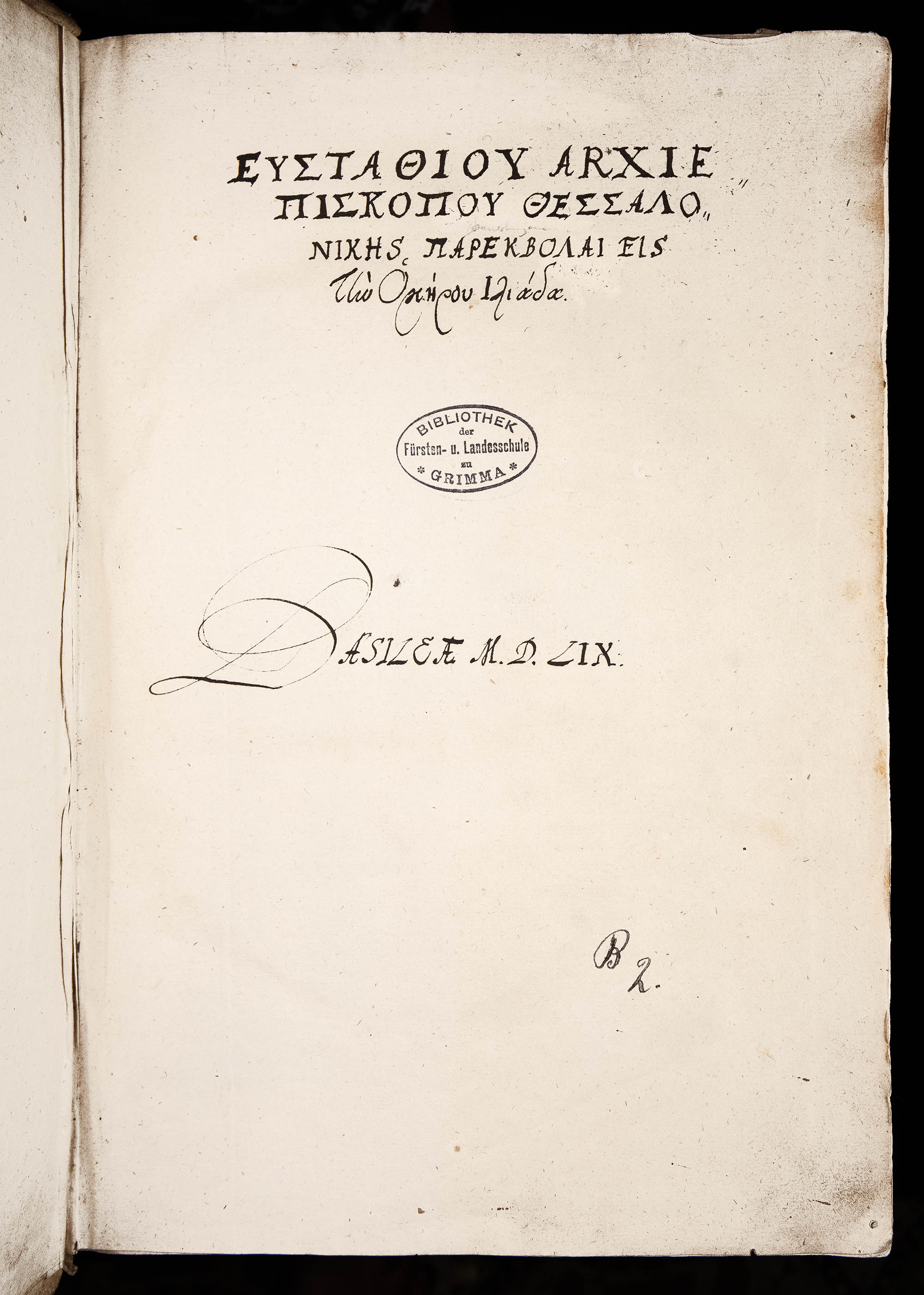
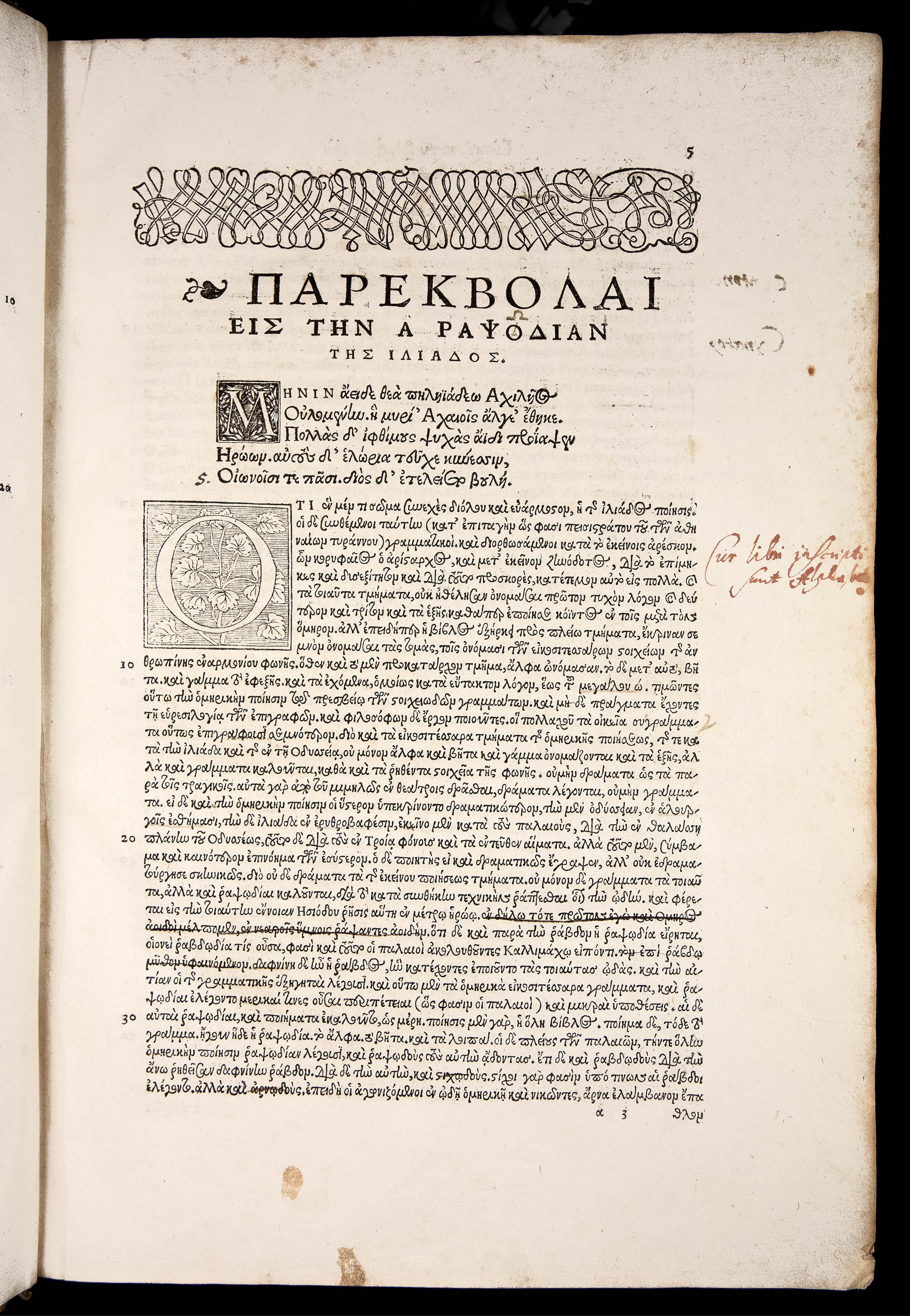
[Trojan War] [Fine and historical bindings - 16th-century - Germany] Homer Iliad In Greek; with commentary by Eustathius of Thessalonica in Greek. Εὐσταθίου ἀρχιεπισκόπου Θεσσαλονίκης Παρεκβολαὶ εἰς τὴν Ὁμήρου Ἰλιαδα ❦ |
|
Printed in Basel by Hieronymus Froben & Nicolaus Episcopius, 1559.
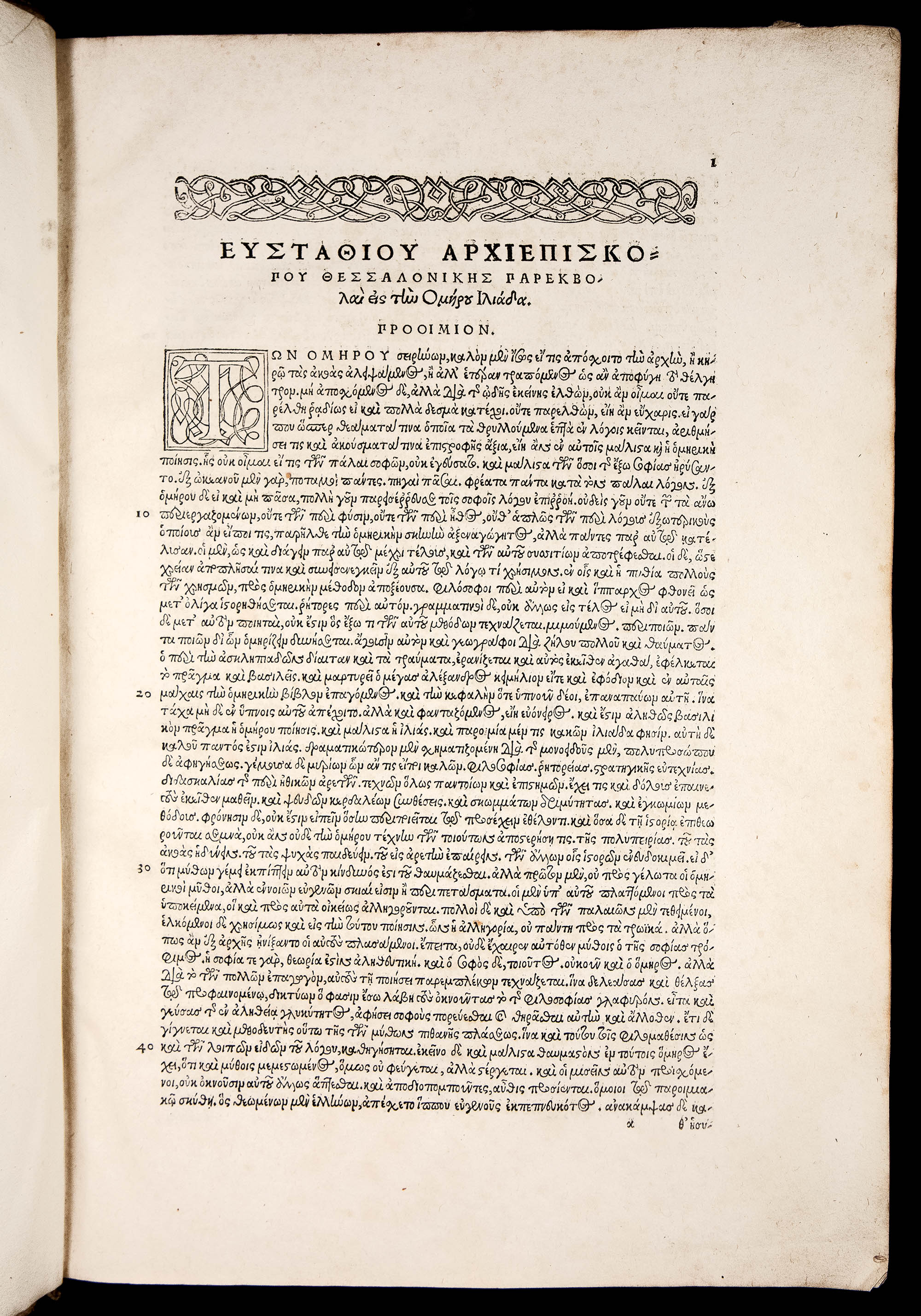
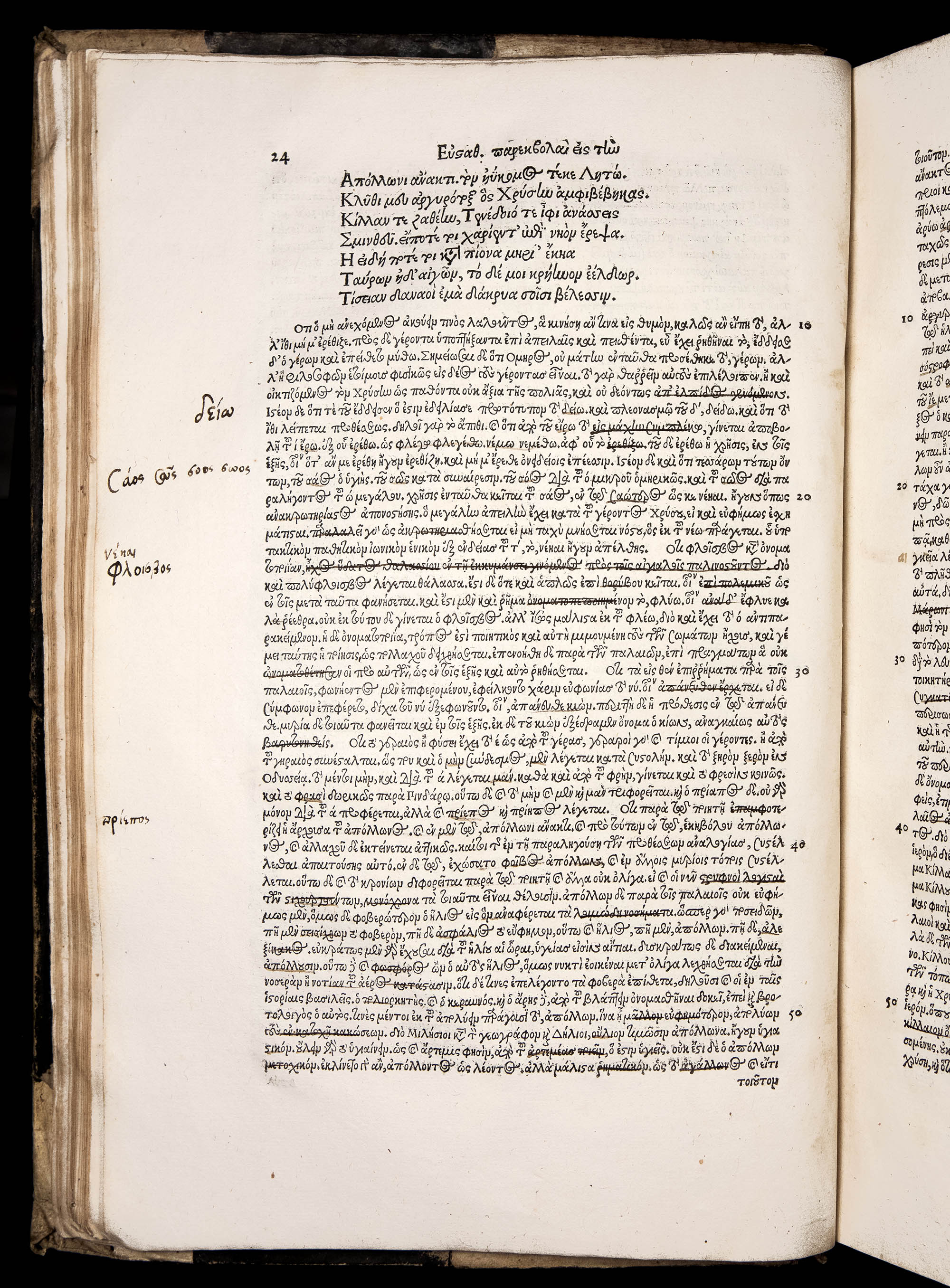
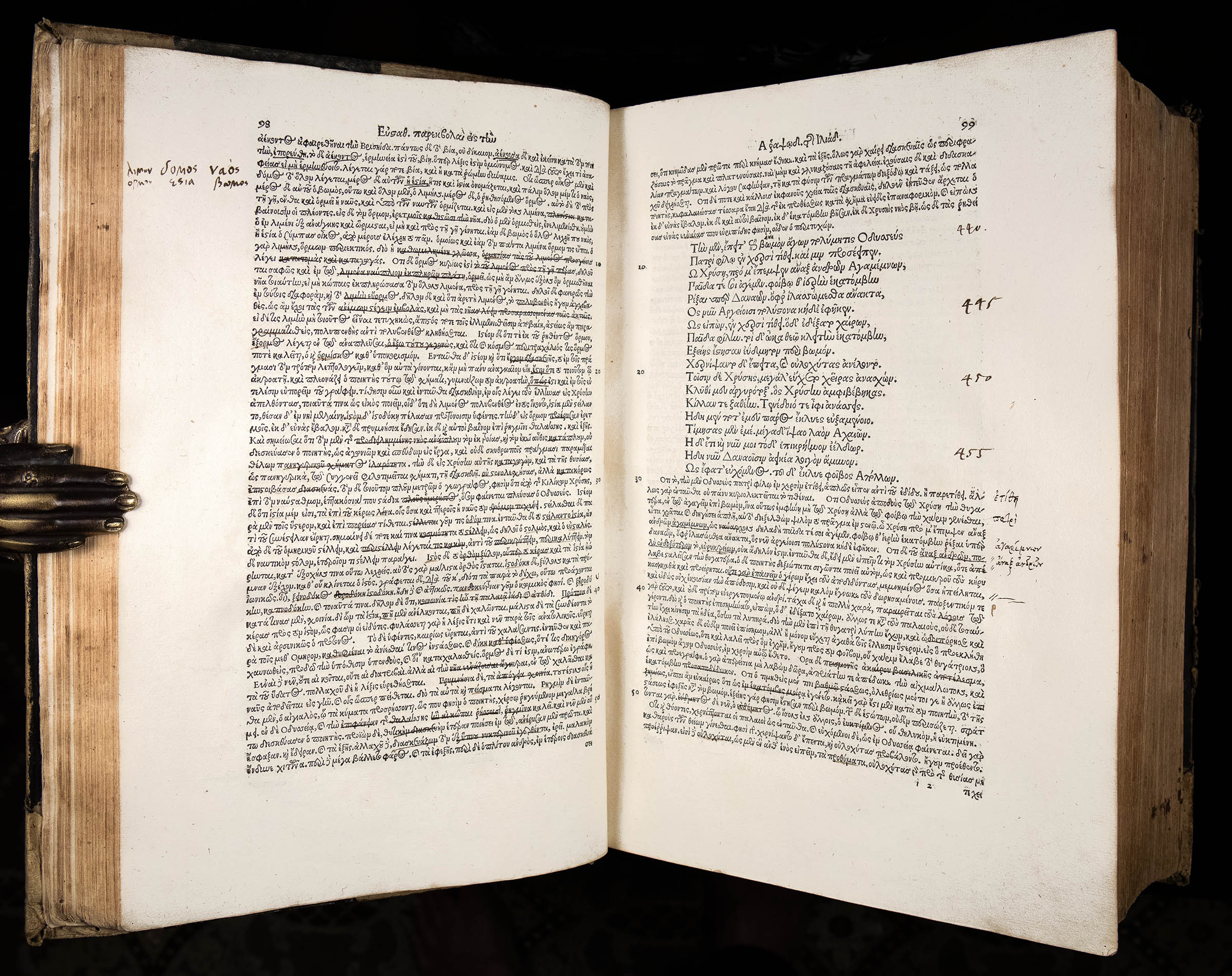
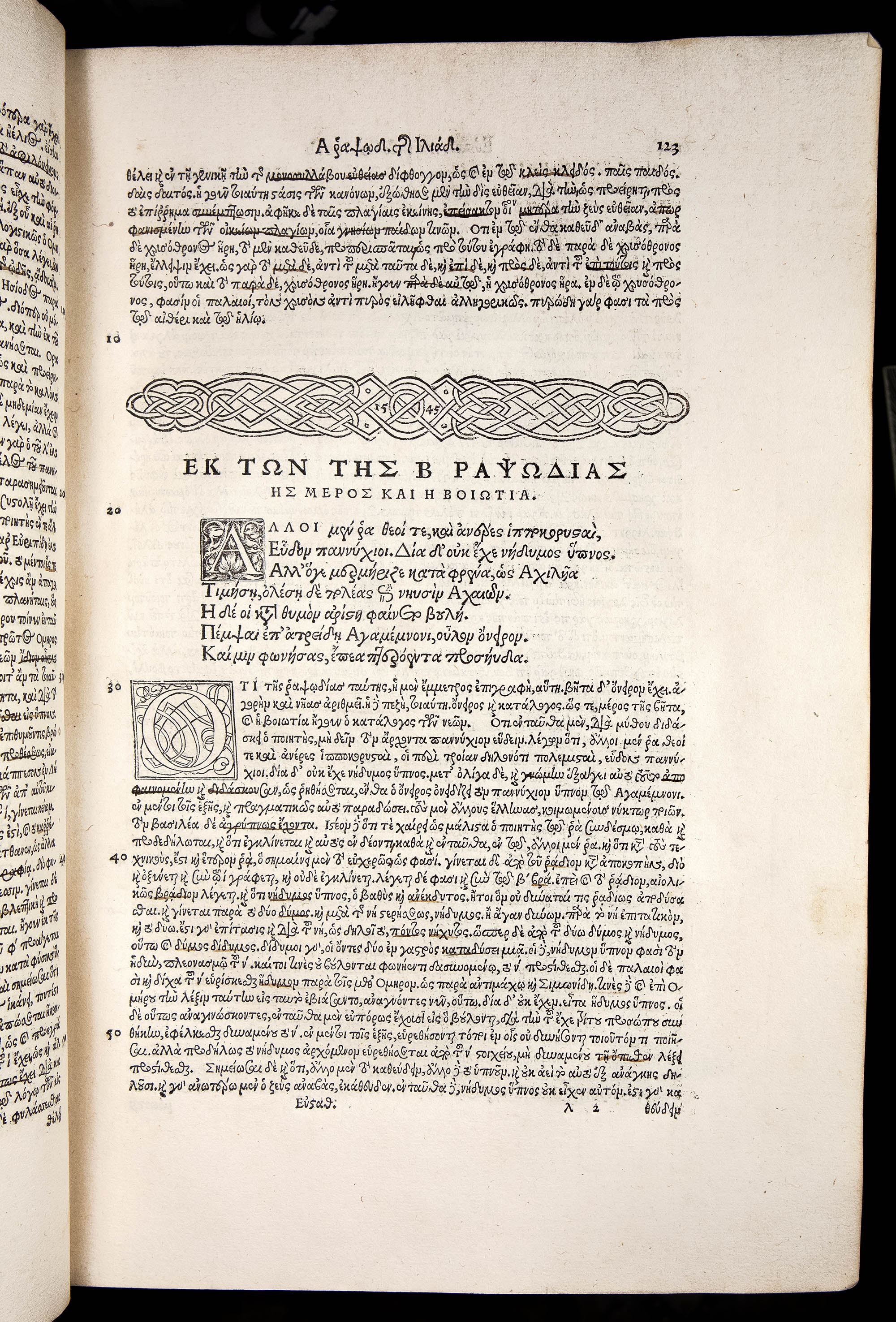
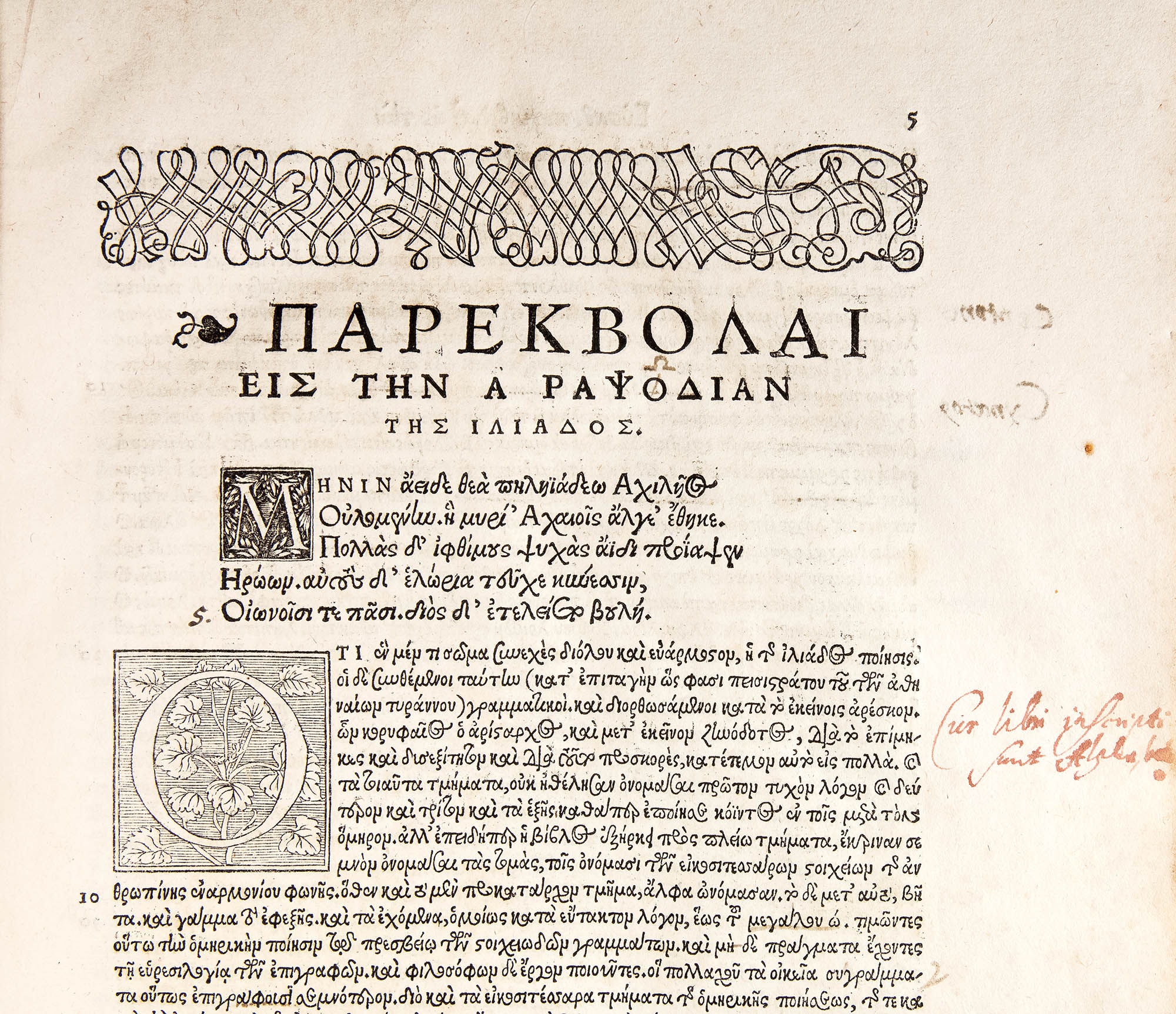
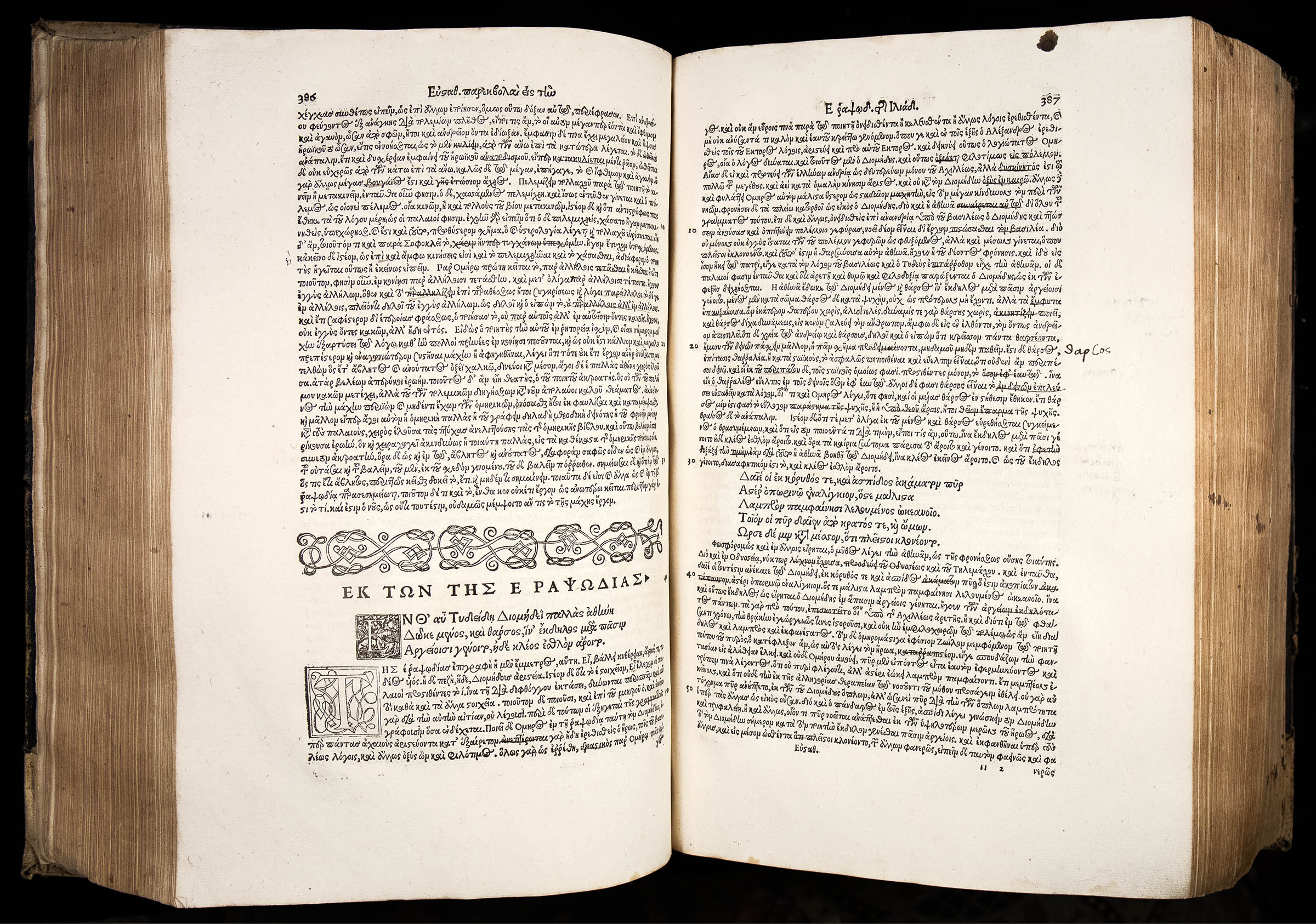
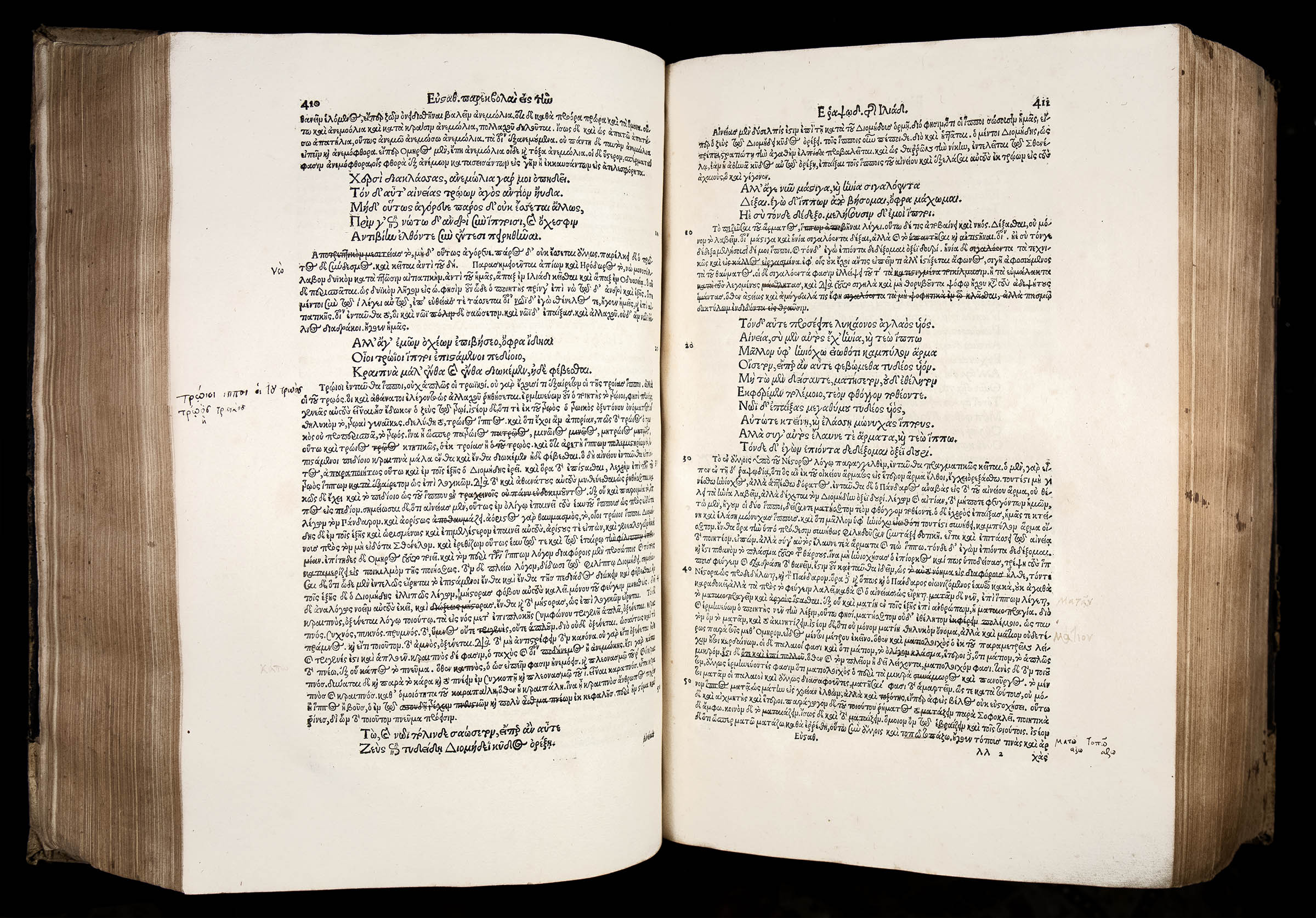
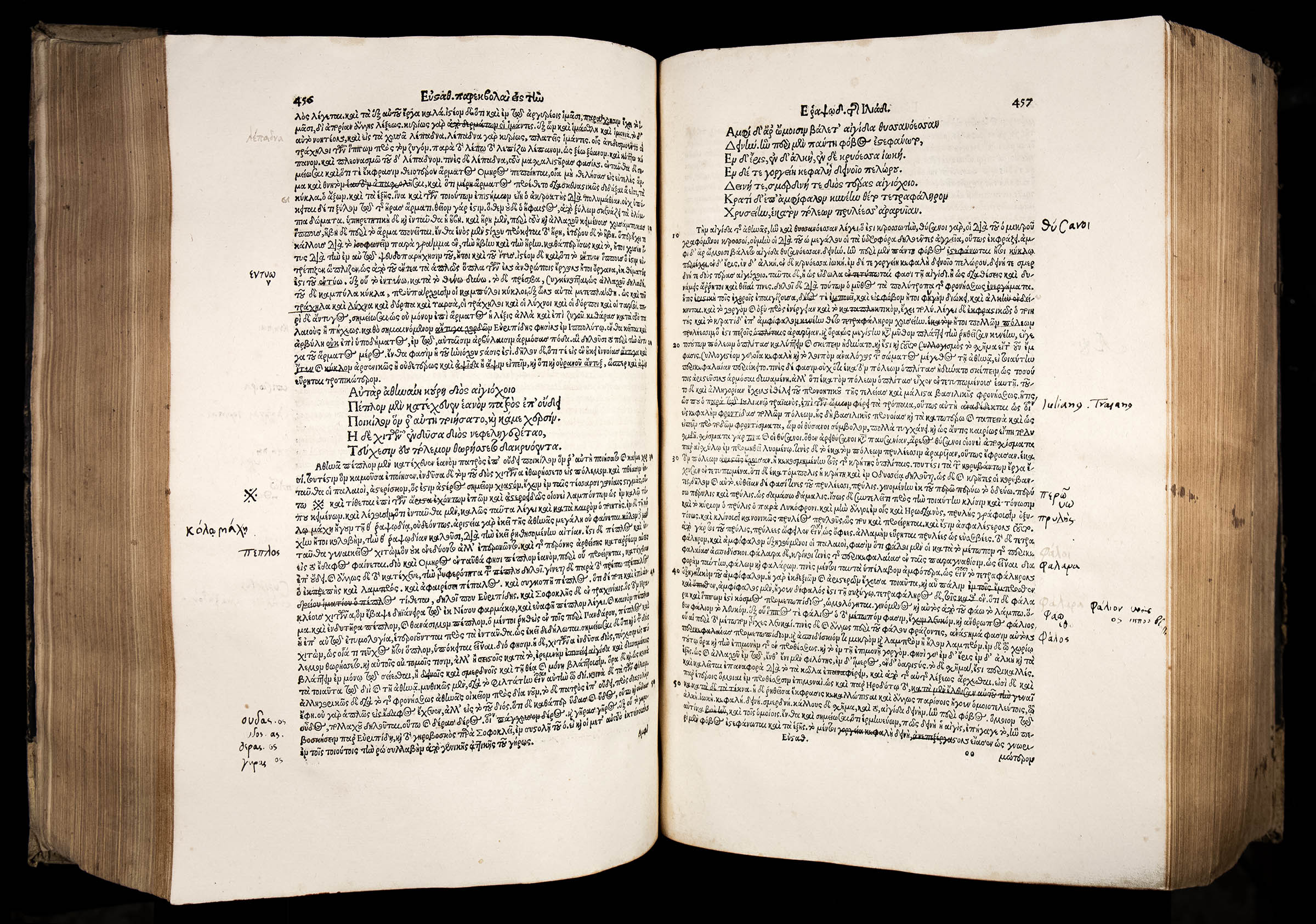
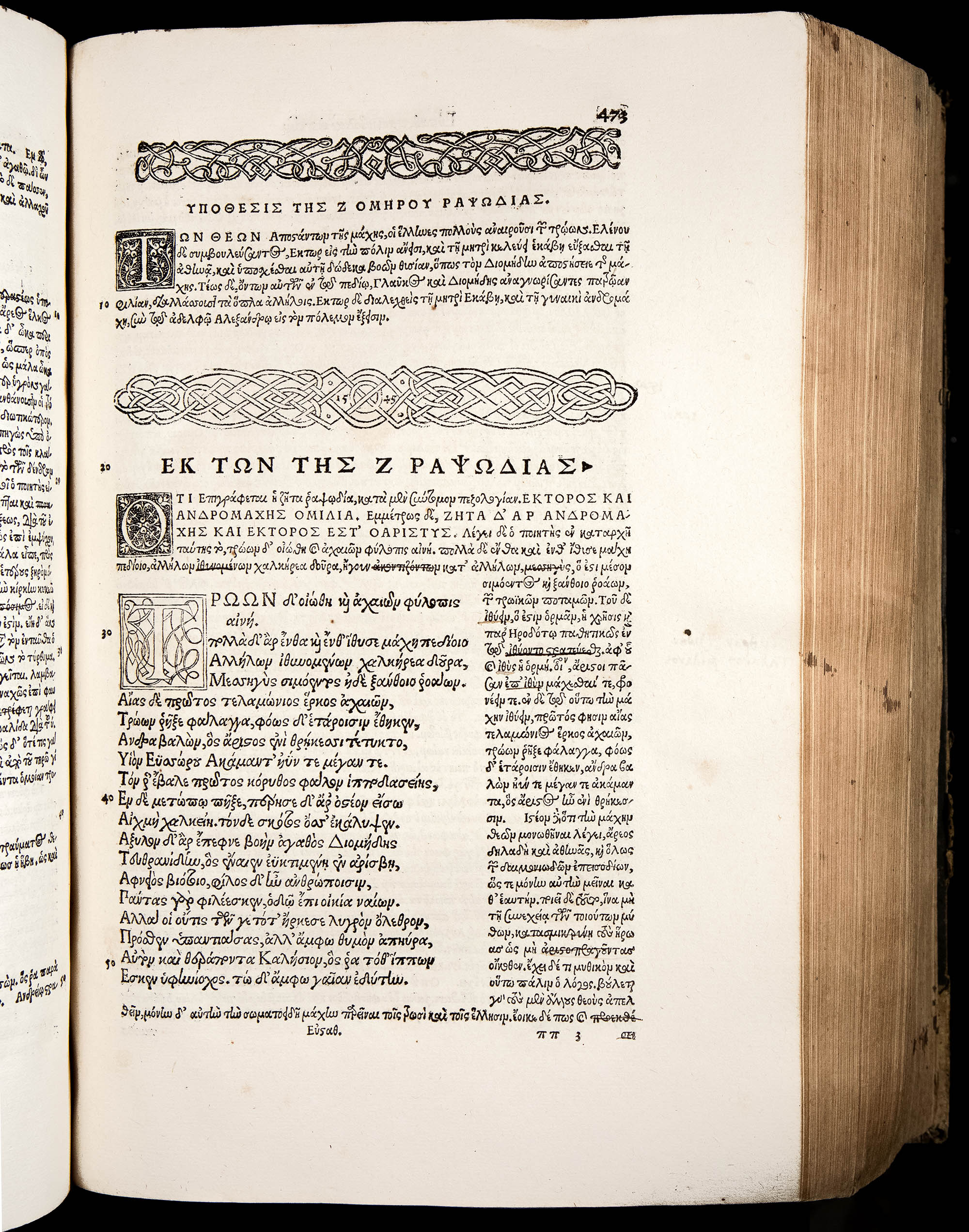
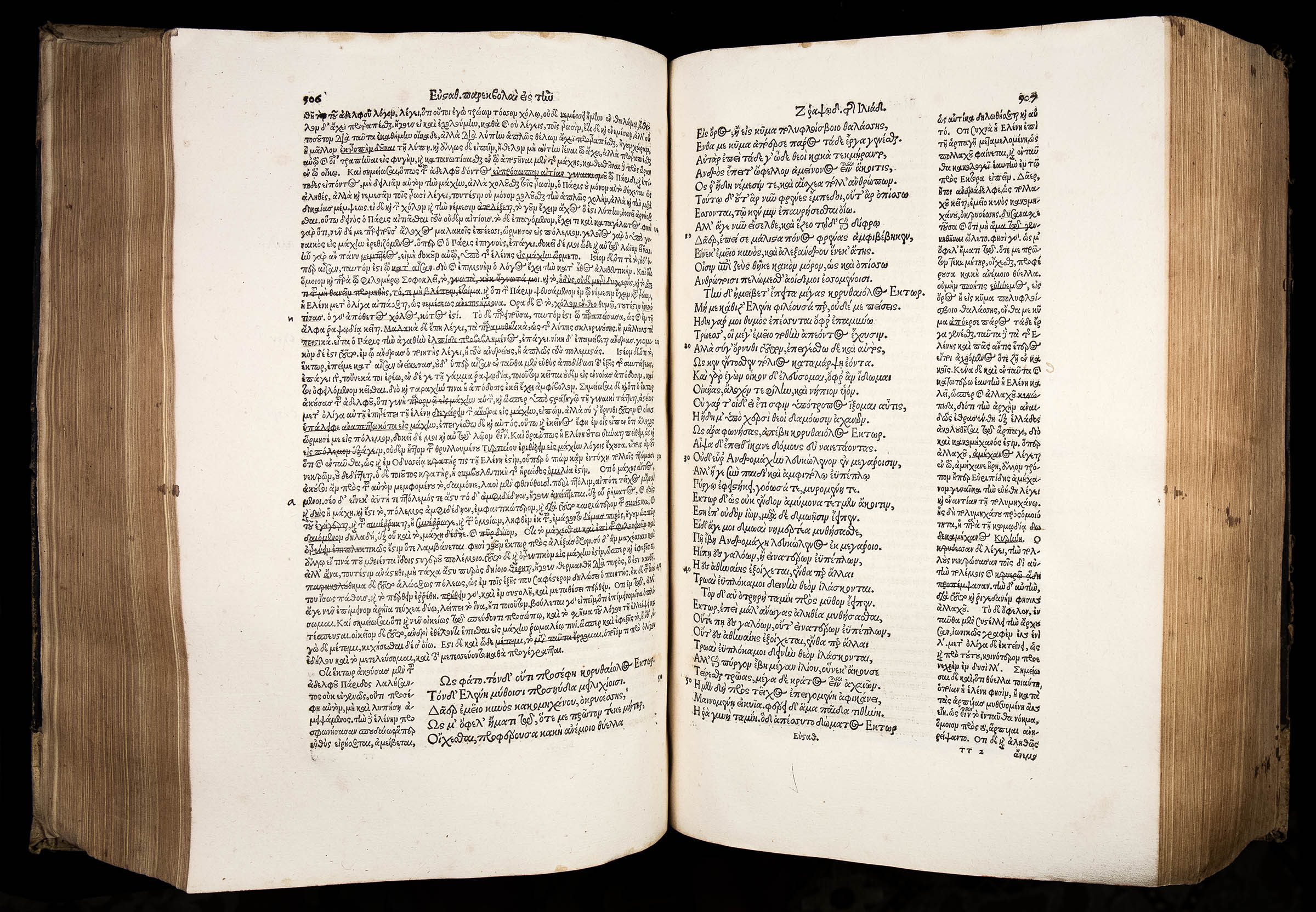
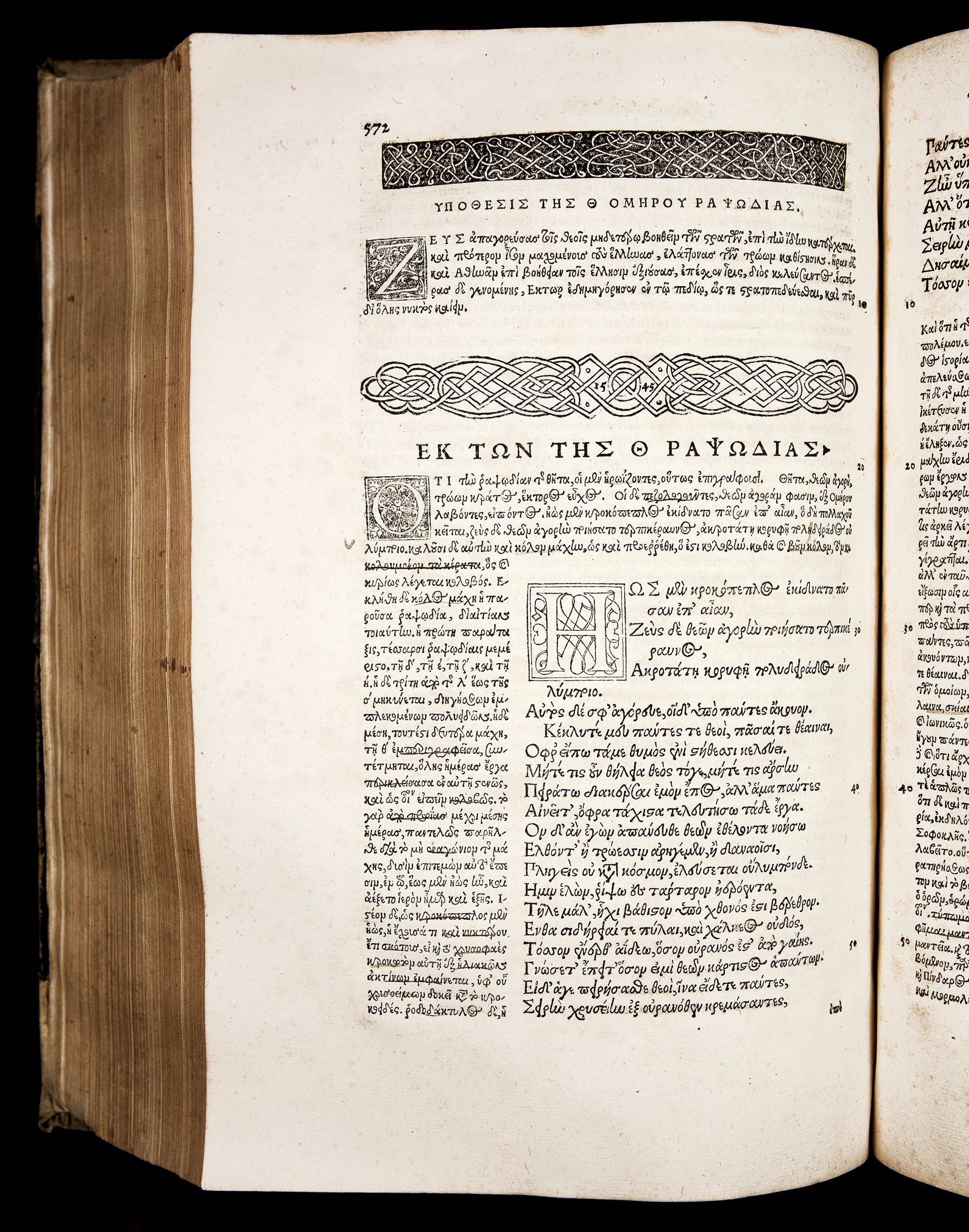
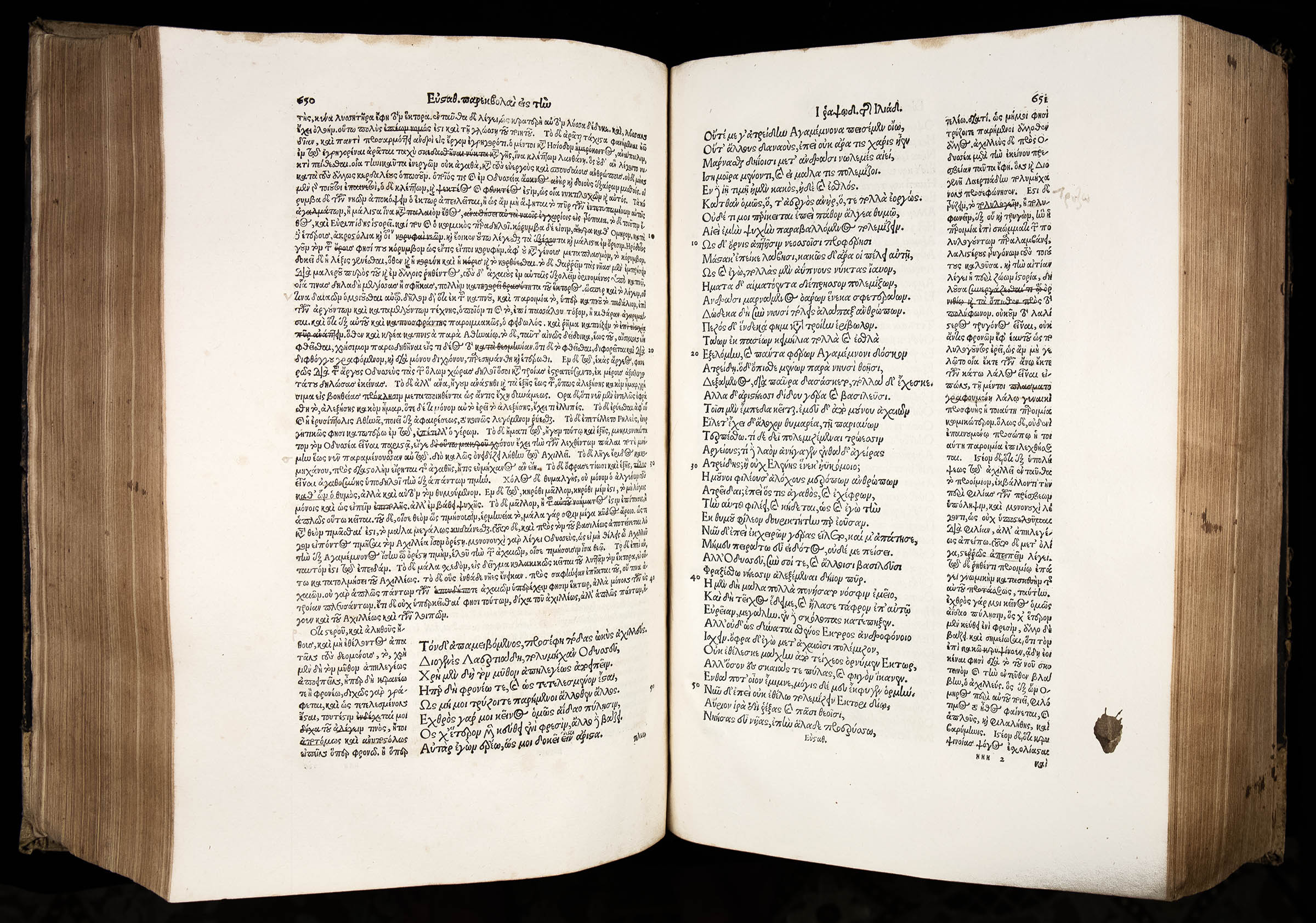
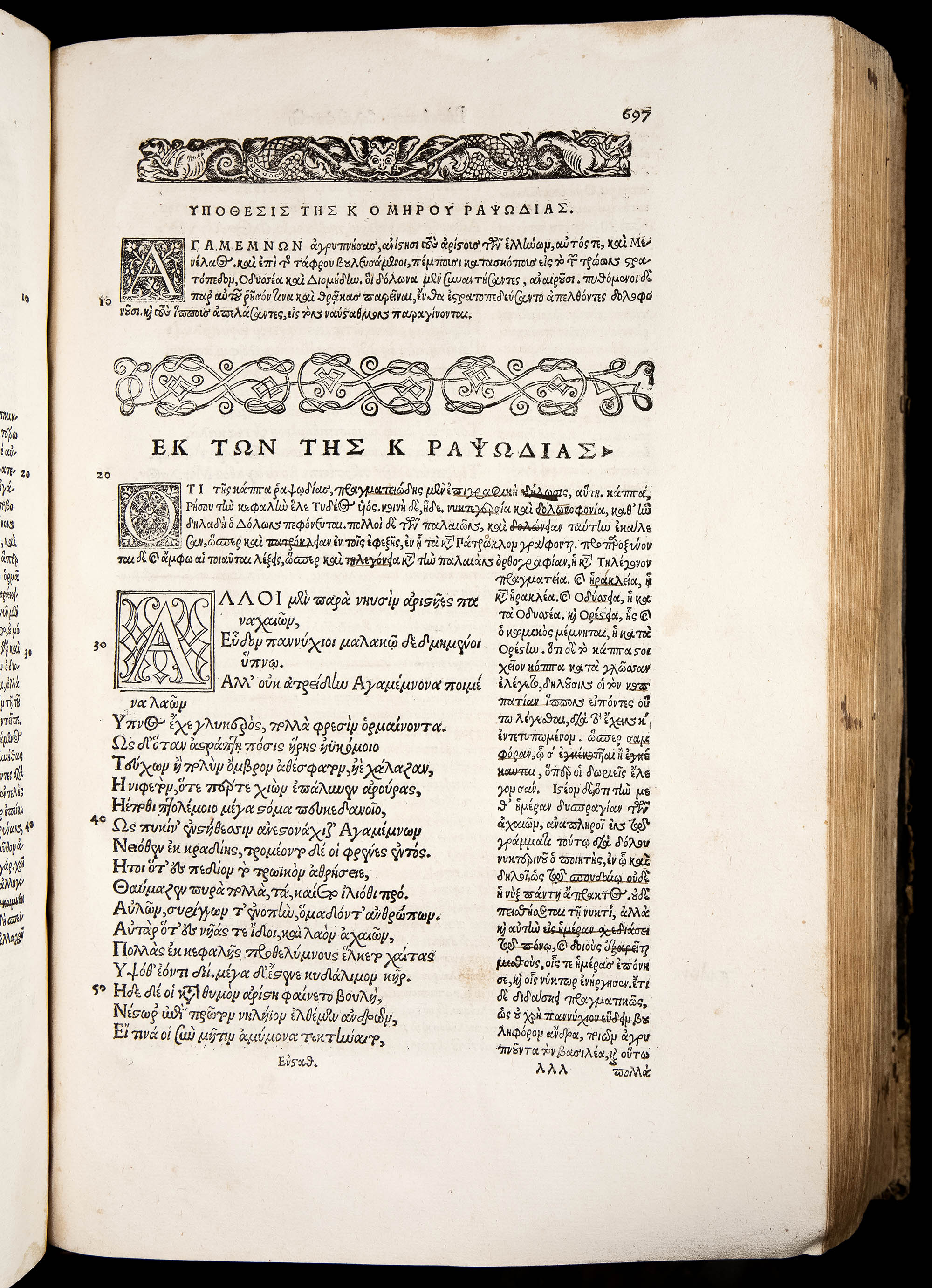
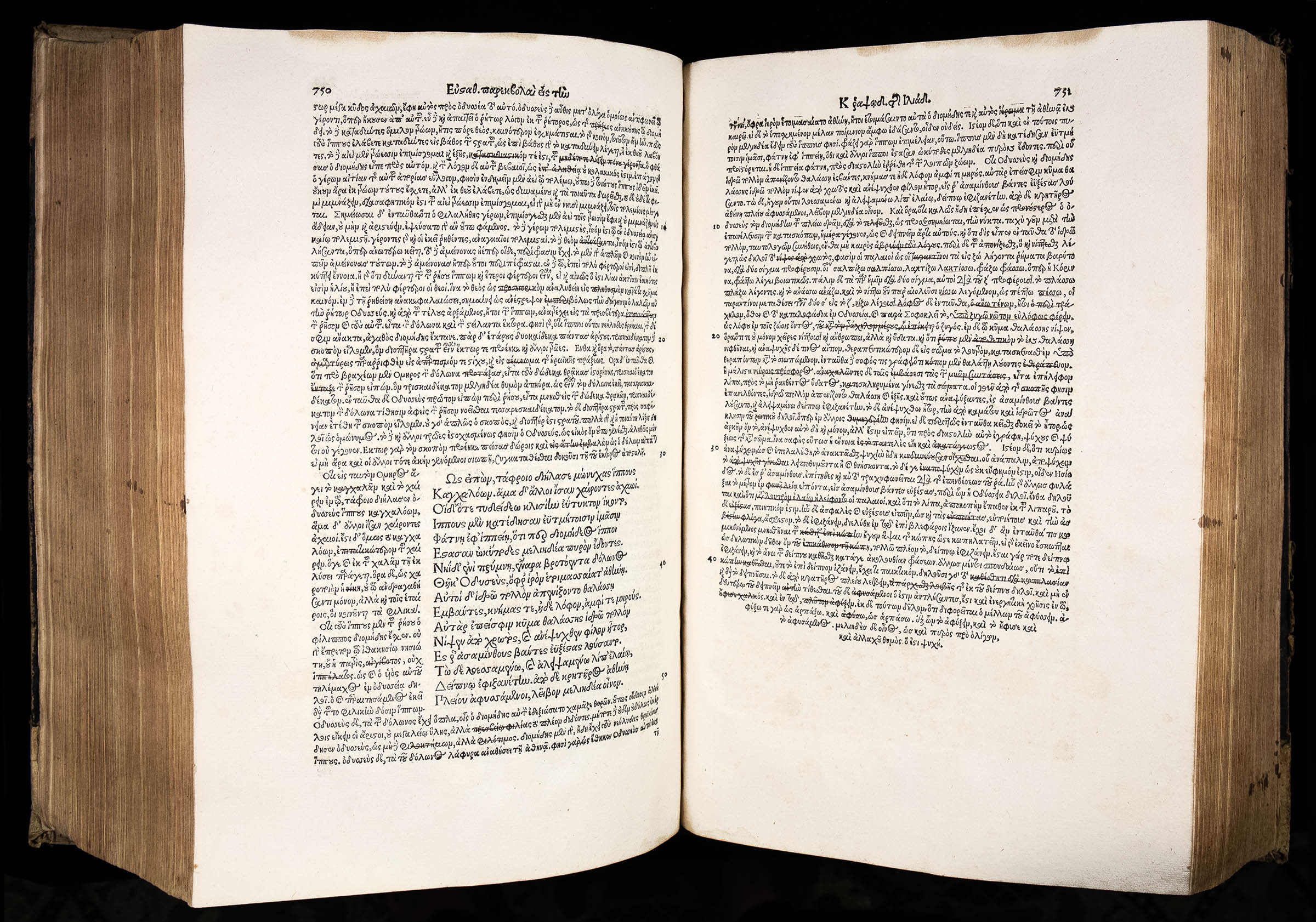
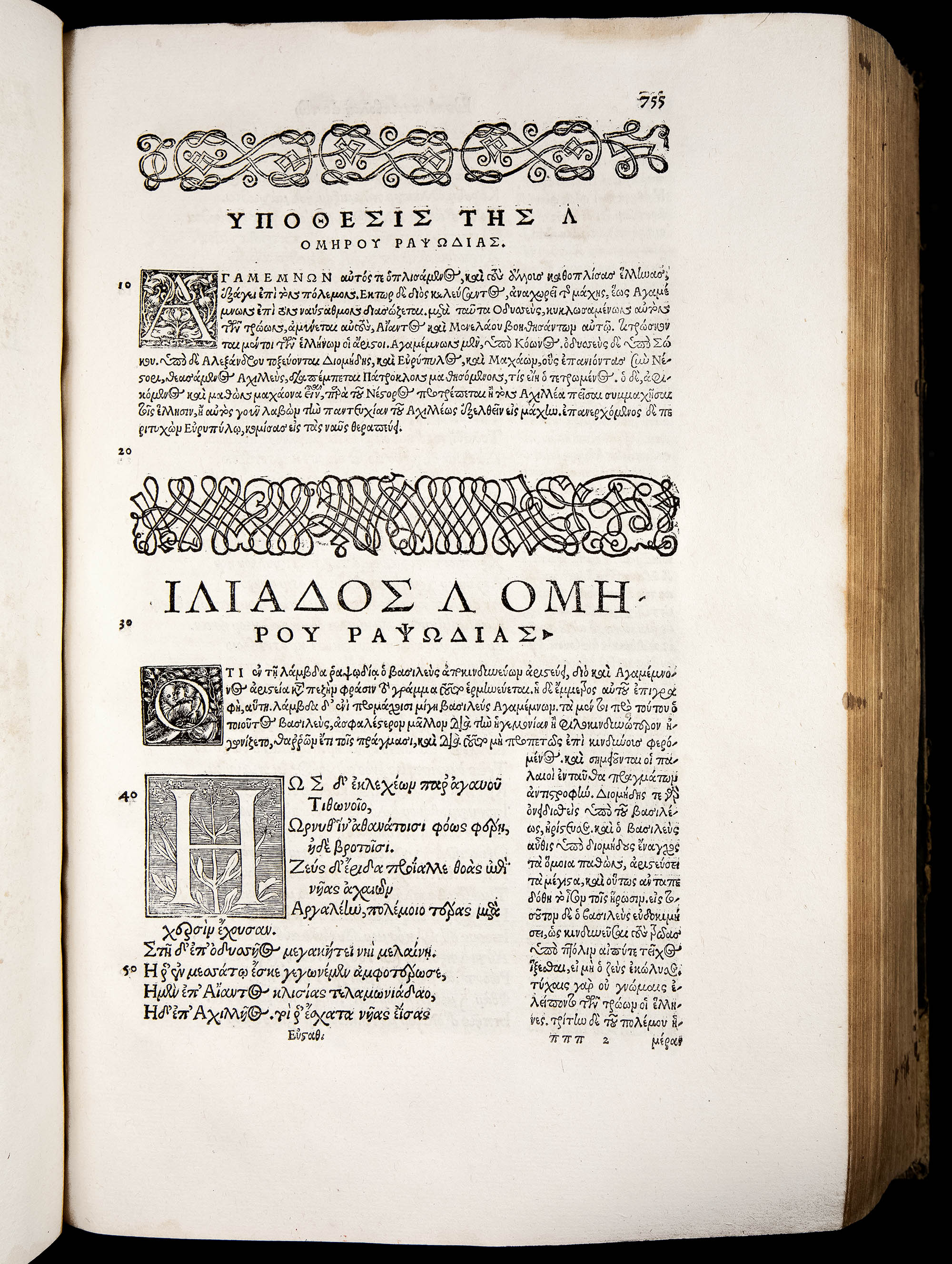
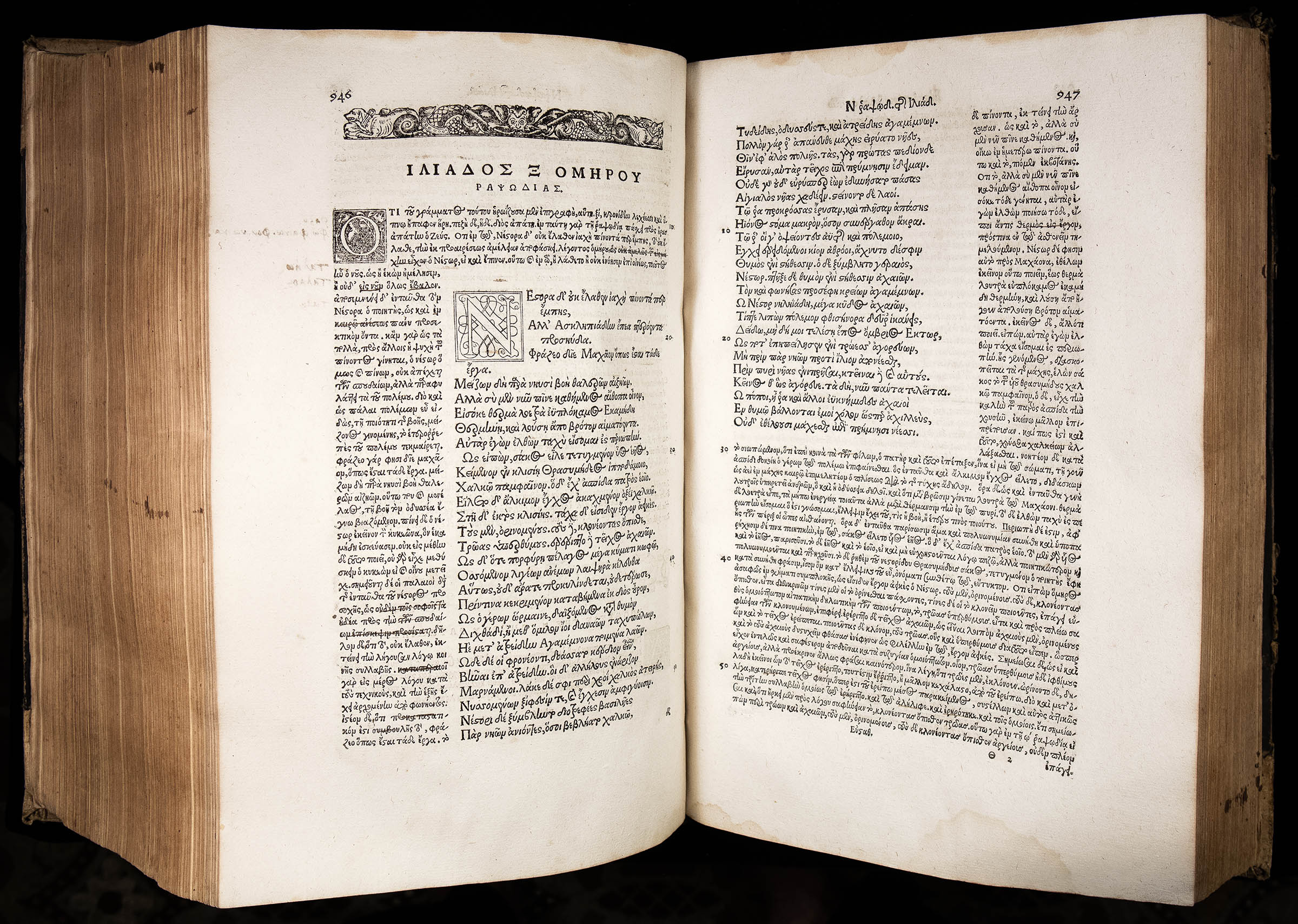
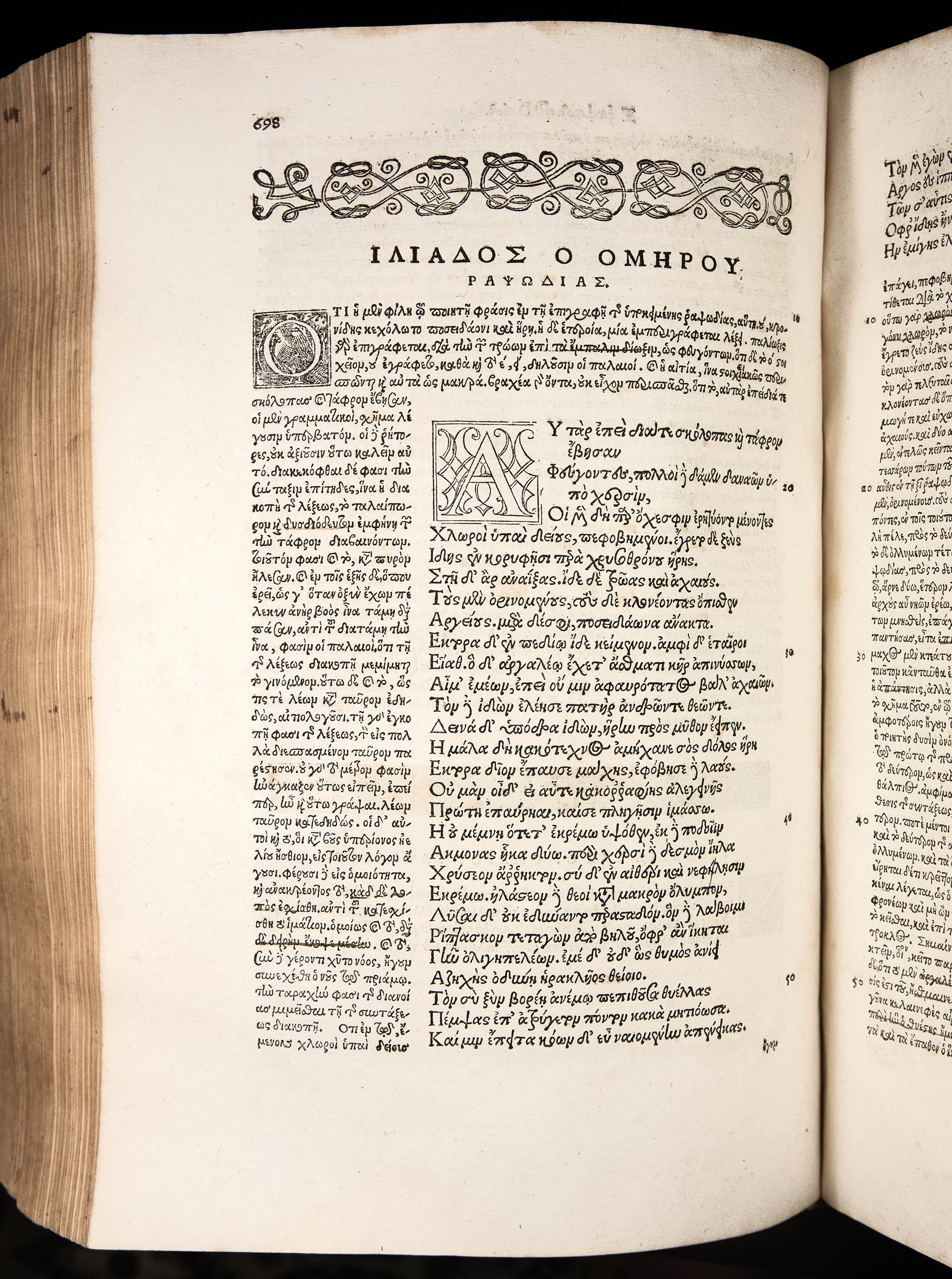
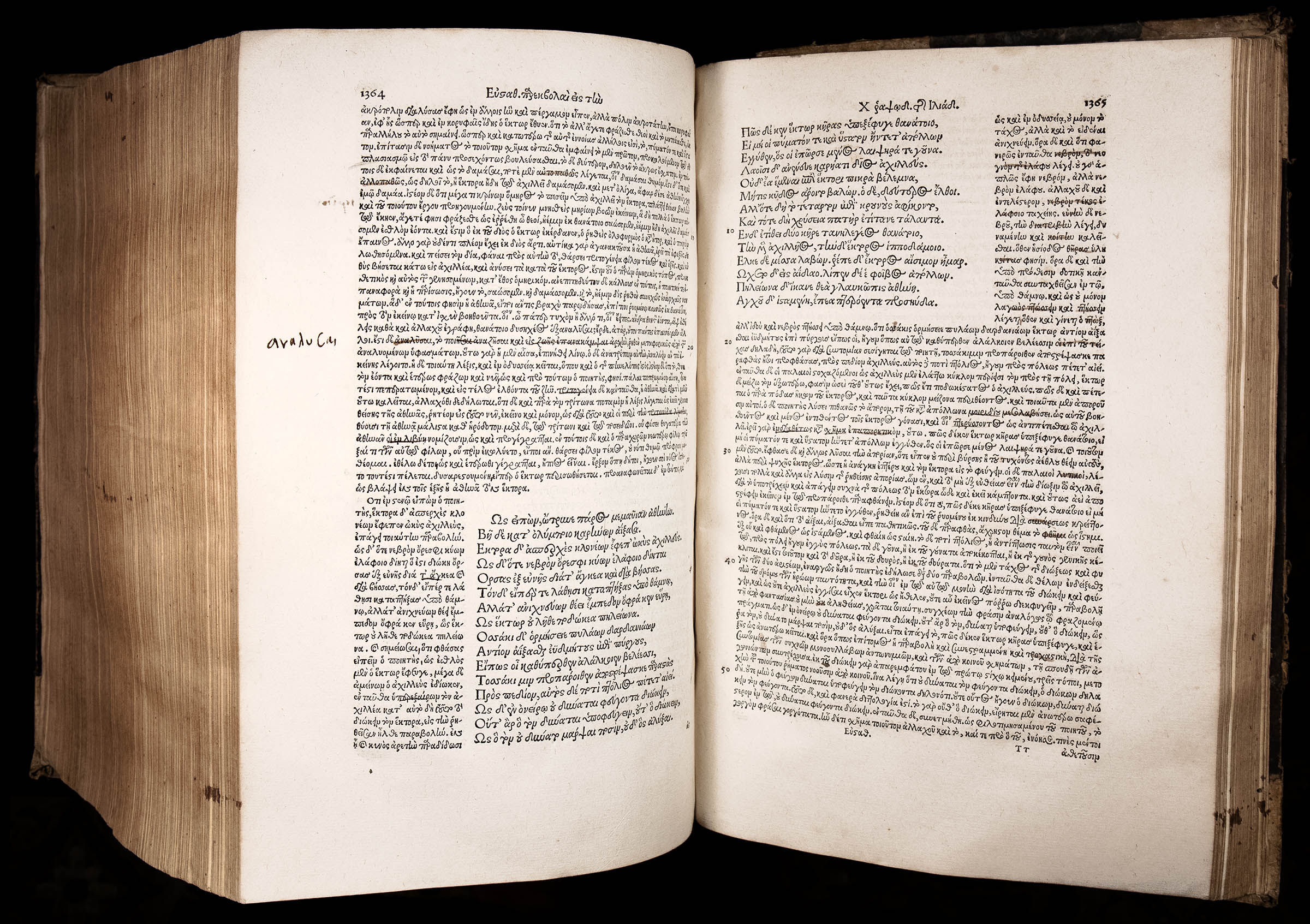
This massive Folio of over 1500 pages contains the entire Iliad volume (itself comprising two parts) of Eustathius monumental and vastly influential Homer commentary, including the complete text of the Iliad in Greek. (The Odyssey commentary volume, printed by Froben next year (1560) is not included here.) This is the highly esteemed 2nd edition of the classic Homeric commentary by the Byzantine scholar and rhetorician, Eustathius of Thessalonica, hailed as "the most learned man of his age" (Oxford Companion to Classical Literature). It was first published in Rome in 1542-50, and the text of the present edition follows the Rome edition closely. A "work of immense labour" (Rose), Eustathius's immense Παρεκβολαι collect material from a wide range of different sources which explain or expand on words, phrases and ideas in the Homeric epics, addressing questions of grammar, etymology, mythology, history and geography. Drawing on numerous works of Alexandrian grammarians, critics and later commentators, such as Aristarchos of Samothrace, Zenodotos, Aristophanes of Byzantium, etc., they are an extremely important contribution to Homeric scholarship, particularly because some of the works Eustathius uses are now lost. Eustathius seems personally acquainted with the works of the greatest ancient critics; his work is a great witness to the state of the libraries of Constantinople and of classical scholarship there in the 12th century. “[The Παρεκβολαι] are evidently based on Eustathius' lectures. Prefaces deal with the differences between the poems and with the cultural importance of Homer. The notes discuss chiefly questions of language, mythology (sometimes interpreted allegorically), history, and geography. Their value lies particularly in the assemblage of material drawn from the old scholia and the lost works of earlier scholars and lexicographers. […] He often illustrates a point by reference to the customs and observances of his own time and to contemporary vernacular Greek.” (Oxford Who's Who in the Classical World) Homer (Ancient Greek: Ὅμηρος) is best known as the author of the Iliad and the Odyssey. He was believed by the ancient Greeks to have been the first and greatest of the epic poets. The first known literary author of Europe, he is central to the Western canon. When exactly he lived is unknown. Herodotus estimates that Homer lived no more than 400 years before his own time, which would place him at around 850 BC or later. Pseudo-Herodotus in his Life of Homer places him at 1102 BCE, i.e. 168 years after the fall of Troy in 1270 BCE. Modern scholars generally agree that there was a poet named Homer who lived before 700 BC, probably in Asia Minor. Legends about Homer were numerous in ancient times. He was said to be blind. His birthplace has always been disputed, but Chios or Smyrna seem most likely. The importance of Homer to the ancient Greeks is emphasized in Plato's Republic, where he is referred to as the "first teacher", "leader of learning", and the one who “has taught Greece". The study of Homer was required of all Greek students in antiquity, and his heroes were worshiped in many parts of Greece. The two epic poems attributed to Homer, the Iliad and the Odyssey, are composed in dactylic hexameter, in a literary type of Greek - Ionic - in basis, with Aeolic admixtures. The Iliad is an epic poem in dactylic hexameters, set in the Trojan War, the ten-year siege of Ilium by a coalition of Greek states. The Iliad is among the oldest extant works of Western literature, and its written version is usually dated to around the 8th century BC. The Iliad contains approximately 15,700 lines, and is written in a literary amalgam of several Greek dialects. One of the foremost achievements in Western literature, it tells the story of the darkest episode of the Trojan War. At its center is Achilles, the greatest warrior-champion of the Greeks, and his conflict with his leader Agamemnon. Interwoven in the tragic sequence of events are powerfully moving descriptions of the ebb and flow of battle, the besieged city of Ilium, the feud between the gods, and the fate of mortals. Although the story covers only a few weeks in the final year of the war, the Iliad mentions or alludes to many of the Greek legends about the siege. Bibliographic references:
Adams E 1108. Dibdin 48f. Hoffmann II, 116. Schweiger 123. Physical description:
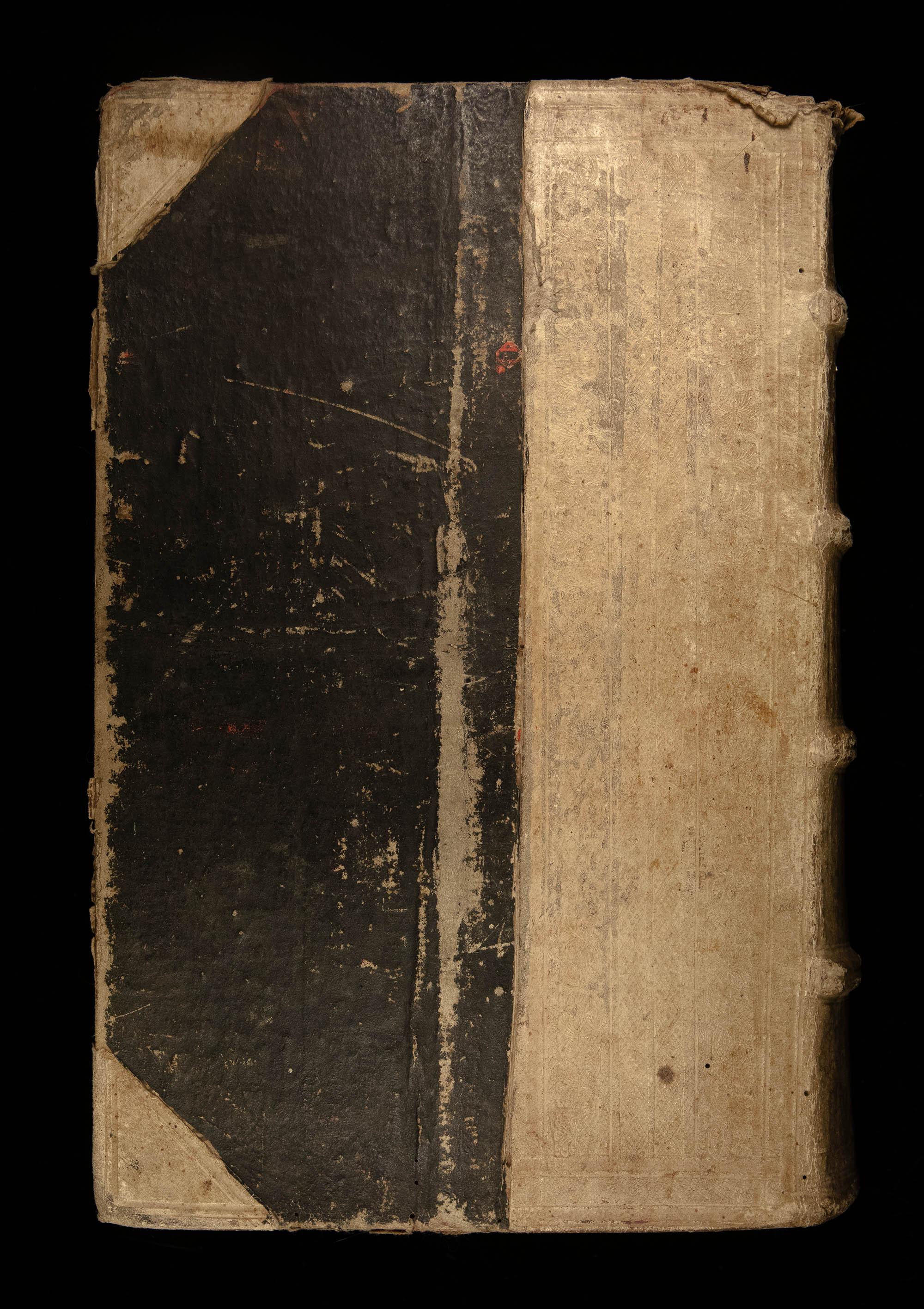
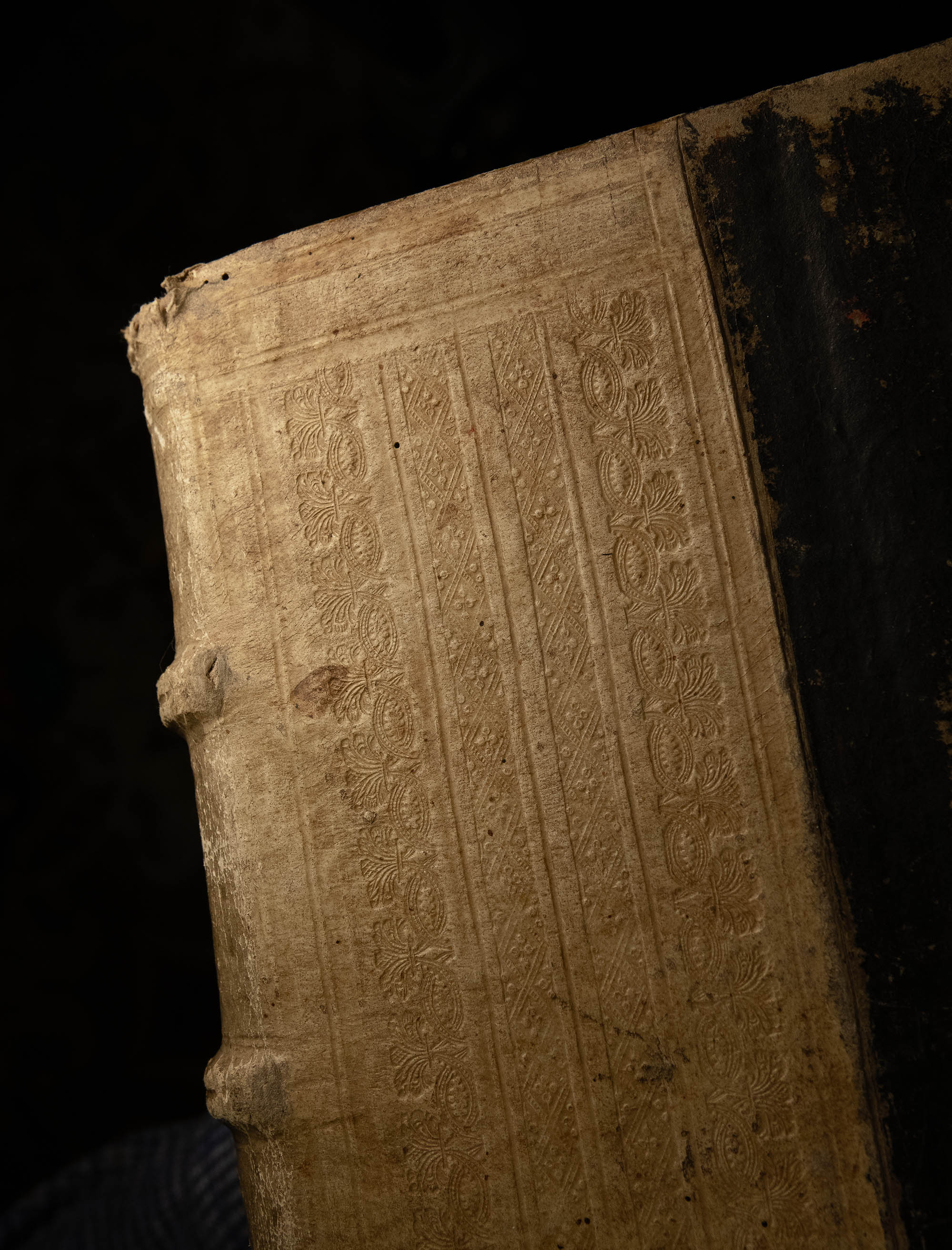
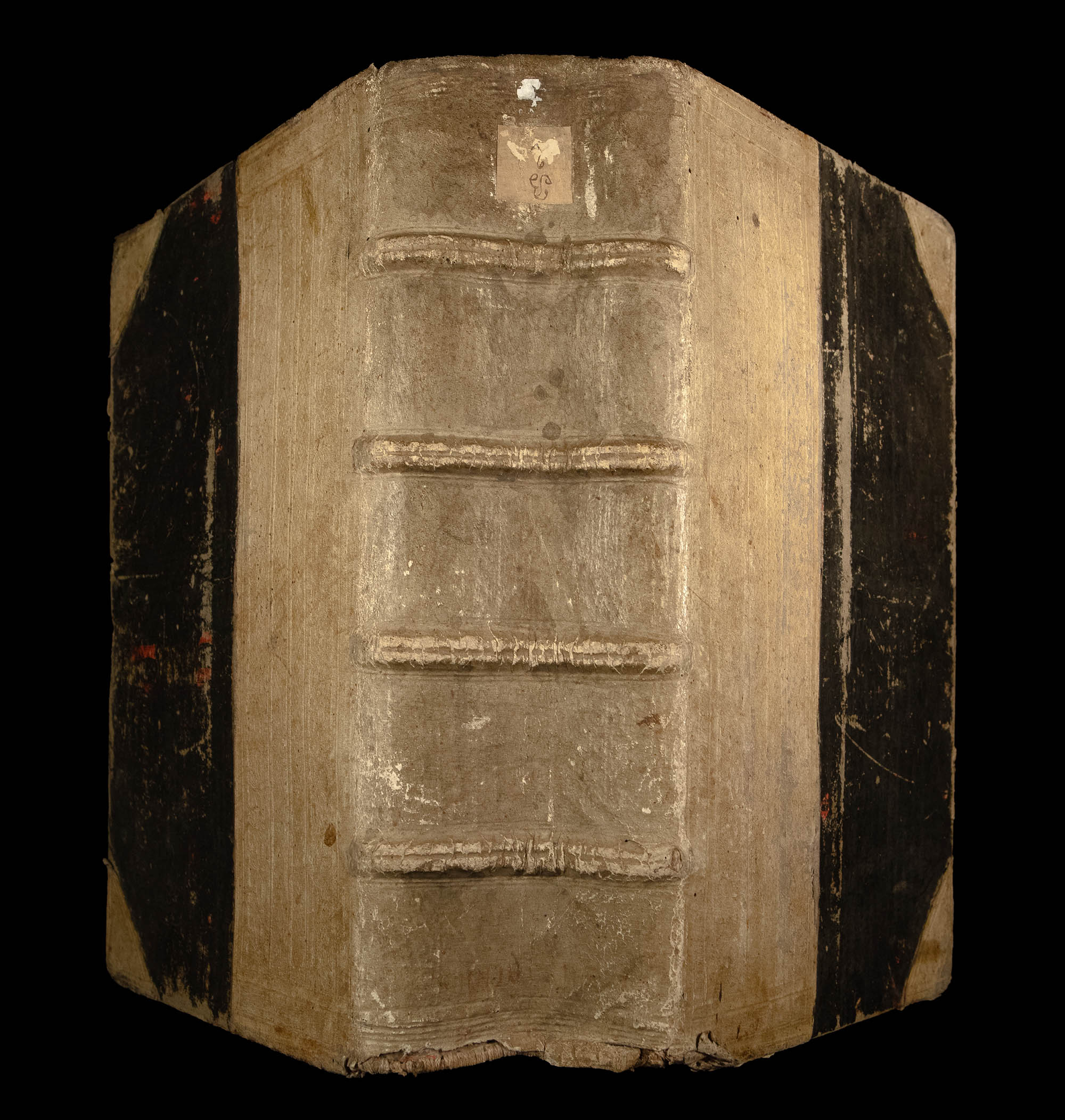
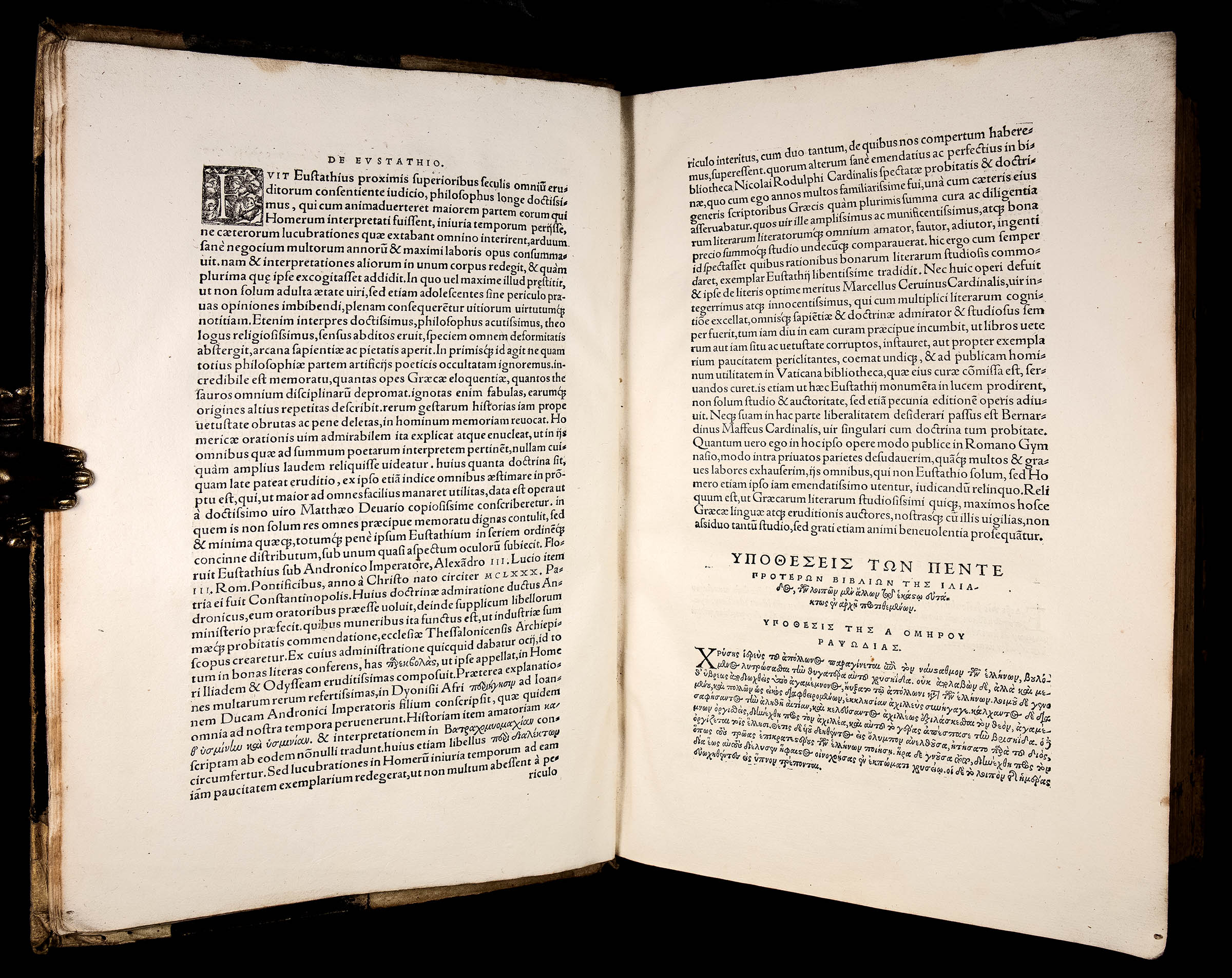
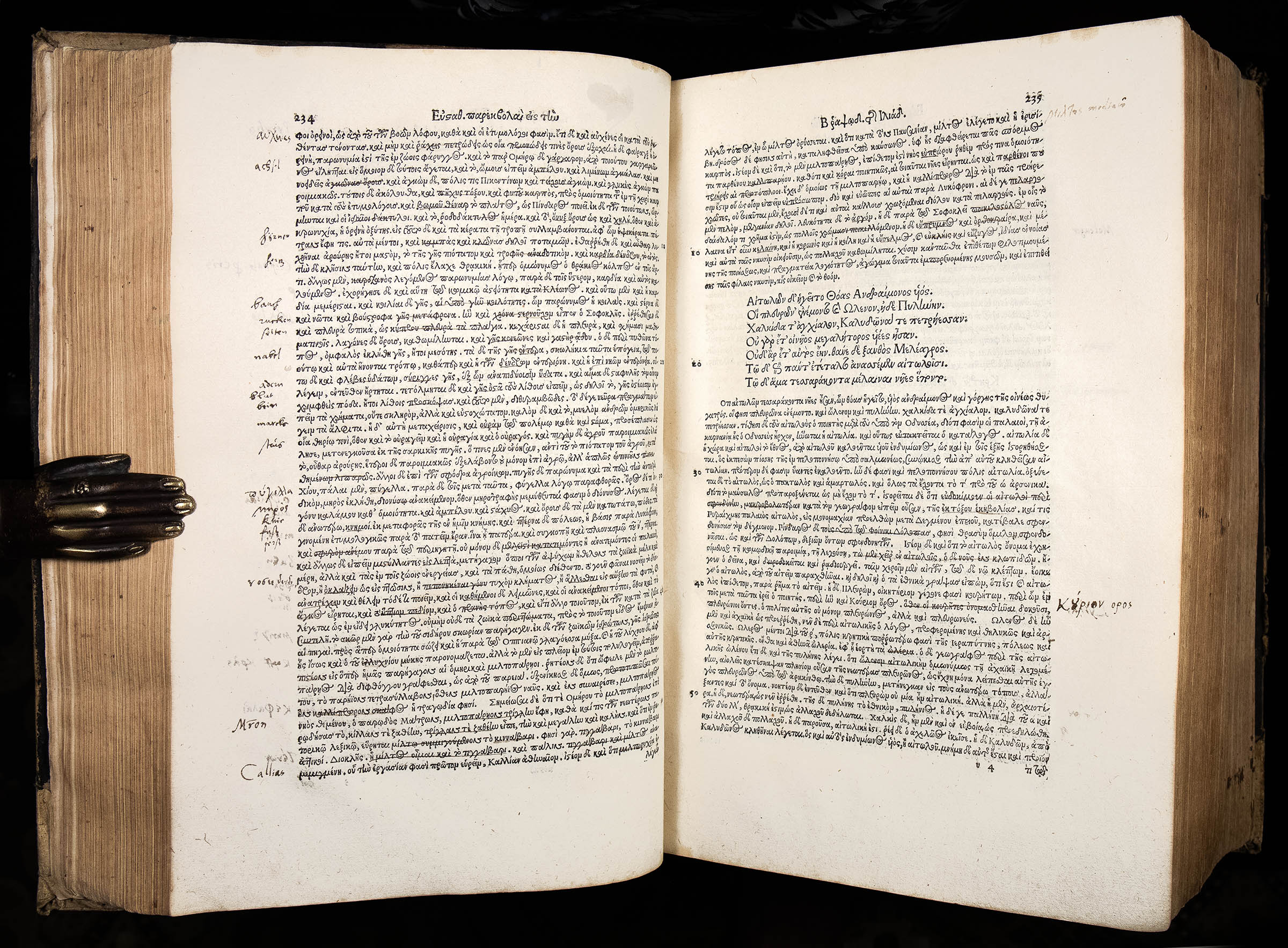
Two parts in one massive Folio. Text-block measures 32 cm by 22 cm, and is 10 cm thick. Bound in late 16th-century half-alum-tawed pigskin over pasteboard covered with black-dyed vellum (apparently from reused manuscript antiphonal leaves with a few red initials visible through the dye). Pigskin blind-tooled in vertical rows formed by ornamental rolls including palmetto leaves. Spine with four prominent raised bands over thick binding cords.
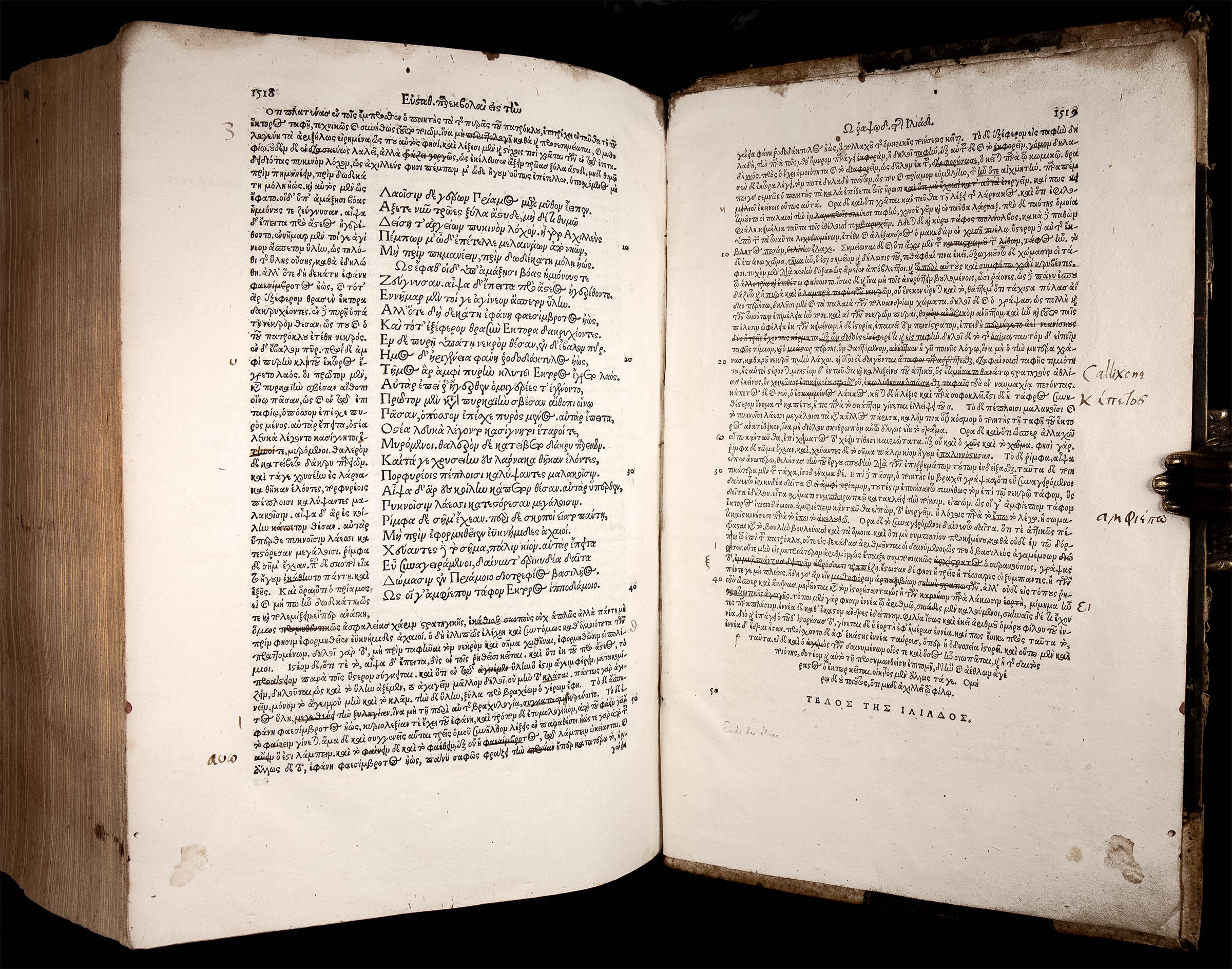
Pagination: (10), 751; (3), 755-1519, (1) pages.
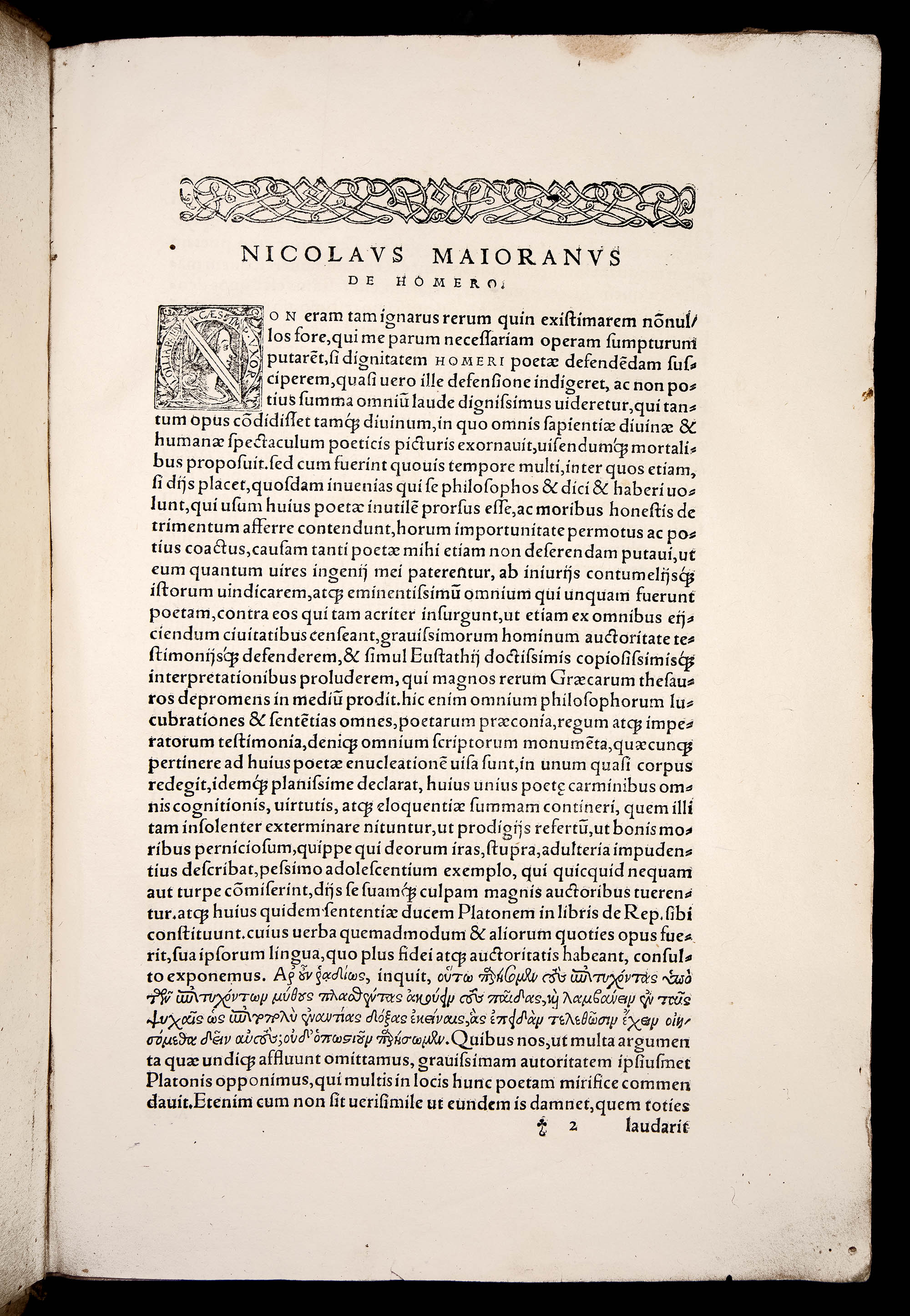
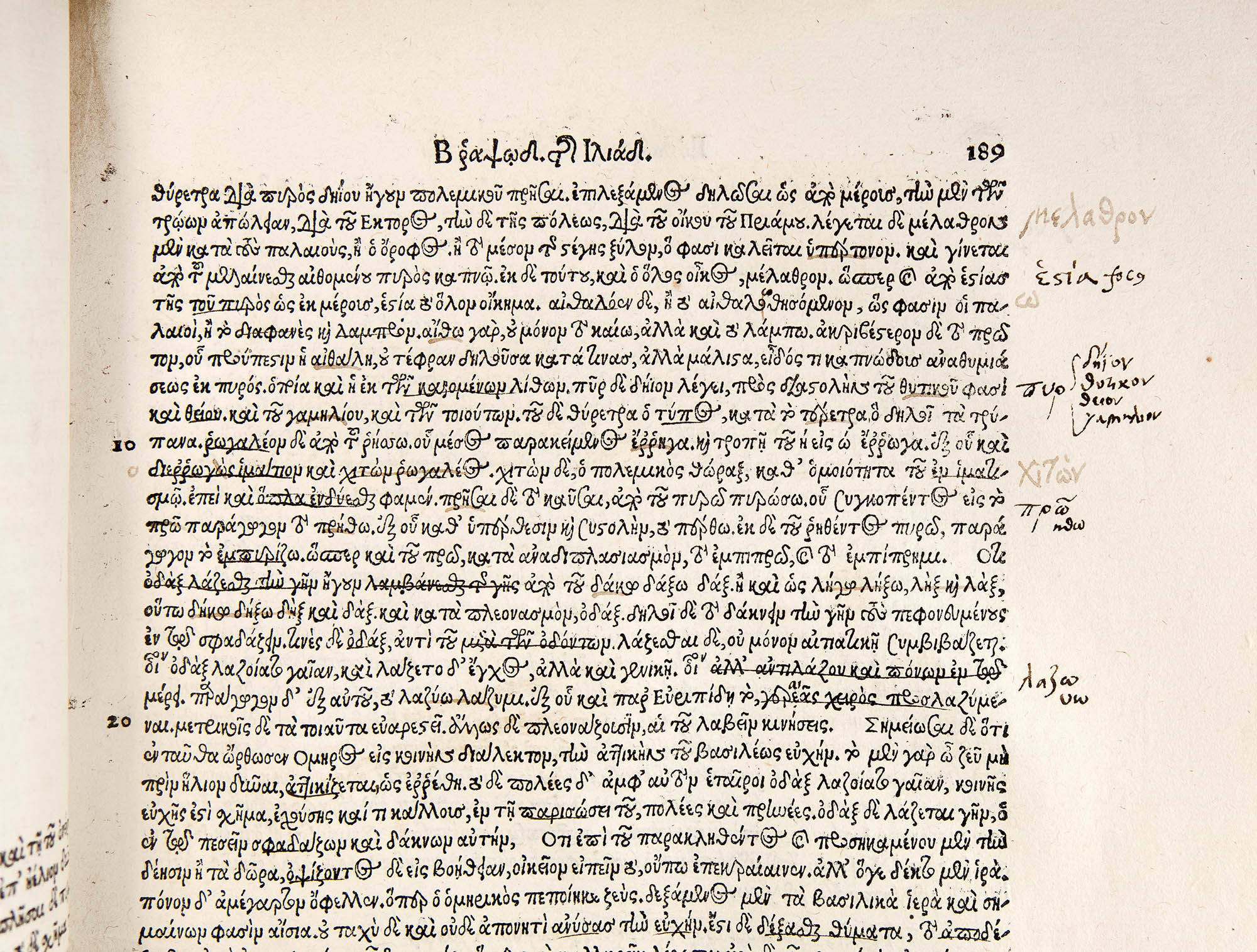
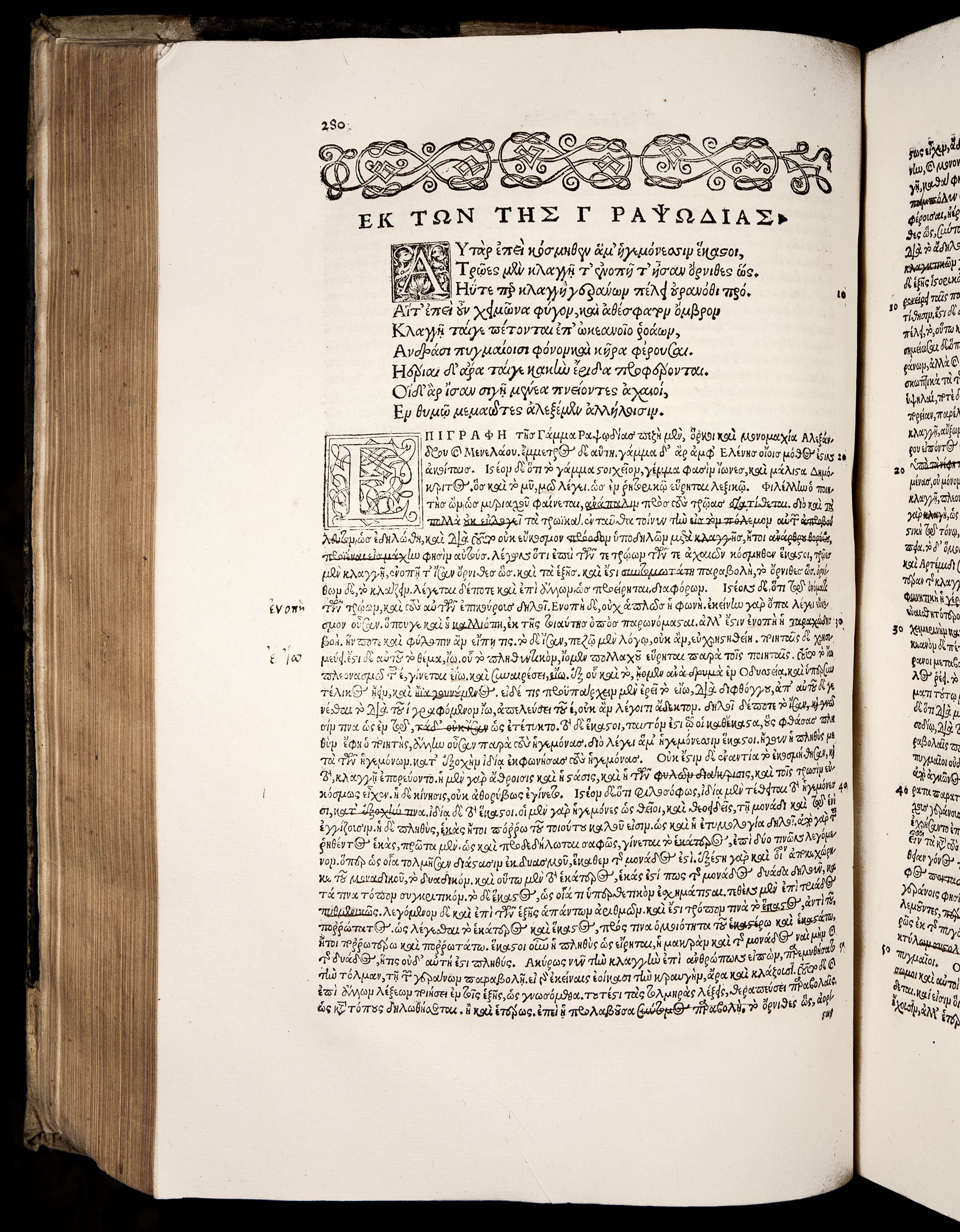
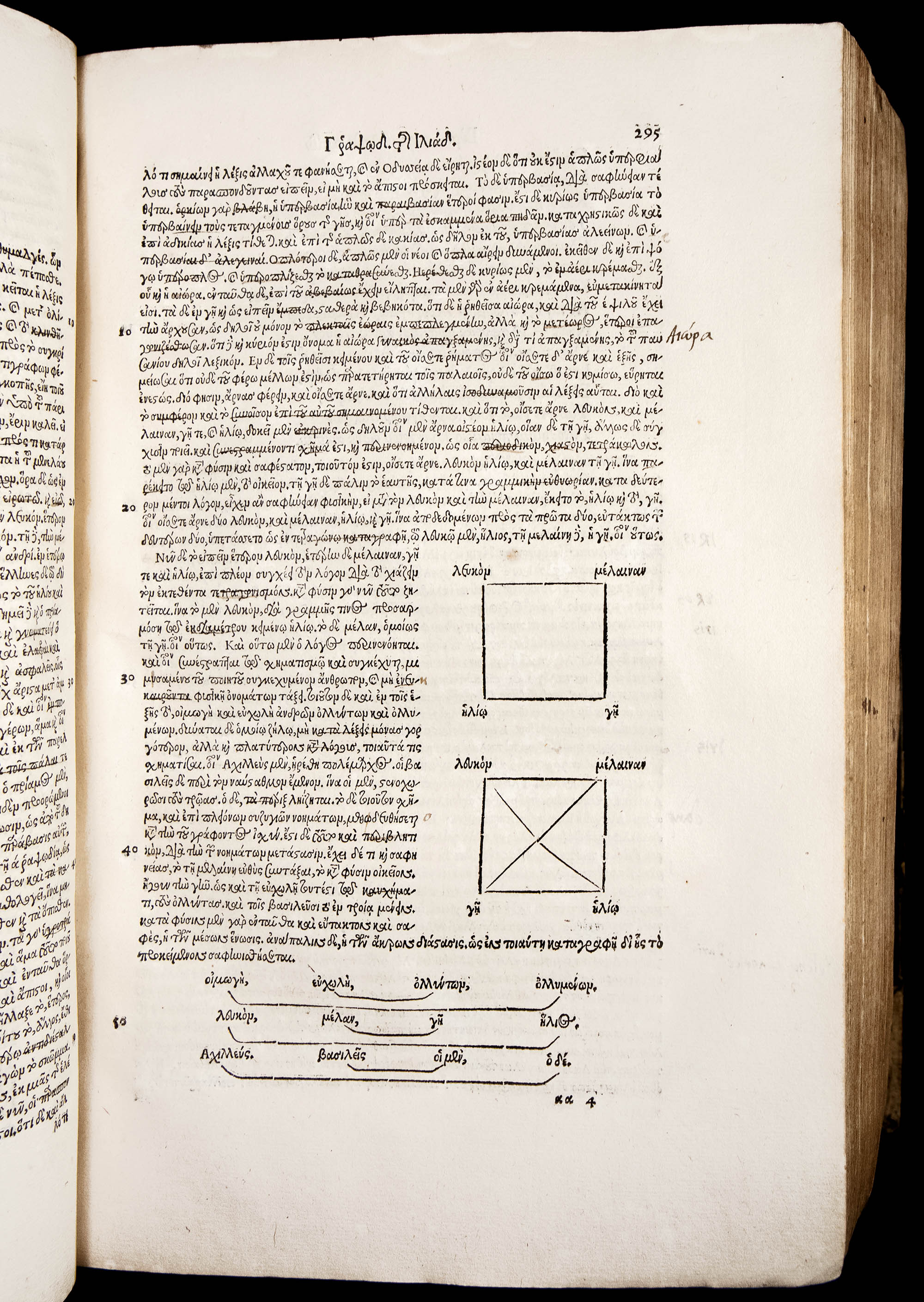
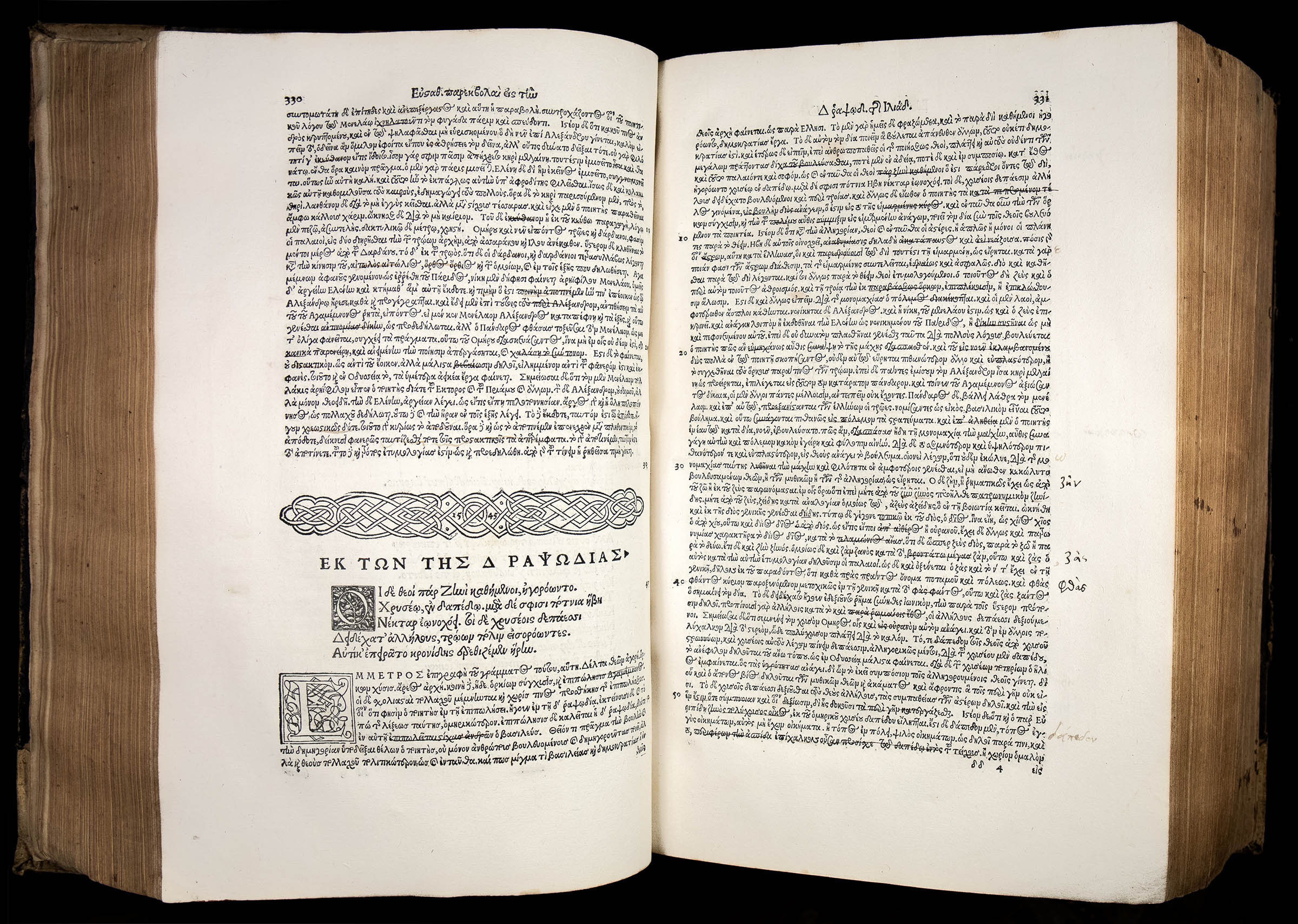
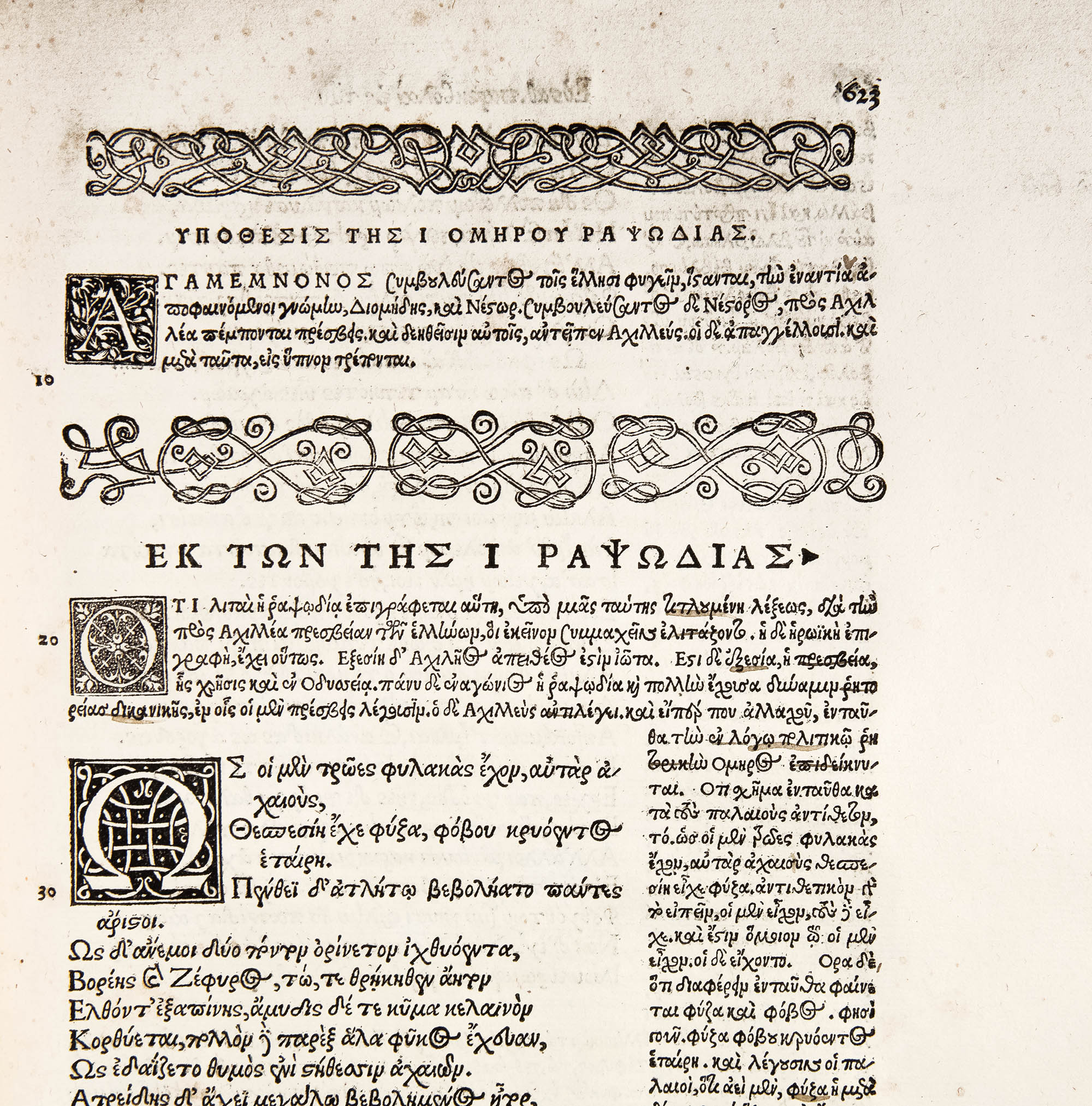
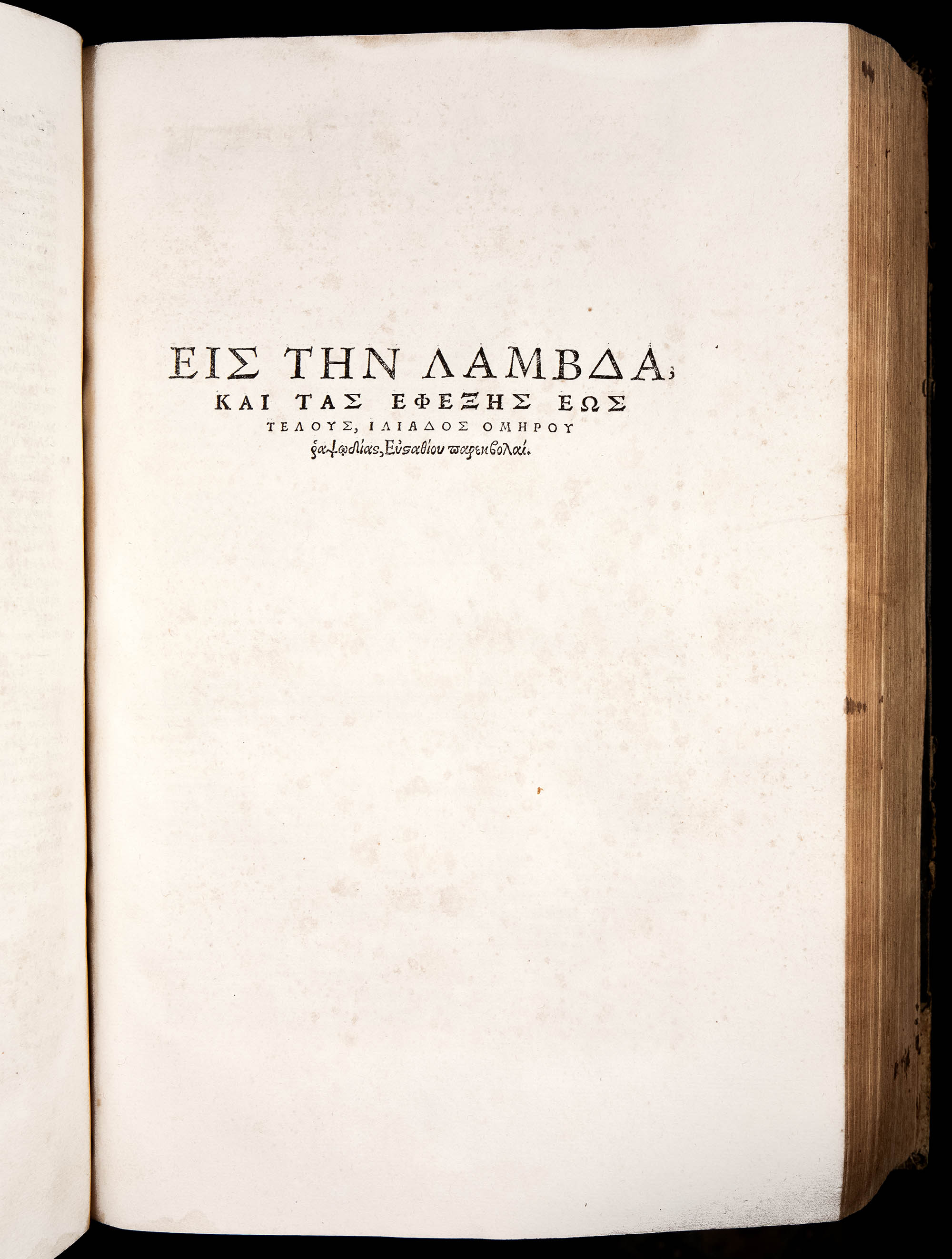
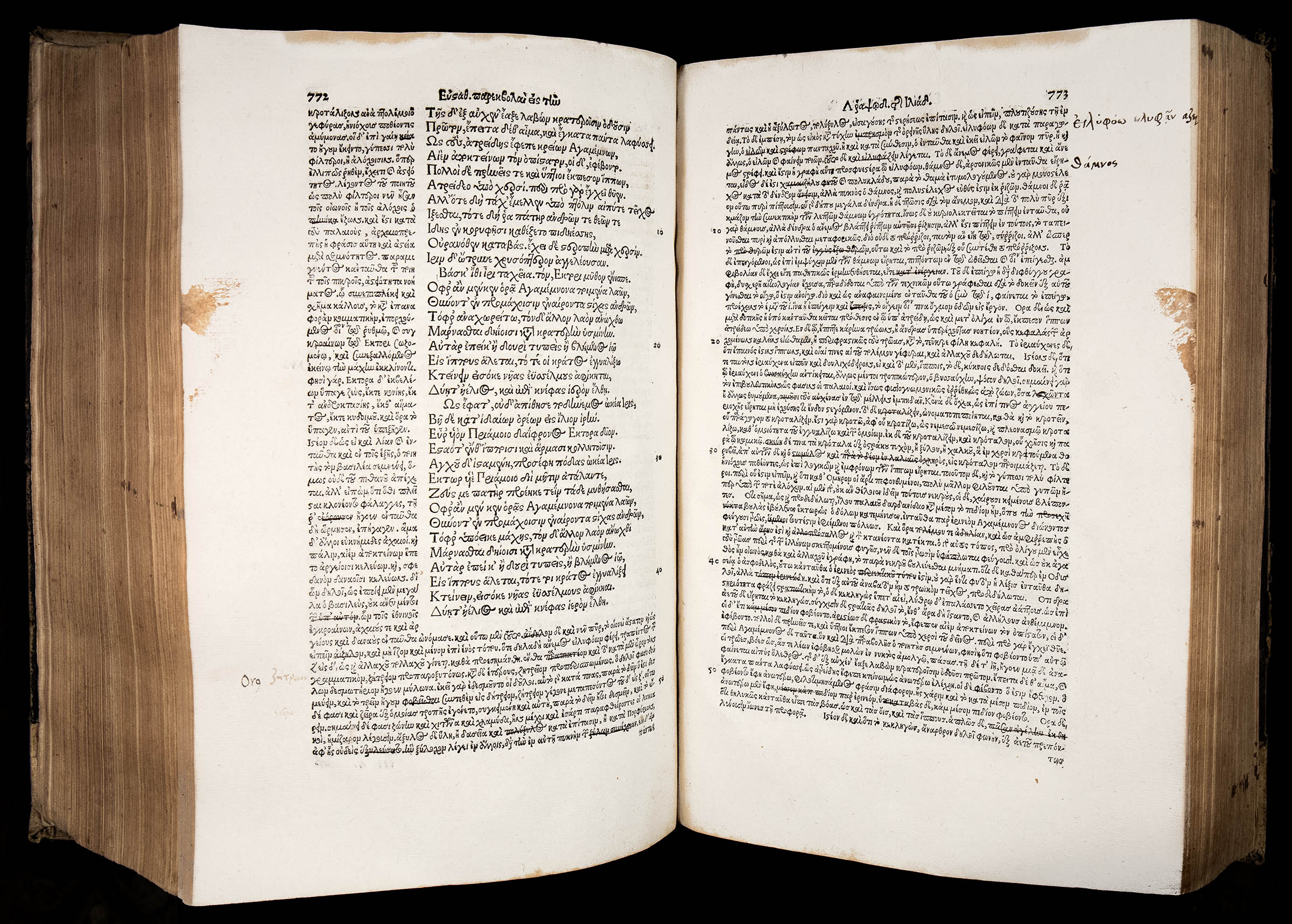
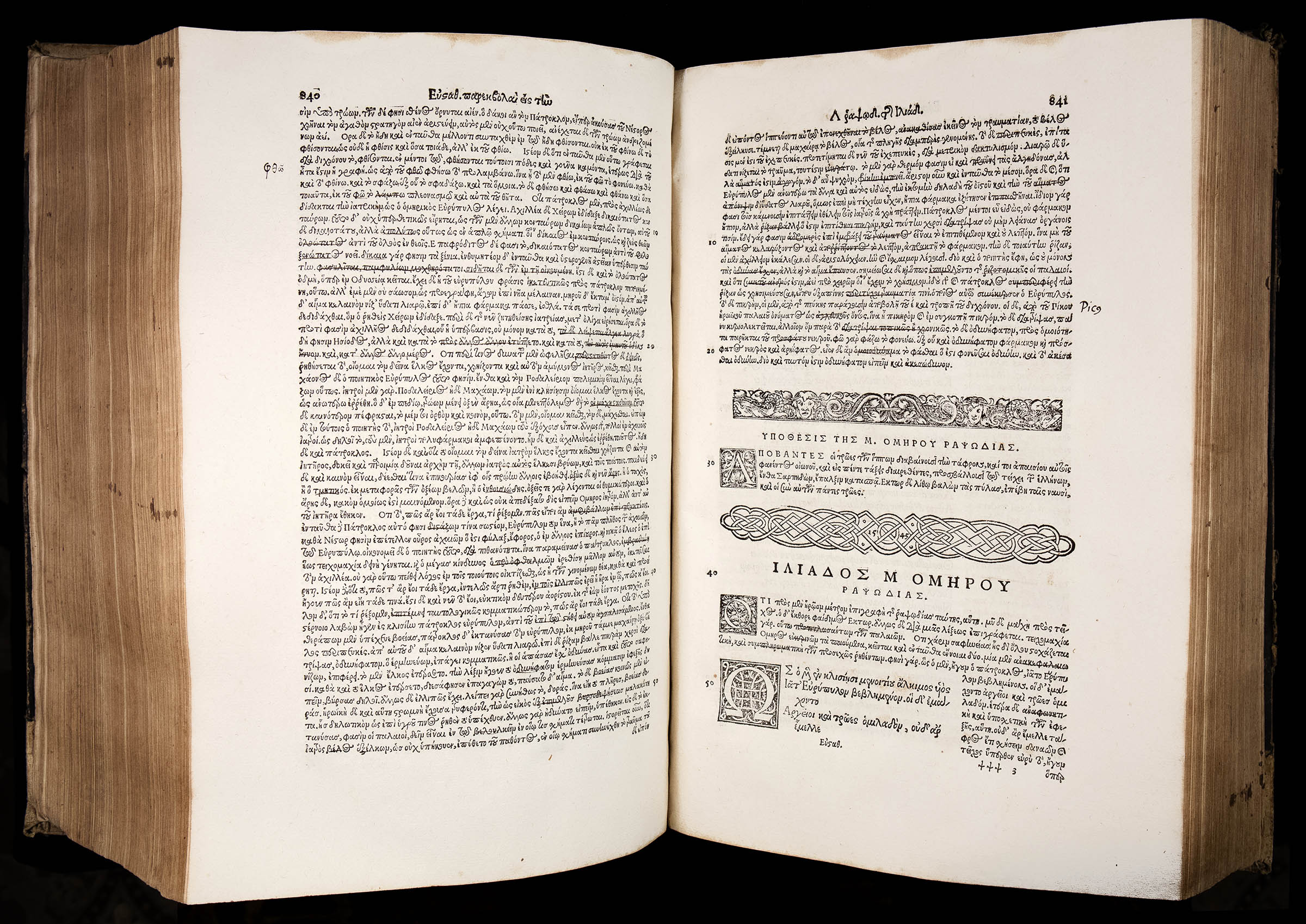
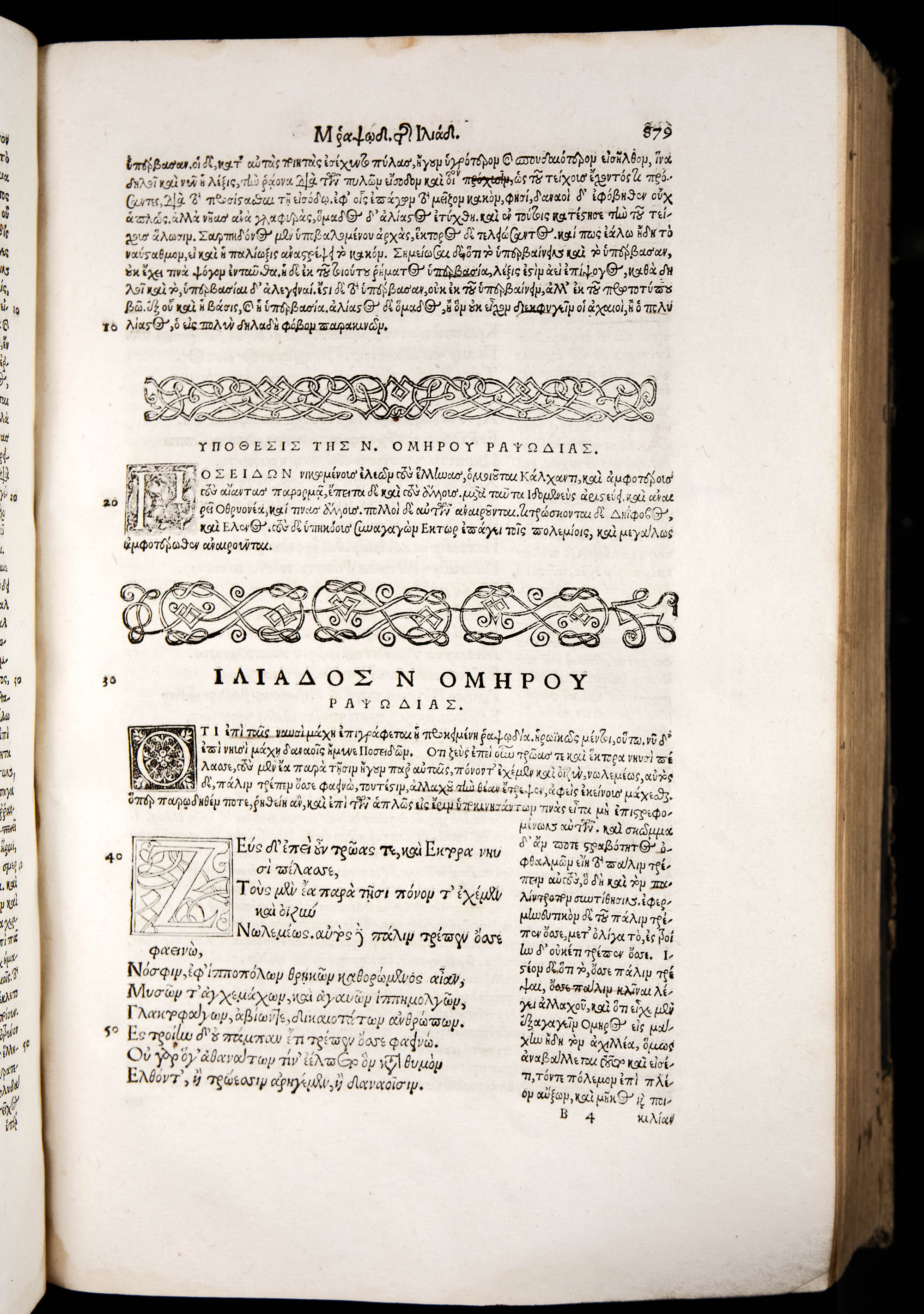
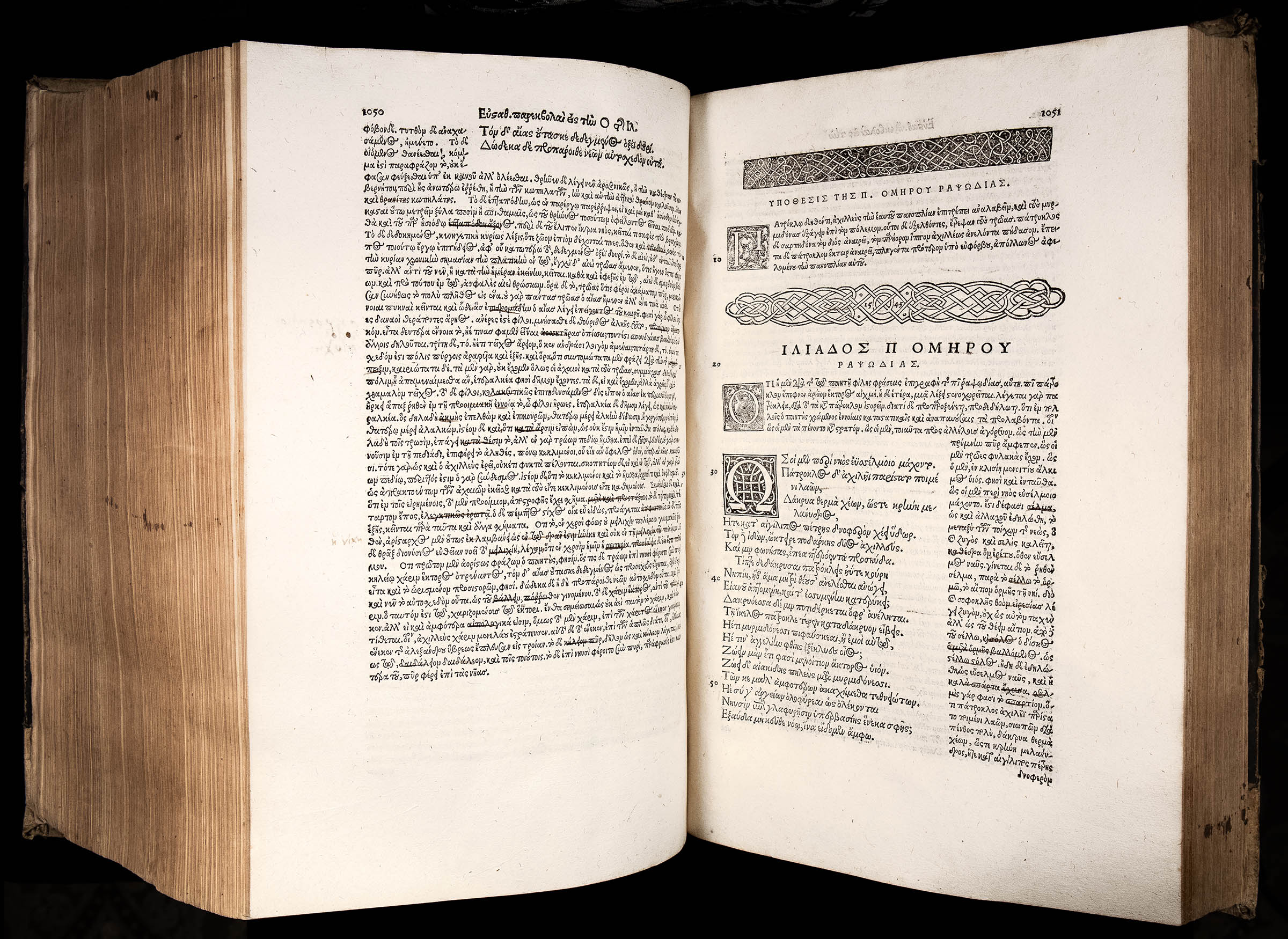
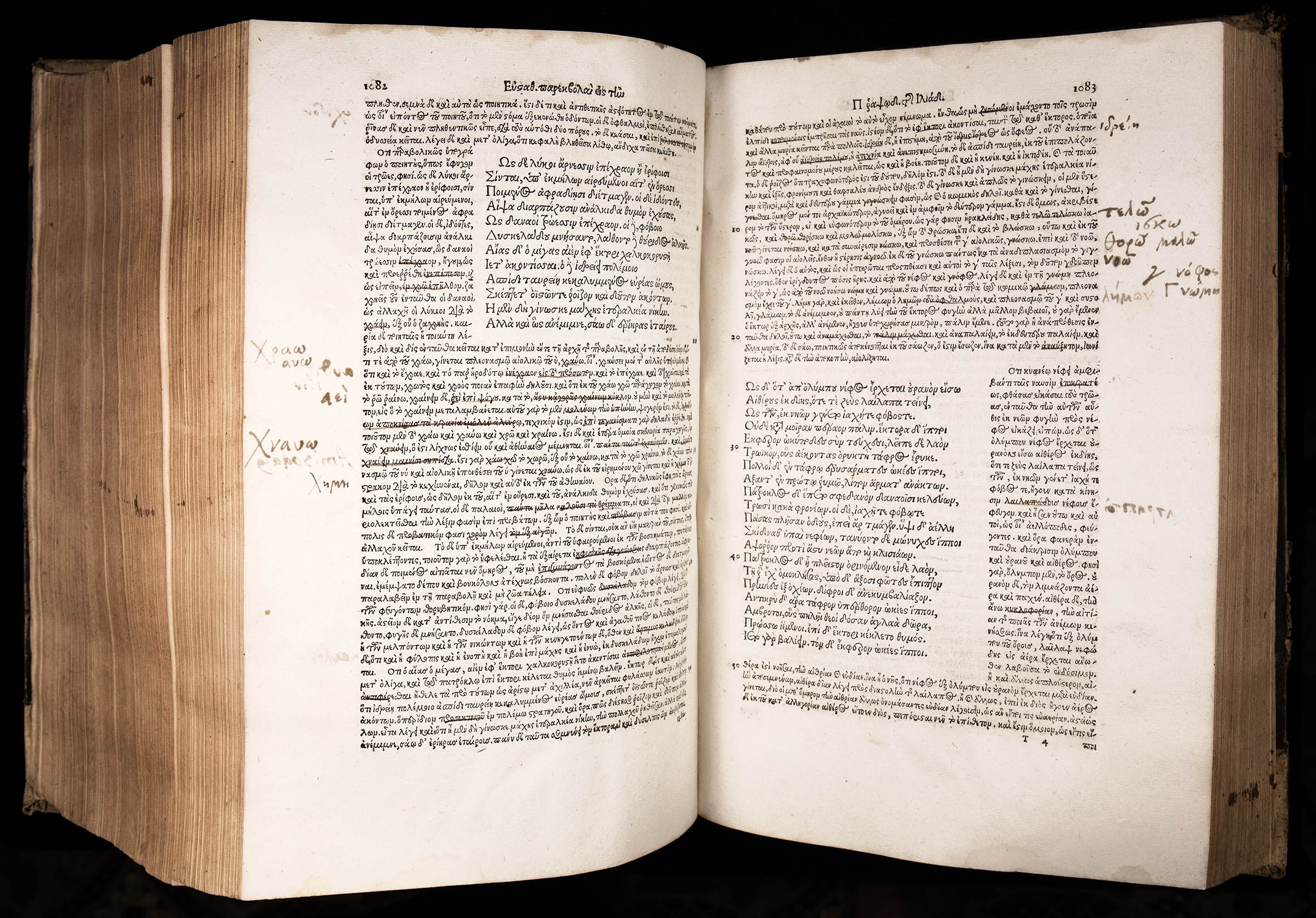
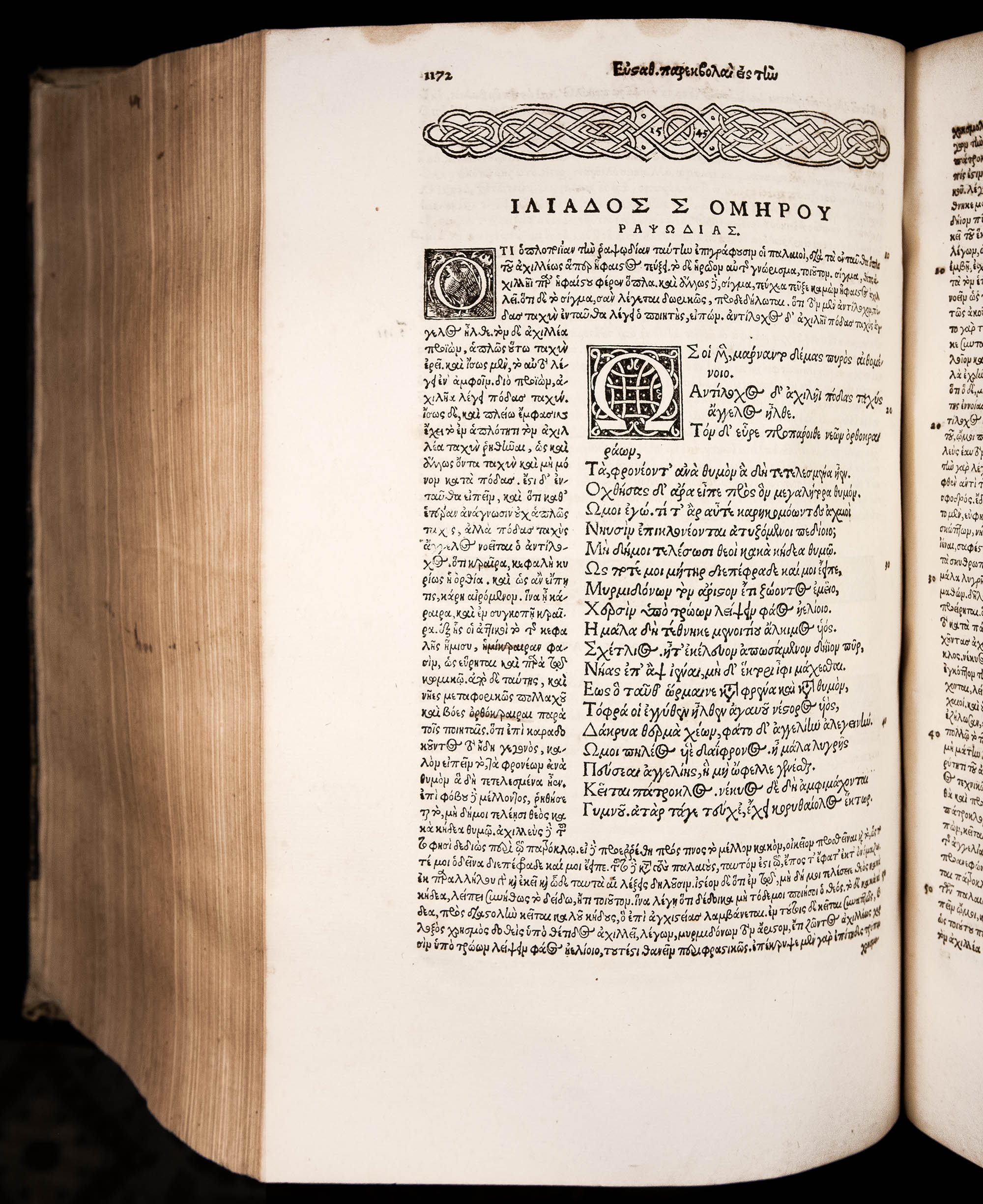
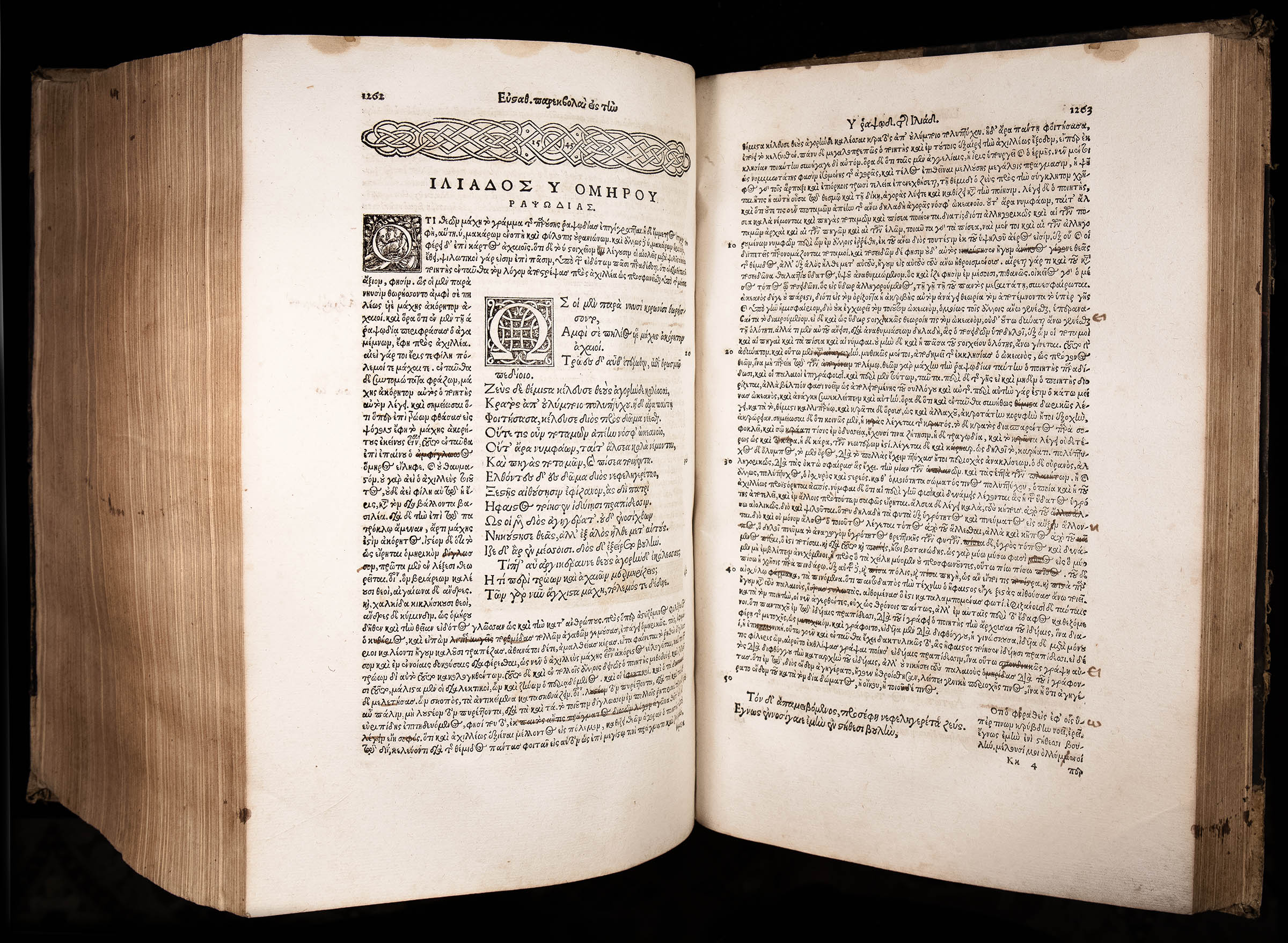
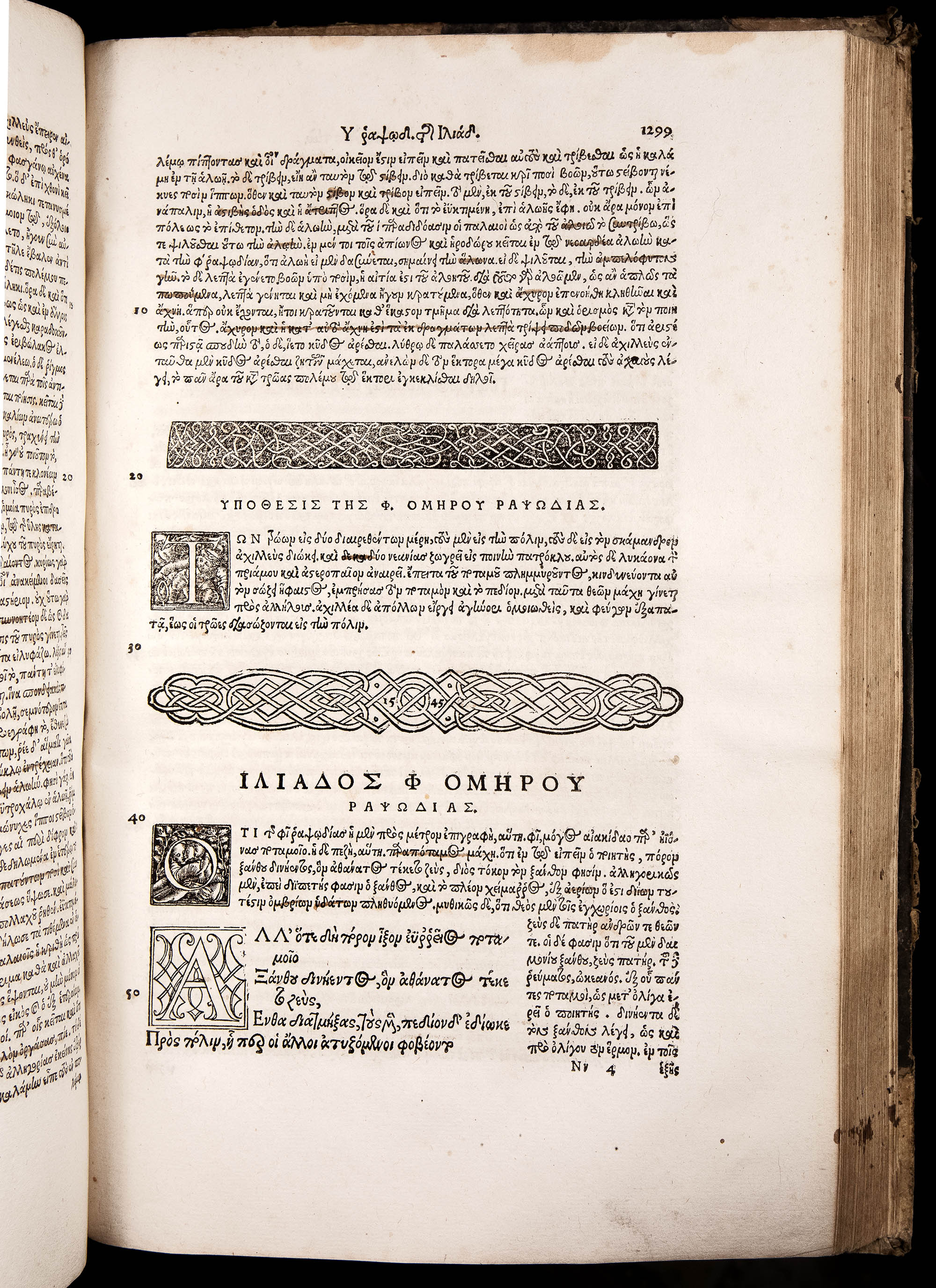
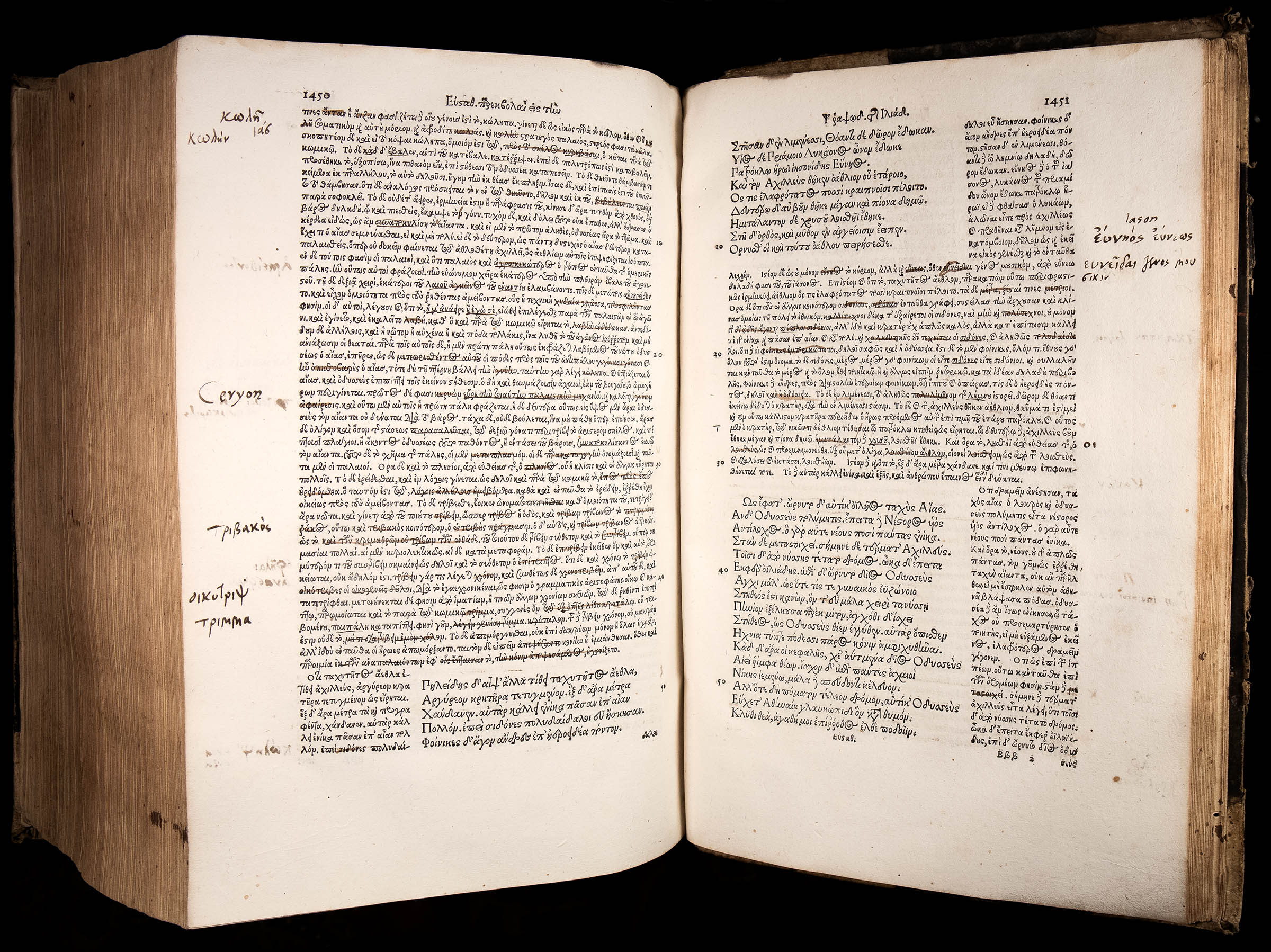
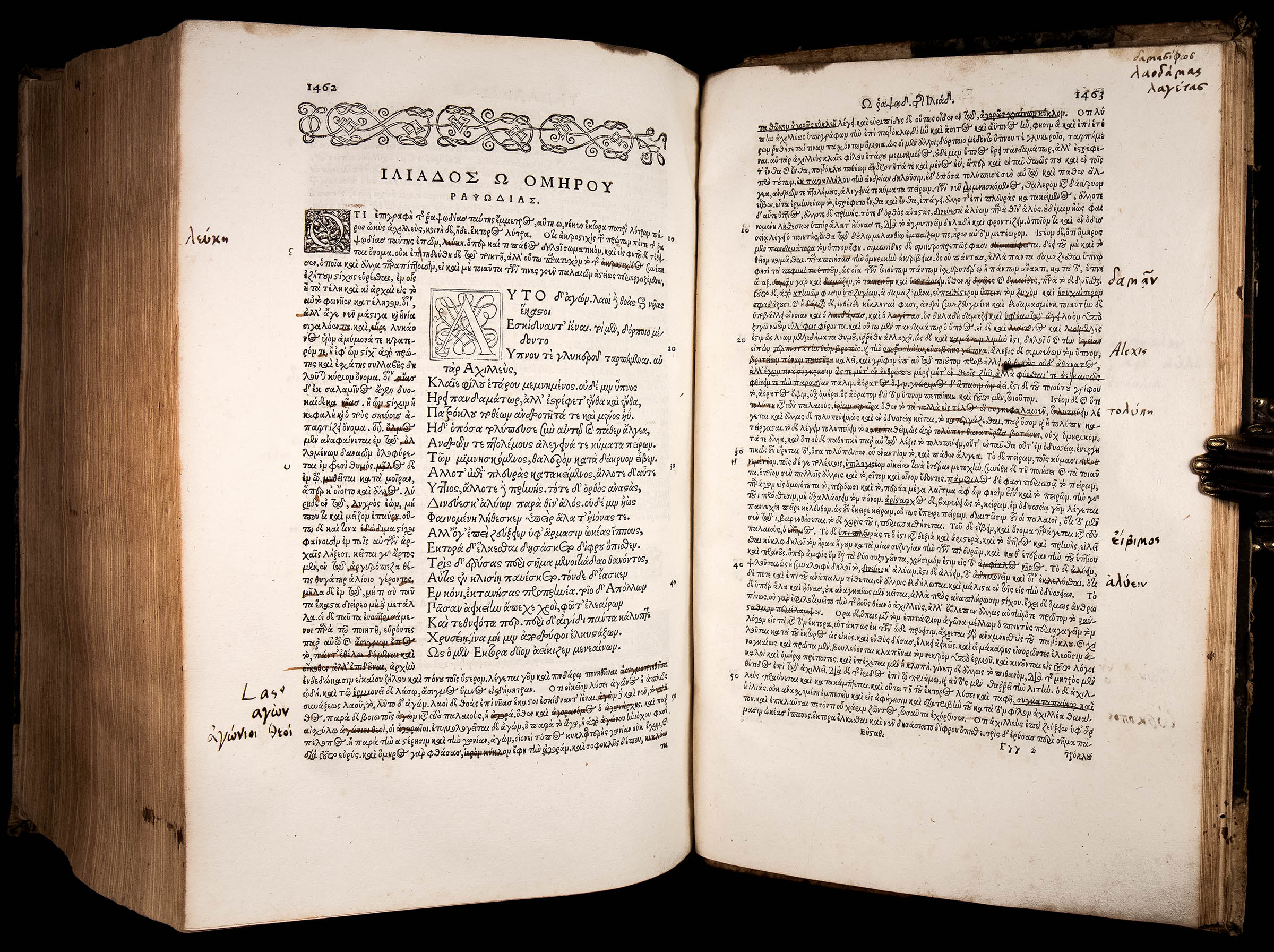
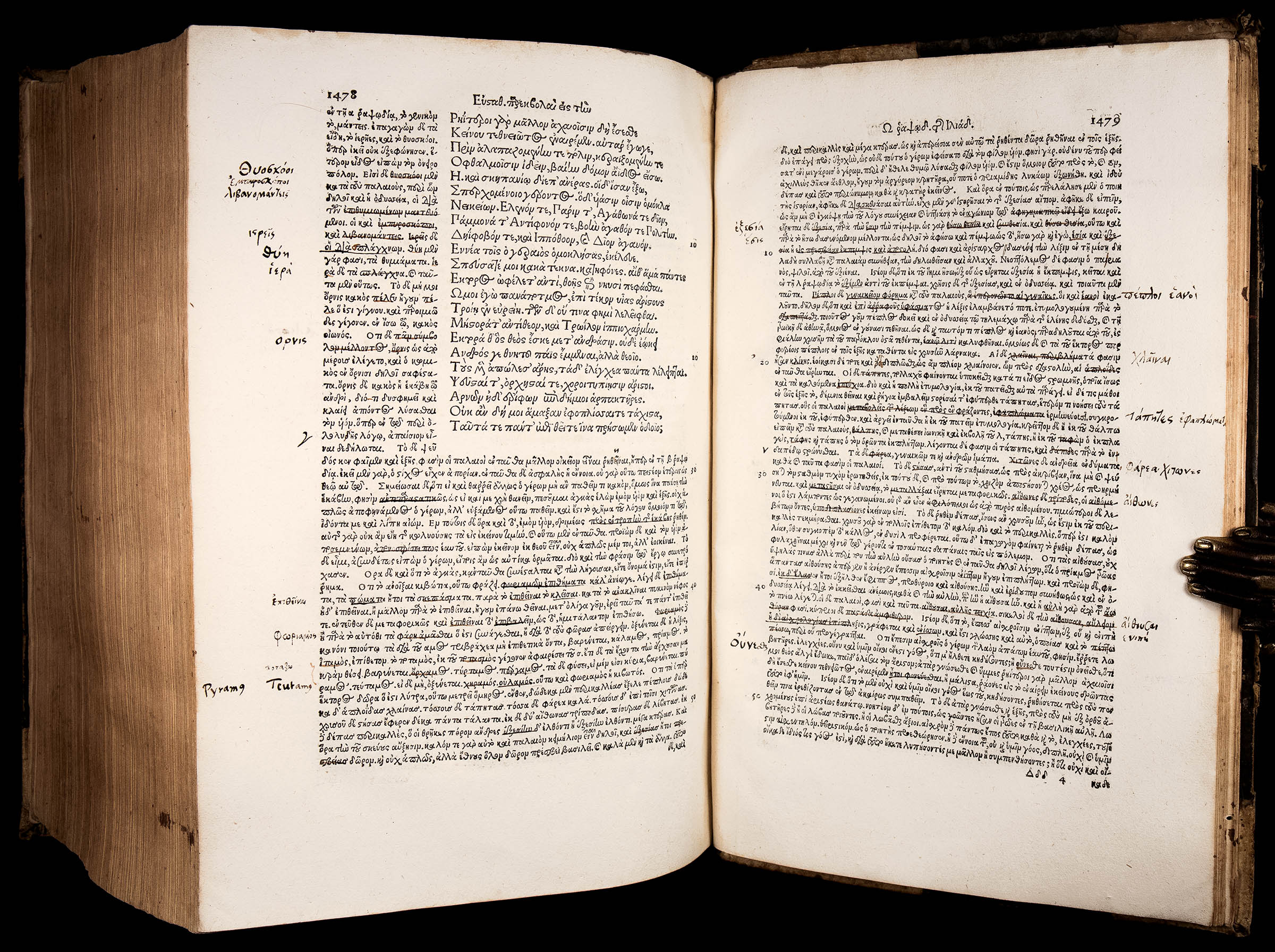
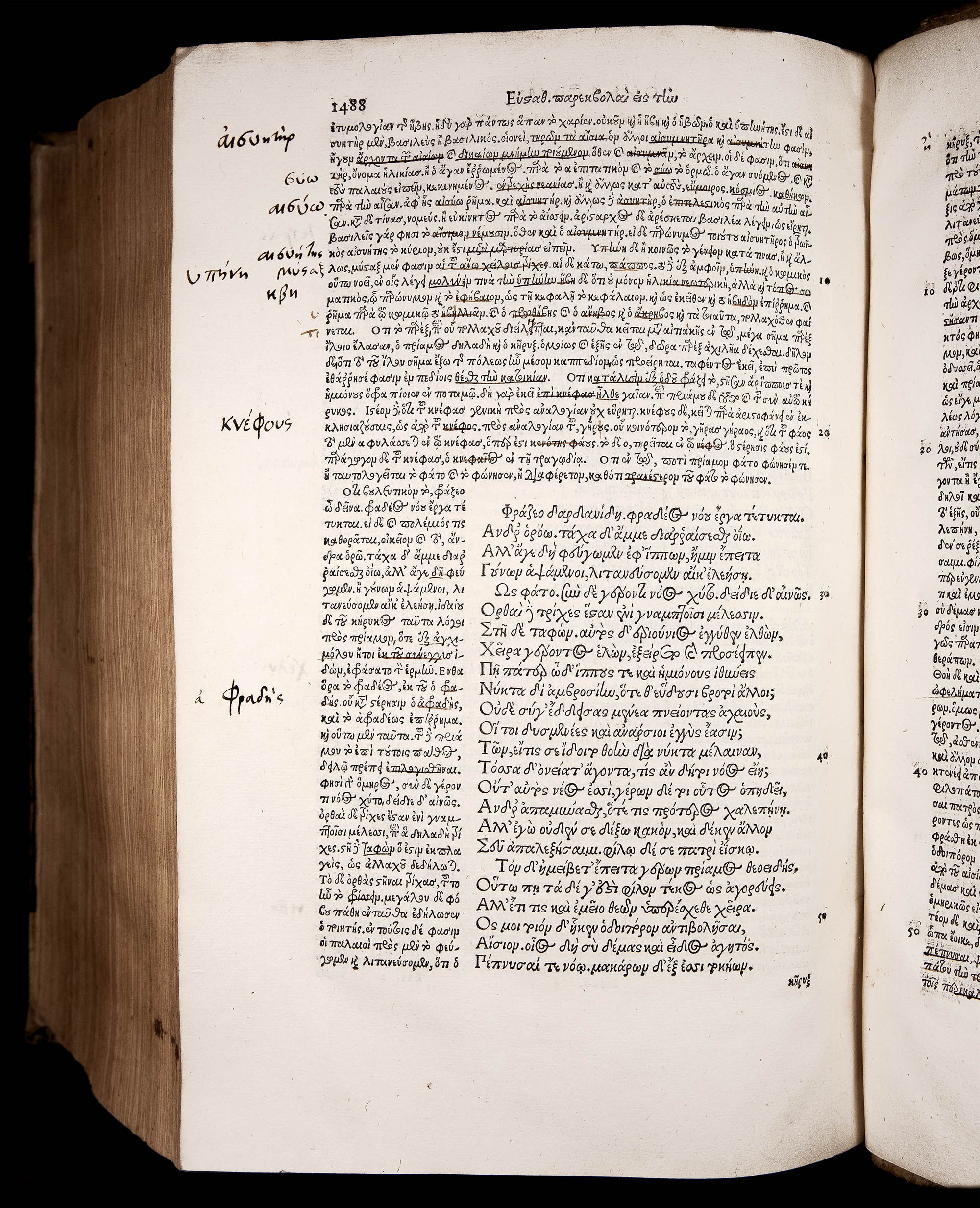
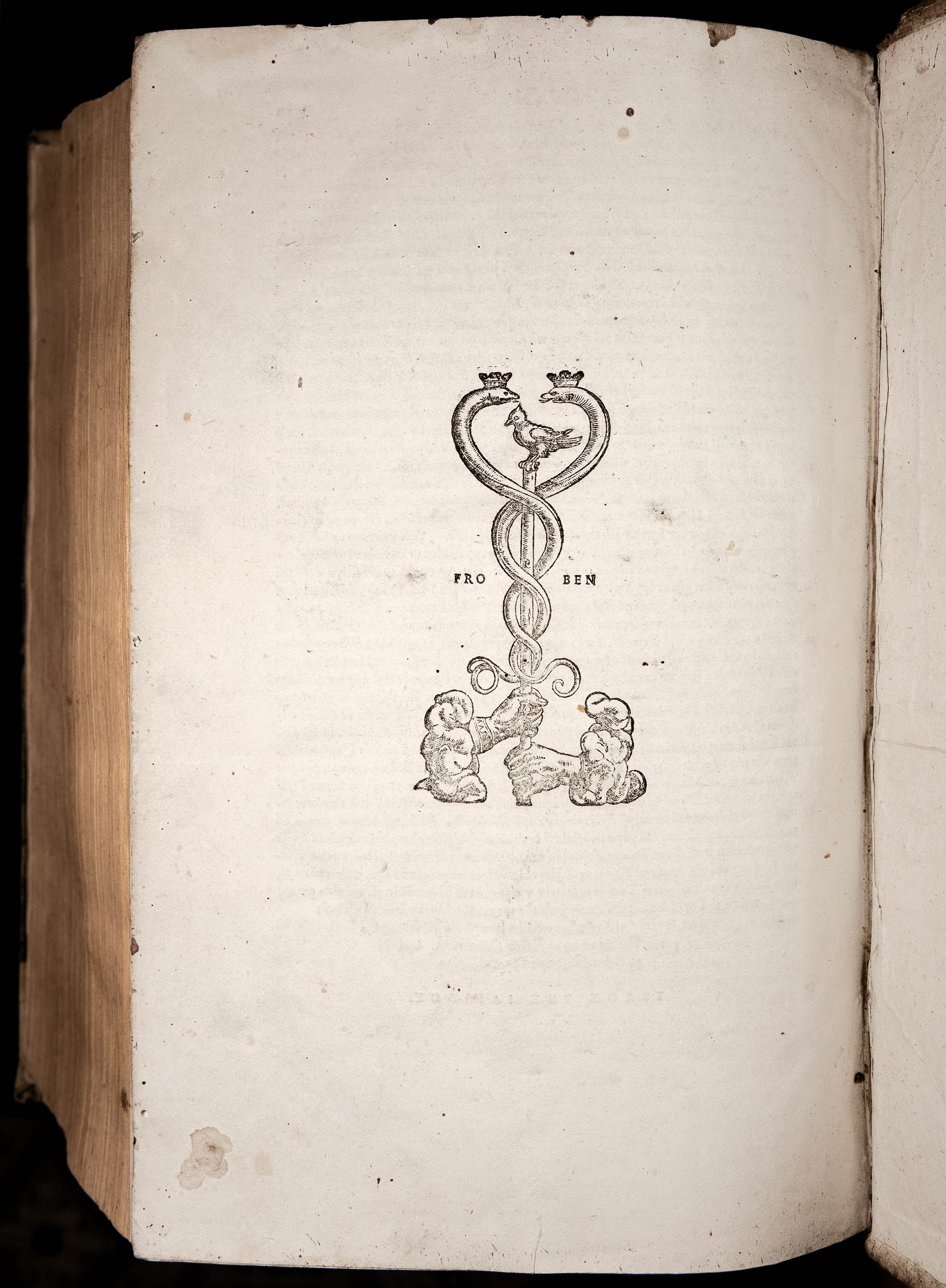
Numerous fine woodcut decorative initials and ornamental woodcut headpieces. Froben’s woodcut device on verso of the final leaf (Ηηη6v). A few woodcut diagrams on p.295. Text of Homer in larger Greek type surrounded by Eustathius commentary in smaller Greek type (with many pages consisting entirely of commentary). Second part with a divisional title (leaf πππ1r); pagination, however, remains continuous. Preliminaries include introductory essays (in Latin) by the editor (Niccolò Maiorano) on both Homer and Eustathius (+2r-6r). Provenance:
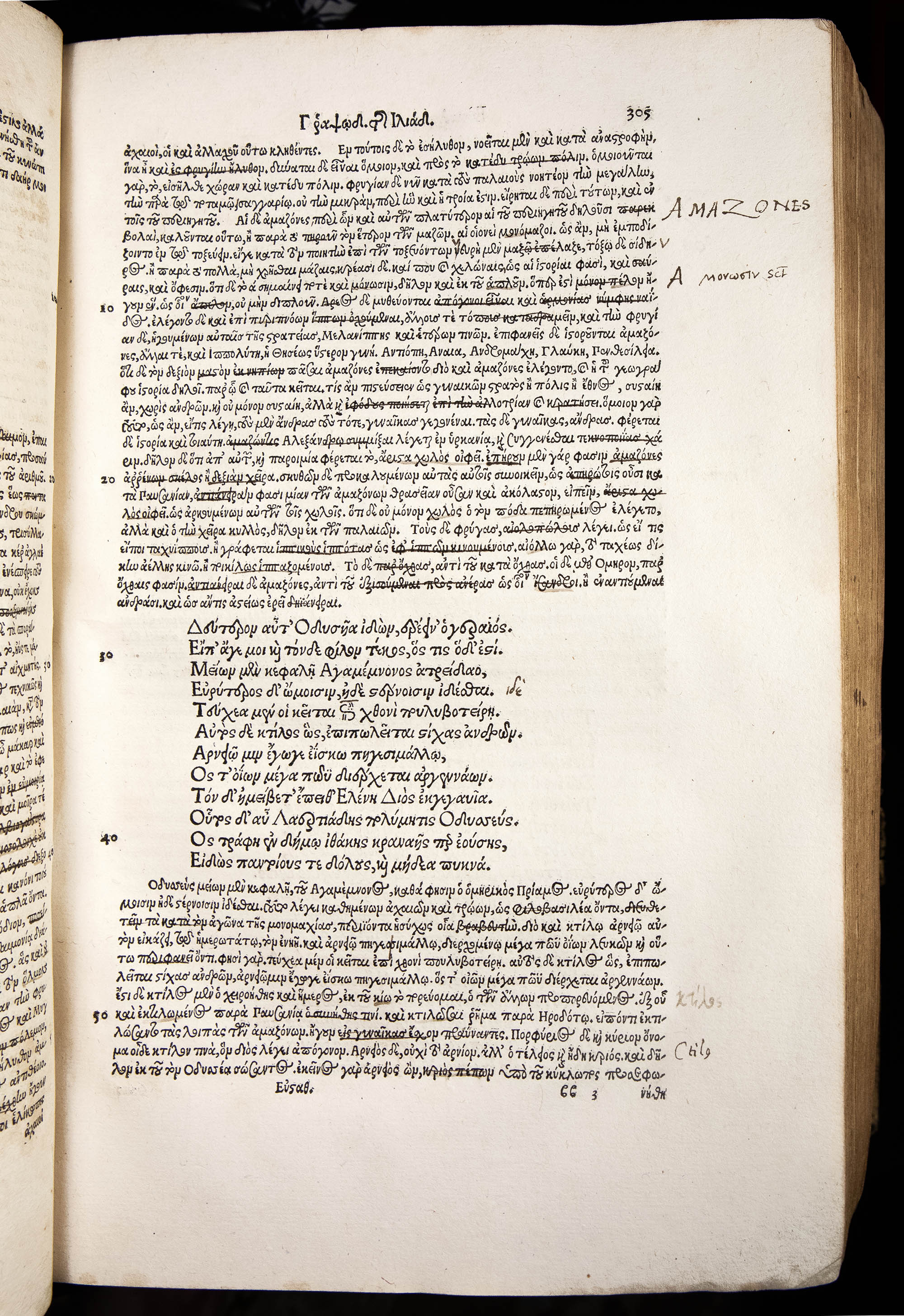
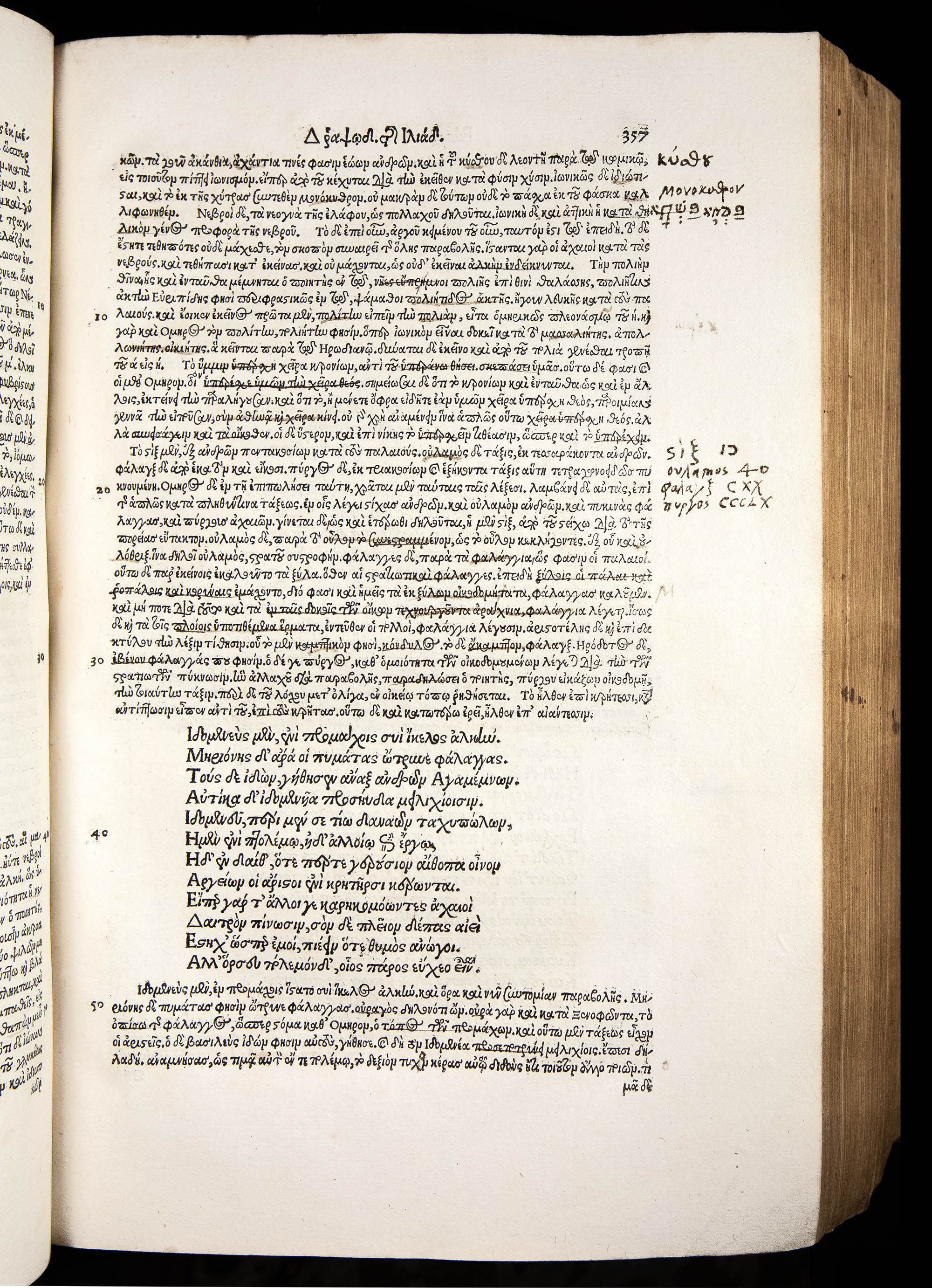
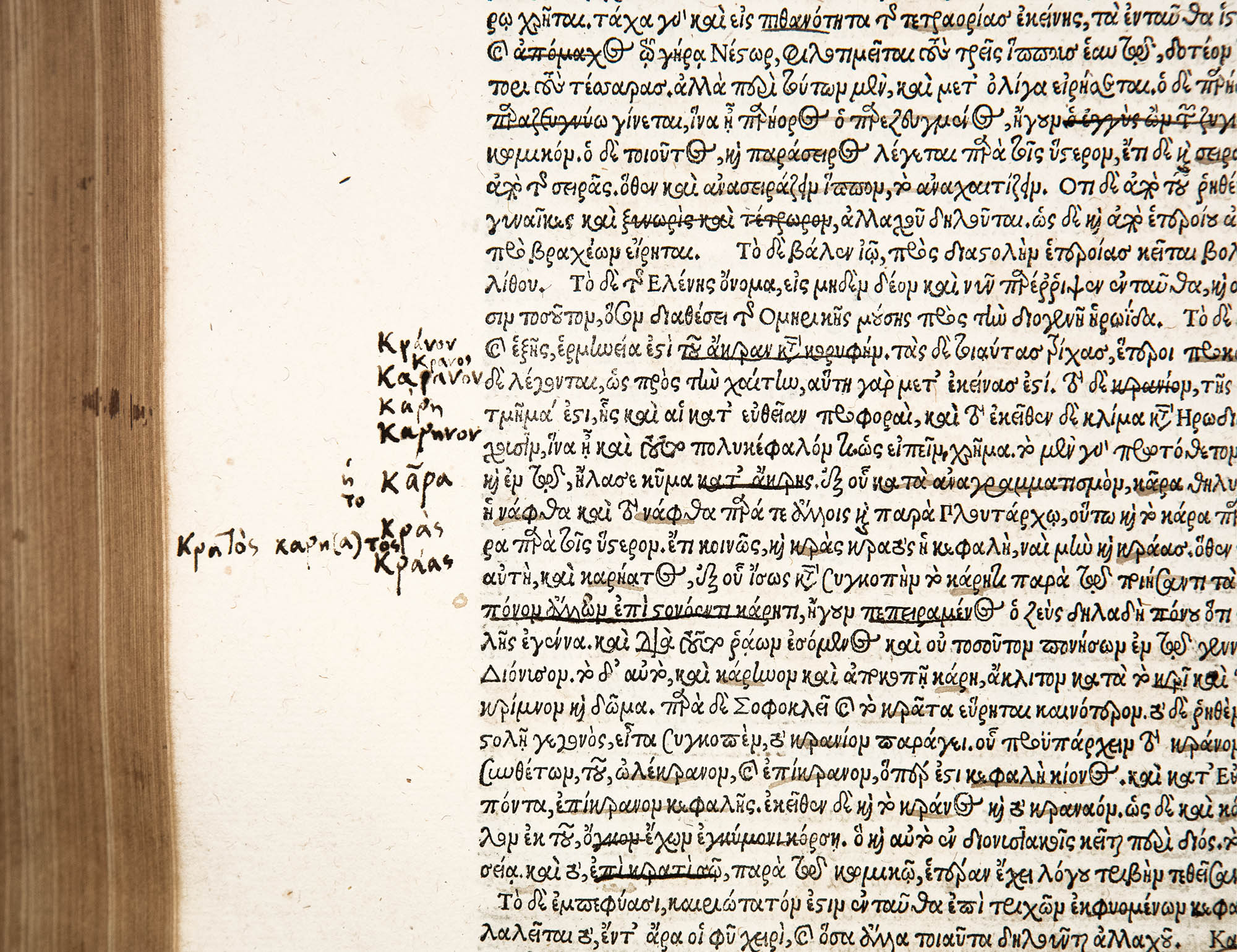
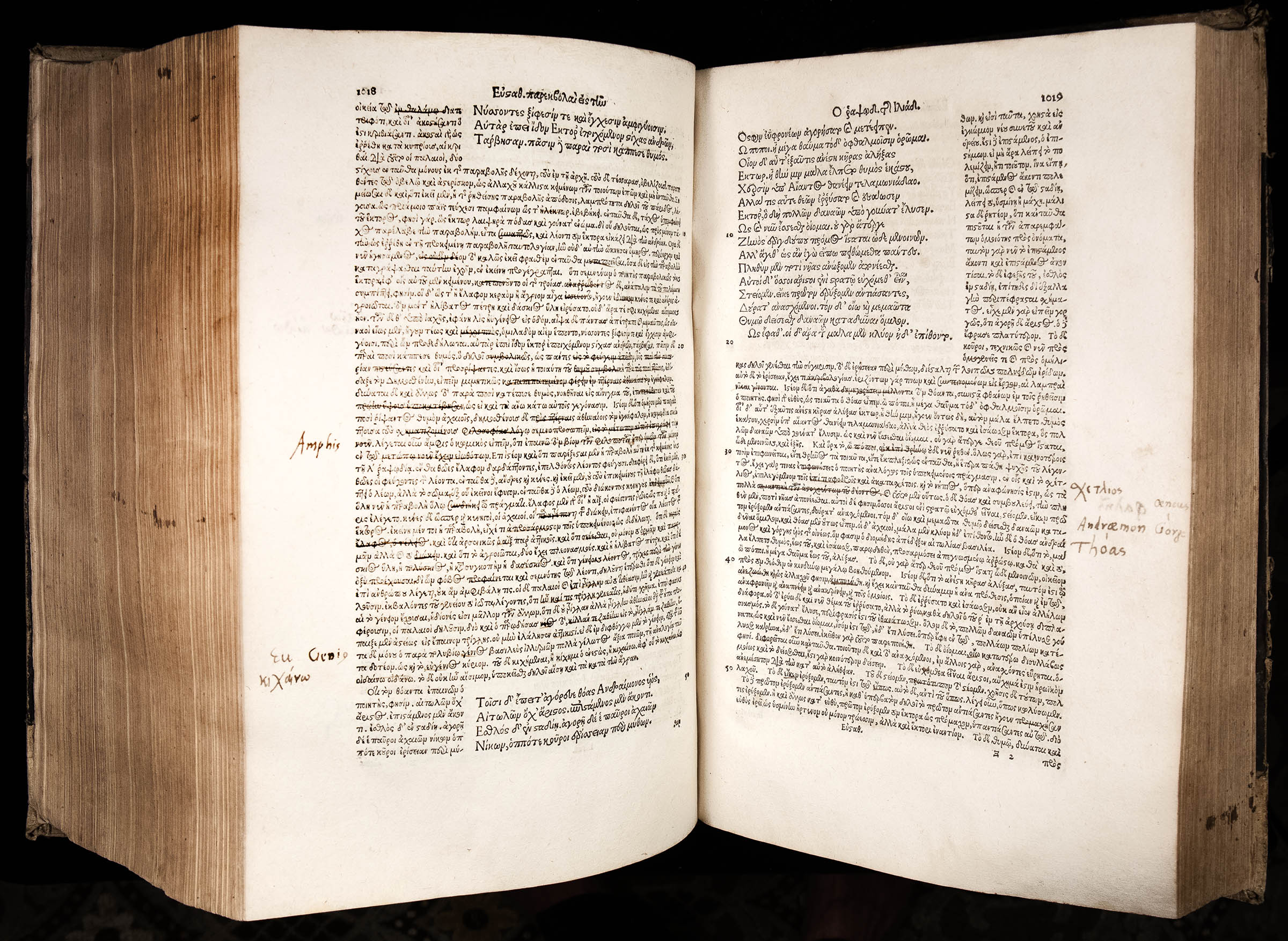
The manuscript substitute title carries a 19th- or early 20th-century stamp of “Fürsten- und Landesschule zu Grimma", known as Gymnasium St. Augustin in Grimma, near Leipzig (East Germany). Founded in 1550 by Duke Maurice of Saxony, it has served for nearly four centuries as a pre-university educational institution, training future civil servants and theologians for the Electorate of Saxony and Central Germany. Numerous manuscript marginalia in Greek and Latin by an (anonymous) late-Renaissance reader. Condition:
Good antiquarian condition. Complete, except for the general title-page (replaced by later manuscript title). Internally with occasional light browning and some light soiling (mostly marginal), occasional very light (and strictly marginal) waters-stains. Numerous pages with early manuscript marginalia and some ink underscoring in text; a few small ink-smudges. Otherwise quite clean and bright. Binding rubbed with some minor scuffs; some wear to edges; top of spine slightly chipped exposing head-band. In all, still a very presentable, solid, wide-margined example of this rare, monumental folio edition, bearing evidence of a careful study by a 16th-century humanist reader, and preserved in its original, very characteristic Renaissance binding. |
|
Please right-click on thumbnails below and choose "open image in a new window" option to see larger images. 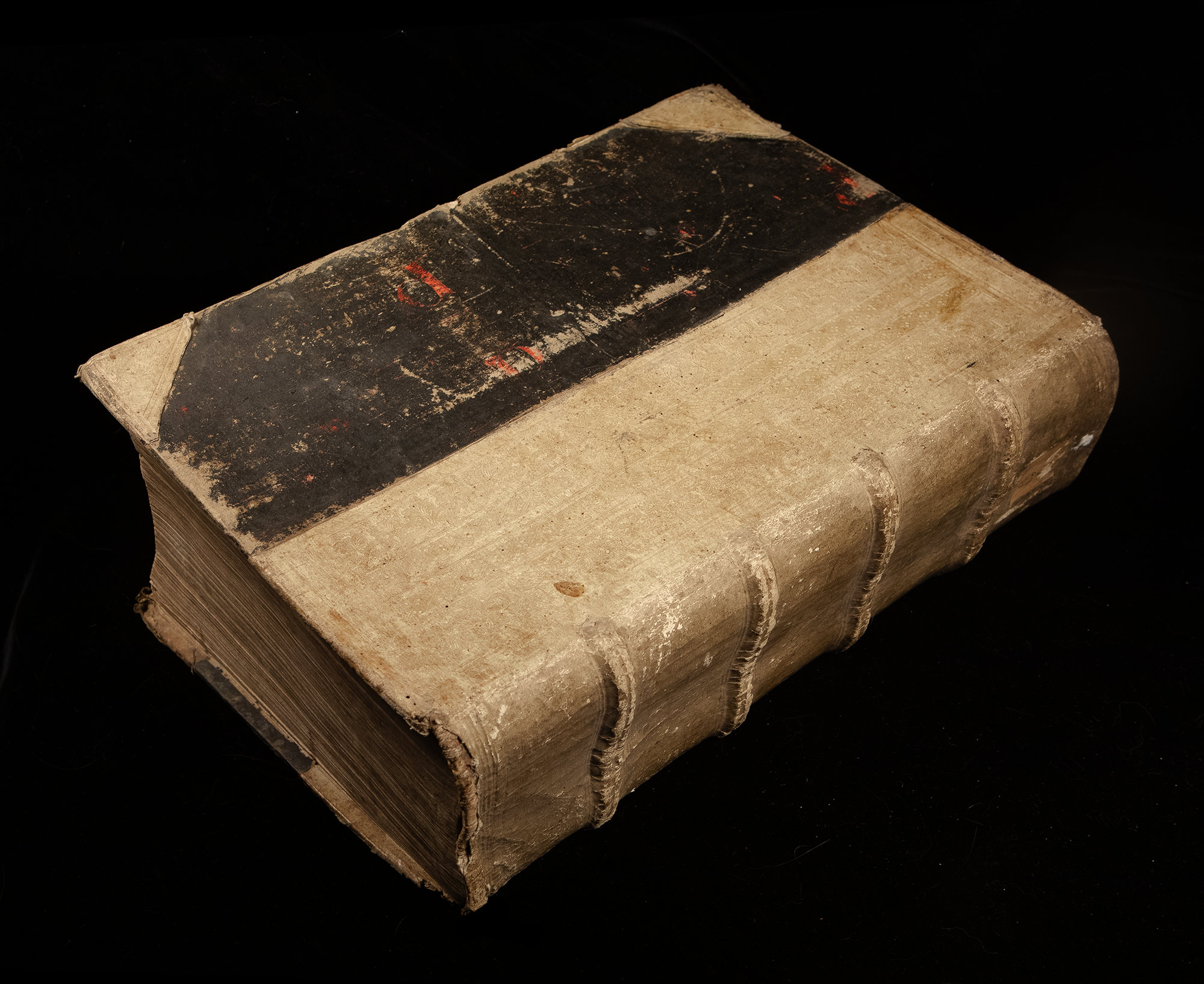
|