

PRODUCT DESCRIPTION
Two marks turn up on every kit ever moulded, and both of them survive ordinary sanding. The first is what is left where the gate was — you nip it, you pare it, you sand it flat, and under a light there is still a faint patch that catches differently from the plastic around it. The second is the parting line, that hairline ridge running down a curved surface where the two halves of the mould met.
Sanding both flat is easy. Getting them invisible is the hard part, because flat is not the same as unmarked. What remains is a field of very fine scratches, too small to see individually and quite big enough to scatter light differently from the surface beside them.
Hobby sandpaper runs out somewhere around #2000 to #2500, which is not fine enough to take that away. This is the tool that finishes the job.
There are five files in this family and three of them are exactly the same size, so comparing them on dimensions tells you nothing. The difference is entirely the shape of the working edges, and this is the plain one.
| MSF-13 | 90 × 13 × 3 mm — the short one, for tight areas and small parts |
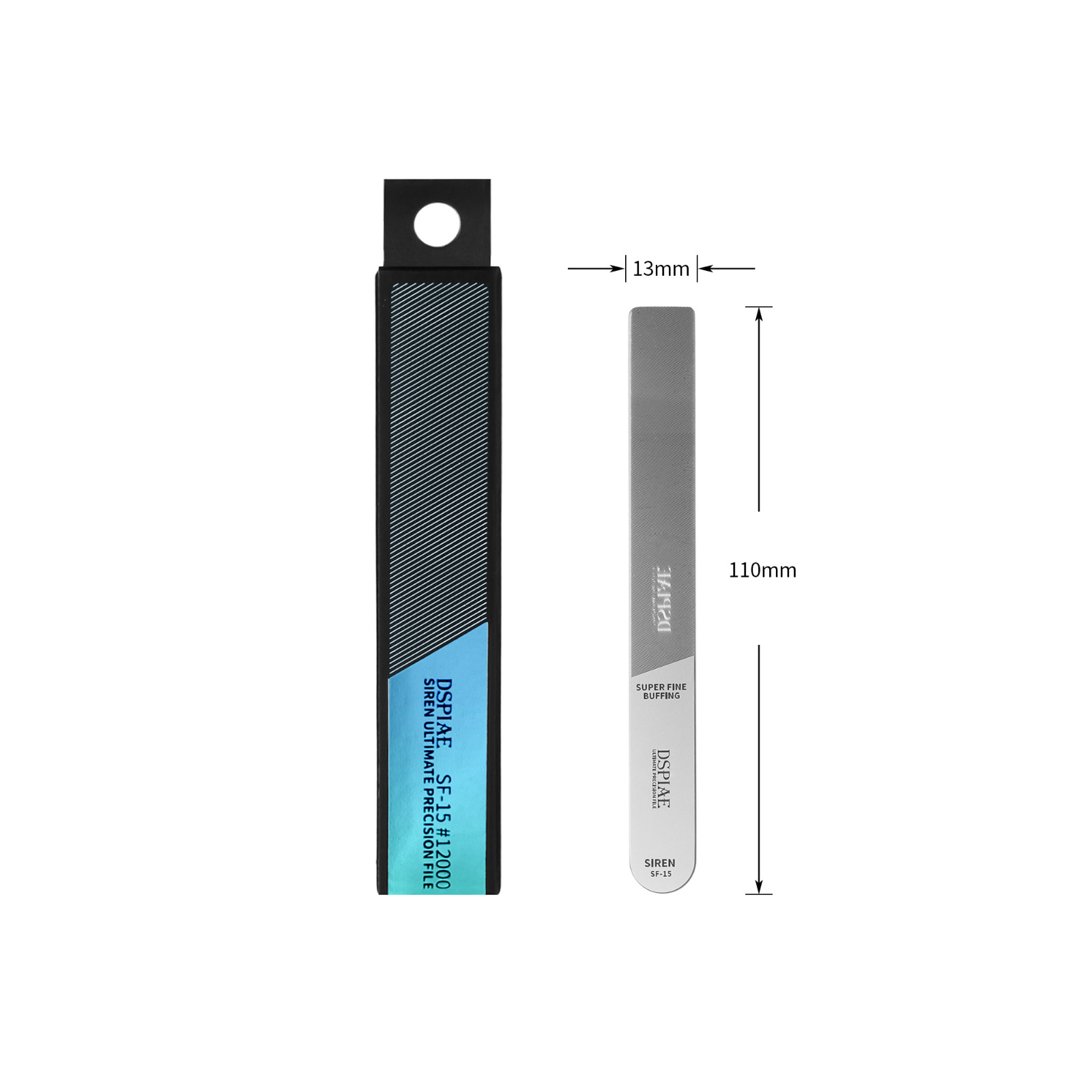
| SF-15 | 110 × 13 × 3 mm, squared — this one. Flat faces, square corners. The default |
| SF-16 | 110 × 13 × 3 mm, irregular profile — for grinding gaps |
| SF-17 | 110 × 13 × 3 mm, sharper and narrower point — for tiny narrow parts |
| SF-20 | 165 × 20 × 3 mm, squared — the big one. Most working surface, most to hold |
| Model | SF-15 |
| Manufacturer's product name | Ultimate Precision Glass Mirror Polishing File, Squared ("Siren" series) |
| Abrasive equivalent | #10000 – #12000 |
| Profile | Squared — flat faces, square edges |
| Material | Tempered glass, nano-textured |
| Dimensions | 110 × 13 × 3 mm |
| Texture | Single-cut, single-direction grain |
| Cleaning | Wash with water — restores full cutting effect |
| Corrosion | Cannot rust |
| Suitable materials | Plastic and wood only — never metal |
| Supplied with | Individual protective case |
| Age guidance | Not suitable for children under 8 |
| EAN | 6977151542878 |
| Country of manufacture | China |
Specifications
- Brand Dspiae
- Type Painting Clips / Part Holders
- Number of Pieces 1
- Grit 10000-12000
- MPN SF-15
- Suitable For Scale Models, Gunpla, Miniatures, Airbrushing, Acrylic/Lacquer/En
- Country of Origin China
- Colour Red / Black

Welcome to Hobby Heaven!
We're a brand built by passionate hobbyists for hobbyists. Our mission is to support all your creative endeavors, whether you're into modeling, wargaming, crafting, or art. As enthusiasts ourselves, we understand the importance of quality supplies at affordable prices.
Our carefully curated selection of high-quality materials is designed to inspire and empower hobbyists and artists alike. We're particularly proud of our innovative, cost-effective basing system - a game-changer for modelers and wargamers looking for professional results without breaking the bank.
At Hobby Heaven, we're dedicated to providing exceptional customer service and ensuring your creative projects are a success. Our team is always ready to offer advice, share techniques, or help you find the perfect supplies for your next masterpiece.
Thank you for choosing us as your trusted partner in creativity. We're excited to be part of your hobby journey!
We accept payment by PayPal and Credit / Debit cards entered on eBay only. You must be registered with PayPal or eBay to buy from us.
Please ensure that all items are returned in their original condition. Returns are processed within 1-2 business days of receipt. Refunds are issued minus the original shipping cost. All returns are handled in accordance with eBay's policies.
At Hobby Heaven, we strive to provide our customers with the best possible online shopping experience. Our commitment to excellent customer service extends well beyond the delivery of your order.
We encourage you to reach out with any questions or concerns regarding your purchase. The most convenient way to contact us is through the eBay messaging system.
Our dedicated customer service team responds to messages within 24 hours, Monday through Friday, between 8:00 AM and 3:00 PM GMT.
Your satisfaction is our top priority. We're here to help and look forward to assisting you!
WHAT OUR CUSTOMERS ARE SAYING ABOUT US
| Order delivered on time with no issues | samki_7639 (16 ) |
| Order delivered on time with no issues | cus_7236 (241 ) |
| Item received. Thanks. | handofganesh (228 ) |
| Order delivered on time with no issues | smigg-the-mi (92 ) |
| Order delivered on time with no issues | hariali (168 ) |