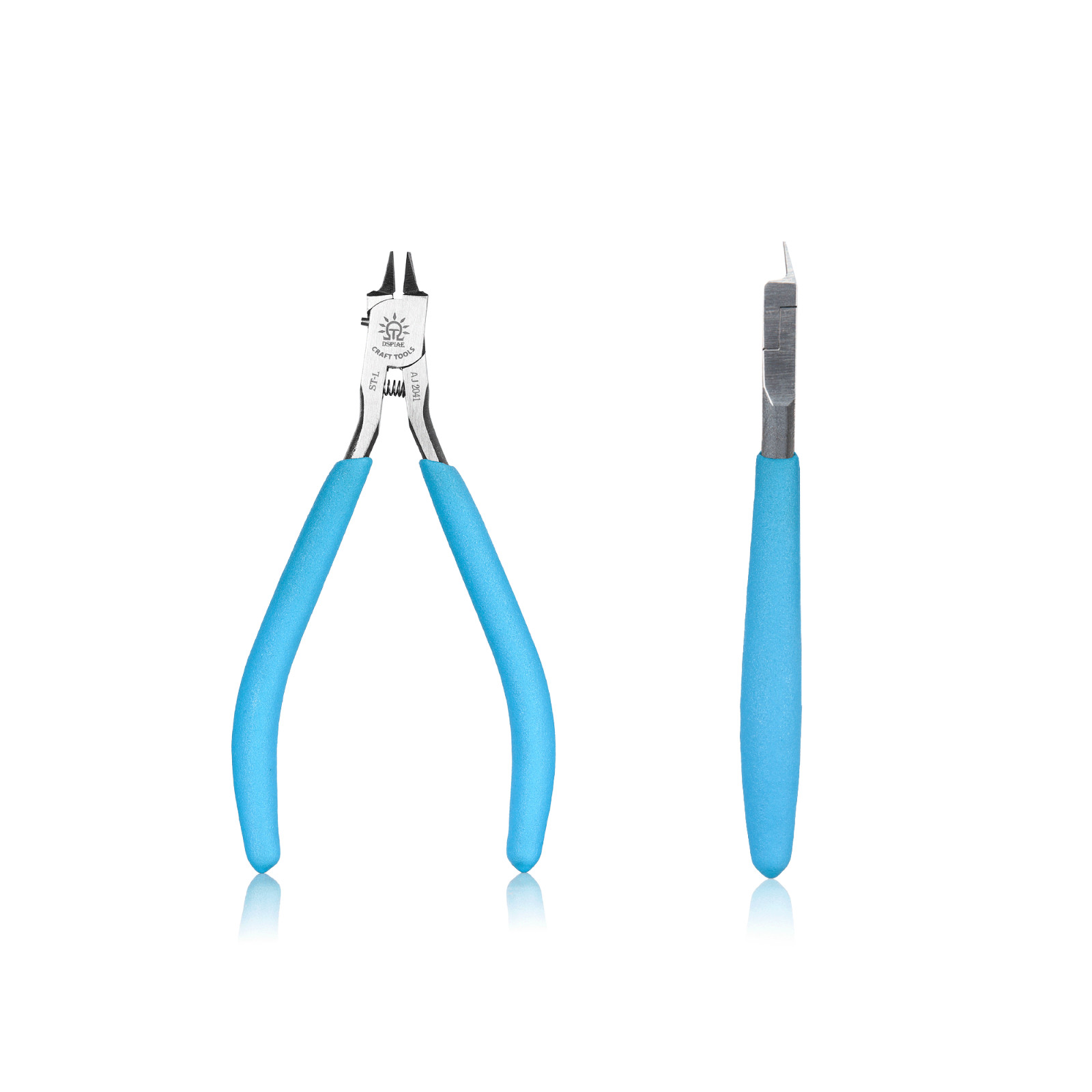
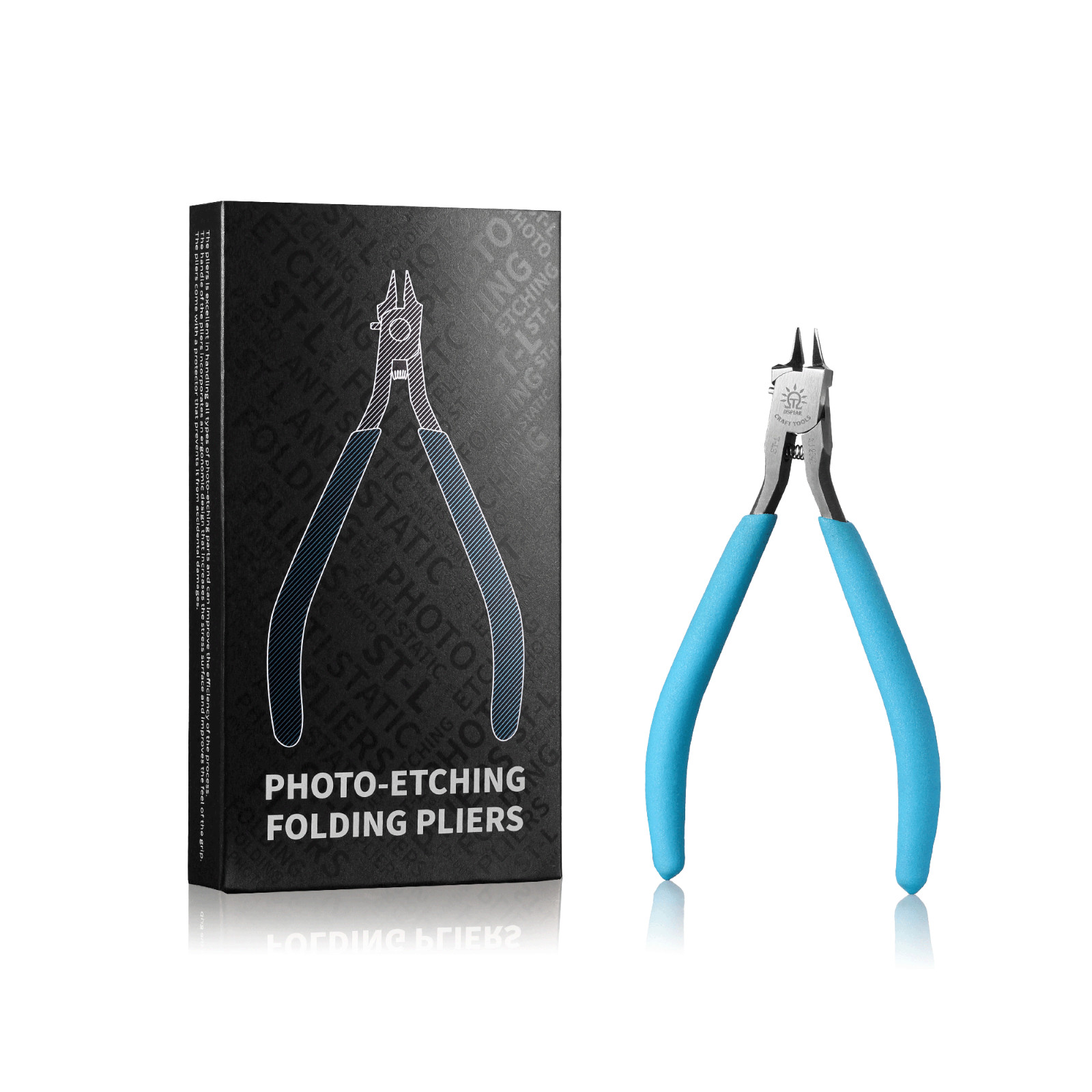
DSPIAE | ST-L
Edgeless PE Bending Pliers
1 mm flat jaws that fold photo-etch cleanly and leave no mark behind
⚠️ This is not a cutter. Using it as one will break the jaws.
It is roughly the same size and shape as DSPIAE's nippers, it carries the same ST- prefix, and half the shops selling it file it under nippers. It is none of those things. There is no cutting edge on this tool at all — the jaws are flat, milled and 1 mm across, made to grip and fold.
Squeeze it onto a sprue gate and you are putting a cutter's force through a pair of thin flat jaws that were never designed to shear anything. They will bend or snap, and there is no repairing that. If you want a nipper, we sell those separately and we would much rather point you at one than sell you this by mistake.
📌 The problem this solves
Photo-etched brass is a few tenths of a millimetre thick and it folds exactly once. Get the line wrong and you have a part with a crease where no crease belongs; the metal work-hardens at the fold, so straightening it and going again usually means snapping it.
Folded with ordinary pliers, two things go wrong at once. The fold line ends up wherever the jaws happened to sit rather than where you wanted it, because you are eyeballing a line you cannot see once the jaws are over it. And the serrations that make ordinary pliers grip press themselves permanently into soft brass — usually on the face that ends up outward, where sanding is not an option.
This tool exists for that specific job. Flat unserrated jaws, milled to a known width, thin enough to reach into places a bench bender cannot.
🔧 What the design actually buys you
▪ 1 mm jaws — that is a gauge, not just a size boast. Every listing quotes "1 mm when closed" and stops there. The useful part is that the jaw is milled to a known width, so it doubles as a measuring reference: set the jaw edge on the fold line and the jaw width tells you exactly how much material stands proud. Step along it and you get repeatable 1 mm increment bends — which is how a photo-etch part folds into a crisp box section instead of a trapezium, without marking anything out first.
▪ Flat and unserrated. Ordinary pliers are textured to grip. On brass this thin, texture is not grip — it is an impression, permanently pressed into a visible surface, and unlike plastic there is nothing you can sand it out with. These jaws hold firmly and leave the surface as they found it.
▪ Thin enough to reach. A bench bender needs the fret flat on a table with clear access from above. Real builds are not like that. Half the folds you actually need to make are on a part already fitted to the model, in the middle of a curve, or on a bracket too small for a table to grip. This is the tool for all of those.
▪ A limiting lever built into the body. It stops the jaws being over-spread or over-pressed — the two things that finish off a pair of thin flat jaws. Same thinking DSPIAE apply across the ST- range, and it is why the tool tolerates being used properly for years.
▪ Carbon steel, and a genuinely useful side job. Hard and strong with low plasticity, which is what lets it form brass sheet and copper wire rather than just squash them. It also makes an excellent third hand — holding a tiny part steady while cement sets, without leaving a print on it.
🤔 Pliers or a bending table?
| ST-L | This tool. Handheld. Small parts, awkward corners, curved and stepped folds, work already on the model, holding while gluing |
| AT-MPB | Compact bench bender. Twelve small teeth plus a short-side tooth. Bench folding on smaller frets |
| AT-PB | Full bench bender, 177 × 91 × 30 mm. Fourteen small teeth plus a long-side tooth, two tables, transparent bending plate |
Straight answer: if most of your photo-etch work is long straight folds across a big fret — engine grilles, hull sides, railings — buy a bench bender instead of this. A table with a proper clamping bar will beat handheld pliers on a 60 mm straight fold every single time, and the AT-PB even has a transparent bending plate so you can see the line you are folding to. This tool is not competing with that. It does the folds a table physically cannot reach, and if you do this hobby seriously you will eventually want both.
📦 What's in the box
✔ 1 × DSPIAE ST-L edgeless bending pliers
✔ 1 × protective cover for the jaws
✘ No photo-etch parts — this is the tool only
✘ No bending table — AT-MPB and AT-PB are separate products
✘ No protective oil, and carbon steel does want some. See the limitations below
📏 Specifications
| Model | ST-L |
| Manufacturer's product name | Edgeless PE Bending Pliers |
| Jaw width when closed | 1 mm |
| Jaw surface | Flat, milled, non-serrated — no cutting edge |
| Material | Carbon steel |
| Jaw protection | Limiting lever against over-spreading and over-pressing |
| Handle | Hand-fit frosted polyethylene, ergonomic profile |
| Length | Approx. 120 mm |
| Intended use | Bending, clamping and indenting photo-etch, brass sheet, copper wire and small plastic parts |
| Not for | Cutting anything, of any material |
| Country of manufacture | China |
DSPIAE do not publish a net weight for the ST-L and we could not find a barcode issued for it, so neither appears above. We would rather leave a gap than fill it with a figure we cannot stand behind.
💡 Getting clean folds
Anneal first if the brass is fighting you. A moment over a flame and a cool down leaves photo-etch noticeably softer and far less likely to crack at the fold. Small parts do not need much heat at all, and this is the single technique that separates frustrating photo-etch from pleasant photo-etch.
Grip first, then fold with something else. Clamp the fret so the fold line sits exactly at the jaw edge, then bring the free side up against the jaw face with a flat tool or a fingernail. Trying to fold by twisting the pliers themselves puts the bend wherever the jaws end up, not where you set it.
Use the jaw as your ruler. For a 1 mm flange, let 1 mm of material stand proud of the jaw. For 2 mm, step along and fold twice. You will get more consistent boxes this way than by measuring.
Over-bend very slightly on tight radii. Brass springs back a little. On a 90° fold, taking it a couple of degrees past and letting it relax lands closer to square than stopping exactly at 90.
Do not squeeze harder to make a difficult fold happen. If it is not going, the metal needs annealing or the grip needs repositioning. Force is what damages the jaws, and the limiting lever is there to stop you rather than to encourage you.
Put the cover back on. Two thin jaws loose in a drawer with other steel tools is how the tips end up out of true, after which every fold is slightly off and nothing looks obviously wrong.
⚖️ Honest limitations
It cuts nothing. Not sprue, not wire, not fret tabs, not anything. Stated at the top and repeated here because it is the one thing on this page that can cost you the tool on day one.
It is the wrong tool for long straight folds. A bench bender does that job better and we would rather send you to one than take the sale.
Small work only. 1 mm jaws are for delicate parts. This is not a tool for bending structural brass or anything with real thickness to it.
Carbon steel rusts. There is no stainless here, and no oil in the box. Wipe it after use and give it a trace of light oil if your hobby space is cold and damp over winter.
The limiting lever protects the jaws; it does not make them indestructible. Over-pressing is still the main way these end up damaged, and the lever only limits travel — it cannot stop you leaning on the handles.
It does not replace tweezers. For picking up and placing tiny parts, tweezers are quicker and more controllable. This is a forming tool that happens to hold things well, not a handling tool.
DSPIAE publish no weight, and we found no barcode issued for it. Two gaps in the specification table that we have left as gaps.
Photo-etch is unforgiving whatever tool you use. This makes accurate folds far easier. It does not undo one made in the wrong place.
🚚 Dispatch & delivery
✅ Same-day dispatch on orders placed before 3 PM, Monday to Friday
✅ Sent by Royal Mail 24 Tracked from our unit in Derby — full tracking from our door to yours, no import charges and no customs delays
✅ Packed properly. Tools travel in protective packaging, not a bare envelope
✅ Describe the photo-etch job you are stuck on and we will tell you whether this is the right answer, whether you want a bending table instead, or whether the honest answer is neither
Hobby Heaven
By Hobbyists. For Hobbyists.
A family-run UK model and miniature supplier. We use the tools we sell, and we will tell you when something is not right for the job you have described.