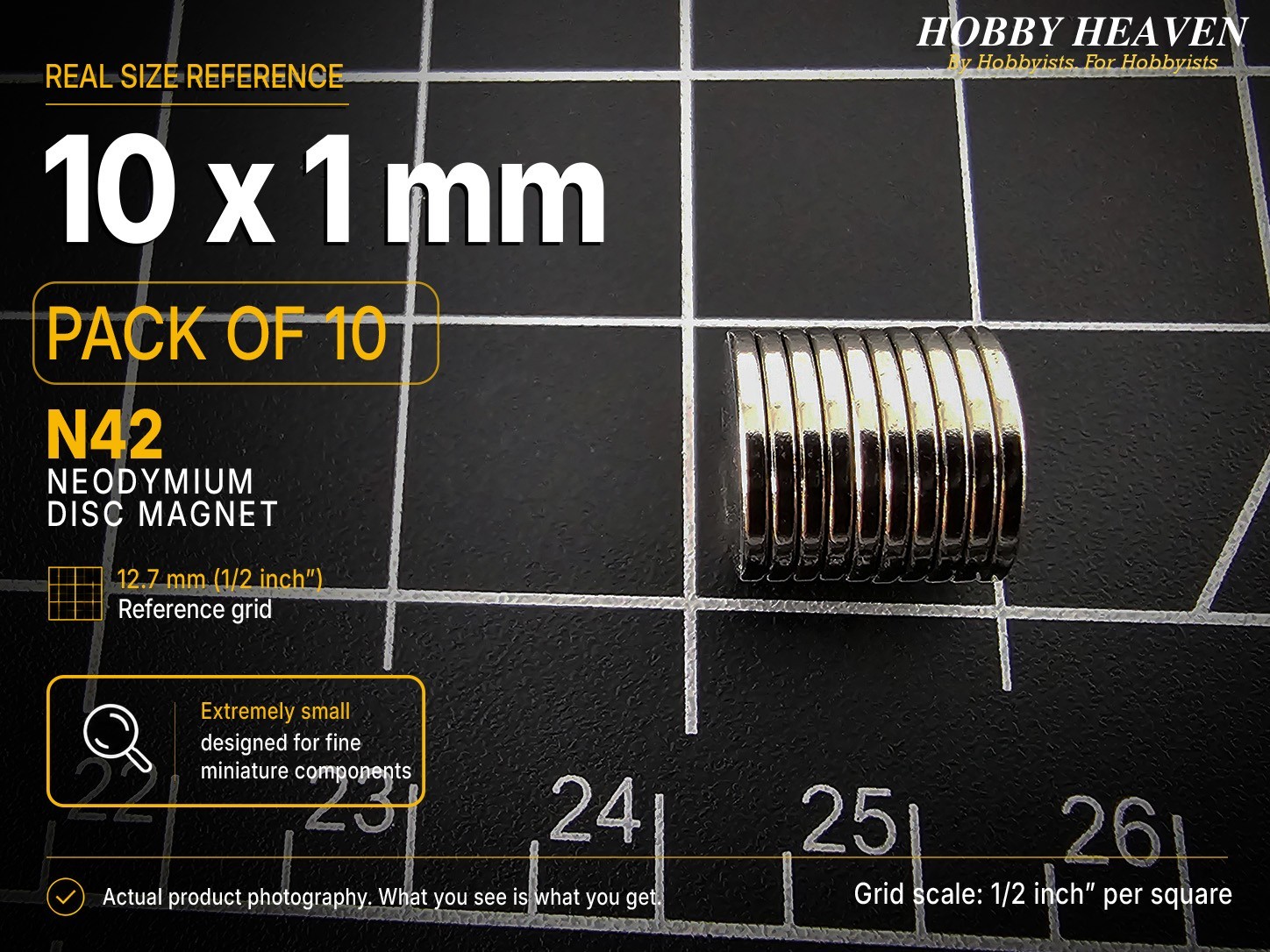
N42 Neodymium Disc Magnets — 10 x 1 mm
Nickel-Copper-Nickel coated • Axially magnetised • Packs of 1, 10, 25, 50 and 100
560 g of hold from a disc 1 mm thick — the strongest shallow magnet we stock. For card, board, fabric, veneer and every job where thickness is the thing you have not got.
Why this size
✓ The most hold per millimetre of depth in our whole range. 560 g from a 1.2 mm recess. Our 5 x 2 mm magnet pulls less, at 470 g, and needs twice the depth to do it.
✓ Calculated pull: 560 g at direct contact. Zero gap, clean flat steel. Magnet-to-magnet also 560 g. Reference value, not a guaranteed working load.
✓ 30% more than our 8 x 1 mm disc, same 1 mm thickness. If you have the width, it costs nothing in depth to step up.
✓ Wide face, flat and stable. A 10 mm disc spreads its grip across a large area, so signs, lids and flaps sit down evenly instead of pivoting or sagging at the corners.
✓ Honest N42 grade. We state the grade we actually buy. If you see the same disc advertised as N52 at this size, treat the claim with caution.
What it is
A sintered neodymium (NdFeB) disc, 10 mm across and 1 mm thick, magnetised through its thickness — the poles are the two flat faces, not the edge. Two magnets meet face to face, the join sits flat and closes cleanly.
This disc is the clearest example in our range of the principle the whole range is built on. Holding force follows the area of the pole face far more than it follows how tall the magnet is. Make a magnet wider and you gain a great deal. Make it taller and you gain steadily less. A 10 mm disc only a millimetre thick therefore out-pulls magnets twice its height, while occupying almost no space in the material it is fitted to.
For craft and light DIY work that is usually the trade you want, because the limit is nearly always thickness rather than surface area. It sandwiches between two layers of card, hides under veneer, lining fabric or leather, and glues flat to the back of a sign or frame with no noticeable standoff.
Specifications
| Diameter |
10 mm |
| Thickness |
1 mm |
| Weight per magnet |
0.60 g |
| Material |
Sintered neodymium iron boron (NdFeB) |
| Grade |
N42 |
| Coating |
Nickel-Copper-Nickel (NiCuNi), triple layer |
| Magnetisation |
Axial — poles on the flat faces |
| Pull to steel (calculated) |
560 g / 5.49 N at direct contact, zero gap |
| Magnet-to-magnet pull |
560 g, bare faces in direct contact |
| Shear (sideways) estimate |
Approximately 80 g — sideways load is far weaker than direct pull |
| Drill bit size |
10 mm |
| 3D print hole size |
10.1 mm |
| Maximum working temperature |
Approximately 80°C — standard for N42 |
| Country of manufacture |
China |
Pull figures are calculated reference values for a clean, flat, direct steel contact with no air gap. Paint, varnish, glue layers, fabric, card, curved surfaces and any gap at all will reduce holding force, in some cases substantially. Treat these numbers as a way to compare sizes to each other, not as a guaranteed working load.
What you get
▪ The pack size you select from the dropdown: 1, 10, 25, 50 or 100 magnets
▪ Supplied stacked pole-to-pole in a resealable bag
▪ Every magnet is the same 10 x 1 mm N42 disc — the only difference between variants is the count
What people use this size for
Signage, display and retail
Changeable price tickets, shelf talkers and ticket holders • exhibition and craft fair display boards • menu boards and sandwich board inserts • poster and print holders that swap over without pins • window and cabinet displays • name badges backed onto a steel plate. The wide face is what stops a card sign sagging at the corners.
Card making, paper craft and bookbinding
Closures on large cards, folios, portfolios and presentation folders • magnetic flaps on gift and rigid boxes • journal, album and menu covers • sample books and swatch folders • pop-up and interactive mechanisms. Glued between two layers of card the join disappears completely.
Home and office
Fridge magnets and photo displays • noticeboards, planners and memo boards • cupboard, cabinet and jewellery box catches • curtain and blind tie-backs • picture frames and lightweight wall fittings • cable tidies against a steel desk frame.
Sewing, textiles and leatherwork
Bag, purse and satchel closures • clasps hidden inside a lining • cosplay and costume fastenings where a visible popper would spoil the piece • removable trims, panels and appliqué. Encase them in fabric or leather rather than gluing bare metal against cloth.
Woodwork, model making and terrain
Cabinet door and drawer catches • removable panels and access covers in thin ply or MDF • hidden closures on boxes and trinket cases • removable terrain boards and modular display sections • large display bases and plinths.
Choosing between sizes
Choose 10 x 2 mm instead when: you need a much firmer hold and have the depth for it — the same 10 mm footprint, 1,100 g instead of 560 g.
Choose 8 x 1 mm instead when: 10 mm is wider than the pocket or the part allows. 430 g, same 1 mm thickness.
A note on closures through material: whatever sits between the two magnets counts as a gap, and gaps cost holding force quickly. Two layers of thick card, or a leather flap, can easily halve what you feel compared with the 560 g figure. If a closure needs to feel positive through material, size up rather than settling for a weak click.
Working with them
Mark the stack before you separate it. Put a dot of permanent marker on one face of the whole stack while it is still assembled. Every magnet then carries the same reference face, so paired closures always attract instead of pushing apart. Getting one the wrong way round is the most common mistake by a wide margin, and it is invisible once the magnet is glued in and covered over.
Glue both halves in place while they are stuck together. Fit the first magnet, let its partner snap onto it, apply adhesive to the exposed face, then close the lid or flap and let it cure. The pair aligns itself perfectly and the polarity cannot be wrong. Slip a piece of paper between them if you need to part them again while the glue is green.
One magnet and a steel washer is often the better closure. There is no polarity to get wrong, it costs half as much, and on a flap or lid you will barely notice the difference in feel. Save magnet pairs for joins that genuinely need the extra grip.
Support the disc while the glue sets. A 10 mm face is wide enough that a small lump of dried glue, a paper fibre or a raised grain under one edge will tilt the whole magnet. Press it down flat and hold it until the adhesive grabs — a magnet sitting at a slight angle gives away contact area and holding force.
Keep them away from your work. Steel rulers, scissors, craft knives, pins, sewing machine beds and cutting mats with metal edges all attract these across a surprising distance. Keep the pack closed and off the bench while you are cutting.
Honest limitations
▪ This is the most fragile shape we sell. Neodymium is sintered and brittle, and a 10 mm disc only 1 mm thick has very little material through the middle. Letting a pair snap together across a gap is the usual way one cracks, and they can also break if flexed against an uneven surface. Handle them flat and bring them together slowly.
▪ Anything between the faces cuts the hold sharply. The 560 g figure is bare magnet against clean flat steel. Through two layers of card, a lining fabric or a coat of varnish you will feel noticeably less. This is normal magnet behaviour, not a fault.
▪ Sideways load is much weaker than straight pull. Around 80 g. A flap that slides across its partner will move far more easily than one that lifts straight off. Design the closure so the load parts the faces.
▪ It needs 10 mm of width. That is a wide footprint on a small piece, and a 10 mm hole is a lot to take out of a narrow rail, a slim frame or a thin section.
▪ Easy to seat crooked. At 1 mm thick there is almost no side wall to keep the disc square in a recess, and the wide face makes any tilt more costly.
▪ Indoor use. NiCuNi plating resists handling and normal indoor humidity, but it is not a marine or outdoor coating. On an exterior door, in a bathroom or on garden signage, seal the magnet into the material rather than leaving it exposed.
▪ Heat weakens them permanently. Above roughly 80°C an N42 magnet loses strength and does not recover on cooling. Keep them away from ovens, heat guns, curing lamps and hot cars — and do not put a magnetised piece through a laminator.
Important safety information
Warning — strong magnets. For adult hobby, craft and technical use. Not a toy.
Swallowing two or more magnets can cause serious internal injury. Magnets can attract to each other through the wall of the intestine, causing blockage or perforation. Seek immediate medical attention if a magnet is swallowed or inhaled. Keep away from children and pets at all times.
If you are making an item that a child may handle, the magnets must be fully enclosed and securely fixed so they cannot work loose. Loose or surface-mounted magnets are not suitable for anything intended for children.
Keep magnets away from pacemakers, implanted defibrillators and hearing aids. Keep them away from bank cards, hard drives and other magnetic media.
Handle with care — neodymium is brittle, and thin wide discs like this one chip and crack more easily than any other shape. Store magnets in their bag, away from loose steel and craft blades.
Dispatch
▪ Same-day dispatch on orders placed before 3 PM, Monday to Friday
▪ Sent from our own unit in Derby — we pick and pack everything ourselves
▪ Magnets are shipped within the UK only
Hobby Heaven
By Hobbyists. For Hobbyists.
We are a small family-run business in Derby, run by people who make things themselves. We publish the grade we buy and the test conditions behind every pull figure, because that is the information we wanted when we were sourcing magnets for our own projects. If something is not right, message us and we will sort it.
N42 Neodymium Disc Magnets — 10 x 1 mm
Nickel-Copper-Nickel coated • Axially magnetised • Packs of 1, 10, 25, 50 and 100
560 g of hold from a disc 1 mm thick — the strongest shallow magnet we stock. For card, board, fabric, veneer and every job where thickness is the thing you have not got.
Why this size
✓ The most hold per millimetre of depth in our whole range. 560 g from a 1.2 mm recess. Our 5 x 2 mm magnet pulls less, at 470 g, and needs twice the depth to do it.
✓ Calculated pull: 560 g at direct contact. Zero gap, clean flat steel. Magnet-to-magnet also 560 g. Reference value, not a guaranteed working load.
✓ 30% more than our 8 x 1 mm disc, same 1 mm thickness. If you have the width, it costs nothing in depth to step up.
✓ Wide face, flat and stable. A 10 mm disc spreads its grip across a large area, so signs, lids and flaps sit down evenly instead of pivoting or sagging at the corners.
✓ Honest N42 grade. We state the grade we actually buy. If you see the same disc advertised as N52 at this size, treat the claim with caution.
What it is
A sintered neodymium (NdFeB) disc, 10 mm across and 1 mm thick, magnetised through its thickness — the poles are the two flat faces, not the edge. Two magnets meet face to face, the join sits flat and closes cleanly.
This disc is the clearest example in our range of the principle the whole range is built on. Holding force follows the area of the pole face far more than it follows how tall the magnet is. Make a magnet wider and you gain a great deal. Make it taller and you gain steadily less. A 10 mm disc only a millimetre thick therefore out-pulls magnets twice its height, while occupying almost no space in the material it is fitted to.
For craft and light DIY work that is usually the trade you want, because the limit is nearly always thickness rather than surface area. It sandwiches between two layers of card, hides under veneer, lining fabric or leather, and glues flat to the back of a sign or frame with no noticeable standoff.
Specifications
Diameter
10 mm
Thickness
1 mm
Weight per magnet
0.60 g
Material
Sintered neodymium iron boron (NdFeB)
Grade
N42
Coating
Nickel-Copper-Nickel (NiCuNi), triple layer
Magnetisation
Axial — poles on the flat faces
Pull to steel (calculated)
560 g / 5.49 N at direct contact, zero gap
Magnet-to-magnet pull
560 g, bare faces in direct contact
Shear (sideways) estimate
Approximately 80 g — sideways load is far weaker than direct pull
Drill bit size
10 mm
3D print hole size
10.1 mm
Maximum working temperature
Approximately 80°C — standard for N42
Country of manufacture
China
Pull figures are calculated reference values for a clean, flat, direct steel contact with no air gap. Paint, varnish, glue layers, fabric, card, curved surfaces and any gap at all will reduce holding force, in some cases substantially. Treat these numbers as a way to compare sizes to each other, not as a guaranteed working load.
What you get
▪ The pack size you select from the dropdown: 1, 10, 25, 50 or 100 magnets
▪ Supplied stacked pole-to-pole in a resealable bag
▪ Every magnet is the same 10 x 1 mm N42 disc — the only difference between variants is the count
What people use this size for
Signage, display and retail
Changeable price tickets, shelf talkers and ticket holders • exhibition and craft fair display boards • menu boards and sandwich board inserts • poster and print holders that swap over without pins • window and cabinet displays • name badges backed onto a steel plate. The wide face is what stops a card sign sagging at the corners.
Card making, paper craft and bookbinding
Closures on large cards, folios, portfolios and presentation folders • magnetic flaps on gift and rigid boxes • journal, album and menu covers • sample books and swatch folders • pop-up and interactive mechanisms. Glued between two layers of card the join disappears completely.
Home and office
Fridge magnets and photo displays • noticeboards, planners and memo boards • cupboard, cabinet and jewellery box catches • curtain and blind tie-backs • picture frames and lightweight wall fittings • cable tidies against a steel desk frame.
Sewing, textiles and leatherwork
Bag, purse and satchel closures • clasps hidden inside a lining • cosplay and costume fastenings where a visible popper would spoil the piece • removable trims, panels and appliqué. Encase them in fabric or leather rather than gluing bare metal against cloth.
Woodwork, model making and terrain
Cabinet door and drawer catches • removable panels and access covers in thin ply or MDF • hidden closures on boxes and trinket cases • removable terrain boards and modular display sections • large display bases and plinths.
Choosing between sizes
Choose 10 x 2 mm instead when: you need a much firmer hold and have the depth for it — the same 10 mm footprint, 1,100 g instead of 560 g.
Choose 8 x 1 mm instead when: 10 mm is wider than the pocket or the part allows. 430 g, same 1 mm thickness.
A note on closures through material: whatever sits between the two magnets counts as a gap, and gaps cost holding force quickly. Two layers of thick card, or a leather flap, can easily halve what you feel compared with the 560 g figure. If a closure needs to feel positive through material, size up rather than settling for a weak click.
Working with them
Mark the stack before you separate it. Put a dot of permanent marker on one face of the whole stack while it is still assembled. Every magnet then carries the same reference face, so paired closures always attract instead of pushing apart. Getting one the wrong way round is the most common mistake by a wide margin, and it is invisible once the magnet is glued in and covered over.
Glue both halves in place while they are stuck together. Fit the first magnet, let its partner snap onto it, apply adhesive to the exposed face, then close the lid or flap and let it cure. The pair aligns itself perfectly and the polarity cannot be wrong. Slip a piece of paper between them if you need to part them again while the glue is green.
One magnet and a steel washer is often the better closure. There is no polarity to get wrong, it costs half as much, and on a flap or lid you will barely notice the difference in feel. Save magnet pairs for joins that genuinely need the extra grip.
Support the disc while the glue sets. A 10 mm face is wide enough that a small lump of dried glue, a paper fibre or a raised grain under one edge will tilt the whole magnet. Press it down flat and hold it until the adhesive grabs — a magnet sitting at a slight angle gives away contact area and holding force.
Keep them away from your work. Steel rulers, scissors, craft knives, pins, sewing machine beds and cutting mats with metal edges all attract these across a surprising distance. Keep the pack closed and off the bench while you are cutting.
Honest limitations
▪ This is the most fragile shape we sell. Neodymium is sintered and brittle, and a 10 mm disc only 1 mm thick has very little material through the middle. Letting a pair snap together across a gap is the usual way one cracks, and they can also break if flexed against an uneven surface. Handle them flat and bring them together slowly.
▪ Anything between the faces cuts the hold sharply. The 560 g figure is bare magnet against clean flat steel. Through two layers of card, a lining fabric or a coat of varnish you will feel noticeably less. This is normal magnet behaviour, not a fault.
▪ Sideways load is much weaker than straight pull. Around 80 g. A flap that slides across its partner will move far more easily than one that lifts straight off. Design the closure so the load parts the faces.
▪ It needs 10 mm of width. That is a wide footprint on a small piece, and a 10 mm hole is a lot to take out of a narrow rail, a slim frame or a thin section.
▪ Easy to seat crooked. At 1 mm thick there is almost no side wall to keep the disc square in a recess, and the wide face makes any tilt more costly.
▪ Indoor use. NiCuNi plating resists handling and normal indoor humidity, but it is not a marine or outdoor coating. On an exterior door, in a bathroom or on garden signage, seal the magnet into the material rather than leaving it exposed.
▪ Heat weakens them permanently. Above roughly 80°C an N42 magnet loses strength and does not recover on cooling. Keep them away from ovens, heat guns, curing lamps and hot cars — and do not put a magnetised piece through a laminator.
Important safety information
Warning — strong magnets. For adult hobby, craft and technical use. Not a toy.
Swallowing two or more magnets can cause serious internal injury. Magnets can attract to each other through the wall of the intestine, causing blockage or perforation. Seek immediate medical attention if a magnet is swallowed or inhaled. Keep away from children and pets at all times.
If you are making an item that a child may handle, the magnets must be fully enclosed and securely fixed so they cannot work loose. Loose or surface-mounted magnets are not suitable for anything intended for children.
Keep magnets away from pacemakers, implanted defibrillators and hearing aids. Keep them away from bank cards, hard drives and other magnetic media.
Handle with care — neodymium is brittle, and thin wide discs like this one chip and crack more easily than any other shape. Store magnets in their bag, away from loose steel and craft blades.
Dispatch
▪ Same-day dispatch on orders placed before 3 PM, Monday to Friday
▪ Sent from our own unit in Derby — we pick and pack everything ourselves
▪ Magnets are shipped within the UK only
Hobby Heaven
By Hobbyists. For Hobbyists.
We are a small family-run business in Derby, run by people who make things themselves. We publish the grade we buy and the test conditions behind every pull figure, because that is the information we wanted when we were sourcing magnets for our own projects. If something is not right, message us and we will sort it.
Specifications
-
Choose Quantity
10
-
Brand
Hobby Heaven
-
Thickness
1mm
-
Type
Disc Magnet
-
Shape
Disc
-
Item Diameter
10mm
-
Grade
N42
-
Coating
Nickel-Copper-Nickel (NiCuNi)
-
Magnetisation
Axial
-
Country of Origin
China
-
Colour
Silver