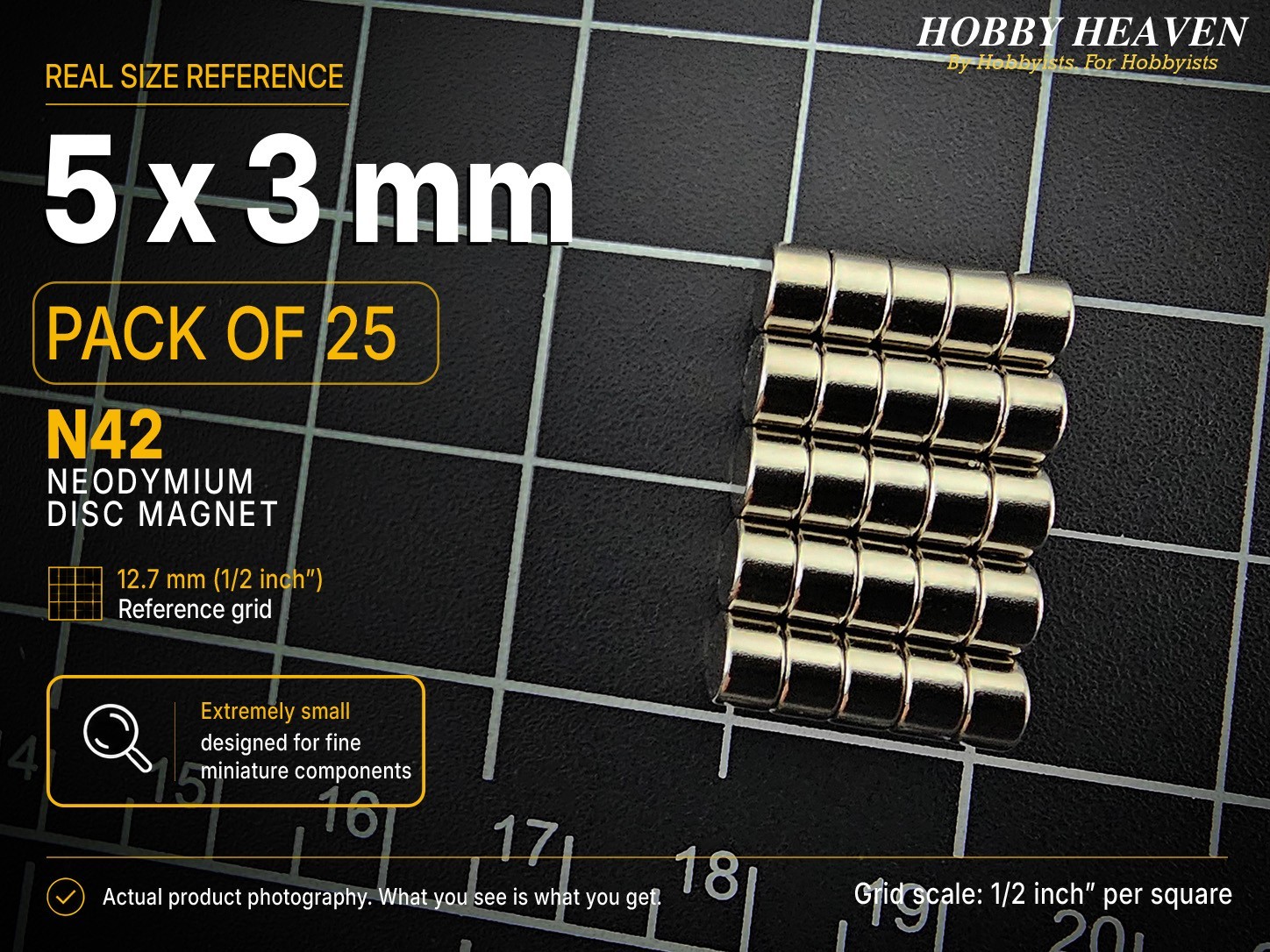
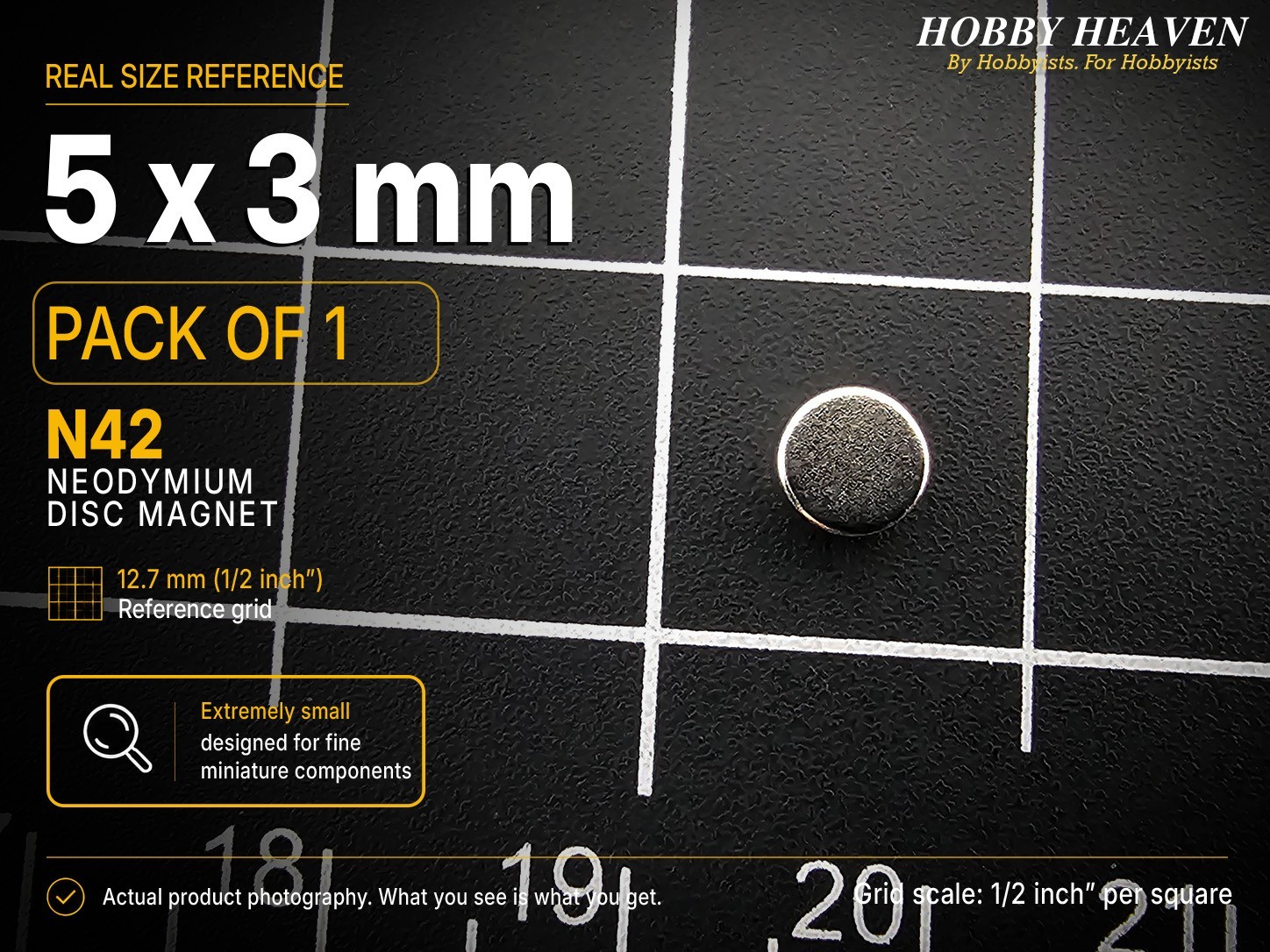
N42 Neodymium Disc Magnets — 5 x 3 mm
Nickel-Copper-Nickel coated • Axially magnetised • Packs of 1, 10, 25, 50 and 100
The most holding force available from a 5 mm hole. 650 g of pull for heavy vehicle components, cast metal parts and removable assemblies that get handled often.
Why this size
✓ Maximum pull from a 5 mm bore. 650 g — the strongest disc we stock at this diameter. When the hole width is set by the part and 5 x 2 mm is not holding, this is the answer.
✓ Calculated pull: 650 g at direct contact. Zero gap, clean flat steel. Magnet-to-magnet also 650 g. Reference value, not a guaranteed working load.
✓ Built for weight. Cast metal hulls, resin turrets, heavy sponsons and multi-part vehicle assemblies stay seated through repeated handling, not just on the shelf.
✓ Deep enough to anchor properly. 3 mm of side wall gives glue real surface to grip, which matters once the magnet is strong enough to try pulling itself out of the hole.
✓ Honest N42 grade. We state the grade we actually buy. If you see the same disc advertised as N52 at this size, treat the claim with caution.
What it is
A sintered neodymium (NdFeB) disc, 5 mm across and 3 mm thick, magnetised through its thickness — the poles are the two flat faces, not the curved edge. Two magnets meet face to face, the join sits flat, and the part seats in the same position every time.
This is where the 5 mm range tops out, following the same curve as every other diameter we stock. 5 x 1 mm to 5 x 2 mm roughly doubles the pull, 220 g to 470 g. 5 x 2 mm to 5 x 3 mm adds far less, 470 g to 650 g, because holding force follows the contact face more than it follows height.
One thing worth knowing, because it is the exception to the usual rule: at this point going wider does not automatically win. Our 6 x 2 mm disc pulls 590 g, which is less than this magnet manages, because it gives up a third of its height. To beat 650 g you need to go both wider and taller, to the 6 x 3 mm.
Specifications
| Diameter |
5 mm |
| Thickness |
3 mm |
| Weight per magnet |
0.45 g |
| Material |
Sintered neodymium iron boron (NdFeB) |
| Grade |
N42 |
| Coating |
Nickel-Copper-Nickel (NiCuNi), triple layer |
| Magnetisation |
Axial — poles on the flat faces |
| Pull to steel (calculated) |
650 g / 6.37 N at direct contact, zero gap |
| Magnet-to-magnet pull |
650 g, bare faces in direct contact |
| Shear (sideways) estimate |
Approximately 90 g — sideways load is far weaker than direct pull |
| Drill bit size |
5 mm |
| 3D print hole size |
5.1 mm |
| Maximum working temperature |
Approximately 80°C — standard for N42 |
| Country of manufacture |
China |
Pull figures are calculated reference values for a clean, flat, direct steel contact with no air gap. Paint, primer, glue layers, curved surfaces and any gap at all will reduce holding force, in some cases substantially. Treat these numbers as a way to compare sizes to each other, not as a guaranteed working load.
What you get
▪ The pack size you select from the dropdown: 1, 10, 25, 50 or 100 magnets
▪ Supplied stacked pole-to-pole in a resealable bag
▪ Every magnet is the same 5 x 3 mm N42 disc — the only difference between variants is the count
What this size is for
Well suited to: interchangeable turrets, sponsons and weapon mounts on vehicle kits • cast metal hulls and heavy resin assemblies • removable engine decks, hatches and superstructure sections • parts fitted to an existing 5 mm pin or post • display plinths and diorama sections that come apart repeatedly • larger craft and cabinet closures.
Choose 5 x 2 mm instead when: 470 g is enough — a millimetre less depth, fits more parts, and it is the better choice for magnetised bases and transport trays.
Choose 6 x 3 mm instead when: 650 g is not settling it and you can drill both wider and deeper — 890 g. Note that our 6 x 2 mm disc pulls 590 g, slightly less than this one, so widening alone is not an upgrade here.
Working with them
Consider magnet plus steel instead of two magnets. A 3.2 mm recess in both halves of a joint is 6.4 mm of material. Magnetise one side only and glue a steel disc or a cut pin into the other. You lose some holding force compared with a magnet pair, but you halve the depth you need to drill — and at 650 g you can afford to give some away.
One magnet lets the part spin. A single disc holds a turret down but does nothing to stop it rotating. Fit two magnets side by side, or pair one magnet with a locating pin off-centre.
The glue joint is the weak point, not the magnet. 650 g will pull a badly seated magnet clean out of its hole rather than release the part. Key smooth resin before gluing, wick thin CA down the side walls of a snug 5 mm recess, and let it cure fully before testing.
Fit them one at a time, with the rest of the pack out of reach. At 650 g a loose magnet will jump several centimetres to reach steel or another magnet, and it will take your work surface, your blade or your fingertip along the way. This is the size where casual handling starts to have consequences.
Slide, do not pull. Separating a stack by pulling straight apart takes the full 650 g. Sliding one magnet sideways off takes roughly a seventh of that and is far less likely to chip the plating.
Honest limitations
▪ Diminishing returns on height. 5 x 2 mm to 5 x 3 mm is 470 g to 650 g — 50% more height for 38% more pull. Still worth it if you need the force, but the gain is no longer proportional.
▪ Too strong for most basing. At 650 g, lifting a miniature straight off a steel tray can break the model before the magnet lets go. For magnetised bases use 5 x 2 mm or smaller.
▪ It needs real depth. 3.2 mm of recess, and 6.4 mm across both halves of a joint. Many parts cannot give that.
▪ Strong enough to damage the part around it. The magnet is usually better anchored than thin resin or hollow styrene. A poorly glued magnet tears out, and a thin socket wall can split.
▪ Sideways load is much weaker than straight pull. Around 90 g. Design the joint so the load pulls the faces apart rather than sliding them.
▪ Neodymium is brittle. These are sintered, ceramic-like magnets. At 650 g they snap together hard enough to shatter, and a chip can come off at speed.
▪ Indoor use. NiCuNi plating resists handling and normal indoor humidity, but it is not a marine or outdoor coating.
▪ Heat weakens them permanently. Above roughly 80°C an N42 magnet loses strength and does not recover on cooling. Keep them away from ovens, curing lamps and hot cars.
Important safety information
Warning — strong magnets. For adult hobby and technical use. Not a toy.
Swallowing two or more magnets can cause serious internal injury. Magnets can attract to each other through the wall of the intestine, causing blockage or perforation. Seek immediate medical attention if a magnet is swallowed or inhaled. Keep away from children and pets at all times.
Keep magnets away from pacemakers, implanted defibrillators and hearing aids. Keep them away from bank cards, hard drives and other magnetic media.
Handle with care. Magnets of this strength can nip skin when they snap together, and neodymium is brittle enough to chip or shatter on impact. Store them in their bag, away from loose steel and craft blades.
Dispatch
▪ Same-day dispatch on orders placed before 3 PM, Monday to Friday
▪ Sent from our own unit in Derby — we pick and pack everything ourselves
▪ Magnets are shipped within the UK only
Hobby Heaven
By Hobbyists. For Hobbyists.
We are a small family-run business in Derby, run by people who actually paint, build and convert. We publish the grade we buy and the test conditions behind every pull figure, because that is the information we wanted when we were sourcing magnets for our own projects. If something is not right, message us and we will sort it.
N42 Neodymium Disc Magnets — 5 x 3 mm
Nickel-Copper-Nickel coated • Axially magnetised • Packs of 1, 10, 25, 50 and 100
The most holding force available from a 5 mm hole. 650 g of pull for heavy vehicle components, cast metal parts and removable assemblies that get handled often.
Why this size
✓ Maximum pull from a 5 mm bore. 650 g — the strongest disc we stock at this diameter. When the hole width is set by the part and 5 x 2 mm is not holding, this is the answer.
✓ Calculated pull: 650 g at direct contact. Zero gap, clean flat steel. Magnet-to-magnet also 650 g. Reference value, not a guaranteed working load.
✓ Built for weight. Cast metal hulls, resin turrets, heavy sponsons and multi-part vehicle assemblies stay seated through repeated handling, not just on the shelf.
✓ Deep enough to anchor properly. 3 mm of side wall gives glue real surface to grip, which matters once the magnet is strong enough to try pulling itself out of the hole.
✓ Honest N42 grade. We state the grade we actually buy. If you see the same disc advertised as N52 at this size, treat the claim with caution.
What it is
A sintered neodymium (NdFeB) disc, 5 mm across and 3 mm thick, magnetised through its thickness — the poles are the two flat faces, not the curved edge. Two magnets meet face to face, the join sits flat, and the part seats in the same position every time.
This is where the 5 mm range tops out, following the same curve as every other diameter we stock. 5 x 1 mm to 5 x 2 mm roughly doubles the pull, 220 g to 470 g. 5 x 2 mm to 5 x 3 mm adds far less, 470 g to 650 g, because holding force follows the contact face more than it follows height.
One thing worth knowing, because it is the exception to the usual rule: at this point going wider does not automatically win. Our 6 x 2 mm disc pulls 590 g, which is less than this magnet manages, because it gives up a third of its height. To beat 650 g you need to go both wider and taller, to the 6 x 3 mm.
Specifications
Diameter
5 mm
Thickness
3 mm
Weight per magnet
0.45 g
Material
Sintered neodymium iron boron (NdFeB)
Grade
N42
Coating
Nickel-Copper-Nickel (NiCuNi), triple layer
Magnetisation
Axial — poles on the flat faces
Pull to steel (calculated)
650 g / 6.37 N at direct contact, zero gap
Magnet-to-magnet pull
650 g, bare faces in direct contact
Shear (sideways) estimate
Approximately 90 g — sideways load is far weaker than direct pull
Drill bit size
5 mm
3D print hole size
5.1 mm
Maximum working temperature
Approximately 80°C — standard for N42
Country of manufacture
China
Pull figures are calculated reference values for a clean, flat, direct steel contact with no air gap. Paint, primer, glue layers, curved surfaces and any gap at all will reduce holding force, in some cases substantially. Treat these numbers as a way to compare sizes to each other, not as a guaranteed working load.
What you get
▪ The pack size you select from the dropdown: 1, 10, 25, 50 or 100 magnets
▪ Supplied stacked pole-to-pole in a resealable bag
▪ Every magnet is the same 5 x 3 mm N42 disc — the only difference between variants is the count
What this size is for
Well suited to: interchangeable turrets, sponsons and weapon mounts on vehicle kits • cast metal hulls and heavy resin assemblies • removable engine decks, hatches and superstructure sections • parts fitted to an existing 5 mm pin or post • display plinths and diorama sections that come apart repeatedly • larger craft and cabinet closures.
Choose 5 x 2 mm instead when: 470 g is enough — a millimetre less depth, fits more parts, and it is the better choice for magnetised bases and transport trays.
Choose 6 x 3 mm instead when: 650 g is not settling it and you can drill both wider and deeper — 890 g. Note that our 6 x 2 mm disc pulls 590 g, slightly less than this one, so widening alone is not an upgrade here.
Working with them
Consider magnet plus steel instead of two magnets. A 3.2 mm recess in both halves of a joint is 6.4 mm of material. Magnetise one side only and glue a steel disc or a cut pin into the other. You lose some holding force compared with a magnet pair, but you halve the depth you need to drill — and at 650 g you can afford to give some away.
One magnet lets the part spin. A single disc holds a turret down but does nothing to stop it rotating. Fit two magnets side by side, or pair one magnet with a locating pin off-centre.
The glue joint is the weak point, not the magnet. 650 g will pull a badly seated magnet clean out of its hole rather than release the part. Key smooth resin before gluing, wick thin CA down the side walls of a snug 5 mm recess, and let it cure fully before testing.
Fit them one at a time, with the rest of the pack out of reach. At 650 g a loose magnet will jump several centimetres to reach steel or another magnet, and it will take your work surface, your blade or your fingertip along the way. This is the size where casual handling starts to have consequences.
Slide, do not pull. Separating a stack by pulling straight apart takes the full 650 g. Sliding one magnet sideways off takes roughly a seventh of that and is far less likely to chip the plating.
Honest limitations
▪ Diminishing returns on height. 5 x 2 mm to 5 x 3 mm is 470 g to 650 g — 50% more height for 38% more pull. Still worth it if you need the force, but the gain is no longer proportional.
▪ Too strong for most basing. At 650 g, lifting a miniature straight off a steel tray can break the model before the magnet lets go. For magnetised bases use 5 x 2 mm or smaller.
▪ It needs real depth. 3.2 mm of recess, and 6.4 mm across both halves of a joint. Many parts cannot give that.
▪ Strong enough to damage the part around it. The magnet is usually better anchored than thin resin or hollow styrene. A poorly glued magnet tears out, and a thin socket wall can split.
▪ Sideways load is much weaker than straight pull. Around 90 g. Design the joint so the load pulls the faces apart rather than sliding them.
▪ Neodymium is brittle. These are sintered, ceramic-like magnets. At 650 g they snap together hard enough to shatter, and a chip can come off at speed.
▪ Indoor use. NiCuNi plating resists handling and normal indoor humidity, but it is not a marine or outdoor coating.
▪ Heat weakens them permanently. Above roughly 80°C an N42 magnet loses strength and does not recover on cooling. Keep them away from ovens, curing lamps and hot cars.
Important safety information
Warning — strong magnets. For adult hobby and technical use. Not a toy.
Swallowing two or more magnets can cause serious internal injury. Magnets can attract to each other through the wall of the intestine, causing blockage or perforation. Seek immediate medical attention if a magnet is swallowed or inhaled. Keep away from children and pets at all times.
Keep magnets away from pacemakers, implanted defibrillators and hearing aids. Keep them away from bank cards, hard drives and other magnetic media.
Handle with care. Magnets of this strength can nip skin when they snap together, and neodymium is brittle enough to chip or shatter on impact. Store them in their bag, away from loose steel and craft blades.
Dispatch
▪ Same-day dispatch on orders placed before 3 PM, Monday to Friday
▪ Sent from our own unit in Derby — we pick and pack everything ourselves
▪ Magnets are shipped within the UK only
Hobby Heaven
By Hobbyists. For Hobbyists.
We are a small family-run business in Derby, run by people who actually paint, build and convert. We publish the grade we buy and the test conditions behind every pull figure, because that is the information we wanted when we were sourcing magnets for our own projects. If something is not right, message us and we will sort it.
Specifications
-
Choose Quantity
10
-
Brand
Hobby Heaven
-
Thickness
3mm
-
Type
Disc Magnet
-
Shape
Disc
-
Item Diameter
5mm
-
Grade
N42
-
Coating
Nickel-Copper-Nickel (NiCuNi)
-
Magnetisation
Axial
-
Country of Origin
China
-
Colour
Silver