Sole Reign (except 421 A.D., with Constantius III)
Ruling in the East: Theodosius I (379-395 A.D.), Arcadius (383-408 A.D.) and Theodosius II (408-450 A.D.)
| Son of Theodosius I and Aelia Flacilla | Brother of Arcadius| Brother-in-law of Aelia Eudoxia | Uncle of Theodosius II and Aelia Pulcheria | Half-brother of Galla Placidia |
 Flavius Honorius
( 9 September 384 - 15 August 423 ) was Roman Emperor (393-395) and
then Western Roman Emperor from 395 until his death. He was the younger
son of Theodosius I and his first wife Aelia Flaccilla, and brother of
the Eastern Emperor Arcadius.
Flavius Honorius
( 9 September 384 - 15 August 423 ) was Roman Emperor (393-395) and
then Western Roman Emperor from 395 until his death. He was the younger
son of Theodosius I and his first wife Aelia Flaccilla, and brother of
the Eastern Emperor Arcadius.
Even by the
standards of the rapidly declining Western Empire, Honorius' reign was
precarious and chaotic. His throne was guarded by his principal general,
Flavius Stilicho, who was successively Honorius's guardian (during his
childhood) and his father-in-law (after the emperor became an adult).
Stilicho's generalship helped preserve some level of stability, but with
his execution, the Western Roman Empire moved closer to collapse.
Early reign
After holding the consulate at the age of two, Honorius was declared Augustus,
and thus co-ruler, on 23 January 393 after the death of Valentinian II
and the usurpation of Eugenius. When Theodosius died, in January 395,
Honorius and Arcadius divided the Empire, so that Honorius became
Western Roman Emperor at the age of ten.
During
the first part of his reign Honorius depended on the military leadership
of the general Stilicho, who was of mixed Vandal and Roman ancestry. To
strengthen his bonds with the young emperor, Stilicho married his
daughter Maria to him. The epithalamion written for the occasion by
Stilicho's court poet Claudian survives.
At first
Honorius based his capital in Mediolanum, but when the Visigoths entered
Italy in 402 he moved his capital to the coastal city of Ravenna, which
was protected by a ring of marshes and strong fortifications. While the
new capital was easier to defend, it was poorly situated to allow Roman
forces to protect central Italy from the increasingly regular threat of
barbarian incursions.
Erosion of the Western Roman Empire
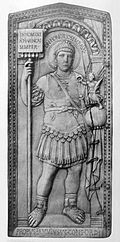 Honorius' reign was plagued by many threats: from the barbarians entering within the Empire's borders to several usurpers.
A revolt led by Gildo, comes Africae,
in Northern Africa lasted for two years (397-398). In 405, a barbarian
army led by Radagaisus invaded Italy, bringing devastation to the heart
of the Empire, until Stilicho defeated them in 406.
The
situation in Britannia was even more problematic. The British provinces
were isolated, lacking support from the Empire, and the soldiers
supported the revolts of Marcus (406 - 407), Gratian (407), and
Constantine "III". Constantine invaded Gaul in 407, occupying Arles.
An
invasion of Alans, Suevi and Vandals moved from Gaul on 31 December
406, and arrived in Hispania in 409. In 408, Stilicho (after forcing the
Roman Senate to pay 4,000 pounds of gold) was arrested and executed by
the order of Honorius, probably because of a court conspiracy against
the Arian general. The Visigoths under their King Alaric I invaded Italy
in 408, besieged Rome, and extorted from the city a ransom of 5,000
pounds of gold, 30,000 pounds of silver, 4,000 silken tunics, 3,000
hides dyed scarlet, and 3,000 pounds of pepper), while Honorius in
Ravenna did nothing.
In 409, Alaric returned, and
with the agreement of the Senate supported the usurpation of Priscus
Attalus. In 410, the Eastern Roman Empire sent six Legions (6,000 men;
late Roman legions were small units) to aid Honorius. To counter
Priscus, Honorius tried to negotiate with Alaric. Alaric withdrew his
support for Priscus in 410, but the negotiations with Honorius broke
down. Alaric again entered Italy and sacked Rome.
The
revolt of Constantine III in the west continued through this period. In
409, Gerontius, Constantine III's general in Hispania, rebelled against
him, proclaimed Maximus Emperor, and besieged Constantine at Arles.
Honorius now found himself an able commander, Constantius, who defeated
Maximus and Gerontius, and then Constantine, in 411.
Gaul
was again a source of troubles for Honorius: just after Constantius'
troops had returned to Italy, Jovinus revolted in northern Gaul, with
the support of Alans, Burgundians, and the Gallic nobility. Jovinus
tried to negotiate with the invading Goths of Ataulf (412), but his
proclamation of his brother Sebastianus as Augustus made Ataulf seek
alliance with Honorius. Honorius had Ataulf settle the matter with
Jovinus, and the rebel was defeated and executed in 413.
In
414, Constantius attacked Ataulf, who proclaimed Priscus Attalus
emperor again. Constantius drove Ataulf into Hispania, and Attalus,
having again lost Visigoth support, was captured and deposed.
Northeastern
Gaul became subject to even greater Frankish influence, while a treaty
signed in 418 granted to the Visigoths the southwestern portion, the
former Gallia Aquitania.
In 417, Constantius
married Honorius' sister, Galla Placidia. In 421, Honorius recognized
him as co-emperor Constantius III, but he died early in 422.
In 420-422, another Maximus (or perhaps the same) gained and lost power in Hispania.
Death
Honorius
died of dropsy in 423, leaving no heir. In the subsequent interregnum
Joannes was nominated emperor. The following year, however, the Eastern
Emperor Theodosius II elected emperor his cousin Valentinian III, son of
Galla Placidia and Constantius III.
Sack of Rome

The Favorites of the Emperor Honorius, by John William Waterhouse, 1883.
The most notable event of his reign was the assault and Sack of Rome on August 24, 410 by the Visigoths under Alaric.
The
city had been under Visigothic siege since shortly after Stilicho's
deposition and execution in the summer of 408. Lacking a strong general
to control the by-now mostly barbarian Roman Army, Honorius could do
little to attack Alaric's forces directly, and apparently adopted the
only strategy he could in the situation: wait passively for the
Visigoths to grow weary and spend the time marshalling what forces he
could. Unfortunately, this course of action appeared to be the product
of Honorius' indecisive character and he suffered much criticism for it
both from contemporaries and later historians.
Whether
this plan could have worked is perhaps debatable. In any case it was
overtaken by events. Stricken by starvation, somebody opened Rome's
defenses to Alaric and the Goths poured in. The city had not been under
the control of a foreign force since an invasion of Gauls some eight
centuries before. The sack itself was notably mild as sacks go; Churches
and religious statuary went unharmed for example. The psychological
blow to the Romans was considerably more painful. The shock of this
event reverberated from Britain to Jerusalem, and inspired Augustine to
write his magnum opus, The City of God.
The
year 410 also saw Honorius reply to a British plea for assistance
against local barbarian incursions. Preoccupied with the Visigoths,
Honorius lacked any military capability to assist the distant province.
According to Zosimus, "Honorius wrote letters to the cities in Britain,
bidding them to guard themselves."
Judgments on Honorius