|
Bidding is for the exact item pictured and described in this listing. Greek city
AR Hemidrachm 386-338 BC.
Rev./ AΓ monogram/ P mnogram pellet. AR/AE fouree Hemidrachm measuring 11-12mm. in diameter. 2.01gm. (F) Rare and interesting coin as pictured. Coin is in good condition and very rare and nice inclusion to the finest collection!! Authenticity guaranteed.!! COA included!!!
Chersonesos was an ancient Greek city located in Thrace , located in the region of the Thracian Chersonesos . The Thracian Chersonese was the ancient name of the Gallipoli peninsula, in the part of historic Thrace that is now part of modern Turkey . The peninsula runs in a south-westerly direction into the Aegean Sea , between the Hellespont (now known as the Dardanelles ) and the bay of Melas (today Saros bay). Near Agora it was protected by a wall running across its full breadth. The isthmus traversed by the wall was only 36 stadia in breadth (about 6.5 km), but the length of the peninsula from this wall to its southern extremity, Cape Mastusia, was 420 stadia (about 77.5 km) HistoryThe Thracian Chersonese was originally inhabited by Thracians . Settlers from Ancient Greece , mainly of Ionian and Aeolian stock, founded about 12 cities on the peninsula in the 7th century BC. The Athenian statesman Miltiades the Elder founded a major Athenian colony there around 560 BC. He took authority over the entire peninsula, building up its defences against incursions from the mainland. It eventually passed to his nephew, the more famous Miltiades the Younger , around 524 BC. The peninsula was abandoned to the Persians in 493 BC after the outbreak of the Greco-Persian Wars (499–478 BC). The Persians were eventually expelled, after which the peninsula was for a time ruled over by Athens, which enrolled it into the Delian League in 478 BC. The Athenians established a number of cleruchies on the Thracian Chersonese and sent an additional 1,000 settlers around 448 BC. Sparta gained control between 431 BC-404 BC, but the peninsula subsequently reverted to the Athenians. In the 4th century BC, the Thracian Chersonese became the focus of a bitter territorial dispute between Athens and Macedon , whose king Philip II sought possession. It was eventually ceded to Philip in 338 BC. After the death of Philip's son Alexander the Great in 323 BC, the Thracian Chersonese became the object of contention among Alexander's successors . Lysimachus established his capital Lysimachia here. In 196 BC, the Seleucid king Antiochus III seized the peninsula. This alarmed the Greeks and prompted them to seek the aid of the Romans , who conquered the Thracian Chersonese, which they gave to their ally Eumenes II of Pergamon in 188 BC. At the extinction of the Attalid dynasty in 133 BC it passed again to the Romans, who from 129 BC administered it in the Roman province of Asia . It was subsequently made a state-owned territory (ager publicus) and during the reign of the emperor Caesar Augustus it was imperial property. The Thracian Chersonese subsequently passed to the Byzantine Empire , which ruled it until the rise of the Ottoman Empire in the 14th century AD. In 1356 the peninsula became the first part of Europe to fall to the Ottomans, who subsequently made it a major base for raids and incursions into territories further afield. Towns and economyThe principal towns of the Thracian Chersonese were Cardia , Pactya , Callipolis (Gallipoli), Alopeconnesus , Sestos , Madytus , and Elaeus . The peninsula was renowned for its wheat . It also benefited from its strategic importance on the main route between Europe and Asia, as well as from its control of the shipping route from Crimea . The city of Sestos was the main crossing-point on the Hellespont (Dardanelles). Thrace (demonym Thracian / ənθreɪʃⁱˈ/; Bulgarian : Тракия, Trakiya, Greek : Θράκη, Thráki, Turkish : Trakya) is a historical and geographic area in southeast Europe . As a geographical concept, Thrace designates a region bounded by the Balkan Mountains on the north, Rhodope Mountains and the Aegean Sea on the south, and by the Black Sea and the Sea of Marmara on the east. The areas it comprises are southeastern Bulgaria (Northern Thrace), northeastern Greece (Western Thrace), and the European part of Turkey (Eastern Thrace). The biggest part of Thrace is part of present-day Bulgaria. In Turkey, it is also called Rumelia . The name comes from the Thracians , an ancient Indo-European people inhabiting Southeastern Europe. The historical boundaries of Thrace have varied. Noteworthy is the fact that, at an early date, the ancient Greeks employed the term "Thrace" to refer to all of the territory which lay north of Thessaly inhabited by the Thracians , a region which "had no definite boundaries" and to which other regions (like Macedonia and even Scythia ) were added. In one ancient Greek source, the very Earth is divided into "Asia, Libya, Europa and Thracia". As the knowledge of world geography of the Greeks broadened, the term came to be more restricted in its application: Thrace designated the lands bordered by the Danube on the north, by the Euxine Sea (Black Sea) on the east, by northern Macedonia in the south and by the Illyrian lands (i.e. Illyria ) to the west. This largely coincided with the Thracian Odrysian kingdom , whose borders varied in time. During this time, specifically after the Macedonian conquest, the region's old border with Macedonia was shifted from the Struma River to the Mesta River . This usage lasted until the Roman conquest. Henceforth, (classical) Thrace referred only to the tract of land largely covering the same extent of space as the modern geographical region. In its early period, the Roman province of Thrace was of this extent, but after the administrative reforms of the late 3rd century, Thracia's much reduced territory became the six small provinces which constituted the Diocese of Thrace . The medieval Byzantine theme of Thrace contained only what today is Eastern Thrace . The largest cities of Thrace are: İstanbul (European side), Plovdiv , Burgas , Stara Zagora , Haskovo , Edirne , Çorlu and Tekirdag . Most of the Bulgarian and Greek population are Christians, while most of the Turkish inhabitants of Thrace are Muslims. Thrace in ancient Greek mythologyAncient Greek mythology provides them with a mythical ancestor, named Thrax , son of the war-god Ares, who was said to reside in Thrace. The Thracians appear in Homer 's Iliad as Trojan allies, led by Acamas and Peiros . Later in the Iliad, Rhesus , another Thracian king, makes an appearance. Cisseus , father-in-law to the Trojan elder Antenor , is also given as a Thracian king. Homeric Thrace was vaguely defined, and stretched from the River Axios in the west to the Hellespont and Black Sea in the east. The Catalogue of Ships mentions three separate contingents from Thrace: Thracians led by Acamas and Peiros, from Aenus ; Cicones led by Euphemus , from southern Thrace, near Ismaros ; and from the city of Sestus , on the Thracian (northern) side of the Hellespont, which formed part of the contingent led by Asius . Greek mythology is replete with Thracian kings, including Diomedes , Tereus , Lycurgus , Phineus , Tegyrius , Eumolpus , Polymnestor , Poltys , and Oeagrus (father of Orpheus ). In addition to the tribe that Homer calls Thracians, ancient Thrace was home to numerous other tribes, such as the Edones , Bisaltae , Cicones , and Bistones . Thrace is also mentioned in Ovid's Metamorphoses in the episode of Philomela , Procne, and Tereus . Tereus, the King of Thrace, lusts after his sister-in-law, Philomela. He kidnaps her, holds her captive, rapes her, and cuts out her tongue. Philomela manages to get free, however. She and her sister, Procne, plot to get revenge, by killing Itys (son of Tereus and Procne) and serving him to his father for dinner. At the end of the myth, all three turn into birds—Procne, a swallow; Philomela, a nightingale; and Tereus, a hoopoe . HistoryAncient history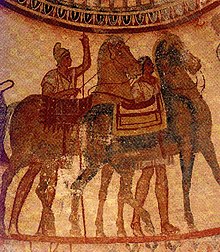
Thracian Tomb of Kazanlak
The indigenous population of Thrace was a people called the Thracians , divided into numerous tribal groups. Thracian troops were known to accompany neighboring ruler Alexander the Great when he crossed the Hellespont which abuts Thrace, and took on the Persian Empire of the day. The Thracians did not describe themselves as such and Thrace and Thracians are simply the names given them by the Greeks. Divided into separate tribes, the Thracians did not manage to form a lasting political organization until the Odrysian state was founded in the 4th century BC. Like Illyrians , Thracian tribes of the mountainous regions fostered a locally ruled warrior tradition, while the tribes based in the plains were purportedly more peaceable. Recently discovered funeral mounds in Bulgaria suggest that Thracian kings did rule regions of Thrace with distinct Thracian national identity. During this period, a subculture of celibate ascetics called the Ctistae lived in Thrace, where they served as philosophers, priests and prophets. Medieval historyBy the mid 5th century, as the Roman Empire began to crumble, Thracia fell from the authority of Rome and into the hands of Germanic tribal rulers. With the fall of Rome, Thracia turned into a battleground territory for the better part of the next 1,000 years. The eastern successor of the Roman Empire in the Balkans, the Byzantine Empire , retained control over Thrace until the 8th century when the northern half of the entire region was incorporated into the First Bulgarian Empire . Byzantium regained Thrace in the late 10th century and administered it as a theme , until the Bulgarians regained control of the northern half at the end of the 12th century. Throughout the 13th century and the first half of the 14th century, the region was changing in the hands of the Bulgarian and the Byzantine Empire(excl. Constantinopole). In 1265 the area suffered a Mongol raid from the Golden Horde , led by Nogai Khan . In 1352, the Ottoman Turks conducted their first incursion into the region subduing it completely within a matter of two decades and occupying it for five centuries. Modern historyWith the Congress of Berlin in 1878, Northern Thrace was incorporated into the semi-autonomous Ottoman province of Eastern Rumelia , which united with Bulgaria in 1885. The rest of Thrace was divided among Bulgaria, Greece and Turkey at the beginning of the 20th century, following the Balkan Wars , World War I and the Greco-Turkish War . Today Thracian is a strong regional identity in Greece, Turkey, Bulgaria and other neighbouring countries. Famous Thracians and people from Thrace
Payment
methods for USA buyers:< PAYPAL Payment methods for International
buyers - including Canada: PAYPAL International payment methods are
available up on request. Please contact me for more details. . Please be
sure to include item # & address with your payment. IF REQUESTING A
CERTIFICATE PLEASE DO SO AT THE TIME OF PAYMENT AND INCLUDE $5 Pay me
securely with any major credit card through PayPal! Items will be
shipped within 1 to 3 business days of purchase completion. $1.99 - DOMESTIC FIRST CLASS MAIL. INTERNATIONAL SHIPPING $9.99 (REGISTERED-$29.00) WE COMBINE SHIPPING If you would like to have special shipping, please contact us. All items will be sent out in protected envelope and boxed if necessary. Please make your payments on time. YOU ARE BIDDING ON AN ANCIENT ITEM(S) AS DESCRIBED AND PICTURED ABOVE!!! Every item offered by cameleoncoins is unconditionally guaranteed to be genuine & authentic. We can provide a certificate of authenticity or extended return policy by request only!!! Please include 5 dollars and a short request with your payment if you would like a COA!!! If in the unlikely event that an item is found to be reproduction, full return privileges are within 14 days of receiving the coins. We will promptly offer a full refund without hesitation or hassle. Please read the auction page prior to contacting US. |