|
Gaius Messius Quintus Decius (ca. 201- June 251) was
the
Emperor of Rome
from 249 to 251. In the last year of his reign, he co-ruled
with his son
Herennius Etruscus
until both of them were killed in the
Battle of Abrittus
.
//
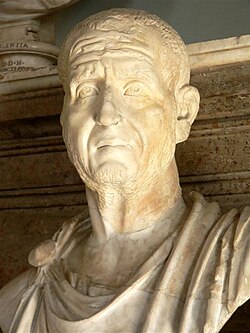 Early
life and rise to power Early
life and rise to power
Decius, who was born at
Budalia
, now
Martinci
,
Serbia
near
Sirmium
(Sremska
Mitrovica), in
Lower Pannonia
was one of the first among a long succession of future Roman
Emperors to originate from the provinces of
Illyria
in
the Danube.[1].
Unlike some of his immediate imperial predecessors such as Philip the Arab or
Maximinus
, Decius was a distinguished senator who had served as
consul
in 232,
had been governor of
Moesia
and
Germania Inferior
soon afterwards, served as governor of
Hispania Tarraconensis
between 235-238, and was
urban prefect
of Rome during the early reign of Emperor
Philip the Arab
(Marcus Iulius Phillipus).
Around 245, Emperor Philip entrusted Decius with an important
command on the Danube
. By the end of 248 or 249, Decius was sent to quell the revolt of
Pacatianus
and his troops in Moesia and Pannonia[3];
the soldiers were enraged because of the peace treaty signed between Philip and
the
Sassanids
. Once arrived, the troops forced Decius to assume the imperial
dignity himself instead. Decius still protested his loyalty to Philip, but the
latter advanced against him and was killed near
Verona
,
Italy
. The
Senate
then recognized Decius as Emperor, giving him the attribute Traianus as a
reference to the good emperor
Trajan
. As the
Byzantine historian
Zosimus
later
noted:
Decius was therefore clothed in purple and forced to
undertake the [burdens of] government, despite his reluctance and
unwillingness.
Political
and monumental initiatives
Decius' political program was focused on the restoration of
the strength of the State, both military opposing the external threats, and
restoring the public piety
with a program of renovation of the
State religion
.
Either as a concession to the Senate, or perhaps with the
idea of improving public morality, Decius endeavoured to revive the separate
office and authority of the
censor
. The choice was left to the Senate, who unanimously selected
Valerian
(afterwards emperor). But Valerian, well aware of the dangers and
difficulties attaching to the office at such a time, declined the
responsibility. The invasion of the
Goths
and Decius' death put an end to the abortive attempt.
During his reign, he proceeded to construct several building
projects in Rome "including the Thermae Deciane or Baths of Decius on the
Aventine" which was completed in 252 and still survived through to the
16th
century
; Decius also acted to repair the Colosseum, which had been damaged
by lightning strikes.
Persecution
of Christians
In January 250, Decius issued an edict for the suppression of
Christianity
. The edict itself was fairly clear:
All the inhabitants of the empire were required to
sacrifice before the magistrates of their community 'for the safety of the
empire' by a certain day (the date would vary from place to place and the
order may have been that the sacrifice had to be completed within a
specified period after a community received the edict). When they sacrificed
they would obtain a certificate (libellus) recording the fact that they had
complied with the order.
While Decius himself may have intended the edict as a way to
reaffirm his conservative vision of the Pax Romana and to reassure Rome's
citizens that the empire was still secure, it nevertheless sparked a "terrible
crisis of authority as various [Christian] bishops and their flocks reacted to
it in different ways." Measures were first taken demanding that the bishops
and officers of the church make a sacrifice for the Emperor,
a matter of an oath of allegiance that Christians considered offensive.
Certificates were issued to those who satisfied the
pagan
commissioners during the persecution of Christians under Decius. Forty-six such
certificates have been published, all dating from 250, four of them from
Oxyrhynchus
.
Christian followers who refused to offer a pagan sacrifice for the Emperor and
the Empire's well-being by a specified date risked torture and execution.
A number of prominent Christians did, in fact, refuse to make a sacrifice and
were killed in the process including
Pope
Fabian
himself in 250 and "anti-Christian feeling[s] led to pogroms at
Carthage and Alexandria."
In reality, however, towards the end of the second year of Decius' reign, "the
ferocity of the [anti-Christian] persecution had eased off, and the earlier
tradition of tolerance had begun to reassert itself."
The Christian church though never forgot the reign of Decius whom they labelled
as that "fierce tyrant".
At this time, there was a second outbreak of the
Antonine Plague
, which at its height in 251 to 266 took the lives of 5,000 a
day in Rome. This outbreak is referred to as the "Plague of
Cyprian
" (the
bishop of Carthage
), where both the plague and the
persecution of Christians
were especially severe. Cyprian's biographer
Pontius
gave a vivid picture of the demoralizing effects of the plague
and Cyprian moralized the event in his essay De mortalitate. In Carthage
the "Decian persecution" unleashed at the onset of the plague sought out
Christian scapegoats. Decius' edicts were renewed under Valerius in 253 and
repealed under his son,
Gallienus
,
in 260-1.
Military
actions and death
The
barbarian
incursions into the Empire were becoming more and more daring and frequent
whereas the Empire was facing a serious economic crisis in Decius' time. During
his brief reign, Decius engaged in important operations against the
Goths
, who
crossed the Danube to raid districts of Moesia and
Thrace
. This is
the first considerable occasion the Goths — who would later come to play such an
important role — appear in the historical record. The Goths under King
Cniva
were
surprised by the emperor while besieging
Nicopolis
on the Danube; the Goths fled through the difficult terrain of the
Balkans
, but
then doubled back and surprised the Romans near Beroë (modern
Stara
Zagora
), sacking their camp and dispersing the Roman troops. It was the
first time a Roman emperor fled in the face of Barbarians. The Goths then moved
to
Philippopolis attack
(modern
Plovdiv
),
which fell into their hands. The governor of Thrace,
Titus Julius Priscus
, declared himself Emperor under Gothic protection in
opposition to Decius but Priscus's challenge was rendered moot when he was
killed soon afterwards.
The siege of Philippopolis had so exhausted the numbers and
resources of the Goths that they offered to surrender their treasure and
prisoners, on condition of being allowed to retire.[
neededcitation] Decius, who had succeeded in surrounding them and hoped to
cut off their retreat, refused to entertain their proposals. The final
engagement, in which the Goths fought with the courage of despair, under the
command of Cniva, took place during the second week of June 251 on swampy ground
in the Ludogorie
(region in northeastern Bulgaria which merges with Dobruja plateau
and the Danube Plain to the north) near the small settlement of Abrittus or
Forum Terebronii (modern
Razgrad
): see
Battle of Abrittus
.
Jordanes
records that Decius' son
Herennius Etruscus
was killed by an arrow early in the battle, and to cheer
his men Decius exclaimed, "Let no one mourn; the death of one soldier is not a
great loss to the republic." Nevertheless, Decius' army was entangled in the
swamp and annihilated in this battle, while he himself was killed on the field
of battle.
As the historian
Aurelius Victor
relates:
The Decii (ie. Decius), while pursuing the
barbarians across the Danube, died through treachery at Abrittus after
reigning two years....Very many report that the son had fallen in battle
while pressing an attack too boldly; that the father however, has
strenuously asserted that the loss of one soldier seemed to him too little
to matter. And so he resumed the war and died in a similar manner while
fighting vigorously.
One literary tradition claims that Decius was betrayed by his
successor
Trebonianus Gallus
, who was involved in a secret alliance with the Goths but
this cannot be substantiated and was most likely a later invention since Gallus
felt compelled to adopt Decius' younger son, Gaius Valens Hostilianus, as joint
emperor even though the latter was too young to rule in his own right.
It is also unlikely that the shattered Roman legions would proclaim as emperor a
traitor who was responsible for the loss of so many soldiers from their ranks.
Decius was the first Roman emperor to die in battle against a foreign enemy
|