ESP32-S Development Board Screw Terminal Adapter © ei-ot ®

AI Thinker ESP32-S USB-Micro DevKit CH340 Board © ei-ot ®

AI Thinker ESP32-S USB-Micro Development Board Pinout © ei-ot ®
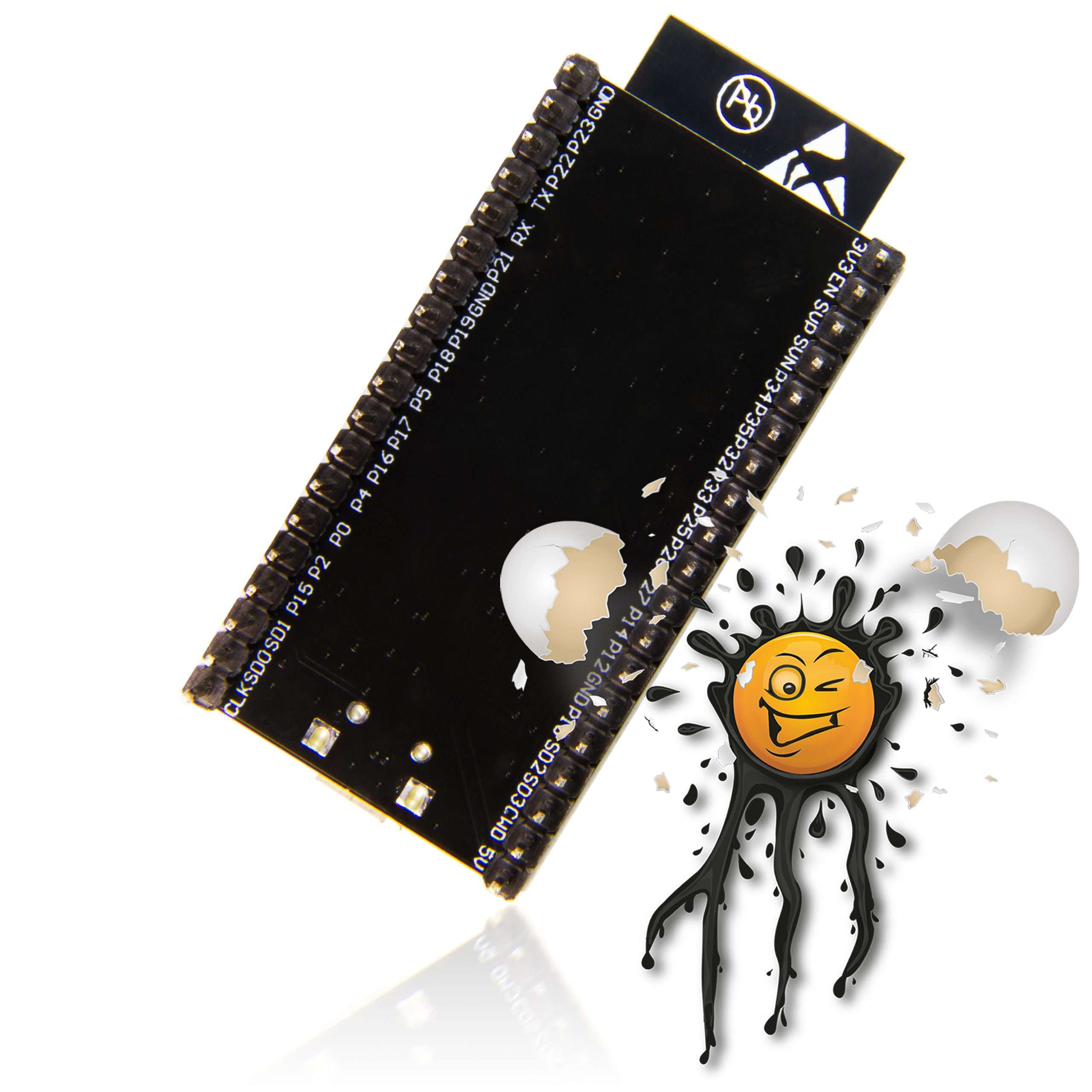
Screw Terminal Adapter Board for ESP32-S 38 Pin Development Board © ei-ot ®

|
|
ESP32 WROOM 32 ESP-32D 38 Pin Entwicklerboard wie folgt verfügbar:
AI Thinker ESP32-S USB-Micro DevKit Entwicklerplatine
Schraubadapter Board passend für AI Thinker ESP32-S USB-Micro DevKitC
Die AI Thinker ESP32-S USB-Micro Entwicklerplatine basiert auf der ESP32-D0WD-V3 (revision v3.1) MCU.
Das ESP32-S Modul basierend auf 2 low-power Xtensa® 32-bit LX6 CPU's. Mittels entsprechender Brücke kann wahlweise
die integrierte PCB Antenne
der U.FL Antennenanschluss zum Anschluss einer externen Antenne mit I-PEX Adapter
aktiviert werden.
Das ESP32-S Modul basiert auf der Xtensa Dual Core 32bit MCU in Kombination mit einem 4MB SPI Flash Speicher.
AI Thinker ESP32-S Entwicklerplatine mit CH340 USB TTL Konverter
Die generelle Spannungsversorgung erfolgt dabei über eine integrierte USB-Mikro Schnittstelle.
WCH stellt notwendige virtuelle COM Port Treiber (CH341) für alle gängigen Betriebssystem wie
Windows
Mac OS-X
Linux
bereit.
Der AI ThinkerESP32-S unterstützt
802.11 b/g/n Standard
HT40 WLan Transceiver
Bluetooth bis 4.2
Takfrequenz 240MHz
SRAM 520kBytes
4MB 32Mbit SPI Flash
36 GPIO
unterstützte Schnittstellen
SPI SD Karte,
UART,
SPI,
SDIO,
I2C,
LED PWM,
Motor PWM,
I2S,
IR,
pulse counter,
GPIO, capacitive touch sensor,
ADC 12-bit,
DAC,
Two-Wire Automotive Interface (TWAI®), compatible with ISO11898-1 (CAN Specification 2.0)
|
ESP32 ESP-32D 38 Pin development board available:
AI Thinker ESP32-S USB-Micro DevKit Development Board
Screw Terminal Adapter Board forAI Thinker ESP32-S USB-Micro DevKit
The AI Thinker ESP32-S USB-Micro Development Board is based on ESP32-D0WD-V3 (revision v3.1) MCU.
The ESP32-S module is based on 2 low power Xtensa Dual Core 32bit MCU in combination with a 4MB Flash.
Within solderpads
the integrated PCB Antenna
the U.FL Antenna Socket Connector for external Antenna with I-PEX Adapter
can be enabled.
ESP32-S Development Board with CH340 USB TTL Converter
The 5V main power supply is supported thru USB-Micro Socket.
For serial communication the ESP32-S Development Board got a CH340 from WCH on board.
Virtual COM Port Driver from WCH available for
Windows
Mac OS-X
Linux
TheESP32-S supports
802.11 b/g/n Standard
HT40 WLan Transceiver
Bluetooth up to 4.2
Frequency 240MHz
SRAM 520kBytes
4MB 32Mbit SPI Flash
36 GPIO
supported Interfaces
SPI SD Karte,
UART,
SPI,
SDIO,
I2C,
LED PWM,
Motor PWM,
I2S,
IR,
pulse counter,
GPIO, capacitive touch sensor,
ADC 12-bit,
DAC,
Two-Wire Automotive Interface (TWAI®), compatible with ISO11898-1 (CAN Specification 2.0)
|
- 5V Power Supply thru USB-Micro Connector
- CH340 USB TTL Converter on board
- USB Specification 2.0 compliant; full-speed (12 Mbps)
- Baud rates: 300 bps to 1 Mbps
- Virtual COM Port Device Drivers
- - Works with existing COM port PC Applications
- - Royalty-free distribution license - Windows 8/7/Vista/Server 2003/XP/2000
- - Mac OS-X/OS-9 and higher
- - Linux
- CPU / MPU:
Frequency: up to 240 MHz. based on Tensilica LX6 microcontroller with 600 DMIPS
up to 600 DMIPS
448 KByte ROM size
520 KByte SRAM size
- SPI Flash:
Flash memory: 32Mbit
clock frequency: 75 MHz.
Page program: up to 256 bytes in 0.64ms (TYP) Sector erase: 512Kb in 0.6s
Bulk erase: 17 - 23 s
Hardware write protection: protected area size defined by nonvolatile bits BP0, BP1, BP2
Deep power-down: 1μA (TYP)
Write Cycles: > 100,000 write cycles per sector Data retention: > 20 Years
- 802.11 b/g/n/e/i protocol
- supports Wi-Fi Direct (P2P)
- soft-AP Integrated TCP/IP protocol stack
- 802.11 n (2.4 GHz), up to 150 Mbps
- 802.11 e: QoS for wireless multimedia technology
- Block ACK
- Fragmentation and defragmentation
- Automatic Beacon monitoring/scanning
- 802.11 i security features: pre-authentication and TSN
- Wi-Fi Protected Access (WPA)/WPA2/WPA2-Enterprise/Wi-Fi Protected Setup (WPS)
- Infrastructure BSS Station mode/SoftAP mode Wi-Fi Direct (P2P), P2P Discovery, P2P Group Owner mode and P2P Power Management
- UMA compliant and certified
- Antenna diversity and selection
- Compliant with Bluetooth v4.2 BR/EDR and BLE specification
- deep sleep current of < 2.5uA
- Class-1, class-2 and class-3 transmitter without external power amplifier
- Enhanced power control
- +10 dBm transmitting power
- NZIF receiver with -98 dBm sensitivity
- Adaptive Frequency Hopping (AFH)
- Standard HCI based on SDIO/SPI/UART
- High speed UART HCI, up to 4 Mbps
- BT 4.2 controller and host stack
- Service Discover Protocol (SDP)
- General Access Profile (GAP)
- Security Manage Protocol (SMP)
- Bluetooth Low Energy (BLE)
- ATT/GATT
- HID
- All GATT-based profile supported
- SPP-Like GATT-based profile
- BLE Beacon
- A2DP/AVRCP/SPP, HSP/HFP, RFCOMM
- CVSD and SBC for audio codec
- Bluetooth Piconet and Scatternet
Adapter Board for 38 Pin ESP3-S2 Development Board Features:
|
|