Lot of 3 original ancient Roman bronze coin of:
Constan, Licinius, Crispus
Licinius I, 308-324 AD. Co-emperor until he was murdered by order of
Constantine I who then, by this act of perfidy, had the entire empire to
himself.
15-19mm
Authenticity guaranteed.
Coins are in good condition and very rare and nice inclusions to the finest collection.
The
cornucopia (from Latin cornu copiae) or horn of plenty is a symbol of
abundance and nourishment, commonly a large horn-shaped container
overflowing with produce, flowers, nuts, other edibles, or wealth in
some form. Originating in classical antiquity, it has continued as a
symbol in Western art, and it is particularly associated with the
Thanksgiving holiday in North America.
Allegorical depiction of the Roman goddess Abundantia with a cornucopia, by Rubens (ca. 1630)
In Mythology
Mythology
offers multiple explanations of the origin of the cornucopia. One of
the best-known involves the birth and nurturance of the infant Zeus, who
had to be hidden from his devouring father Cronus. In a cave on Mount
Ida on the island of Crete, baby Zeus was cared for and protected by a
number of divine attendants, including the goat Amalthea ("Nourishing
Goddess"), who fed him with her milk. The suckling future king of the
gods had unusual abilities and strength, and in playing with his
nursemaid accidentally broke off one of her horns, which then had the
divine power to provide unending nourishment, as the foster mother had
to the god.
In another myth, the cornucopia was created when
Heracles (Roman Hercules) wrestled with the river god Achelous and
wrenched off one of his horns; river gods were sometimes depicted as
horned. This version is represented in the Achelous and Hercules mural
painting by the American Regionalist artist Thomas Hart Benton.
The
cornucopia became the attribute of several Greek and Roman deities,
particularly those associated with the harvest, prosperity, or spiritual
abundance, such as personifications of Earth (Gaia or Terra); the child
Plutus, god of riches and son of the grain goddess Demeter; the nymph
Maia; and Fortuna, the goddess of luck, who had the power to grant
prosperity. In Roman Imperial cult, abstract Roman deities who fostered
peace (pax Romana) and prosperity were also depicted with a cornucopia,
including Abundantia, "Abundance" personified, and Annona, goddess of
the grain supply to the city of Rome. Pluto, the classical ruler of the
underworld in the mystery religions, was a giver of agricultural,
mineral and spiritual wealth, and in art often holds a cornucopia to
distinguish him from the gloomier Hades, who holds a drinking horn
instead.
Modern depictions
In modern depictions, the
cornucopia is typically a hollow, horn-shaped wicker basket filled with
various kinds of festive fruit and vegetables. In North America, the
cornucopia has come to be associated with Thanksgiving and the harvest.
Cornucopia is also the name of the annual November Wine and Food
celebration in Whistler, British Columbia, Canada. Two cornucopias are
seen in the flag and state seal of Idaho. The Great Seal of North
Carolina depicts Liberty standing and Plenty holding a cornucopia. The
coat of arms of Colombia, Panama, Peru and Venezuela, and the Coat of
Arms of the State of Victoria, Australia, also feature the cornucopia,
symbolising prosperity.
The horn of plenty is used on body art and at Halloween, as it is a symbol of fertility, fortune and abundance.
Juno
Moneta, an epithet of Juno, was the protectress of funds. As such,
money in ancient Rome was coined in her temple. The Temple of Juno
Moneta (Latin: Templum Iunonis Monetæ) was an ancient Roman temple that
stood on the Arx or the citadel on the Capitoline Hill overlooking the
Roman Forum. Located at the center of the city of Rome, it was the place
where Roman coins were first minted, thereby initiating the ancient
practice of associating mints with temples. In addition, it was the
place where the books of the magistrates were deposited. The word
"moneta" is where we get the words "money", or "monetize", used by
writers such as Ovid, Martial, Juvenal, and Cicero. In several modern
languages including Russian and Italian, moneta (Spanish moneda) is the
word for "coin." As with the goddess Moneta, Juno Moneta's name is
derived either from the Latin monēre, since, as protectress of funds,
she "warned" of instability or more likely from the Greek "moneres"
meaning "alone, unique", an epithet that every mother has.
Maximian
(Latin: Marcus Aurelius Valerius Maximianus Herculius Augustus; c. 250 –
c. July 310) was Roman Emperor from 286 to 305. He was Caesar from 285
to 286, then Augustus from 286 to 305. He shared the latter title with
his co-emperor and superior, Diocletian, whose political brain
complemented Maximian's military brawn. Maximian established his
residence at Trier but spent most of his time on campaign. In late 285,
he suppressed rebels in Gaul known as the Bagaudae. From 285 to 288, he
fought against Germanic tribes along the Rhine frontier. Together with
Diocletian, he launched a scorched earth campaign deep into Alamannic
territory in 288, temporarily relieving the Rhine provinces from the
threat of Germanic invasion.
The man he appointed to police the
Channel shores, Carausius, rebelled in 286, causing the secession of
Britain and northwestern Gaul. Maximian failed to oust Carausius, and
his invasion fleet was destroyed by storms in 289 or 290. Maximian's
subordinate, Constantius, campaigned against Carausius' successor,
Allectus, while Maximian held the Rhine frontier. The rebel leader was
ousted in 296, and Maximian moved south to combat piracy near Hispania
and Berber incursions in Mauretania. When these campaigns concluded in
298, he departed for Italy, where he lived in comfort until 305. At
Diocletian's behest, Maximian abdicated on May 1, 305, gave the Augustan
office to Constantius, and retired to southern Italy.
In late
306, Maximian took the title of Augustus again and aided his son
Maxentius' rebellion in Italy. In April 307, he attempted to depose his
son, but failed and fled to the court of Constantius' successor,
Constantine (Maximian's step-grandson and son-in-law), in Trier. At the
Council of Carnuntum in November 308, Diocletian and his successor,
Galerius, forced Maximian to renounce his imperial claim again. In early
310, Maximian attempted to seize Constantine's title while the emperor
was on campaign on the Rhine. Few supported him, and he was captured by
Constantine in Marseille. Maximian killed himself in mid-310 on
Constantine's orders. During Constantine's war with Maxentius,
Maximian's image was purged from all public places. However, after
Constantine ousted and killed Maxentius, Maximian's image was
rehabilitated, and he was deified.
In
Roman mythology
,
Jupiter
or
Jove was the
king of the gods
, and the god of
sky and
thunder
. He
is
 the equivalent of Zeus
in the
Greek pantheon
. He was called Iuppiter (or Diespiter)
Optimus Maximus ("Father God the Best and Greatest"). As the patron deity of
ancient
Rome
, he ruled over laws and social order. He was the chief god of the
Capitoline Triad
, with sister/wife
Juno
. Jupiter is also the father of the god
Mars
with Juno. Therefore, Jupiter is the grandfather of
Romulus and Remus
, the legendary founders of Rome. Jupiter was venerated in
ancient Roman religion
, and is still venerated in
Roman Neopaganism
. He is a son of
Saturn
, along with brothers
Neptune
and
Pluto
.
He is also the brother/husband of
Ceres
(daughter of Saturn and mother of
Proserpina
),
brother of Veritas
(daughter of Saturn), and father of
Mercury
. the equivalent of Zeus
in the
Greek pantheon
. He was called Iuppiter (or Diespiter)
Optimus Maximus ("Father God the Best and Greatest"). As the patron deity of
ancient
Rome
, he ruled over laws and social order. He was the chief god of the
Capitoline Triad
, with sister/wife
Juno
. Jupiter is also the father of the god
Mars
with Juno. Therefore, Jupiter is the grandfather of
Romulus and Remus
, the legendary founders of Rome. Jupiter was venerated in
ancient Roman religion
, and is still venerated in
Roman Neopaganism
. He is a son of
Saturn
, along with brothers
Neptune
and
Pluto
.
He is also the brother/husband of
Ceres
(daughter of Saturn and mother of
Proserpina
),
brother of Veritas
(daughter of Saturn), and father of
Mercury
.
Constantine the Great (Latin:
Flavius Valerius Aurelius Constantinus Augustus;
27 February c. 272 – 22 May 337), also known as Constantine I or Saint
Constantine, was
Roman Emperor
from 306 to 337. Well known for
being the first Roman emperor to
be converted
to
Christianity
, Constantine and co-Emperor
Licinius
issued the
Edict of Milan
in 313, which proclaimed
tolerance of all religions
throughout the
empire.
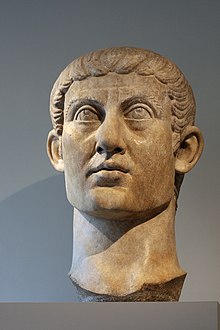
Constantine defeated the emperors
Maxentius
and
Licinius
during civil wars. He also fought
successfully against the
Franks
,
Alamanni
,
Visigoths
, and
Sarmatians
during his reign — even resettling
parts of Dacia
which had been abandoned during the
previous century. Constantine built a new imperial residence at
Byzantium
, naming it
New Rome
. However, in Constantine's honor,
people called it
Constantinople
, which would later be the
capital of what is now known as the
Byzantine Empire
for over one thousand years.
Because of this, he is thought of as the founder of the Byzantine Empire.
Flavius Valerius Constantinus, as he was originally named, was born in the
city of Naissus,
Dardania
province of
Moesia
, in present-day
Niš,
Serbia
, on 27 February of an uncertain year,
probably near 272.
His father was
Flavius Constantius
, a native of
Dardania
province of Moesia (later
Dacia Ripensis
). Constantius was a tolerant and
politically skilled man. Constantine probably spent little time with his father.
Constantius was an officer in the Roman army, part of the Emperor
Aurelian
's imperial bodyguard. Constantius
advanced through the ranks, earning the
governorship
of
Dalmatia
from Emperor
Diocletian
, another of Aurelian's companions
from
Illyricum
, in 284 or 285.Constantine's mother
was
Helena
, a
Bithynian
woman of low social standing.It is
uncertain whether she was legally married to Constantius or merely his concubine
Helena gave birth to the future emperor
Constantine I
on 27 February of an uncertain
year soon after 270 (probably around 272). At the time, she was in
Naissus
(Niš,
Serbia
). In order to obtain a wife more
consonant with his rising status, Constantius divorced Helena some time before
289, when he married
Theodora
, Maximian's daughter.(The narrative
sources date the marriage to 293, but the
Latin panegyric
of 289 refers to the couple as
already married). Helena and her son were dispatched to the court of
Diocletian
at Nicomedia, where Constantine grew
to be a member of the inner circle. Helena never remarried and lived for a time
in obscurity, though close to her only son, who had a deep regard and affection
for her.


She received the title of
Augusta
in 325 and died in 330 with her son
at her side. She was buried in the
Mausoleum of Helena
, outside
Rome on the
Via Labicana
. Her
sarcophagus
is on display in the
Pio-Clementine Vatican Museum
, although the
connection is often questioned, next to her is the sarcophagus of her
granddaughter Saint Constantina (Saint Constance). The elaborate reliefs contain
hunting scenes. During her life, she gave many presents to the poor, released
prisoners and mingled with the ordinary worshippers in modest attire.
Constantine received a formal education at Diocletian's court, where he
learned Latin literature, Greek, and philosophy.
On 1 May 305, Diocletian, as a result of a debilitating sickness taken in the
winter of 304–5, announced his resignation. In a parallel ceremony in Milan,
Maximian did the same. Lactantius states that Galerius manipulated the weakened
Diocletian into resigning, and forced him to accept Galerius' allies in the
imperial succession. According to Lactantius, the crowd listening to
Diocletian's resignation speech believed, until the very last moment, that
Diocletian would choose Constantine and
Maxentius
(Maximian's son) as his successors.
It was not to be: Constantius and Galerius were promoted to Augusti, while
Severus
and
Maximin
were appointed their Caesars
respectively. Constantine and Maxentius were ignored.
Constantine recognized the implicit danger in remaining at Galerius' court,
where he was held as a virtual hostage. His career depended on being rescued by
his father in the west. Constantius was quick to intervene. In the late spring
or early summer of 305, Constantius requested leave for his son, to help him
campaign in Britain. After a long evening of drinking, Galerius granted the
request. Constantine's later propaganda describes how he fled the court in the
night, before Galerius could change his mind. He rode from
post-house
to post-house at high speed,
hamstringing
every horse in his wake.By the
time Galerius awoke the following morning, Constantine had fled too far to be
caught. Constantine joined his father in
Gaul
, at Bononia (Boulogne)
before the summer of 305.
From Bononia they crossed the
Channel
to Britain and made their way to
Eboracum
(York),
capital of the province of
Britannia Secunda
and home to a large military
base. Constantine was able to spend a year in northern Britain at his father's
side, campaigning against the
Picts
beyond
Hadrian's Wall
in the summer and autumn.
Constantius's campaign, like that of
Septimius Severus
before it, probably advanced
far into the north without achieving great success. Constantius had become
severely sick over the course of his reign, and died on 25 July 306 in
Eboracum
(York).
Before dying, he declared his support for raising Constantine to the rank of
full Augustus. The
Alamannic
king
Chrocus
, a barbarian taken into service under
Constantius, then proclaimed Constantine as Augustus. The troops loyal to
Constantius' memory followed him in acclamation. Gaul and Britain quickly
accepted his rule; Iberia, which had been in his father's domain for less than a
year, rejected it.
Constantine sent Galerius an official notice of Constantius's death and his
own acclamation. Along with the notice, he included a portrait of himself in the
robes of an Augustus. The portrait was wreathed in
bay
. He requested recognition as heir to his
father's throne, and passed off responsibility for his unlawful ascension on his
army, claiming they had "forced it upon him".Galerius was put into a fury by the
message; he almost set the portrait on fire. His advisers calmed him, and argued
that outright denial of Constantine's claims would mean certain war.Galerius was
compelled to compromise: he granted Constantine the title "Caesar" rather than
"Augustus" (the latter office went to Severus instead). Wishing to make it clear
that he alone gave Constantine legitimacy, Galerius personally sent Constantine
the emperor's traditional
purple robes
. Constantine accepted the
decision. Constantine's share of the Empire consisted of Britain, Gaul, and
Spain.
Because Constantine was still largely untried and had a hint of illegitimacy
about him, he relied on his father's reputation in his early propaganda: the
earliest panegyrics to Constantine give as much coverage to his father's deeds
as to those of Constantine himself.
Constantine's military skill and building projects soon gave
the panegyrist the opportunity to comment favorably on the similarities between
father and son, and Eusebius remarked that Constantine was a "renewal, as it
were, in his own person, of his father's life and reign". Constantinian coinage,
sculpture and oratory also shows a new tendency for disdain towards the
"barbarians" beyond the frontiers. After Constantine's victory over the
Alemanni, he minted a coin issue depicting weeping and begging Alemannic
tribesmen—"The Alemanni conquered"—beneath the phrase "Romans' rejoicing".There
was little sympathy for these enemies. As his panegyrist declared: "It is a
stupid clemency that spares the conquered foe."

In 310, a dispossessed and power-hungry Maximian rebelled against Constantine
while Constantine was away campaigning against the Franks. Maximian had been
sent south to Arles with a contingent of Constantine's army, in preparation for
any attacks by Maxentius in southern Gaul. He announced that Constantine was
dead, and took up the imperial purple. In spite of a large donative pledge to
any who would support him as emperor, most of Constantine's army remained loyal
to their emperor, and Maximian was soon compelled to leave. Constantine soon
heard of the rebellion, abandoned his campaign against the Franks, and marched
his army up the Rhine. At Cabillunum (Chalon-sur-Saône),
he moved his troops onto waiting boats to row down the slow waters of the
Saône
to the quicker waters of the
Rhone
. He disembarked at
Lugdunum
(Lyon).Maximian
fled to Massilia (Marseille),
a town better able to withstand a long siege than Arles. It made little
difference, however, as loyal citizens opened the rear gates to Constantine.
Maximian was captured and reproved for his crimes. Constantine granted some
clemency, but strongly encouraged his suicide. In July 310, Maximian hanged
himself.
The death of Maximian required a shift in Constantine's public image. He
could no longer rely on his connection to the elder emperor Maximian, and needed
a new source of legitimacy.In a speech delivered in Gaul on 25 July 310, the
anonymous orator reveals a previously unknown dynastic connection to
Claudius II
, a third-century emperor famed for
defeating the Goths and restoring order to the empire. Breaking away from
tetrarchic models, the speech emphasizes Constantine's ancestral prerogative to
rule, rather than principles of imperial equality. The new ideology expressed in
the speech made Galerius and Maximian irrelevant to Constantine's right to rule.
Indeed, the orator emphasizes ancestry to the exclusion of all other factors:
"No chance agreement of men, nor some unexpected consequence of favor, made you
emperor," the orator declares to Constantine.
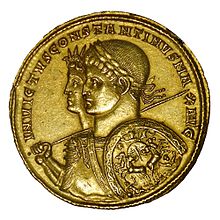
A gold multiple of "Unconquered Constantine" with
Sol Invictus
, struck in 313. The use of
Sol's image appealed to both the educated citizens of Gaul, who would
recognize
in it Apollo's patronage of
Augustus
and the arts; and to Christians,
who found solar monotheism less objectionable than the traditional pagan
pantheon.
The oration also moves away from the religious ideology of the Tetrarchy,
with its focus on twin dynasties of
Jupiter
and
Hercules
. Instead, the orator proclaims that
Constantine experienced a divine vision of
Apollo
and
Victory
granting him
laurel wreaths
of health and a long reign. In
the likeness of Apollo Constantine recognized himself as the saving figure to
whom would be granted "rule of the whole world", as the poet Virgil had once
foretold. The oration's religious shift is paralleled by a similar shift in
Constantine's coinage. In his early reign, the coinage of Constantine advertised
Mars
as his patron. From 310 on, Mars was
replaced by
Sol Invictus
, a god conventionally identified
with Apollo.
By the middle of 310, Galerius had become too ill to involve himself in
imperial politics. His final act survives: a letter to the provincials posted in
Nicomedia on 30 April 311, proclaiming an end to the persecutions, and the
resumption of religious toleration. He died soon after the edict's proclamation,
destroying what little remained of the tetrarchy. Maximin mobilized against
Licinius, and seized Asia Minor. A hasty peace was signed on a boat in the
middle of the Bosphorus. While Constantine toured Britain and Gaul, Maxentius
prepared for war.He fortified northern Italy, and strengthened his support in
the Christian community by allowing it to elect a new
Bishop
of
Rome
,
Eusebius
.
Constantine's advisers and generals cautioned against preemptive attack on
Maxentius; even his soothsayers recommended against it, stating that the
sacrifices had produced unfavorable omens. Constantine, with a spirit that left
a deep impression on his followers, inspiring some to believe that he had some
form of supernatural guidance, ignored all these cautions. Early in the spring
of 312,Constantine crossed the
Cottian Alps
with a quarter of his army, a
force numbering about 40,000.The first town his army encountered was Segusium (Susa,
Italy
), a heavily fortified town that shut its
gates to him. Constantine ordered his men to set fire to its gates and scale its
walls. He took the town quickly. Constantine ordered his troops not to loot the
town, and advanced with them into northern Italy.
At the approach to the west of the important city of Augusta Taurinorum (Turin,
Italy), Constantine met a large force of heavily armed Maxentian cavalry. In the
ensuing
battle
Constantine's army encircled Maxentius'
cavalry, flanked them with his own cavalry, and dismounted them with blows from
his soldiers' iron-tipped clubs. Constantine's armies emerged victorious. Turin
refused to give refuge to Maxentius' retreating forces, opening its gates to
Constantine instead.
Other cities of the north Italian plain sent Constantine
embassies of congratulation for his victory. He moved on to Milan, where he was
met with open gates and jubilant rejoicing. Constantine rested his army in Milan
until mid-summer 312, when he moved on to
Brixia
(Brescia).
Brescia's army was easily dispersed, and Constantine quickly advanced to
Verona
, where a large Maxentian force was
camped. Ruricius Pompeianus, general of the Veronese forces and Maxentius'
praetorian prefect, was in a strong defensive position, since the town was
surrounded on three sides by the
Adige
. Constantine sent a small force north of
the town in an attempt to cross the river unnoticed. Ruricius sent a large
detachment to counter Constantine's expeditionary force, but was defeated.
Constantine's forces successfully surrounded the town and laid siege. Ruricius
gave Constantine the slip and returned with a larger force to oppose
Constantine. Constantine refused to let up on the siege, and sent only a small
force to oppose him. In the desperately fought
encounter
that followed, Ruricius was killed
and his army destroyed.Verona surrendered soon afterwards, followed by
Aquileia
, Mutina (Modena),
and
Ravenna
. The road to Rome was now wide open to
Constantine.
Maxentius prepared for the same type of war he had waged against Severus and
Galerius: he sat in Rome and prepared for a siege. He still controlled Rome's
praetorian guards, was well-stocked with African grain, and was surrounded on
all sides by the seemingly impregnable
Aurelian Walls
. He ordered all bridges across
the Tiber
cut, reportedly on the counsel of the
gods, and left the rest of central Italy undefended; Constantine secured that
region's support without challenge. Constantine progressed slowly along the
Via Flaminia
, allowing the weakness of
Maxentius to draw his regime further into turmoil. Maxentius' support continued
to weaken: at chariot races on 27 October, the crowd openly taunted Maxentius,
shouting that Constantine was invincible. Maxentius, no longer certain that he
would emerge from a siege victorious, built a temporary boat bridge across the
Tiber in preparation for a field battle against Constantine. On 28 October 312,
the sixth anniversary of his reign, he approached the keepers of the
Sibylline Books
for guidance. The keepers
prophesied that, on that very day, "the enemy of the Romans" would die.
Maxentius advanced north to meet Constantine in battle.
Maxentius organized his forces—still twice the size of Constantine's—in long
lines facing the battle plain, with their backs to the river. Constantine's army
arrived at the field bearing unfamiliar symbols on either its standards or its
soldiers' shields. Constantine was visited by a dream the night before the
battle, wherein he was advised "to mark the heavenly sign of God on the shields
of his soldiers...by means of a slanted letter X with the top of its head bent
round, he marked Christ on their shields." Eusebius describes the sign as
Chi
(Χ) traversed by
Rho
(Ρ): ☧, a symbol representing the first two
letters of the Greek spelling of the word Christos or Christ.
Constantine deployed his own forces along the whole length of Maxentius'
line. He ordered his cavalry to charge, and they broke Maxentius' cavalry. He
then sent his infantry against Maxentius' infantry, pushing many into the Tiber
where they were slaughtered and drowned. The battle was brief: Maxentius' troops
were broken before the first charge. Maxentius' horse guards and praetorians
initially held their position, but broke under the force of a Constantinian
cavalry charge; they also broke ranks and fled to the river. Maxentius rode with
them, and attempted to cross the bridge of boats, but he was pushed by the mass
of his fleeing soldiers into the Tiber, and drowned.
In Rome
Constantine entered Rome on 29 October.He staged a grand
adventus
in the city, and was met with
popular jubilation. Maxentius' body was fished out of the Tiber and decapitated.
His head was paraded through the streets for all to see. Unlike his
predecessors, Constantine neglected to make the trip to the
Capitoline Hill
and perform customary
sacrifices at the
Temple of Jupiter
. He did, however, choose to
honor the
Senatorial
Curia
with a visit, where he promised to
restore its ancestral privileges and give it a secure role in his reformed
government: there would be no revenge against Maxentius' supporters.In response,
the Senate decreed him "title of the first name", which meant his name would be
listed first in all official documents, and acclaimed him as "the greatest
Augustus". He issued decrees returning property lost under Maxentius, recalling
political exiles, and releasing Maxentius' imprisoned opponents.
In the following years, Constantine gradually consolidated his military
superiority over his rivals in the crumbling Tetrarchy. In 313, he met
Licinius
in
Milan
to secure their alliance by the marriage
of Licinius and Constantine's half-sister
Constantia
. During this meeting, the emperors
agreed on the so-called
Edict of Milan
,officially granting full
tolerance to Christianity and all religions in the Empire.The document had
special benefits for Christians, legalizing their religion and granting them
restoration for all property seized during Diocletian's persecution.
In the year 320,
Licinius
reneged on the religious freedom
promised by the
Edict of Milan
in 313 and began to oppress
Christians anew, generally without bloodshed, but resorting to confiscations and
sacking of Christian office-holders.That became a challenge to Constantine in
the West, climaxing in the great civil war of 324. Licinius, aided by
Goth
mercenaries
, represented the past and the
ancient Pagan
faiths. Constantine and his
Franks
marched under the standard of the
labarum
, and both sides saw the battle in
religious terms. Outnumbered, but fired by their zeal, Constantine's army
emerged victorious in the
Battle of Adrianople
. Licinius fled across the
Bosphorus and appointed
Martius Martinianus
, the commander of his
bodyguard, as Caesar, but Constantine next won the
Battle of the Hellespont
, and finally the
Battle of Chrysopolis
on 18 September
324.Licinius and Martinianus surrendered to Constantine at Nicomedia on the
promise their lives would be spared: they were sent to live as private citizens
in Thessalonica and Cappadocia respectively, but in 325 Constantine accused
Licinius of plotting against him and had them both arrested and hanged;
Licinius's son (the son of Constantine's half-sister) was also killed. Thus
Constantine became the sole emperor of the Roman Empire.
Foundation of
Constantinople
Licinius' defeat came to represent the defeat of a rival center of Pagan and
Greek-speaking political activity in the East, as opposed to the Christian and
Latin-speaking Rome, and it was proposed that a new Eastern capital should
represent the integration of the East into the Roman Empire as a whole, as a
center of learning, prosperity, and cultural preservation for the whole of the
Eastern Roman Empire
. Among the various
locations proposed for this alternative capital, Constantine appears to have
toyed earlier with
Serdica
(present-day
Sofia
), as he was reported saying that "Serdica
is my Rome". Sirmium
and
Thessalonica
were also considered. Eventually,
however, Constantine decided to work on the Greek city of
Byzantium
, which offered the advantage of
having already been extensively rebuilt on Roman patterns of urbanism, during
the preceding century, by
Septimius Severus
and
Caracalla
, who had already acknowledged its
strategic importance. The city was then renamed Constantinopolis
("Constantine's City" or
Constantinople
in English), and issued special
commemorative coins in 330 to honor the event. The new city was protected by the
relics of the
True Cross
, the
Rod of Moses
and other holy
relics
, though a cameo now at the
Hermitage Museum
also represented Constantine
crowned by the tyche
of the new city. The figures of old gods
were either replaced or assimilated into a framework of
Christian symbolism
. Constantine built the new
Church of the Holy Apostles
on the site of a
temple to Aphrodite
. Generations later there was the
story that a
divine vision
led Constantine to this spot, and
an angel
no one else could see, led him on a
circuit of the new walls. The capital would often be compared to the 'old' Rome
as Nova Roma Constantinopolitana, the "New Rome of Constantinople".
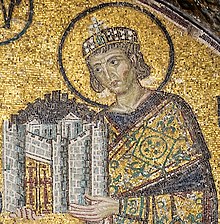
Constantine the Great, mosaic in
Hagia Sophia
, c. 1000
Religious policy
Constantine is perhaps best known for being the first "Christian" Roman
emperor. Scholars debate whether Constantine adopted his mother
St. Helena
's
Christianity in his youth, or whether he adopted it gradually over the course of
his life.
Constantine was over 40 when he finally declared himself a Christian, writing to
Christians to make clear that he believed he owed his successes to the
protection of the Christian High God alone.Throughout his rule, Constantine
supported the Church financially, built basilicas, granted privileges to clergy
(e.g. exemption from certain taxes), promoted Christians to high office, and
returned property confiscated during the Diocletianic persecution.His most
famous building projects include the
Church of the Holy Sepulchre
, and
Old Saint Peter's Basilica
.
However, Constantine certainly did not patronize Christianity alone. After
gaining victory in the Battle of the Milvian Bridge (312), a triumphal arch—the
Arch of Constantine
—was built (315) to
celebrate his triumph. The arch is most notably decorated with images of the
goddess
Victoria
and, at the time of its dedication,
sacrifices to gods like
Apollo
,
Diana
, and
Hercules
were made. Most notably absent from
the Arch are any depictions whatsoever regarding Christian symbolism.
Later in 321, Constantine instructed that Christians and non-Christians
should be united in observing the venerable day of the sun, referencing
the sun-worship
that
Aurelian
had established as an official cult.
Furthermore, and long after his oft alleged "conversion" to Christianity,
Constantine's coinage continued to carry the symbols of the sun. Even after the
pagan gods had disappeared from the coinage, Christian symbols appeared only as
Constantine's personal attributes: the
chi rho
between his hands or on his
labarum
, but never on the coin itself. Even
when Constantine dedicated the new capital of Constantinople, which became the
seat of Byzantine Christianity for a millennium, he did so wearing the
Apollonian
sun-rayed
Diadem
; no Christian symbols were present at
this dedication.
Constantine made new laws regarding the
Jews. They were forbidden to own Christian slaves or to
circumcise
their slaves.

Administrative reforms
Beginning in the mid-3rd century the emperors began to favor members of the
equestrian order
over senators, who had had a
monopoly on the most important offices of state. Senators were stripped of the
command of legions and most provincial governorships (as it was felt that they
lacked the specialized military upbringing needed in an age of acute defense
needs), such posts being given to equestrians by Diocletian and his
colleagues—following a practice enforced piecemeal by their predecessors. The
emperors however, still needed the talents and the help of the very rich, who
were relied on to maintain social order and cohesion by means of a web of
powerful influence and contacts at all levels. Exclusion of the old senatorial
aristocracy threatened this arrangement.
In 326, Constantine reversed this pro-equestrian trend, raising many
administrative positions to senatorial rank and thus opening these offices to
the old aristocracy, and at the same time elevating the rank of already existing
equestrians office-holders to senator, eventually wiping out the equestrian
order—at least as a bureaucratic rank—in the process. One could become a
senator, either by being elected
praetor
or (in most cases) by fulfilling a
function of senatorial rank: from then on, holding of actual power and social
status were melded together into a joint imperial hierarchy. At the same time,
Constantine gained with this the support of the old nobility, as the Senate was
allowed itself to elect praetors and
quaestors
, in place of the usual practice of
the emperors directly creating new magistrates (adlectio).
The Senate as a body remained devoid of any significant power; nevertheless,
the senators, who had been marginalized as potential holders of imperial
functions during the 3rd century, could now dispute such positions alongside
more upstart bureaucrats. Some modern historians see in those administrative
reforms an attempt by Constantine at reintegrating the senatorial order into the
imperial administrative elite to counter the possibility of alienating pagan
senators from a Christianized imperial rule.
Constantine's reforms had to do only with the civilian administration: the
military chiefs, who since the
Crisis of the Third Century
had risen from the
ranks, remained outside the senate, in which they were included only by
Constantine's children.

Monetary reforms
After the
runaway inflation of the third century
,
associated with the production of
fiat money
to pay for public expenses,
Diocletian had tried unsuccessfully to reestablish trustworthy minting of silver
and
billon
coins. The failure of the various
Diocletianic attempts at the restoration of a functioning silver coin resided in
the fact that the silver currency was overvalued in terms of its actual metal
content, and therefore could only circulate at much discounted rates. Minting of
the Diocletianic "pure" silver
argenteus
ceased, therefore, soon after
305, while the billon currency continued to be used until the 360s. From the
early 300s on, Constantine forsook any attempts at restoring the silver
currency, preferring instead to concentrate on minting large quantities of good
standard gold pieces—the
solidus
, 72 of which made a pound of gold. New
(and highly debased) silver pieces would continue to be issued during
Constantine's later reign and after his death, in a continuous process of
retariffing, until this billon minting eventually ceased, de jure, in
367, with the silver piece being de facto continued by various
denominations of bronze coins, the most important being the
centenionalis
. Later emperors like
Julian the Apostate
tried to present themselves
as advocates of the humiles by insisting on trustworthy mintings of the
bronze currency.
Constantine's monetary policy were closely associated with his religious
ones, in that increased minting was associated with measures of
confiscation—taken since 331 and closed in 336—of all gold, silver and bronze
statues from pagan temples, who were declared as imperial property and, as such,
as monetary assets. Two imperial commissioners for each province had the task of
getting hold of the statues and having them melded for immediate minting—with
the exception of a number of bronze statues who were used as public monuments
for the beautification of the new capital in Constantinople.
Later campaigns
Constantine considered Constantinople as his capital and permanent residence.
He lived there for a good portion of his later life. He rebuilt Trajan's bridge
across the Danube, in hopes of reconquering
Dacia
, a province that had been abandoned under
Aurelian. In the late winter of 332, Constantine campaigned with the
Sarmatians
against the
Goths
. The weather and lack of food cost the
Goths dearly: reportedly, nearly one hundred thousand died before they submitted
to Rome. In 334, after Sarmatian commoners had overthrown their leaders,
Constantine led a campaign against the tribe. He won a victory in the war and
extended his control over the region, as remains of camps and fortifications in
the region indicate.Constantine resettled some Sarmatian exiles as farmers in
Illyrian and Roman districts, and conscripted the rest into the army.
Constantine took the title Dacicus maximus in 336.
Sickness and death
Constantine had known death would soon come. Within the Church of the Holy
Apostles, Constantine had secretly prepared a final resting-place for himself.It
came sooner than he had expected. Soon after the Feast of Easter 337,
Constantine fell seriously ill. He left Constantinople for the hot baths near
his mother's city of Helenopolis (Altinova), on the southern shores of the Gulf
of İzmit. There, in a church his mother built in honor of Lucian the Apostle, he
prayed, and there he realized that he was dying. Seeking purification, he became
a catechumen
, and attempted a return to
Constantinople, making it only as far as a suburb of Nicomedia. He summoned the
bishops, and told them of his hope to be baptized in the
River Jordan
, where Christ was written to have
been baptized. He requested the baptism right away. The bishops, Eusebius
records, "performed the sacred ceremonies according to custom". He chose the
Arianizing bishop
Eusebius of Nicomedia
, bishop of the
city
where he lay dying, as his baptizer. In
postponing his baptism, he followed one custom at the time which postponed
baptism until after infancy. Constantine died soon after at a suburban villa
called Achyron, on the last day of the fifty-day festival of Pentecost directly
following Pascha (or Easter), on 22 May 337.
Following his death, his body was transferred to Constantinople and buried in
the
Church of the Holy Apostles
there. He was
succeeded by his three sons born of Fausta,
Constantine II
,
Constantius II
and
Constans
. A number of relatives were killed by
followers of Constantius, notably Constantine's nephews
Dalmatius
(who held the rank of Caesar) and
Hannibalianus
, presumably to eliminate possible
contenders to an already complicated succession. He also had two daughters,
Constantina
and
Helena
, wife of
Emperor Julian
.
Legacy
The Byzantine Empire considered Constantine its founder and the
Holy Roman Empire
reckoned him among the
venerable figures of its tradition. In the later Byzantine state, it had become
a great honor for an emperor to be hailed as a "new Constantine". Ten emperors,
including the last emperor of Byzantium, carried the name. Most Eastern
Christian churches consider Constantine a saint (Άγιος Κωνσταντίνος, Saint
Constantine). In the Byzantine Church he was called isapostolos (Ισαπόστολος
Κωνσταντίνος) —an
equal of the Apostles
.
Niš airport
is named Constantine the Great in
honor of his birth in Naissus.
|
In ancient Roman religion
and
myth
, Jupiter (Latin:
Iuppiter) or Jove is the
king of the gods
and the
god of sky
and
thunder
. Jupiter was the chief deity of Roman
state religion throughout the
Republican
and
Imperial
eras, until the Empire
came under Christian rule
. In
Roman mythology
, he negotiates with
Numa Pompilius
, the second
king of Rome
, to establish principles of Roman
religion such as sacrifice.
Jupiter is usually thought to have originated as a sky god. His identifying
implement is the
thunderbolt
, and his primary sacred animal is
the eagle, which held precedence over other birds in the taking of
auspices
and became one of the most common
symbols of the
Roman army
(see
Aquila
). The two emblems were often combined to
represent the god in the form of an eagle holding in its claws a thunderbolt,
frequently seen on Greek and Roman coins. As the sky-god, he was a divine
witness to oaths, the sacred trust on which justice and good government depend.
Many of his functions were focused on the
Capitoline
("Capitol Hill"), where the
citadel
was located. He was the chief deity of
the
early Capitoline Triad
with
Mars
and
Quirinus
. In the
later Capitoline Triad
, he was the central
guardian of the state with
Juno
and
Minerva
. His sacred tree was the oak.
The Romans regarded Jupiter as the
equivalent
of Greek
Zeus, and in
Latin literature
and
Roman art
, the myths and iconography of Zeus
are adapted under the name Iuppiter. In the Greek-influenced tradition,
Jupiter was the brother of
Neptune
and
Pluto
. Each presided over one of the three
realms of the universe: sky, the waters, and the underworld. The
Italic
Diespiter was also a sky god who
manifested himself in the daylight, usually but not always identified with
Jupiter. The
Etruscan
counterpart was
Tinia
and
Hindu
counterpart is
Indra
.
Relation to other gods
Archaic Triad
The Archaic Triad is a theological structure (or system) consisting of the
gods Jupiter, Mars and Quirinus. It was first described by Wissowa, and the
concept was developed further by Dumézil. The three-function hypothesis of
Indo-European society
advanced by Dumézil holds
that in prehistory, society was divided into three classes (priests, warriors
and craftsmen) which had as their religious counterparts the divine figures of
the sovereign god, the warrior god and the civil god. The sovereign function
(embodied by Jupiter) entailed omnipotence; thence, a domain extended over every
aspect of nature and life. The colour relating to the sovereign function is
white.
The three functions are interrelated with one another, overlapping to some
extent; the sovereign function, although essentially religious in nature, is
involved in many ways in areas pertaining to the other two. Therefore, Jupiter
is the "magic player" in the founding of the Roman state and the fields of war,
agricultural plenty, human fertility and welth.
Capitoline Triad
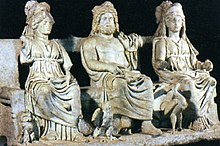
Capitoline Triad
The Capitoline Triad was introduced to Rome by the Tarquins. Dumézil thinks
it might have been an Etruscan (or local) creation based on Vitruvius' treatise
on architecture, in which the three deities are associated as the most
important. It is possible that the Etruscans paid particular attention to
Menrva
(Minerva) as a goddess of destiny, in
addition to the royal couple Uni (Juno) and Tinia (Jupiter).[169]
In Rome, Minerva later assumed a military aspect under the influence of
Athena Pallas
(Polias). Dumézil argues that
with the advent of the Republic, Jupiter became the only king of Rome, no longer
merely the first of the great gods.
Jupiter and Minerva
Apart from being protectress of the arts and craft as Minerva Capta, who was
brought from Falerii, Minerva's association to Jupiter and relevance to Roman
state religion is mainly linked to the
Palladium
, a wooden statue of Athena that could
move the eyes and wave the spear. It was stored in the penus interior,
inner penus of the aedes Vestae, temple of Vesta and considered the most
important among the
pignora imperii
, pawns of dominion, empire.[170]
In Roman traditional lore it was brought from Troy by Aeneas. Scholars though
think it was last taken to Rome in the third or second century BC.
Juno and Fortuna
The divine couple received from Greece its matrimonial implications, thence
bestowing on Juno the role of tutelary goddess of marriage (Iuno Pronuba).
The couple itself though cannot be reduced to a Greek apport. The association
of Juno and Jupiter is of the most ancient Latin theology.
Praeneste
offers a glimpse into original Latin
mythology: the local goddess
Fortuna
is represented as milking two infants,
one male and one female, namely Jove (Jupiter) and Juno. It seems fairly safe to
assume that from the earliest times they were identified by their own proper
names and since they got them they were never changed through the course of
history: they were called Jupiter and Juno. These gods were the most ancient
deities of every Latin town. Praeneste preserved divine filiation and infancy as
the sovereign god and his paredra Juno have a mother who is the primordial
goddess Fortuna Primigenia.[174]
Many terracotta statuettes have been discovered which represent a woman with a
child: one of them represents exactly the scene described by Cicero of a woman
with two children of different sex who touch her breast. Two of the votive
inscriptions to Fortuna associate her and Jupiter: " Fortunae Iovi puero..." and
"Fortunae Iovis puero..."
In 1882 though R. Mowat published an inscription in which Fortuna is called
daughter of Jupiter, raising new questions and opening new perspectives
in the theology of Latin gods. Dumezil has elaborated an interpretative theory
according to which this aporia would be an intrinsic, fundamental feature
of Indoeuropean deities of the primordial and sovereign level, as it finds a
parallel in Vedic religion. The contradiction would put Fortuna both at the
origin of time and into its ensuing diachronic process: it is the comparison
offered by Vedic deity
Aditi
, the Not-Bound or Enemy of
Bondage, that shows that there is no question of choosing one of the two
apparent options: as the mother of the
Aditya
she has the same type of relationship
with one of his sons,
Dakṣa
, the minor sovereign. who represents the
Creative Energy, being at the same time his mother and daughter, as is
true for the whole group of sovereign gods to which she belongs. Moreover Aditi
is thus one of the heirs (along with
Savitr
) of the opening god of the Indoiranians,
as she is represented with her head on her two sides, with the two faces looking
opposite directions. The mother of the sovereign gods has thence two solidal but
distinct modalities of duplicity, i.e. of having two foreheads and a double
position in the genealogy. Angelo Brelich has interpreted this theology as the
basic opposition between the primordial absence of order (chaos) and the
organisation of the cosmos.
Janus
The relation of Jupiter to Janus is problematic. Varro defines Jupiter as the
god who has potestas (power) over the forces by which anything happens in
the world. Janus, however, has the privilege of being invoked first in rites,
since in his power are the beginnings of things (prima), the appearance
of Jupiter included.
Saturn
The
Latins
considered Saturn the predecessor of
Jupiter. Saturn reigned in
Latium
during a mythical
Golden Age
reenacted every year at the festival
of Saturnalia
. Saturn also retained primacy in
matters of agriculture and money. Unlike the Greek tradition of
Cronus
and Zeus, the usurpation of Saturn as
king of the gods by Jupiter was not viewed by the Latins as violent or hostile;
Saturn continued to be revered in his temple at the foot of the Capitol Hill,
which maintained the alternative name Saturnius into the time of Varro.[182]
A. Pasqualini has argued that Saturn was related to Iuppiter Latiaris,
the old Jupiter of the Latins, as the original figure of this Jupiter was
superseded on the Alban Mount, whereas it preserved its gruesome character in
the ceremony held at the sanctuary of the Latiar Hill in Rome which involved a
human sacrifice and the aspersion of the statue of the god with the blood of the
victim.
Fides
The abstract
personification
Fides ("Faith, Trust") was one
of the oldest gods associated with Jupiter. As guarantor of public faith, Fides
had her temple on the Capitol (near that of Capitoline Jupiter).
Genius
Augustine quotes Varro who explains the genius as "the god who is in
charge and has the power to generate everything" and "the rational spirit of all
(therefore, everyone has their own)". Augustine concludes that Jupiter should be
considered the genius of the universe.
G. Wissowa advanced the hypothesis that Semo
Sancus
is the genius of Jupiter.[189]
W. W. Fowler has cautioned that this interpretation looks to be an anachronism
and it would only be acceptable to say that Sancus is a Genius Iovius, as
it appears from the Iguvine Tables.
Censorinus cites
Granius Flaccus
as saying that "the Genius was
the same entity as the Lar" in his lost work De Indigitamentis. Dumézil
opines that the attribution of a Genius to the gods should be earlier than its
first attestation of 58 BC, in an inscription which mentions the Iovis Genius.
A connection between Genius and Jupiter would be apparent in
Plautus
' comedy
Amphitryon
, in which Jupiter takes up the
looks of Alcmena
's husband in order to seduce her: J.
Hubeaux sees there a reflection of the story that
Scipio Africanus
' mother conceived him with a
snake that was in fact Jupiter transformed. Scipio himself claimed that only he
would rise to the mansion of the gods through the widest gate.
It is noteworthy that among the Etruscan Penates there is a Genius
Iovialis who comes after Fortuna and Ceres and before Pales . Genius
Iovialis is one of the earthly Penates and not one of the Penates of
Jupiter though, as these were located in region I of Martianus Capella' s
division of Heaven, while Genius appear in regions V and VI along with Ceres,
Favor (possibly a Roman approximation to an Etruscan male manifestation of
Fortuna) and Pales.
Victoria

Coin with
laureate
head of Jupiter (obverse)
and (reverse) Victory, standing ("ROMA" below in
relief
)
Victoria was connected to Iuppiter Victor in his role as bestower of
military victory. Jupiter, as a sovereign god, was considered as having the
power to conquer anyone and anything in a supernatural way; his contribution to
military victory was different from that of
Mars
(god of military valour). Victoria appears
first on the reverse of coins representing Venus (driving the quadriga of
Jupiter, with her head crowned and with a palm in her hand) during the first
Punic War. Sometimes, she is represented walking and carrying a trophy.
A temple was dedicated to the goddess afterwards on the Palatine, testifying
to her high station in the Roman mind. When
Hieron of Syracuse
presented a golden statuette
of the goddess to Rome, the Senate had it placed in the temple of Capitoline
Jupiter among the greatest (and most sacred) deities. Although Victoria played a
significant role in the religious ideology of the late Republic and the Empire,
she is undocumented in earlier times. A function similar to hers may have been
played by the little-known
Vica Pota
. |
Valerius Licinianus Licinius, Licinius II or Licinius the
Younger (approx. 315-326), was the son of Roman emperor
Licinius
.
He nominally served as
Caesar
in the eastern empire from 317 to 324 A.D while his father was
Augustus
. His mother was Licinius' wife
Flavia Julia Constantia
, who was also the half-sister of
Constantine I
.
After his defeat by Constantine at the
Battle of Chrysopolis
, Licinius the elder was initially spared and placed in
captivity at
Thessalonica
. However, within a year Constantine seems to have regretted his
leniency and the former Emperor was hanged.
The younger Licinius, who was Constantine's nephew, also fell victim to the
emperor's suspicions and was killed, probably in the context of the execution of
Crispus
in
326.
Other reports relate that Licinius the younger was forced into slavery in the
imperial textile factories in Africa, where he is noted in 336. However, the
imperial rescript of 336 makes it clear that the "son of Licinianus" referred to
was not Licinius II as it directs that he be reduced to the slave status of his
birth. No son of Constantine's sister would have been referred to in this
manner.
The Roman Empire (Latin:
Imperium Romanum) was the post-Republican
period of the
ancient Roman civilization
, characterised by an
autocratic
form of government and large
territorial holdings in Europe and around the Mediterranean.

The Roman Empire at its greatest extent,
during the reign of Trajan
in 117 AD
The 500-year-old
Roman Republic
, which preceded it, had been
weakened and
subverted
through several
civil wars
. Several events are commonly proposed to mark the transition
from Republic to Empire, including
Julius Caesar
's appointment as perpetual
dictator
(44 BC), the
Battle of Actium
(2
September 31 BC), and the Roman Senate's granting to
Octavian
the
honorific
Augustus
(16 January
27 BC).
Roman expansion began in the days of the Republic, but the Empire reached its
greatest extent under Emperor
Trajan
: during his reign (98 to 117 AD) the
Roman Empire controlled approximately 6.5 million km2
of land surface. Because of the Empire's vast extent and long endurance, the
institutions and culture of Rome had a profound and lasting influence on the
development of language, religion, architecture, philosophy, law, and forms of
government in the territory it governed, particularly Europe, and by means of
European expansionism throughout the modern world.
In the late 3rd century AD,
Diocletian
established the practice of dividing
authority between four co-emperors (known as the
tetrarchy
) in order to better secure the vast
territory, putting an end to the
Crisis of the Third Century
. During the
following decades the Empire was often divided along an East/West axis. After
the death of
Theodosius I
in 395 it was divided for the last
time.
The
Western Roman Empire
collapsed
in 476 as
Romulus Augustus
was forced to abdicate to the
Germanic
warlord
Odoacer
.
The Eastern Roman or
Byzantine Empire
ended in 1453 with the death
of
Constantine XI
and the
capture of Constantinople
to
Mehmed II
, leader of the
Ottoman Turks
.
Government
Emperor
The powers of an emperor (his
imperium
) existed, in theory at least, by
virtue of his "tribunician powers" (potestas tribunicia) and his "proconsular
powers" (imperium proconsulare).
In theory, the tribunician powers (which were similar to those of the
Plebeian Tribunes
under the old republic) made
the Emperor's person and office sacrosanct, and gave the Emperor authority over
Rome's civil government, including the power to preside over and to control the
Senate.
The proconsular powers (similar to those of military governors, or
Proconsuls
, under the old Republic) gave him
authority over the Roman army. He was also given powers that, under the
Republic, had been reserved for the
Senate
and the
assemblies
, including the right to declare war,
to ratify treaties, and to negotiate with foreign leaders.
The emperor also had the authority to carry out a range of duties that had
been performed by the
censors
, including the power to control Senate
membership.
In addition, the emperor controlled the
religious institutions
, since, as emperor, he
was always
Pontifex Maximus
and a member of each of
the four major priesthoods.
While these distinctions were clearly defined during the early Empire,
eventually they were lost, and the emperor's powers became less constitutional
and more monarchical.
Realistically, the main support of an emperor's power and authority was the
military. Being paid by the imperial treasury, the legionaries also swore an
annual military oath of loyalty towards him, called the
Sacramentum
.
The death of an emperor led to a crucial period of uncertainty and crisis. In
theory the Senate was entitled to choose the new emperor, but most emperors
chose their own successors, usually a close family member. The new emperor had
to seek a swift acknowledgement of his new status and authority in order to
stabilize the political landscape. No emperor could hope to survive, much less
to reign, without the allegiance and loyalty of the
Praetorian Guard
and of the legions. To secure
their loyalty, several emperors paid the
donativum
, a monetary reward.
Senate
While the
Roman assemblies
continued to meet after the
founding of the Empire, their powers were all transferred to the
Roman Senate
, and so senatorial decrees (senatus
consulta) acquired the full force of law.
In theory, the Emperor and the Senate were two equal branches of government,
but the actual authority of the Senate was negligible and it was largely a
vehicle through which the Emperor disguised his autocratic powers under a cloak
of republicanism. Although the Senate still commanded much prestige and respect,
it was largely a glorified
rubber stamp
institution. Stripped of most of
its powers, the Senate was largely at the Emperor's mercy.
Many emperors showed a certain degree of respect towards this ancient
institution, while others were notorious for ridiculing it. During Senate
meetings, the Emperor sat between the two
consuls
,[18]
and usually acted as the presiding officer. Higher ranking senators spoke before
lower ranking senators, although the Emperor could speak at any time.[18]
By the 3rd century, the Senate had been reduced to a glorified municipal body.
Senators and
equestrians
No emperor could rule the Empire without the Senatorial order and the
Equestrian order
. Most of the more important
posts and offices of the government were reserved for the members of these two
aristocratic orders. It was from among their ranks that the provincial
governors, legion commanders, and similar officials were chosen.
These two classes were hereditary[citation
needed] and mostly closed to outsiders. Very
successful and favoured individuals could enter, but this was a rare occurrence.
The career of a young aristocrat was influenced by his family connections and
the favour of patrons. As important as ability, knowledge, skill, or competence,
patronage was considered vital for a successful career and the highest posts and
offices required the Emperor's favour and trust.
Senatorial order
The son of a senator was expected to follow the
Cursus honorum
, a
career ladder
, and the more prestigious
positions were restricted to senators only. A senator also had to be wealthy;
one of the basic requirements was the wealth of 12,000 gold
aurei
(about 100 kg of gold), a figure which would later be raised with the passing of
centuries.
Equestrian order
Below the Senatorial order was the Equestrian order. The requirements and
posts reserved for this class, while perhaps not so prestigious, were still very
important. Some of the more vital posts, like the governorship of
Egypt
(Latin Aegyptus), were even
forbidden to the members of the Senatorial order and available only to
equestrians.
Military
Legions
During and after the civil war, Octavian reduced the huge number of the
legions
(over 60)
to a much more manageable and affordable size (28).
Several legions, particularly those with doubtful loyalties, were simply
disbanded. Other legions were amalgamated, a fact suggested by the title
Gemina (Twin).
In AD 9, Germanic tribes wiped out three full legions in the
Battle of the Teutoburg Forest
. This disastrous
event reduced the number of the legions to 25. The total of the legions would
later be increased again and for the next 300 years always be a little above or
below 30.
Augustus also created the
Praetorian Guard
: nine
cohorts
ostensibly to maintain the public peace
which were garrisoned in Italy. Better paid than the legionaries, the
Praetorians also served less time; instead of serving the standard 25 years of
the legionaries, they retired after 16 years of service.
Auxilia
While the
auxilia
(Latin: auxilia = supports) are
not as famous as the legionaries, they were of major importance. Unlike the
legionaries, the auxilia were recruited from among the non-citizens. Organized
in smaller units of roughly cohort strength, they were paid less than the
legionaries, and after 25 years of service were rewarded with
Roman citizenship
, also extended to their sons.
According to Tacitus
there were roughly as many auxiliaries as there were legionaries. Since at this
time there were 25 legions of around 5,000 men each, the auxilia thus amounted
to around 125,000 men, implying approximately 250 auxiliary regiments.
Navy
The Roman navy
(Latin: Classis, lit.
"fleet") not only aided in the supply and transport of the legions, but also
helped in the protection of the frontiers in the rivers
Rhine
and
Danube
. Another of its duties was the
protection of the very important maritime trade routes against the threat of
pirates. Therefore it patrolled the whole of the Mediterranean, parts of the
North Atlantic
(coasts of Hispania, Gaul, and
Britannia), and had also a naval presence in the
Black Sea
. Nevertheless the army was considered
the senior and more prestigious branch.
Provinces
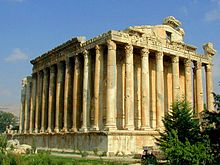
The
Temple of Bacchus
in
Baalbec
,
Lebanon
Until the Tetrarchy
(296 AD) Roman provinces (lat.
provincae) were administrative and territorial units of the Roman Empire
outside of
Italy
. In the old days of the Republic the
governorships of the provinces were traditionally
awarded to members of the
Senatorial Order
. Augustus' reforms changed
this policy.
Imperial provinces
Augustus created the
Imperial provinces
.
Most, but not all, of the Imperial provinces were relatively recent conquests
and located at the borders. Thereby the overwhelming majority of legions, which
were stationed at the frontiers, were under direct Imperial control. Very
important was the
Imperial province of Egypt
, the major
breadbasket
of the Empire, whose
grain supply
was vital to feed the masses in
Rome. It was considered the personal fiefdom of the Emperor, and Senators were
forbidden to even visit this province. The governor of Egypt and the commanders
of any legion stationed there were not from the Senatorial Order, but were
chosen by the Emperor from among the members of the lower
Equestrian Order
.
Senatorial provinces
The old traditional policy continued largely unchanged in the
Senatorial provinces
. Due to their location,
away from the borders, and to the fact that they were under longer Roman
sovereignty and control, these provinces were largely peaceful and stable. Only
a single legion was based in a Senatorial province:
Legio III Augusta
, stationed in the Senatorial
province of
Africa
(modern northern Algeria).
The status of a province was subject to change; it could change from
Senatorial towards Imperial, or vice-versa. This happened several times
[26]
during Augustus' reign. Another
trend was to create new provinces, mostly by dividing older ones, or by
expanding the Empire.
Religion

The
Pantheon
, the present structure
built during
Hadrian
's reign, was dedicated to
the worship of all Roman deities.
As the Empire expanded, and came to include people from a variety of
cultures, the worship of an ever increasing number of
deities
was tolerated and accepted. The
Imperial government, and the Romans in general, tended to be very tolerant
towards most religions and cults, so long as they did not cause trouble. This
could easily be accepted by other faiths as Roman liturgy and ceremonies were
frequently tailored to fit local culture and identity. Since the Romans
practiced polytheism they were also able to easily assimilate the gods of the
peoples the Empire conquered.
An individual could attend to both the Roman gods representing his Roman
identity and his own personal faith, which was considered part of his personal
identity. There were periodic persecutions of various religions at various
points in time, most notably that of Christians. As the historian
Edward Gibbon
noted, however, most of the
recorded histories of Christian persecutions come to us through the Christian
church, which had an incentive to exaggerate the degree to which the
persecutions occurred. The non-Christian contemporary sources only mention the
persecutions passingly and without assigning great importance to them. |
The Chi Rho is one of the earliest
christograms
used by Christians. It is formed by superimposing the
first two letters in the Greek spelling of the word
Christ
(
Greek
: "Χριστός" ), chi = ch and rho = r, in such a way to produce
the monogram
☧. The Chi-Rho symbol was also used by pagan Greek scribes to
mark, in the margin, a particularly valuable or relevant passage; the
combined
letters Chi and Rho standing for chrēston, meaning "good."
Although not technically a cross, the Chi Rho invokes the crucifixion
of Jesus as well as symbolizing his status as the Christ. There is early
evidence of the Chi Rho symbol on Christian Rings of the third century.
The labarum (Greek:
λάβαρον) was a
vexillum
(military standard) that displayed the "Chi-Rho"
symbol, formed from the first two
Greek letters
of the word "Christ"
(Greek:
ΧΡΙΣΤΟΣ, or Χριστός) — Chi (χ)
and Rho (ρ).
It was first used by the
Roman emperor
Constantine I
. Since the vexillum consisted of a flag suspended from
the crossbar of a cross, it was ideally suited to symbolize
crucifixion
. The Chi-Rho symbol was also used by Greek scribes to
mark, in the margin, a particularly valuable or relevant passage; the
combined letters Chi and Rho standing for chrēston, meaning
"good." Flavius Valentinianus, known in English as
Valentinian I, (321
-
November
17
, 375
)
was Roman Emperor
from 364 until his death. Valentinian is often referred to as
the "last great western emperor".[1]
Both he and his brother Emperor
Valens
were
born at
Cibalae
(modern days
Vinkovci
,
Croatia
), in
Pannonia
,
the sons of a successful general,
Gratian the Elder
.
//
Life
He had been an officer who served under the emperors
Julian
and Jovian
, and had risen high in the imperial service. Of robust frame and
distinguished appearance, he possessed great courage and military capacity.
After the death of Jovian, he was chosen emperor in his forty-third year by the
officers of the army at
Nicaea
in Bithynia
on
February
26
, 364, and shortly afterwards named his brother
Valens
colleague with him in the empire.
The two brothers, after passing through the chief cities of
the neighbouring district, arranged the partition of the empire at
Naissus
(Nissa) in Upper
Moesia
. As
Western Roman Emperor, Valentinian took
Italia
,
Illyricum
, Hispania
, the Gauls
,
Britain
and
Africa
, leaving to
Eastern Roman Emperor
Valens the eastern half of the
Balkan peninsula
,
Greece
,
Aegyptus
,
Syria
and
Asia Minor
as far as
Persia
. They were immediately confronted by the revolt of
Procopius
, a relative of the deceased Julian. Valens defeated his army at
Thyatira
in Lydia
in 366, and Procopius was executed shortly afterwards.
During the short reign of Valentinian there were wars in
Africa, in Germany
, and in Britain, and
Rome came into
collision with
barbarian
peoples, specifically the
Burgundians
and the
Saxons
.
Valentinian's chief work was guarding the frontiers and
establishing military positions.
Milan
was at
first his headquarters for settling the affairs of northern Italy. The following
year (365) Valentinian was at
Paris
, and then
at
Reims
, to direct the operations of his generals against the
Alamanni
.
These people, defeated at Scarpona (Charpeigne) and Catelauni (Châlons-en-Champagne)
by Jovinus, were driven back to the German bank of the
Rhine
, and
checked for a while by a chain of military posts and fortresses. At the close of
367, however, they suddenly crossed the Rhine, attacked Moguntiacum (Mainz)
and plundered the city. Valentinian attacked them at Solicinium (Sulz
am Neckar, in the
Neckar
valley
, or
Schwetzingen
) with a large army, and defeated them with great slaughter. But
his own losses were so considerable that Valentinian abandoned the idea of
following up his success.
Later, in 371, Valentinian made peace with their king,
Macrian
, who
from that time remained a true friend of the
Romans
.
The next three years he spent at
Trier
, which he
chiefly made his headquarters, organizing the defence of the Rhine frontier, and
personally superintending the construction of numerous forts.
During his reign the coasts of Gaul were harassed by the
Saxon pirates, with whom the
Picts
and
Scots
of northern Britain joined hands, and ravaged the island from the
Antonine Wall
to the shores of
Kent. In 368
Count Theodosius
was sent to drive back the invaders; in this he was
completely successful, and established a new British province, called
Valentia
in honour of the emperor.
In Africa,
Firmus
raised the standard of revolt, being joined by the provincials, who
had been rendered desperate by the cruelty and extortions of
Comes
Romanus,
the military governor. The services of Theodosius were again requisitioned. He
landed in Africa with a small band of veterans, and Firmus, to avoid being taken
prisoner, committed suicide.
In 374, the
Quadi
, a
Germanic tribe
in what is now
Moravia
and
Slovakia
,
resenting the erection of Roman forts to the north of the
Danube
in what
they considered to be their own territory, and further exasperated by the
treacherous murder of their king,
Gabinius
,
crossed the river and laid waste the province of Pannonia. The emperor in April,
375 entered Illyricum with a powerful army. But during an audience to an embassy
from the Quadi at
Brigetio
on the Danube (near today Komárno in Slovakia), Valentinian
suffered a burst
blood
vessel
in the skull while angrily yelling at the people gathered. This
injury resulted in his death on November 17, 375.
Reputation
A.H.M. Jones
writes that though he was "less of a boor" than his chief rival
for election to the imperial throne, "he was of a violent and brutal temper, and
not only uncultivated himself, but hostile to cultivated persons", as
Ammianus
tells us, 'he hated the well-dressed and educated and wealthy and
well-born'. He was, however, an able soldier and a conscientious administrator,
and took an interest in the welfare of the humbler classes, from which his
father had risen. Unfortunately his good intentions were often frustrated by a
bad choice of ministers, and an obstinate belief in their merits despite all
evidence to the contrary."[2]
According to the
Encyclopædia Britannica 1911
, he was a founder of schools, and provided
medical attendance for the poor of
Rome, by appointing
a physician for each of the fourteen districts of the city.
Valentinian was a
Christian
but permitted liberal religious freedom to all his subjects, proscribing only
some forms of rituals such as particular types of sacrifices, and banning the
practice of magic. Against all abuses, both civil and ecclesiastical (excepting,
of course, his own excesses), Valentinian steadily set his face, even against
the increasing wealth and worldliness of the clergy. His chief flaw was his
temper, which at times was frightful, and showed itself in its full fierceness
in the punishment of persons accused of witchcraft, some kinds of
fortune-telling or magical practices." |
|
Please make your payments on time.
Payment methods for USA buyers:< PAYPAL
Payment methods for International buyers - including Canada: PAYPAL contact us for more info.
Payments must be received within 7 days from the end of auction (14 days for international).
Please be sure to include item # & address with your payment. IF
REQUESTING A CERTIFICATE PLEASE DO SO AT THE TIME OF PAYMENT. | Pay me securely with any major credit card through PayPal! |
Items will be shipped within 1 to 3 business days of purchase completion.
$5.99 - FIRST CLASS DOMESTIC MAIL.
INTERNATIONAL SHIPPING - $9.99
(REGISTERED-$29.00)
WE COMBINE SHIPPING.
If you would like to have special shipping, please contact us.
All items will be sent out in protected envelope and boxed if necessary..
YOU ARE BIDDING ON AN ANCIENT ITEM(S) AS DESCRIBED AND PICTURED ABOVE!!!
Every item offered by cameleoncoins is unconditionally guaranteed to be genuine & authentic.
We can provide a certificate of authenticity or extended return policy by request only!!!
If in the unlikely event that an item is found to be reproduction, full
return privileges are within 14 days of receiving the coins.
We will promptly offer a full refund without hesitation or hassle. |
Please read the auction page prior to contacting US.
|
|