
- ✅ Geprüfte Gebrauchtware
- ✅ Verkäufer seit 2015
- ✅ Käuferschutz

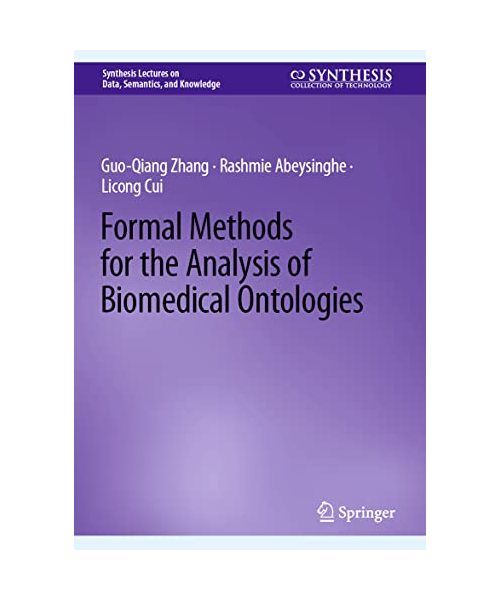
Formal Methods for the Analysis of Biomedical Ontologies
- Zustand: USED_VERY_GOOD
- Autor: Guo-Qiang Zhang, Licong Cui, Rashmie Abeysinghe
- Verlag: Springer International Publishing
- ISBN/EAN: 3031121309
- Produktart/Einband: Gebundene Ausgabe
- Erscheinungsjahr: November 2022
- Seiten: 260
- Größe: 2 cm x 17.3 cm x 24.6 cm
- Gewicht: 618 g
Produktbeschreibung
The book synthesizes research on the analysis of biomedical ontologies using formal concept analysis, including through auditing, curation, and enhancement. As the evolution of biomedical ontologies almost inevitably involves manual work, formal methods are a particularly useful tool for ontological engineering and practice, particularly in uncovering unexpected "bugs" and content materials. The book first introduces simple but formalized strategies for discovering undesired and incoherent patterns in ontologies before exploring the application of formal concept analysis for semantic completeness. The book then turns to formal concept analysis, a classical approach used in the mathematical treatment of orders and lattices, as an ontological engineering principle, focusing on the structural property of ontologies with respect to its conformation to lattice or not (non-lattice). The book helpfully covers the development of more efficient algorithms for non-latticedetection and extraction required by exhaustive lattice/non-lattice analysis. The book goes on to highlight the power and utility of uncovering non-lattice structure for debugging ontologies and describes methods that leverage the linguistic information in concept names (labels) for ontological analysis. It also addresses visualization and performance evaluation issues before closing with an overview and forward-looking perspectives on the field. This book is intended for graduate students and researchers interested in biomedical ontologies and their applications. It can be a useful supplement for courses on knowledge representation and engineering and also provide readers with a reference for related scientific publications and literature to assist in identifying potential research topics. All mathematical concepts and notations used in this book can be found in standard discrete mathematics textbooks, and the appendix at the end of the book provides a list of key ontological resources, as well as annotated non-lattice and lattice examples that were discovered using the authors' methods, demonstrating how "bugs are fixed" by converting non-lattices to lattices with minimal edit changes.
Auflagen bei Büchern
In Einzelfällen kann es vorkommen, dass ein Buch von der angegebenen Auflage abweicht. Sollte dies der Fall sein, setzen Sie sich bitte vor Bewertung mit uns in Verbindung, damit wir ggf. eine Lösung finden können.
Bibliotheksbücher
Diese können Stempel oder ähnliches der jeweiligen Bibliothek enthalten. Cover-Abweichungen durch Behandlung der Bibliothek möglich. (Neubindung, Kleber, Umschläge oder ähnliches)
Zustandsbeschreibung
Den Zustand der Ware versuchen wir so gut wie möglich zu beschreiben. Jeder Artikel wird von uns händisch geprüft und bewertet.
Sollten Sie mit unserer Bewertung des Artikels nicht zufrieden sein, so melden Sie sich bitte vor einer Bewertung und wir werden alles uns mögliche tun, um Sie zufrieden zu stellen.
Über jegliches Feedback würden wir uns freuen.
Neuwertig:
- Buch in neuwertigem Zustand mit unbenutztem Einband, teilweise bereits gelesen.
- Keine sichtbaren Gebrauchsspuren, Schutzumschlag bei gebundenen Büchern vorhanden.
- Alle Seiten intakt, keine Knitter, Risse, Unterstreichungen oder Markierungen. Minimale Gebrauchsspuren am Inneneinband möglich.
Sehr gut:
- Gebrauchter Artikel ist in sehr gutem Zustand.
- Artikel kann leichte Gebrauchsspuren haben wie z.B. leichte Klebereste, Eselsohr, leichte Vergilbung, Lesespuren, ...
Gut:
- Artikel befindet sich in einem gebrauchten, aber guten Zustand
- Knicke oder Lesespuren können vorhanden sein, auch leichte Wasserflecken sind möglich
- Umschlag kann unter Umständen fehlen
- Es kann sich unter Umständen um ein Mängelexemplar in gutem Zustand handeln
- Textmarkierungen können vorhanden sein
- Cover und/oder Hüllen können abweichend sein
- CDs/DVDs/Vinyls können Kratzer aufweisen, Funktion sollte aber nicht beeinträchtigt sein
- Ist aber gut für den Eigenbedarf geeignet
Akzeptabel:
- Artikel zeigen deutliche Gebrauchsspuren
- Textmarkierungen, Klebereste, leichte Risse, Wasserschäden sind möglich
- Artikel können bearbeitet/repariert sein
- Beilagen wie Beschreibung, Poster oder Ähnliches können fehlen
- Funktionsweise sollte nicht beeinträchtigt sein