One original ancient Roman silver coin of:

Philip I, the Arab; AD 244-249.

Obv./ IMP M IVL PHILIPPVS AVG, radiate, draped & cuirassed bust right.

Rev./ P M TR P IIII COS II P P, Felicitas standing left holding caduceus & cornucopia. 

RSC 136.

AR ANTONINIANUS 22.4mm. 4.44gm. Rome mint. (EF) Well centered nice specimen. Genuine tone.

Authenticity guaranteed.

Original ancient Roman coin as pictured and described above.

Coin is good condition and a very rare and nice inclusion to a fine ancient coin collection.

Certificate of authenticity included!!

Marcus Julius Philippus or Philippus I Arabs (c. 204–249), known in English as Philip the Arab or formerly (prior to World War II) in English as Philip the Arabian, was a Roman Emperor from 244 to 249.Bust of emperor Philippus Arabus - Hermitage Museum.jpg

//

Little is known about Philip's early life and political career. He was born in Shahba , about 55 miles southeast of Damascus , in the Roman province of Syria . Philip has the nickname "the Arab" because he had family who had originated in the Arabian peninsula , believed to be distant descendants of the prestigious Baleed family of Aleppo . Philip was the son of a Julius Marinus, a local Roman citizen, possibly of some importance. Many historians[1][2][3] agree that he was of Arab descent who gained Roman citizenship through his father, a man of considerable influence. Many citizens from the provinces took Roman names upon acquiring citizenship. This makes tracing his Arabic blood line difficult. However, it is documented that Rome used the Ghassan tribe from the Azd of Yemen as vassals to keep the neighboring northern Arabs in check.

The name of Philip's mother is unknown, but sources refer to a brother, Gaius Julius Priscus , a member of the Praetorian guard under Gordian III (238–244). In 234, Philip married Marcia Otacilia Severa , daughter of a Roman Governor. They had two children: a son named Marcus Julius Philippus Severus (Philippus II) in 238 and according to numismatic evidence they had a daughter called Julia Severa or Severina, whom the ancient Roman sources don't mention.

Philip became a member of the Pretorian Guard during the reign of the emperor Alexander Severus , who was a Syrian. In ancient Rome the Pretorian Guard was closely associated with the emperor, serving among other things as the emperor's bodyguard.

 Political career

In 243, during Gordian III 's campaign against Shapur I of Persia, the Praetorian prefect Timesitheus died under unclear circumstances. At the suggestion of his brother Priscus, Philip became the new Praetorian prefect, with the intention that the two brothers would control the young Emperor and rule the Roman world as unofficial regents. Following a military defeat, Gordian III died in 244 under circumstances that are still debated. While some claim that Philip conspired in his murder, other accounts (including one coming from the Persian point of view) state that Gordian died in battle. Whatever the case, Philip assumed the purple following Gordian's death. According to Edward Gibbon:

His rise from so obscure a station to the first dignities of the empire seems to prove that he was a bold and able leader. But his boldness prompted him to aspire to the throne, and his abilities were employed to supplant, not to serve, his indulgent master.

Philip was not willing to repeat the mistakes of previous claimants, and was aware that he had to return to Rome in order to secure his position with the senate . He thus travelled west, after concluding a peace treaty with Shapur I, and left his brother Priscus as extraordinary ruler of the Eastern provinces. In Rome he was confirmed Augustus , and nominated his young son Caesar and heir.

Philip's rule started with yet another Germanic incursion on the provinces of Pannonia and the Goths invaded Moesia (modern-day Serbia and Bulgaria ) in the Danube frontier. They were finally defeated in the year 248, but the legions were not satisfied with the result, probably due to a low share of the plunder, if any. Rebellion soon arose and Tiberius Claudius Pacatianus was proclaimed emperor by the troops. The uprising was crushed and Philip nominated Gaius Messius Quintus Decius as governor of the province. Future events would prove this to be a mistake. Pacatianus' revolt was not the only threat to his rule: in the East, Marcus Jotapianus led another uprising in response to the oppressive rule of Priscus and the excessive taxation of the Eastern provinces. Two other usurpers, Marcus Silbannacus and Sponsianus , are reported to have started rebellions without much success.

In April A.D. 248 (April 1000 A.U.C. ), Philip had the honour of leading the celebrations of the one thousandth birthday of Rome, which according to tradition was founded in 753 BC by Romulus . He combined the anniversary with the celebration of Rome's alleged tenth saeculum . According to contemporary accounts, the festivities were magnificent and included spectacular games, ludi saeculares , and theatrical presentations throughout the city. In the coliseum, more than 1,000 gladiators were killed along with hundreds of exotic animals including hippos, leopards, lions, giraffes, and one rhinoceros. The events were also celebrated in literature, with several publications, including Asinius Quadratus 's History of a Thousand Years, specially prepared for the anniversary.

Despite the festive atmosphere, discontent in the legions was growing. Decius (249–251) was proclaimed Emperor by the Danubian armies in the spring of 249 and immediately marched to Rome. Philip's army met the usurper near modern Verona that summer. Decius won the battle and Philip was killed sometime in September 249, either in the fighting or assassinated by his own soldiers who were eager to please the new ruler. Philip's eleven-year-old son and heir may have been killed with his father and Priscus disappeared without a trace.

 Religious beliefs

Some later traditions, first mentioned in the historian Eusebius in his Ecclesiastical History , held that Philip was the first Christian Roman emperor. This tradition seems to be based on reports in Eusebius that Philip allegedly had once entered a Christian service on Easter, after having been required by a bishop to confess his sins. Later versions located this event in Antioch.

However, historians generally identify the later Emperor Constantine, baptised on his deathbed, as the first Christian emperor, and generally describe Philip's adherence to Christianity as dubious, because non-Christian writers do not mention the fact, and because throughout his reign, Philip to all appearances (coinage, etc.) continued to follow the state religion . Critics ascribe Eusebius' claim as probably due to the tolerance Philip showed towards Christians. Saint Quirinus of Rome was, according to a legendary account, the son of Philip the Arab.


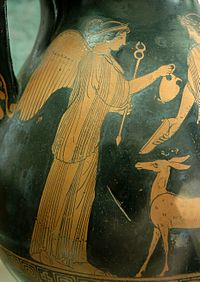
The caduceus from Greek "herald's staff" is the staff carried by Hermes in Greek mythology . The same staff was also borne by heralds in general, for example by Iris , the messenger of Hera. It is a short staff entwined by two serpents , sometimes surmounted by wings. In Roman iconography it was often depicted being carried in the left hand of Mercury , the messenger of the gods, guide of the dead and protector of merchants, shepherds, gamblers, liars, and thieves.

As a symbolic object it represents Hermes (or the Roman Mercury), and by extension trades, occupations or undertakings associated with the god. In later Antiquity the caduceus provided the basis for the astrological symbol representing the planet Mercury . Thus, through its use in astrology and alchemy , it has come to denote the elemental metal of the same name.

By extension of its association with Mercury/Hermes, the caduceus is also a recognized symbol of commerce and negotiation, two realms in which balanced exchange and reciprocity are recognized as ideals. This association is ancient, and consistent from the Classical period to modern times. The caduceus is also used as a symbol representing printing, again by extension of the attributes of Mercury (in this case associated with writing and eloquence).

The caduceus is sometimes mistakenly used as a symbol of medicine and/or medical practice , especially in North America , because of widespread confusion with the traditional medical symbol, the rod of Asclepius , which has only a single snake and no wings.

The term kerukeion denoted any herald's staff, not necessarily associated with Hermes in particular.

Lewis Richard Farnell (1909) in his study of the cult of Hermes assumed that the two snakes had simply developed out of ornaments of the shepherd's crook used by heralds as their staff. This view has been rejected by later authors pointing to parallel iconography in the Ancient Near East. It has been argued that the staff or wand entwined by two snakes was itself representing a god in the pre-anthropomorphic era. Like the herm or priapus , it would thus be a predecessor of the anthropomorphic Hermes of the classical era.
Ancient Near East

William Hayes Ward (1910) discovered that symbols similar to the classical caduceus sometimes appeared on Mesopotamian cylinder seals . He suggested the symbol originated some time between 3000 and 4000 BCE, and that it might have been the source of the Greek caduceus.[10] A.L. Frothingham incorporated Dr. Ward's research into his own work, published in 1916, in which he suggested that the prototype of Hermes was an "Oriental deity of Babylonian extraction" represented in his earliest form as a snake god. From this perspective, the caduceus was originally representative of Hermes himself, in his early form as the Underworld god Ningishzida , "messenger" of the "Earth Mother". The caduceus is mentioned in passing by Walter Burkert [12] as "really the image of copulating snakes taken over from Ancient Near Eastern tradition".

In Egyptian iconography, the Djed pillar is depicted as containing a snake in a frieze of the Dendera Temple complex .

The rod of Moses and the brazen serpent are frequently compared to the caduceus, especially as Moses is acting as a messenger of God to the Pharaoh at the point in the narrative where he changes his staff into a serpent.[13]

Classical antiquity

Mythology

The Homeric hymn  to Hermes relates how Hermes offered his lyre fashioned from a tortoise shell as compensation for the cattle he stole from his half brother Apollo . Apollo in return gave Hermes the caduceus as a gesture of friendship. The association with the serpent thus connects Hermes to Apollo , as later the serpent was associated with Asclepius , the "son of Apollo". The association of Apollo with the serpent is a continuation of the older Indo-European dragon -slayer motif. Wilhelm Heinrich Roscher  (1913) pointed out that the serpent as an attribute of both Hermes and Asclepius is a variant of the "pre-historic semi-chthonic serpent hero known at Delphi as Python ", who in classical mythology is slain by Apollo.

One Greek myth of origin of the caduceus is part of the story of Tiresias , who found two snakes copulating and killed the female with his staff. Tiresias was immediately turned into a woman, and so remained until he was able to repeat the act with the male snake seven years later. This staff later came into the possession of the god Hermes, along with its transformative powers.

Another myth suggests that Hermes (or Mercury) saw two serpents entwined in mortal combat. Separating them with his wand he brought about peace between them, and as a result the wand with two serpents came to be seen as a sign of peace.

In Rome, Livy refers to the caduceator who negotiated peace arrangements under the diplomatic protection of the caduceus he carried.

Iconography

In some vase paintings ancient depictions of the Greek kerukeion are somewhat different from the commonly seen modern representation. These representations feature the two snakes atop the staff (or rod), crossed to create a circle with the heads of the snakes resembling horns. This old graphic form, with an additional crossbar to the staff, seems to have provided the basis for the graphical sign of Mercury (☿) used in Greek astrology  from Late Antiquity.

Use in alchemy and occultism

As the symbol of both the planet and the metal named for Mercury, the caduceus became an important symbol in alchemy .

The crucified serpent was also revived as an alchemical symbol for fixatio , and John Donne  (Sermons 10:190) uses "crucified Serpent" as a title of Jesus Christ .

Symbol of commerce

A simplified variant of the caduceus is to be found in dictionaries, indicating a “commercial term” entirely in keeping with the association of Hermes with commerce. In this form the staff is often depicted with two winglets attached and the snakes are omitted (or reduced to a small ring in the middle). The Customs Service of the former German Democratic Republic employed the caduceus, bringing its implied associations with thresholds, translators, and commerce, in the service medals they issued their staff.

Misuse as symbol of medicine

It is relatively common, especially in the United States, to find the caduceus, with its two snakes and wings, used as a symbol of medicine instead of the correct rod of Asclepius, with only a single snake. This usage is erroneous, popularised largely as a result of the adoption of the caduceus as its insignia by the US Army medical corps in 1902 at the insistence of a single officer (though there are conflicting claims as to whether this was Capt. Frederick P. Reynolds or Col. John R. van Hoff).

The rod of Asclepius is the dominant symbol for professional healthcare associations in the United States. One survey found that 62% of professional healthcare associations used the rod of Asclepius as their symbol. The same survey found that 76% of commercial healthcare organizations used the Caduceus symbol. The author of the study suggests the difference exists because professional associations are more likely to have a real understanding of the two symbols, whereas commercial organizations are more likely to be concerned with the visual impact a symbol will have in selling their products.

The initial errors leading to its adoption and the continuing confusion it generates are well known to medical historians. The long-standing and abundantly attested historical associations of the caduceus with commerce, theft, deception, and death are considered by many to be inappropriate in a symbol used by those engaged in the healing arts. This has occasioned significant criticism of the use of the caduceus in a medical context.


In Roman mythology , Felicitas (meaning "good luck" or "fortune") was the goddess or personification of good luck and success. The word felicitas, "luck", is also the source of the word and name felicity. She played an important role in Rome's state religion during the empire , and was frequently portrayed on coins . She became a prominent symbol of the wealth and prosperity of the Roman Empire .

Felicitas was unknown before the mid-2nd century BC, when a temple was dedicated to her in the Velabrum in the Campus Martius by Lucius Licinius Lucullus , using booty from his 151–150 BC campaign in Spain. The temple was destroyed by a fire during the reign of Claudius and was never rebuilt.

Another temple in Rome was planned by Julius Caesar and was erected after his death by Marcus Aemilius Lepidus on the site of the Curia Hostilia , which had been restored by Lucius Cornelius Sulla but demolished by Caesar in 44 BC. This temple no longer existed by the time of Hadrian , and its site probably lies under the church of Santi Martina e Luca .

Marcus Claudius Tacitus (/ˈtæsɪtəs/; died June 276) was Roman emperor from 275 to 276. During his short reign he campaigned against the Goths and the Heruli, for which he received the title Gothicus Maximus.
Early life


Items will be shipped within 1 to 3 business days of purchase completion. 
$5.99 - domestic SHIPPING
INTERNATIONAL $9.99
(REGISTERED-$21.00) WE COMBINE SHIPPING.
If you would like to have special shipping, please contact us.
All items will be sent out in protected envelope and boxed if necessary.

YOU ARE BIDDING ON AN ANCIENT ITEM(S) AS DESCRIBED AND PICTURED ABOVE!!!
Every item offered by cameleoncoins is unconditionally guaranteed to be genuine & authentic.
We can provide a certificate of authenticity or extended return policy by request only!!!
Please include 5 dollars and a short request with your payment if you would like a COA!!!
If in the unlikely event that an item is found to be reproduction, full return privileges are within 14 days of receiving the coins. We will promptly offer a full refund without hesitation or hassle.