[SIGNED AUTOGRAPH LETTER - SWISS WRITER XIX/XX]
-
1 Bristol business card
(VCT)
4 handwritten words in ink, thanks...
Discreet inscription in pencil on the upper part of the card
"around Nach Paris..."
(1919)
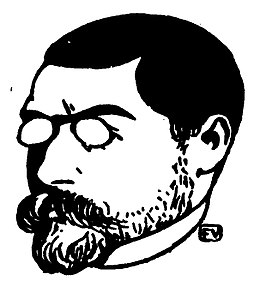
Portrait of Louis Dumur
by Felix Vallotton
appeared in The Book of Masks
by Remy de Gourmont (1898).
-
Louis Dumur
1860-1933
Louis Dumur
Swiss
Novelist, lyricist, writer, journalist, poet
Louis Dumur (1860-1933) is a French-speaking Swiss writer, whose essential literary career
took place in Paris, within the Mercury of France.
Biography
Youth and training
As the eldest of many siblings, the education of the JEUNE Louis is done in the observation of the strictest Calvinist Protestantism, and in respect of family values. His mother, Marie Adrienne Amélie Berguer-Dumur, was the daughter of a pastor, as was his father, Charles Henri Gustave Dumur.
He attended the College of Geneva, as well as Sunday Protestant education classes. Very quickly, his penchant for literature pushes him to make contested choices. As early as 1882, he said he wanted to pass his university degree in Paris. His mother blocks his departure, but in vain. In 1884, he enrolled for a license at the Sorbonne, where his first results were rather mediocre. Giving little news to his parents, who do not even know where he lives, they begin various procedures to find him, going so far as to appeal to the Swiss Embassy in Paris. Locked up in work for his studies and for his first plays (theater and poetry), Louis Dumur does not want to see anyone. He even moved three times, when we finally got hold of his address. His returns to Geneva during this period can also be counted on the fingers of one hand.
Career at the Mercure de France
Dismissed in 1887, he left for Saint Petersburg, where he taught as tutor to Martin, son of Countess G. Warpakowsky, until 1892. During this stay, he published his first collection of poetry,
La Neva (1890), in which he claims to reform classical metrics. He also took the opportunity to travel regularly to Paris, where he frequented various literary circles.
After founding the magazine La Pléiade with Édouard Dubus, George-Albert Aurier and Louis-Pilate
de Brinn'Gaubast, it was there that he met Alfred Vallette, among others, with whom he revived in 1889 at the Mercure de France, of which he was first editor-in-chief. In 1895, he became executive secretary and, unofficially, the literary director – he remained so until his death. His autograph signature appears on one of the sheets signed by the guests of the memorable banquet given on December 31, 1916 in honor of Apollinaire.
at the Old Palace of Orléans on Avenue du Maine.
Returning permanently to Paris in 1892, Dumur then devoted himself entirely to Mercury and to writing.
He performed several of his plays, including La Nébuleuse (1895) and Rembrandt (1896, with Virgile Josz). His first novels were also published: Pauline, or the Freedom of Love in 1896 and Un Coco de Génie, in 1902.
Literary successes
Between 1909 and 1911, his first real literary successes appeared, which formed the Geneva trilogy: Les trois demoiselles du Père Maire, Le Centenaire de Jean-Jacques and the most controversial in its tone of free thinker, L'École du dimanche. The influence of Rousseau, very perceptible from the beginning to the end of the trilogy, is further amplified by the preparations for the tercentenary of the birth of the philosopher, in 1912, in which Dumur finds himself very involved: it is in particular through him that Bernard Bouvier, president of the very JEUNE Jean-Jacques Rousseau Society, is invited to the ceremony of the Pantheon.
When war broke out in 1914, Dumur moved to Geneva for a while. He then collaborated with the International Agency for Prisoners of War, an organ of the Red Cross. At the same time, he carried out a great journalistic activity, denouncing both the misdeeds committed by the German army on Belgian territory (French culture and German culture, Les Cahiers Vaudois, 1915) and the lack of reaction from the Swiss Confederation - without forgetting the consequences that this has on Swiss neutrality. His public positions, most of the time published in French journals, for lack of reception in French-speaking Switzerland, are grouped together in a collection entitled Les deux Suisses en 1917.
The armistice signed, Dumur returned to Paris, where he pursued his literary career – but his tone changed radically. He published in the Mercure in 1919 Nach Paris!, a vengeful book representing under sordid features the first months of the war seen by a JEUNE German midshipman. This book is the first of a tetralogy devoted
to the First World War, and which includes Le Boucher de Verdun (1921), Les Défaitistes (1923)
and The Red Cross and the White Cross, or the War Among Neutrals (1925).
The Defeatists describe the adventure of the spy Mata-Hari and wonder, along the way, about what should be understood, in the aftermath of hostilities, about the notion of homeland.
Louis Dumur devoted the last part of his life to a final series of novels devoted to Russia, from Tsarist Russia to the two revolutions of 1917: God protect the Tsar! (1928), The Scepter of Russia (1929), The Furriers of Lenin (1932) and The Red Wolves (1932) show, as was already the case with the tetralogy
"warrior" of Dumur, a romantic art which is in line with Zolian naturalism
but also draws on the resources of journalistic writing.
Louis Dumur died on Mars 28, 1933, following cancer of the larynx. Many pages of the Literary Journal of Paul Leautaud are full of details concerning Louis Dumur and in particular
during his last months.
His obituary was written by Alfred Vallette.
Main publications
The Neva, poems (1890)
Albert, novel (1890)
Lassitudes, poems (1891)
Pauline, or the Freedom of Love (1896)
A coco of genius, novel (1902)
The Three Maidens of Father Mayor, novel (1909)
The Centenary of Jean-Jacques, novel (1910)
Children and Religion, novel (1911)
Sunday School, novel (1911)
The Society of Gens de Lettres: Its Committee and the Interests of French Writers, review (1913)
A stomach from Austria, novel, (written in 1913 but published in 1932)
French culture and German culture (1915)
The Two Swiss, 1914-1917 (1917)
Nach Paris! novel (1919)
The Butcher of Verdun, novel (1921)
The Defeatists, novel (1923)
The Red Cross and the White Cross or War among Neutrals, novel (1925)
God save the Tsar! novel (1928) - 1st volume of the cycle of Russian novels
The Scepter of Russia, novel (1929) - 2nd volume
Lenin's Furriers, novel (1932) - 3rd volume
The Red Wolves, novel (1932) - 4th and last volume of the cycle of Russian novels.
Lafayette, here we come! novel (1933)
Theater
The Clod of Earth, 1 act (1894)
The Nebula, 1 act (1895)
Rembrandt, prose drama, in 5 acts and 9 tableaux, with Virgile Josz (1896)
Don Juan in Flanders, drama in 1 act, with Virgile Josz (1913)
-
1 CDV
1 CDV
Undated unsigned
(circa 1920)
-
[From Georges or Louis Boulay]
-
Good condition
see visuals...
-
Rare !
As always, combined shipping costs in case of multiple purchases...


