
- Wireless Systems
- Microphones
- Camera Raincovers
- Trolley Cases
- Lenses
- Camcorder Cases/Bags
- Tripod Adaptor Plates
- Camcorders
- Tripods
- Dolly
- Blank Media
- Camera Stabilisers
- Vtrs
- Other
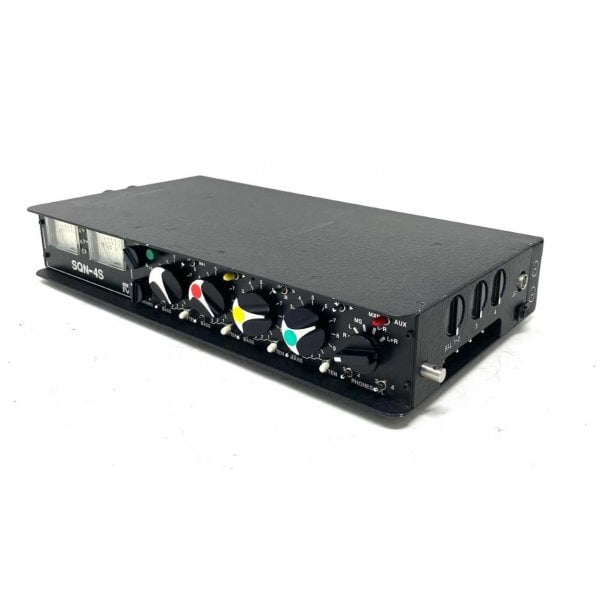
SQN 4-S Sound Mixer, Used
- £403.20
SQN 4-S Sound Mixer, Used(FMP61289KSSH)
The original broadcast quality stereo portable mixer for TV, film and radio locations
The SQN-4S has been the unrivalled Industry standard portable audio mixer since it was the first to arrive on the scene back in 1984.
4S View
The new SERIES IV is the culmination of an extensive development programme to ensure that the SQN-4S remains at the forefront of location sound technology. Extending the control panel to include all the required functions on one face of the mixer has made it even easier to use than before.
4S Front Panel
Newly designed transformerless input amplifiers, larger output transformers for low distortion bass, virtually unbreakable analogue level meters, pre-fade listening, slating microphone, logic processing of many switching functions leading to a minimal length audio path, optional feed for four output channels and improved filtering and screening have all contributed to making it a welcome successor to its illustrious forbears.
4S Baseplate
The essential information for connecting to and operating the mixer is permanently printed on the baseplate.
SQN-4S Series IV
Mixer Inputs
Four transformerless balanced inputs using XLR-3 type female connectors.
Channels one and two also share an XLR-5 type connector. Each channel is
switchable for:
Powering:
a)12V T (Din AB)
b)12V Phantom
c) 48V Phantom
d) Dynamic (150 to 600 Ohms)
Attenuation:
0dB, -12dB or -24dB
Bass Cut:
Flat, -4dB or -10dB at 100Hz
Line Attenuation:
Adds 50dB attenuation before the mic preamp.
Sensitivity
-78dBu for nominal line level (PPM4, 0VU) with the channel gain at maximum and the master gain at 0dB
Max Level, Mic Inputs
-20dBu (+4dBu with 24dB attenuation)
Noise Figure
-130dBu (A weighted) from a 200 Ohm source.
Frequency Response
20Hz to 20kHz +0, -1dB, referred to 1kHz.
Crosstalk
Isolation, channel to unrelated channel: 75dB at 1kHz, 60dB at 15kHz.
Channel Configuration
[GANG]
[MAT]
The mixer is intended to work in several modes. The mode controls affect channel pairs CH1 & 2 and CH3 & 4. Within the pairs, channels 1 & 3 are called "first channels" and 2 & 4 "second channels".
Twin MONO [O] in which the channels are unganged and each input channel can be routed or panpotted to either or both of the output channels.
Stereo [S] ganging in which the first channel fader controls the gain of both channels and the first channel panpot acts as a stereo balance control
Mid-Side [MS] ganging in which the first channel fader controls the gain of both channels and the second channel fader acts as an image width control.
Mid-Side Matrix [MAT] matrixing in which each channel pair has a mid-sidematrix which will convert an MS input into AB stereo or vice-versa.
Panning Mode [PAN]. The CH3, CH4 pair has a selectable panning mode in which the output is treated as MS encoded stereo and the channel signal is panned to move across the equivalent AB stereo image.
Top
Phase Switch
The second channel of each pair can have its phase inverted by means of afront panel switch. This has the incidental effect of interchanging left and right in an MS encoded signal.
Monitor Return Input
Unbalanced inputs with a range of sensitivity from -20dBu to +20dBu for loudness parity with the internal monitoring. The sensitivity is adjusted by a screwdriver preset on the base.
Mixing Bus Inputs
Two inputs directly into the summing amplifiers with their gain adjustable inside the mixer. Maximum sensitivity is 0dBu for +8dBu at the balanced outputs with the master gain set at 0.
Balanced Outputs
Two line driver amplifiers provide the output channels and each output is available on both an individual XLR and a combined 12-way connector.
Output Attenuators
The level at either set of connectors can be attenuated by 50dB to provide a nominally microphone level feed.
Line Drivers
Floating sources (transformer coupled) with a clipping level of +20dBm into 600 Ohms. Distortion at the nominal peak level of +8dBm is less than 0.01% with a 600 Ohm load 20Hz to 20kHz. The output resistance is switchable from 60 Ohms to 180 Ohms. At 180 Ohms, with the limiter switched on, the mixer can be worked into an arbitrarily low impedance load with acceptable distortion. The balanced Mic-Level send is derived from a separate winding on the output transformer and has an essentially resistive source impedance of 200 Ohms.
Unbalanced Outputs
A subsidiary connector carries separately buffered outputs at 10dB below the level of the main line drivers.
Post-Fader Outputs,
CH3 & CH4
Buffered outputs at 10dB below the level of the main line drivers. Channels three and four may also be switched out of the mixing bus so that they can be recorded separately.
Meters
Twin peak reading, logarithmic level meters with Peak Programme Meter (PPM) dynamics. Scaling may be BBC PPM, Nordic Norm, or SMPTE.
VU meters can also be provided. The meters are normally calibrated with the mixer driving a bridging load of 10k Ohms. Meter illumination is by permanently lit glow tubes which consume no electrical power.
Line Output Level
The nominal line level is normally set at 0dBu for PPM metered mixers and +4dBu for VU metered mixers. Peak level, which is used as a reference for the limiters, is considered to be 8dB above this setting. Other calibration levels are readily available to order.
Top
Output Limiters
Switchable [O]ff [M]ono [S]tereo (ganged). Approximately 40:1 compression over a 17dB range. Attack time constant 0.5ms, release time 100ms. The limiter threshold is set 1dB below the nominal peak level. An LED indicator for each output channel shows when the limiter is attenuating the signal.
Line-up Tone
A tone at 1.05kHz which is injected into both channels upon operating a front panel switch. Two modes are available, [M]ono in which the tone is injected at a fixed level into both outputs and [S]tereo in which the left hand channel tone is interrupted for 250ms every 3s. The tone displaces the normal channel signal.
Monitoring
Headphone amplifiers with adjustable gain capable of driving most headphone types to a suitable level. The use of headphones with a resistance of between 200 Ohms and 600 Ohms per side will make best use of battery power.
The gain control is on the connector side panel. Please note that with some sets of headphones it will be possible to produce sound levels capable of damaging the hearing if the phones gain is set too high. Pre-Fade listening to each of the input channels is possible as is MS matrixing of the two output channels so that an MS recording may be monitored in the equivalent
AB stereo.
Monitoring Mode Selector
The monitoring mode rotary selector switch on the front panel [PHONES] has the following functions.
S Stereo
L Left Channel
R Right Channel
L+R Left plus Right
(MS stereo equivalent Left or Phase Check)
L-R Left minus Right (MS stereo equivalent Right)
MS MS Matrix (MS stereo equivalent)
Pre-Fade Listen on each Channel:
PF 1
PF 2
PF 3
PF 4
Monitoring Source Selector
A front panel toggle switch selects the monitoring source as either internal
[MXR] or external [AUX]
Top
Slating Microphone
A microphone mounted behind the front panel at the right hand end of the mixer is brought into operation by pressing a button on the side panel. The output of the microphone is levelled by a 2:1 compressor and overrides the main audio, appearing on the mixer outputs and in the monitoring system.
While the microphone is active, the monitoring mode automatically reverts to the internal or [MXR] setting.
Batteries
Eight AA size cells housed in a quick-change compartment. The acceptable range of voltages is 6 to 24 Vdc allowing the use of most cell technologies.
Battery life with alkaline cells will be 10 hours when using unpowered microphones.
Battery Test
The right channel meter is fitted with a suppressed-zero scale, brought into operation by a front panel push button, which indicates the battery voltage directly.
External
Power
A supply in the range 6 to 24 Vdc may be used. The maximum consumption will be 2.5W and quiescent consumption, without microphones, 1.6W. The input terminals float with respect to ground. Either (or neither) side may be grounded at will, thereby allowing the use of floating supplies or grounded supplies of either polarity. There will be no possibility of hum-loops being formed.
Power Distribution
The mixer carries two four-way connectors, one of which [DC] gives access to the internal batteries for charging and also serves to connect to an external power source. The second connector [PT] is an output which provides a switched, short circuit proof connection to the power supplied to [DC].
This allows the mixer to be used as the focal point for a system of interconnected devices, all controlled from the mixer’s power switch.
Temperature Range
The mixer is designed to work over the temperature range of -20 to +60 °C.
Dimensions
The dimensions of the mixer case are: Height 47mm, Width 297mm, Depth 161mm
Construction
The outer case of the mixer is made of aluminium. The end blocks holding the connectors and the panpots are milled from solid aluminium bar. Inside the mixer is an inner compartment of steel, tin-plated after forming, which contains all of the circuitry that might be sensitive to radio frequency interference. The top and bottom of this compartment are sealed by copper screens and rf gasket material and all inputs to and outputs from this compartment are filtered. The circuitry is constructed on multi-layer printed circuit boards with internal ground and power planes which ensure the integrity of the internal grounding system.
All control knobs are special to SQN and are turned and milled from solid aluminium bar. The internal battery compartment is milled and bored from a solid block of polyacetal engineering plastics material and the moving parts are aluminium and stainless steel.
All labels and legends on the mixer are permanent. On the end blocks they are engraved; on the front panel they are printed into the hard-anodised surface; on the baseplate they are reverse printed on a polycarbonate label.
The mechanical construction is a development of a system which has proven in the past to be resistant to mechanical damage.
Weight
The weight of the mixer without batteries is 2.2kg
Standard UK Delivery
We offer a standard mainland UK Delivery charge of £7.50 on all items or FREE DELIVERY on items over |£500.00 excl. VAT
Items are estimated to arrive between 1-3 working days, subject to stock availability.
European Delivery Service
DigiBroadcast can ship any items within Europe. Delivery charges will apply £30.00 on all items
Items are estimated to arrive between 1-3 working days, subject to stock availability.
EU Delivery Service
DigiBroadcast can ship any items within EU. Delivery charges will apply £30.00 on all items
Items are estimated to arrive between 1-3 working days, subject to stock availability.
Worldwide Delivery Service
DigiBroadcast can ship any item worldwide. Delivery charges will apply £150.00 on all items
All International deliveries are estimated to arrive between 2-5 working days, subject to stock availability.
You will be responsible for any customs or import duties levied once the goods reach your country.
IMPORTANT NOTES
Final price includes UK VAT (20%)
If you are an EU customer (not including UK) with an EU VAT registered business, then you do not pay any VAT
If you wish to pay straight away we can refund you the VAT once we receive your VAT number or we can send you an invoice asking for payment once you commit to buy + shipment costs.
If you are a European customer but not part of the EU you will not be charged VAT (Vat must be paid in your own country) + shipment costs
Returns Policy
This web site is intended for professional users. Customers must satisfy themselves that a product is suitable before making a purchase. Items sold online are sold on a firm sale basis and are not returnable. Items sold as new that within one year of the date of sale exhibit problems which can be attributed to manufacturing faults will be repaired or replaced. The decision to repair or replace will be at the discretion of Digibroadcast Co Ltd.
As part of our policy, items must be returned as new within 7 working days of delivery and with all the original packaging intact and product tags attached.
Please notify us of your intention to return in writing within 7 working days of receiving your delivery.
Returns Policy for USED products
Problems that can be attributed to fair wear and tear, misuse, exposure to contaminants including water or impact damage will be chargeable repairs.
"You" the customer within 7 days must notify us if you wish to return your purchased products to be able to asses, verify and fix any disputes with the purchase.
Customers wishing to return items to Digibroadcast Co Ltd. must contact us to obtain a returned material number (RMA) before shipping the item. When contacting us please say that you want to make a return and have your invoice number ready to quote.
Items returned to Digibroadcast Co Ltd without prior agreement will be returned to the customer. Digibroadcast Co Ltd accepts no liability for financial losses incurred by customers who have submitted unauthorised returns.
For some products the manufacturer offers the facility to register the product and obtain an enhanced warranty. Customers are strongly urged to register such products immediately. Digibroadcast co ltd regret that unregistered customers will not be able to benefit from the additional benefits.
Unwanted Product Returns within 14 days
"You" the customer within 7 days must notify us if you wish to return your purchased products. After 7 days, unwanted goods will only be accepted at Digibroadcast Co Ltd discretion and will be subject to a 25% restocking charge.
The unwanted product must be returned in its original and undamaged packaging with all the accessories. Returns must be made within a reasonable period - maximum of 28 days from the day you receive the product.
If the product is not returned in its original packaging, is damaged or has any accessories missing, we reserve the right to refuse a refund or charge for the missing accessories.
We will not refund the delivery charge and you will be liable for the delivery charge when returning the product. Follow our Return Procedure to return the product.
SQN 4-S Sound Mixer, Used(FMP61289KSSH)
The original broadcast quality stereo portable mixer for TV, film and radio locations
The SQN-4S has been the unrivalled Industry standard portable audio mixer since it was the first to arrive on the scene back in 1984.
4S View
The new SERIES IV is the culmination of an extensive development programme to ensure that the SQN-4S remains at the forefront of location sound technology. Extending the control panel to include all the required functions on one face of the mixer has made it even easier to use than before.
4S Front Panel
Newly designed transformerless input amplifiers, larger output transformers for low distortion bass, virtually unbreakable analogue level meters, pre-fade listening, slating microphone, logic processing of many switching functions leading to a minimal length audio path, optional feed for four output channels and improved filtering and screening have all contributed to making it a welcome successor to its illustrious forbears.
4S Baseplate
The essential information for connecting to and operating the mixer is permanently printed on the baseplate.
SQN-4S Series IV
Mixer Inputs
Four transformerless balanced inputs using XLR-3 type female connectors.
Channels one and two also share an XLR-5 type connector. Each channel is
switchable for:
Powering:
a)12V T (Din AB)
b)12V Phantom
c) 48V Phantom
d) Dynamic (150 to 600 Ohms)
Attenuation:
0dB, -12dB or -24dB
Bass Cut:
Flat, -4dB or -10dB at 100Hz
Line Attenuation:
Adds 50dB attenuation before the mic preamp.
Sensitivity
-78dBu for nominal line level (PPM4, 0VU) with the channel gain at maximum and the master gain at 0dB
Max Level, Mic Inputs
-20dBu (+4dBu with 24dB attenuation)
Noise Figure
-130dBu (A weighted) from a 200 Ohm source.
Frequency Response
20Hz to 20kHz +0, -1dB, referred to 1kHz.
Crosstalk
Isolation, channel to unrelated channel: 75dB at 1kHz, 60dB at 15kHz.
Channel Configuration
[GANG]
[MAT]
The mixer is intended to work in several modes. The mode controls affect channel pairs CH1 & 2 and CH3 & 4. Within the pairs, channels 1 & 3 are called "first channels" and 2 & 4 "second channels".
Twin MONO [O] in which the channels are unganged and each input channel can be routed or panpotted to either or both of the output channels.
Stereo [S] ganging in which the first channel fader controls the gain of both channels and the first channel panpot acts as a stereo balance control
Mid-Side [MS] ganging in which the first channel fader controls the gain of both channels and the second channel fader acts as an image width control.
Mid-Side Matrix [MAT] matrixing in which each channel pair has a mid-sidematrix which will convert an MS input into AB stereo or vice-versa.
Panning Mode [PAN]. The CH3, CH4 pair has a selectable panning mode in which the output is treated as MS encoded stereo and the channel signal is panned to move across the equivalent AB stereo image.
Top
Phase Switch
The second channel of each pair can have its phase inverted by means of afront panel switch. This has the incidental effect of interchanging left and right in an MS encoded signal.
Monitor Return Input
Unbalanced inputs with a range of sensitivity from -20dBu to +20dBu for loudness parity with the internal monitoring. The sensitivity is adjusted by a screwdriver preset on the base.
Mixing Bus Inputs
Two inputs directly into the summing amplifiers with their gain adjustable inside the mixer. Maximum sensitivity is 0dBu for +8dBu at the balanced outputs with the master gain set at 0.
Balanced Outputs
Two line driver amplifiers provide the output channels and each output is available on both an individual XLR and a combined 12-way connector.
Output Attenuators
The level at either set of connectors can be attenuated by 50dB to provide a nominally microphone level feed.
Line Drivers
Floating sources (transformer coupled) with a clipping level of +20dBm into 600 Ohms. Distortion at the nominal peak level of +8dBm is less than 0.01% with a 600 Ohm load 20Hz to 20kHz. The output resistance is switchable from 60 Ohms to 180 Ohms. At 180 Ohms, with the limiter switched on, the mixer can be worked into an arbitrarily low impedance load with acceptable distortion. The balanced Mic-Level send is derived from a separate winding on the output transformer and has an essentially resistive source impedance of 200 Ohms.
Unbalanced Outputs
A subsidiary connector carries separately buffered outputs at 10dB below the level of the main line drivers.
Post-Fader Outputs,
CH3 & CH4
Buffered outputs at 10dB below the level of the main line drivers. Channels three and four may also be switched out of the mixing bus so that they can be recorded separately.
Meters
Twin peak reading, logarithmic level meters with Peak Programme Meter (PPM) dynamics. Scaling may be BBC PPM, Nordic Norm, or SMPTE.
VU meters can also be provided. The meters are normally calibrated with the mixer driving a bridging load of 10k Ohms. Meter illumination is by permanently lit glow tubes which consume no electrical power.
Line Output Level
The nominal line level is normally set at 0dBu for PPM metered mixers and +4dBu for VU metered mixers. Peak level, which is used as a reference for the limiters, is considered to be 8dB above this setting. Other calibration levels are readily available to order.
Top
Output Limiters
Switchable [O]ff [M]ono [S]tereo (ganged). Approximately 40:1 compression over a 17dB range. Attack time constant 0.5ms, release time 100ms. The limiter threshold is set 1dB below the nominal peak level. An LED indicator for each output channel shows when the limiter is attenuating the signal.
Line-up Tone
A tone at 1.05kHz which is injected into both channels upon operating a front panel switch. Two modes are available, [M]ono in which the tone is injected at a fixed level into both outputs and [S]tereo in which the left hand channel tone is interrupted for 250ms every 3s. The tone displaces the normal channel signal.
Monitoring
Headphone amplifiers with adjustable gain capable of driving most headphone types to a suitable level. The use of headphones with a resistance of between 200 Ohms and 600 Ohms per side will make best use of battery power.
The gain control is on the connector side panel. Please note that with some sets of headphones it will be possible to produce sound levels capable of damaging the hearing if the phones gain is set too high. Pre-Fade listening to each of the input channels is possible as is MS matrixing of the two output channels so that an MS recording may be monitored in the equivalent
AB stereo.
Monitoring Mode Selector
The monitoring mode rotary selector switch on the front panel [PHONES] has the following functions.
S Stereo
L Left Channel
R Right Channel
L+R Left plus Right
(MS stereo equivalent Left or Phase Check)
L-R Left minus Right (MS stereo equivalent Right)
MS MS Matrix (MS stereo equivalent)
Pre-Fade Listen on each Channel:
PF 1
PF 2
PF 3
PF 4
Monitoring Source Selector
A front panel toggle switch selects the monitoring source as either internal
[MXR] or external [AUX]
Top
Slating Microphone
A microphone mounted behind the front panel at the right hand end of the mixer is brought into operation by pressing a button on the side panel. The output of the microphone is levelled by a 2:1 compressor and overrides the main audio, appearing on the mixer outputs and in the monitoring system.
While the microphone is active, the monitoring mode automatically reverts to the internal or [MXR] setting.
Batteries
Eight AA size cells housed in a quick-change compartment. The acceptable range of voltages is 6 to 24 Vdc allowing the use of most cell technologies.
Battery life with alkaline cells will be 10 hours when using unpowered microphones.
Battery Test
The right channel meter is fitted with a suppressed-zero scale, brought into operation by a front panel push button, which indicates the battery voltage directly.
External
Power
A supply in the range 6 to 24 Vdc may be used. The maximum consumption will be 2.5W and quiescent consumption, without microphones, 1.6W. The input terminals float with respect to ground. Either (or neither) side may be grounded at will, thereby allowing the use of floating supplies or grounded supplies of either polarity. There will be no possibility of hum-loops being formed.
Power Distribution
The mixer carries two four-way connectors, one of which [DC] gives access to the internal batteries for charging and also serves to connect to an external power source. The second connector [PT] is an output which provides a switched, short circuit proof connection to the power supplied to [DC].
This allows the mixer to be used as the focal point for a system of interconnected devices, all controlled from the mixer’s power switch.
Temperature Range
The mixer is designed to work over the temperature range of -20 to +60 °C.
Dimensions
The dimensions of the mixer case are: Height 47mm, Width 297mm, Depth 161mm
Construction
The outer case of the mixer is made of aluminium. The end blocks holding the connectors and the panpots are milled from solid aluminium bar. Inside the mixer is an inner compartment of steel, tin-plated after forming, which contains all of the circuitry that might be sensitive to radio frequency interference. The top and bottom of this compartment are sealed by copper screens and rf gasket material and all inputs to and outputs from this compartment are filtered. The circuitry is constructed on multi-layer printed circuit boards with internal ground and power planes which ensure the integrity of the internal grounding system.
All control knobs are special to SQN and are turned and milled from solid aluminium bar. The internal battery compartment is milled and bored from a solid block of polyacetal engineering plastics material and the moving parts are aluminium and stainless steel.
All labels and legends on the mixer are permanent. On the end blocks they are engraved; on the front panel they are printed into the hard-anodised surface; on the baseplate they are reverse printed on a polycarbonate label.
The mechanical construction is a development of a system which has proven in the past to be resistant to mechanical damage.
Weight
The weight of the mixer without batteries is 2.2kg
SQN 4-S Sound Mixer, Used(FMP61289KSSH)
The original broadcast quality stereo portable mixer for TV, film and radio locations
The SQN-4S has been the unrivalled Industry standard portable audio mixer since it was the first to arrive on the scene back in 1984.
4S View
The new SERIES IV is the culmination of an extensive development programme to ensure that the SQN-4S remains at the forefront of location sound technology. Extending the control panel to include all the required functions on one face of the mixer has made it even easier to use than before.
4S Front Panel
Newly designed transformerless input amplifiers, larger output transformers for low distortion bass, virtually unbreakable analogue level meters, pre-fade listening, slating microphone, logic processing of many switching functions leading to a minimal length audio path, optional feed for four output channels and improved filtering and screening have all contributed to making it a welcome successor to its illustrious forbears.
4S Baseplate
The essential information for connecting to and operating the mixer is permanently printed on the baseplate.
SQN-4S Series IV
Mixer Inputs
Four transformerless balanced inputs using XLR-3 type female connectors.
Channels one and two also share an XLR-5 type connector. Each channel is
switchable for:
Powering:
a)12V T (Din AB)
b)12V Phantom
c) 48V Phantom
d) Dynamic (150 to 600 Ohms)
Attenuation:
0dB, -12dB or -24dB
Bass Cut:
Flat, -4dB or -10dB at 100Hz
Line Attenuation:
Adds 50dB attenuation before the mic preamp.
Sensitivity
-78dBu for nominal line level (PPM4, 0VU) with the channel gain at maximum and the master gain at 0dB
Max Level, Mic Inputs
-20dBu (+4dBu with 24dB attenuation)
Noise Figure
-130dBu (A weighted) from a 200 Ohm source.
Frequency Response
20Hz to 20kHz +0, -1dB, referred to 1kHz.
Crosstalk
Isolation, channel to unrelated channel: 75dB at 1kHz, 60dB at 15kHz.
Channel Configuration
[GANG]
[MAT]
The mixer is intended to work in several modes. The mode controls affect channel pairs CH1 & 2 and CH3 & 4. Within the pairs, channels 1 & 3 are called "first channels" and 2 & 4 "second channels".
Twin MONO [O] in which the channels are unganged and each input channel can be routed or panpotted to either or both of the output channels.
Stereo [S] ganging in which the first channel fader controls the gain of both channels and the first channel panpot acts as a stereo balance control
Mid-Side [MS] ganging in which the first channel fader controls the gain of both channels and the second channel fader acts as an image width control.
Mid-Side Matrix [MAT] matrixing in which each channel pair has a mid-sidematrix which will convert an MS input into AB stereo or vice-versa.
Panning Mode [PAN]. The CH3, CH4 pair has a selectable panning mode in which the output is treated as MS encoded stereo and the channel signal is panned to move across the equivalent AB stereo image.
Top
Phase Switch
The second channel of each pair can have its phase inverted by means of afront panel switch. This has the incidental effect of interchanging left and right in an MS encoded signal.
Monitor Return Input
Unbalanced inputs with a range of sensitivity from -20dBu to +20dBu for loudness parity with the internal monitoring. The sensitivity is adjusted by a screwdriver preset on the base.
Mixing Bus Inputs
Two inputs directly into the summing amplifiers with their gain adjustable inside the mixer. Maximum sensitivity is 0dBu for +8dBu at the balanced outputs with the master gain set at 0.
Balanced Outputs
Two line driver amplifiers provide the output channels and each output is available on both an individual XLR and a combined 12-way connector.
Output Attenuators
The level at either set of connectors can be attenuated by 50dB to provide a nominally microphone level feed.
Line Drivers
Floating sources (transformer coupled) with a clipping level of +20dBm into 600 Ohms. Distortion at the nominal peak level of +8dBm is less than 0.01% with a 600 Ohm load 20Hz to 20kHz. The output resistance is switchable from 60 Ohms to 180 Ohms. At 180 Ohms, with the limiter switched on, the mixer can be worked into an arbitrarily low impedance load with acceptable distortion. The balanced Mic-Level send is derived from a separate winding on the output transformer and has an essentially resistive source impedance of 200 Ohms.
Unbalanced Outputs
A subsidiary connector carries separately buffered outputs at 10dB below the level of the main line drivers.
Post-Fader Outputs,
CH3 & CH4
Buffered outputs at 10dB below the level of the main line drivers. Channels three and four may also be switched out of the mixing bus so that they can be recorded separately.
Meters
Twin peak reading, logarithmic level meters with Peak Programme Meter (PPM) dynamics. Scaling may be BBC PPM, Nordic Norm, or SMPTE.
VU meters can also be provided. The meters are normally calibrated with the mixer driving a bridging load of 10k Ohms. Meter illumination is by permanently lit glow tubes which consume no electrical power.
Line Output Level
The nominal line level is normally set at 0dBu for PPM metered mixers and +4dBu for VU metered mixers. Peak level, which is used as a reference for the limiters, is considered to be 8dB above this setting. Other calibration levels are readily available to order.
Top
Output Limiters
Switchable [O]ff [M]ono [S]tereo (ganged). Approximately 40:1 compression over a 17dB range. Attack time constant 0.5ms, release time 100ms. The limiter threshold is set 1dB below the nominal peak level. An LED indicator for each output channel shows when the limiter is attenuating the signal.
Line-up Tone
A tone at 1.05kHz which is injected into both channels upon operating a front panel switch. Two modes are available, [M]ono in which the tone is injected at a fixed level into both outputs and [S]tereo in which the left hand channel tone is interrupted for 250ms every 3s. The tone displaces the normal channel signal.
Monitoring
Headphone amplifiers with adjustable gain capable of driving most headphone types to a suitable level. The use of headphones with a resistance of between 200 Ohms and 600 Ohms per side will make best use of battery power.
The gain control is on the connector side panel. Please note that with some sets of headphones it will be possible to produce sound levels capable of damaging the hearing if the phones gain is set too high. Pre-Fade listening to each of the input channels is possible as is MS matrixing of the two output channels so that an MS recording may be monitored in the equivalent
AB stereo.
Monitoring Mode Selector
The monitoring mode rotary selector switch on the front panel [PHONES] has the following functions.
S Stereo
L Left Channel
R Right Channel
L+R Left plus Right
(MS stereo equivalent Left or Phase Check)
L-R Left minus Right (MS stereo equivalent Right)
MS MS Matrix (MS stereo equivalent)
Pre-Fade Listen on each Channel:
PF 1
PF 2
PF 3
PF 4
Monitoring Source Selector
A front panel toggle switch selects the monitoring source as either internal
[MXR] or external [AUX]
Top
Slating Microphone
A microphone mounted behind the front panel at the right hand end of the mixer is brought into operation by pressing a button on the side panel. The output of the microphone is levelled by a 2:1 compressor and overrides the main audio, appearing on the mixer outputs and in the monitoring system.
While the microphone is active, the monitoring mode automatically reverts to the internal or [MXR] setting.
Batteries
Eight AA size cells housed in a quick-change compartment. The acceptable range of voltages is 6 to 24 Vdc allowing the use of most cell technologies.
Battery life with alkaline cells will be 10 hours when using unpowered microphones.
Battery Test
The right channel meter is fitted with a suppressed-zero scale, brought into operation by a front panel push button, which indicates the battery voltage directly.
External
Power
A supply in the range 6 to 24 Vdc may be used. The maximum consumption will be 2.5W and quiescent consumption, without microphones, 1.6W. The input terminals float with respect to ground. Either (or neither) side may be grounded at will, thereby allowing the use of floating supplies or grounded supplies of either polarity. There will be no possibility of hum-loops being formed.
Power Distribution
The mixer carries two four-way connectors, one of which [DC] gives access to the internal batteries for charging and also serves to connect to an external power source. The second connector [PT] is an output which provides a switched, short circuit proof connection to the power supplied to [DC].
This allows the mixer to be used as the focal point for a system of interconnected devices, all controlled from the mixer’s power switch.
Temperature Range
The mixer is designed to work over the temperature range of -20 to +60 °C.
Dimensions
The dimensions of the mixer case are: Height 47mm, Width 297mm, Depth 161mm
Construction
The outer case of the mixer is made of aluminium. The end blocks holding the connectors and the panpots are milled from solid aluminium bar. Inside the mixer is an inner compartment of steel, tin-plated after forming, which contains all of the circuitry that might be sensitive to radio frequency interference. The top and bottom of this compartment are sealed by copper screens and rf gasket material and all inputs to and outputs from this compartment are filtered. The circuitry is constructed on multi-layer printed circuit boards with internal ground and power planes which ensure the integrity of the internal grounding system.
All control knobs are special to SQN and are turned and milled from solid aluminium bar. The internal battery compartment is milled and bored from a solid block of polyacetal engineering plastics material and the moving parts are aluminium and stainless steel.
All labels and legends on the mixer are permanent. On the end blocks they are engraved; on the front panel they are printed into the hard-anodised surface; on the baseplate they are reverse printed on a polycarbonate label.
The mechanical construction is a development of a system which has proven in the past to be resistant to mechanical damage.
Weight
The weight of the mixer without batteries is 2.2kg
In the Box
SQN 4-S Sound Mixer, Used
If you are a European customer (not including the UK), the price you offer/buy at will be excluding any taxes or duties. They will have to be paid in your own country.
If you are outside of Europe, the price you offer/buy at will be excluding any taxes or duties. They will have to be paid in your own country.
We accept all card payments excluding American express
We also accept payment by Bank Transfer and Cash
Payments can also be made in person on collection
We are specialists in new, demo and used professional and broadcast video equipment sales. Since we began trading we have firmly established ourselves in the broadcast industry with an impressive list of clientele from all over the world.
We supply equipment from all the major manufacturers and we can help you make the ideal choice when it comes to buying any professional and broadcast video and audio equipment through our on-line store.
You can browse through all our range of products by brand name or category. If you do not find a product you are looking for please use our ‘ other quotes ' form. We also offer leasing services, and we also have a forum facility whereby you can list, display and sell your surplus equipment. From time to time there will be special offers so keep checking back and don't miss out on a bargain.