ITEM DETAILS
Title: The Second Annual Report of the Executive Committee of the Indian Rights Association, for the year ending December, 1884.
Author: Executive Committee of the Indian Rights Association
Publisher: Office of the Indian Rights Association, Philadelphia
Publication Date: 1885
Edition: Second annual report (year ending 1884)
Condition: Good
ITEM DESCRIPTION
Original 1885 pamphlet in the publisher’s terracotta printed wrappers (Philadelphia imprint at 1316 Filbert Street). Pagination to p. 50 plus covers. The front wrapper shows a small shallow chip and soft wrinkling at the head edge near center, faint handling creases, and light surface rub—presenting well for the period. Spine fold sound with mild wear at crown and tail; wrappers sit square to the text block. Title-page bears a small tidemark at the upper margin and scattered light foxing; occasional tiny fox specks and gentle toning appear through the text, typical of 19th-century stock. Corners modestly softened; edges show a few tiny nicks. Leaves remain supple, generally clean, and legible; no writing or stamps observed on a careful pass. No odors noticed. Collates complete to p. 50 with the financial statements and lists present as shown.
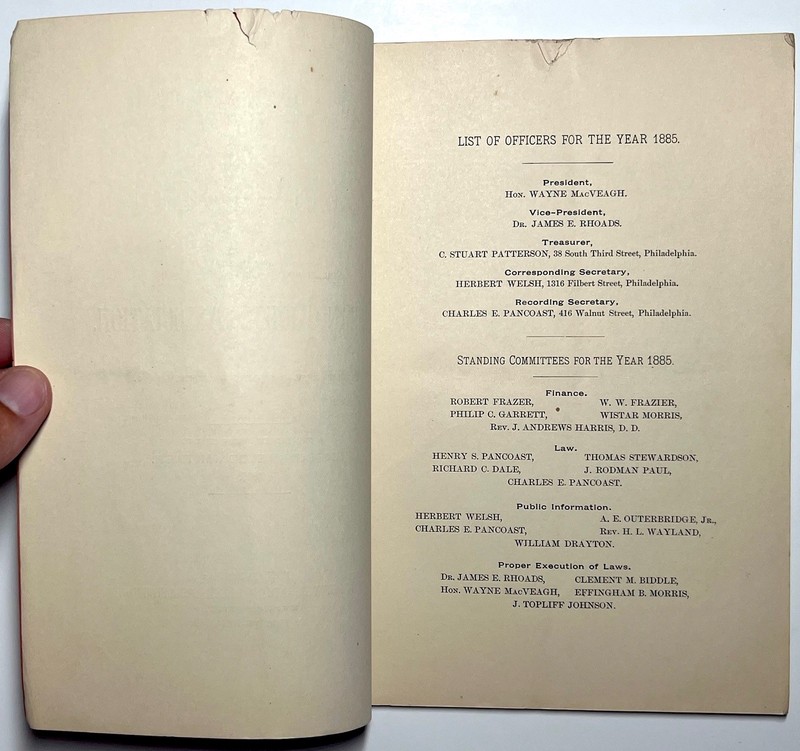
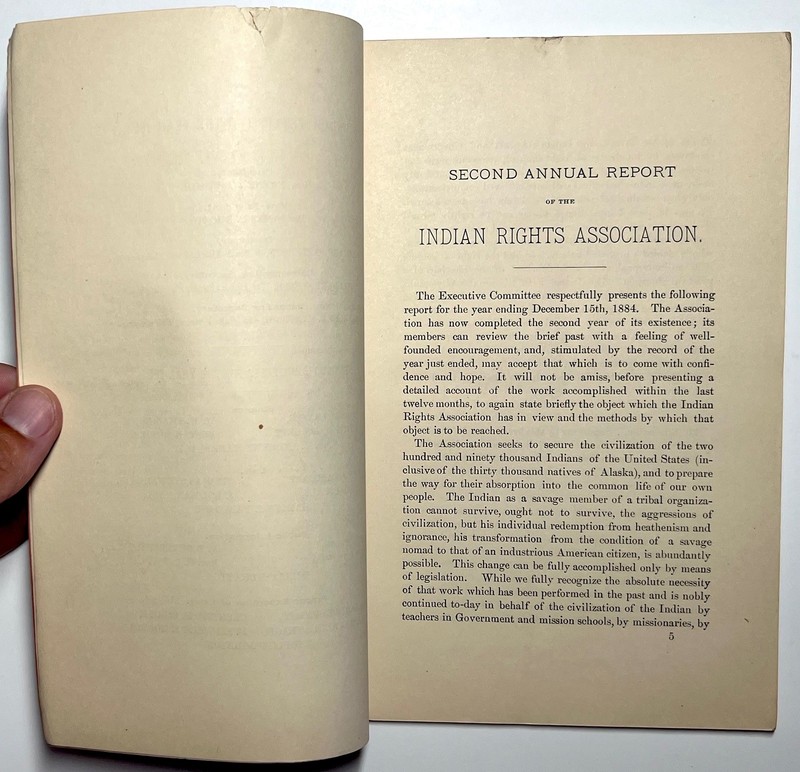
Historically significant report from the second year of the Indian Rights Association (founded in Philadelphia in 1882), documenting the organization’s assimilationist reform program and national lobbying during the year ending December 15, 1884. The preliminary matter lists officers for 1885—President Hon. Wayne MacVeagh; Vice-President Dr. James E. Rhoads; Treasurer C. Stuart Patterson; Corresponding Secretary Herbert Welsh (at the IRA office on Filbert Street); and Recording Secretary Charles E. Pancoast—along with standing committees on Finance, Law, Public Information, and the Proper Execution of Laws. The Executive Committee’s narrative restates the Association’s three core objectives: I) secure just law and even-handed justice for Native peoples, II) education toward “their highest useful, intellectual, and moral powers,” and III) “a protected individual title to land,” the wedge the IRA believed would replace tribal organization with citizenship.
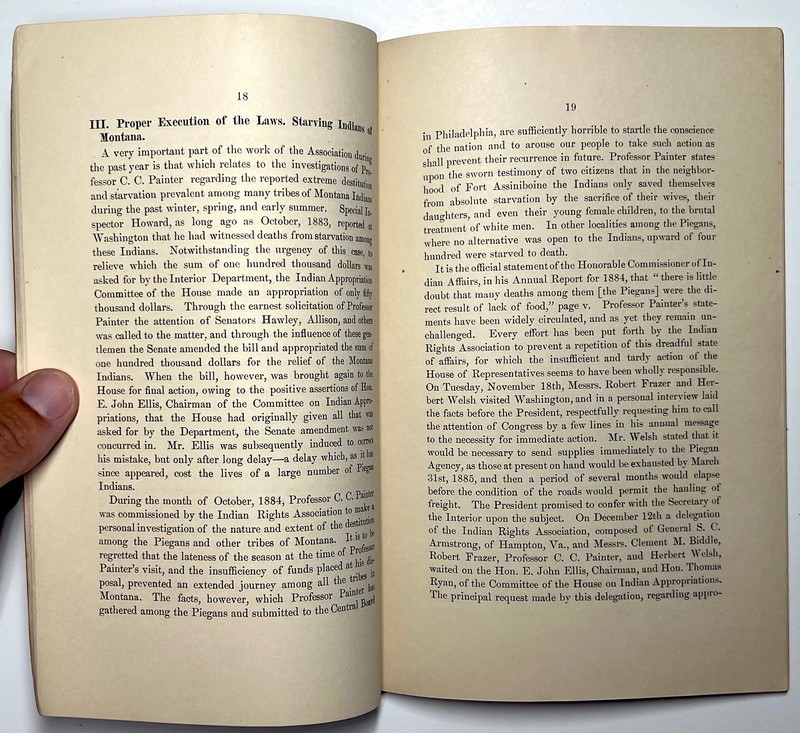
Methods and activities are detailed at length. The Board in Philadelphia coordinated a national network of branch associations to diffuse information and influence legislation; Professor Charles C. Painter served as the Association’s Washington representative, charged to remain in the capital during Congressional sessions, attend to Indian legislation, and brief lawmakers. The report enumerates forty-nine public addresses for 1884 in churches and halls from New York City, Philadelphia, and Boston to St. Louis, Providence, Hartford, New Haven, Albany, Orange (N.J.), Wilmington (Del.), Lake Mohonk (N.Y.), and Albuquerque and Santa Fé, with thirteen new branches formed (including St. Louis; Columbus, Ohio; Wilmington, Del.; West Chester, Pa.; Albuquerque, N.M.; Santa Fé, N.M.; Orange, N.J.; and others). Travels to the Indian Country included Herbert Welsh to New Mexico and Arizona (visiting Pueblo, Navajo, and Hualapai groups); Painter to the Piegan and other Montana tribes and to the Mille Lacs and Chippewa in Minnesota; and Robert Frazer to the Apaches of Arizona at the invitation of General George Crook.
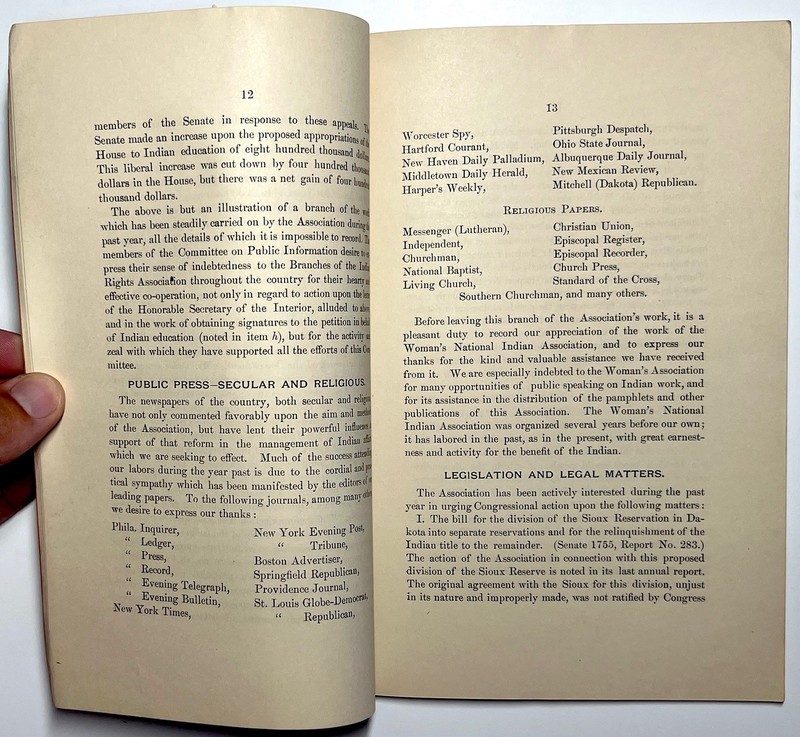
Government relations occupy substantial space: reprints and circulation data are given for major pamphlets (e.g., The Indian Before the Law; “Sioux Bill” and “Coke Bill” abstracts; minutes of the Lake Mohonk Conference), along with petitions and circulars directed to Congress and the press (including a circular on the Association’s objects; Senator Dawes’s letter to the Springfield Republican on Agent McGillycuddy’s case; and appeals regarding appropriations for Indian schools sent to the Secretary of the Interior, H.M. Teller). The press section acknowledges coverage in leading secular and religious journals—from the Philadelphia Inquirer and New York Evening Post to denominational papers such as the Messenger (Lutheran) and Christian Union. Legislative pages summarize the Association’s stances, including opposition to the proposed division of the Sioux Reservation that would have relinquished Indian title to certain lands, and broader efforts that foreshadow the allotment policies soon to culminate in the Dawes Act. The closing Treasurer’s Report provides line-item accounts of receipts and disbursements for 1883–84, documenting the finances behind this reform campaign.
A substantial primary source for scholars of federal Indian policy, Gilded-Age reform, Quaker-adjacent activism, and the Lake Mohonk network, preserving names of officers, donors, branch organizers, meeting venues, itineraries, and publications. An appealing survivor in original printed wraps, sound and complete, showing modest, time-appropriate wear as described above.
Make sure to see the photos above for complete details.
50 pages.
Measures approximately 8 3/4 inches tall by 5 3/4 inches wide.
KEYWORDS
Indian Rights Association, IRA, Philadelphia reform, 1316 Filbert Street, Annual Report, Second Annual Report, 1884 activities, 1885 imprint, original printed wrappers, pamphlet, booklet, 19th century Native American policy, federal Indian policy, assimilation era, allotment era, protected individual title to land, education of Indians, citizenship campaign, Quaker reform, Lake Mohonk Conference, Wayne MacVeagh, James E. Rhoads, C. Stuart Patterson, Herbert Welsh, Charles E. Pancoast, Henry S. Pancoast, Thomas Stewardson, Richard C. Dale, Robert Frazer, Philip C. Garrett, Wistar Morris, J. Andrews Harris, William Drayton, A. E. Outerbridge Jr., H. L. Wayland, Clement B. Biddle, Effingham B. Morris, J. Topliff Johnson, Professor Charles C. Painter, Senator Henry L. Dawes, H. M. Teller, Secretary of the Interior, General George Crook, Agent McGillycuddy, Sioux Bill, Coke Bill, Lake Mohonk proceedings, petitions to Congress, Congressional lobbying, Washington representative, branch associations, public addresses list, itinerary, Albuquerque, Santa Fé, Orange New Jersey, Wilmington Delaware, Lake Mohonk New York, New Haven, Hartford, Providence, Boston, Springfield, St. Louis, Philadelphia, Columbus Ohio, West Chester Pennsylvania, New Bedford Massachusetts, Governor’s Room State House Columbus, Episcopal churches, public halls, treasurer’s report, financial statements, receipts and disbursements, subscription lists, donors, membership, press coverage, Philadelphia Inquirer, New York Evening Post, Harper’s Weekly, Christian Union, Episcopal Register, Lutheran Messenger, Standard of the Cross, reform periodicals, missionary papers, Quaker interest, Pueblo Indians, Navajo, Hualapai, Piegan, Chippewa, Apache, reservations, New Mexico, Arizona, Montana, Minnesota, Dakota legislation, Sioux Reservation division, Indian school appropriations, Indian education funding, Board of Indian Commissioners era, Gilded Age philanthropy, social reform, progressive precursors, US Army involvement, Indian agents, government employees, law committee, finance committee, public information committee, proper execution of laws committee, 19th century ephemera, Americana, Native American history, indigenous studies source, primary source document, complete to page 50, terracotta wraps, decorative corner devices, tide mark head margin, light foxing, toned paper, soft corner wear, sturdy spine fold, no ownership marks seen, research copy, reference copy, rare pamphlet, scarce Philadelphia imprint, early Indian Rights Association material, pre-Dawes Act context, citizenship advocacy, legislative circulars, Springfield Republican letter, public opinion campaigns, petitions circulation statistics, printing history, social history, US policy debate, historical society collection, university library upgrade, archive ready, antique booklet, 1880s activism, American reform movements.