Constantine II, Caesar 317-337 AD, Augustus 337-340 AD.
AE follis 18-19mm. 2.99gm. (VF) Original brown-green patina over ancient silvering. Better in hand.
Authenticity guaranteed.
Coin is in good condition and very rare and nice inclusion to the finest collection!! |
Flavius Claudius Constantinus, known in English as
Constantine II, (316-340) was
Roman Emperor
from 337
On March 1 , 317, Constantine was made Caesar , and at the age of seven in 323, took part in his father's campaign against the Sarmatians . At the age of ten he became commander of Gaul, after the death of his half-brother Crispus . An inscription dating to 330 records the title of Alamannicus, so it is probable that his generals won a victory over the Alamanni . His military career continued when Constantine I elected his son field commander during the 332 campaign against the Goths . Following the death of his father in 337, Constantine II became emperor jointly with his brothers Constantius II and Constans . After the division of the empire, made by the three brothers in September of the same year in Pannonia, he ruled over Gaul, Britannia and Hispania . He was involved in the struggle between the different Christian streams. The Western portion of the empire leaned towards Catholicism and against Arianism , and Constantine freed Athanasius and allowed him to return to Alexandria . This action also put some burden on Constantius II, who was a supporter of Arianism. At first, he was the guardian of his younger brother Constans, whose portion was Italia , Africa and Illyricum . As Constans came of age, Constantine would not relinquish the guardianship and in 340 he marched against Constans in Italy, but was defeated at Aquileia and he was killed in an ambush in Cervignano del Friuli . Constans came to control his deceased brother's realm. 
Division of the Roman Empire among the Caesars appointed by
Constantine I
: from left to right,
the territories of Constantine II,
Constans I
,
Dalmatius
and
Constantius II
. After the death of
Constantine I (May 337), this was the formal division of the Empire,
until Dalmatius was killed and his territory divided between
Constans and Constantius.
A laurel wreath is a circular wreath made of interlocking branches and leaves of the bay laurel (Laurus nobilis), an aromatic broadleaf evergreen, or later from spineless butcher's broom (Ruscus hypoglossum) or cherry laurel (Prunus laurocerasus). In Greek mythology , Apollo is represented wearing a laurel wreath on his head. In ancient Greece wreaths were awarded to victors, both in athletic competitions, including the ancient Olympics made of wild olive-tree known as "kotinos" (κότινος), (sc. at Olympia ) and in poetic meets; in Rome they were symbols of martial victory, crowning a successful commander during his triumph . Whereas ancient laurel wreaths are most often depicted as a horseshoe shape, modern versions are usually complete rings. In common modern idiomatic usage it refers to a victory. The expression "resting on one's laurels" refers to someone relying entirely on long-past successes for continued fame or recognition, where to "look to one's laurels" means to be careful of losing rank to competition. Academic use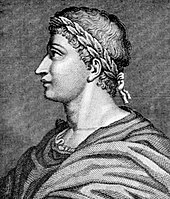
In some countries the laurel wreath is used as symbol of the master's degree . The wreath is given to young masters in the graduation ceremony of the university. The word "Laureate" in 'poet laureate' refers to being signified by the laurel wreath. The medieval Florentine poet and philosopher Dante Alighieri ,[dubious ] a graduate of the Sicilian School , is often represented in paintings and sculpture wearing a laurel wreath. Laureato[3] is the term used in Italy to refer to any graduated student. In some italian regions (Veneto, Friuli-Venezia Giulia and Trentino ), right after the graduation ceremony (in Italian: laurea), the student receives a laurel wreath and is allowed to wear it for the rest of the day. This tradition was born in the University of Padua and since the end of the 19th century is common to all northeastern Italian universities. At Connecticut College in the United States, members of the junior class carry a laurel chain , which the seniors pass through during commencement. It represents nature and the continuation of life from year to year. Immediately following commencement, the junior girls write out with the laurels their class year, symbolizing they have officially become seniors and the cycle will repeat itself the following spring. At Mount Holyoke College in South Hadley, Massachusetts , United States, laurel has been a fixture of commencement traditions since 1900, when graduating students carried or wore laurel wreaths. In 1902, the chain of mountain laurel was introduced; since then, tradition has been for seniors to march across campus, carrying and linked by the chain. The mountain laurel represents the bay laurel used by the Romans in wreaths and crowns of honor.[4] At Reed College in Portland, Oregon , United States, members of the senior class receive laurel wreaths upon submitting their senior thesis in May. The tradition stems from the use of laurel wreaths in athletic competitions; the seniors have "crossed the finish line," so to speak. At St. Mark's School in Southborough, Massachusetts , students who successfully complete three years of one classical language and two of the other earn the distinction of the Classics Diploma and the honor of wearing a laurel wreath on Prize Day. In Sweden , those receiving a Doctorate or an Honorary Doctorate at the Faculty of Philosophy (meaning Philosophy, Languages, Arts, History and Social Sciences), receive a laurel wreath during the ceremony of conferral of the degree. The laurel wreath is a common motif in architecture , furniture , and textiles . The laurel wreath is seen carved in the stone and decorative plaster works of Robert Adam , and in Federal , Regency , Directoire , and Beaux-Arts periods of architecture. In decorative arts, especially during the Empire period , the laurel wreath is seen woven in textiles, inlaid in marquetry, and applied to furniture in the form of gilded brass mounts. Alfa Romeo added a laurel wreath to their logo after they won the inaugural Automobile World Championship in 1925 with the P2 racing car. |
 to
340. The eldest son of
Constantine the Great
and
Fausta
, he was
born at Arles
,
and was raised as a Christian.
to
340. The eldest son of
Constantine the Great
and
Fausta
, he was
born at Arles
,
and was raised as a Christian.
|