N42 Neodymium Disc Magnets — 2 x 1 mm
Nickel-Copper-Nickel coated • Axially magnetised • Packs of 1, 10, 25, 50 and 100
The smallest disc we stock. Made for micro part-swaps on 28mm miniatures and scale models — hands, weapon options, small hatches and aerials.
Why this size
✓ Honest N42 grade. We state the grade we actually buy. If you see the same disc advertised as N52 at this size, treat the claim with caution.
✓ Calculated pull: 50 g at direct contact. Zero gap, clean flat steel. Magnet-to-magnet also 50 g. Reference value, not a guaranteed working load.
✓ Fits a 2 mm drill bit. No reaming, no filling gaps — drill 2 mm, recess 1.2 mm deep, glue flush.
✓ NiCuNi coating. Three-layer nickel-copper-nickel plating, the standard finish for indoor hobby use. Handles handling and superglue without flaking.
✓ Buy the count you need. Single magnets through to 100 per pack, so you are not forced into a bulk bag for one conversion.
What it is
A sintered neodymium (NdFeB) disc, 2 mm across and 1 mm thick, magnetised through its thickness — the poles are the two flat faces, not the edge. That is what makes discs this size useful for swap-out parts: two magnets meet face to face, the join sits flat, and the part seats in the same position every time.
At 2 mm this is a precision component rather than a general-purpose magnet. It disappears into a wrist, a shoulder socket, a small hatch or a turret pin, and it holds a light resin or plastic part firmly enough for transport in a foam case. It will not hold a metal-bodied vehicle, and it is not the size for magnetising bases — see the honest limitations below.
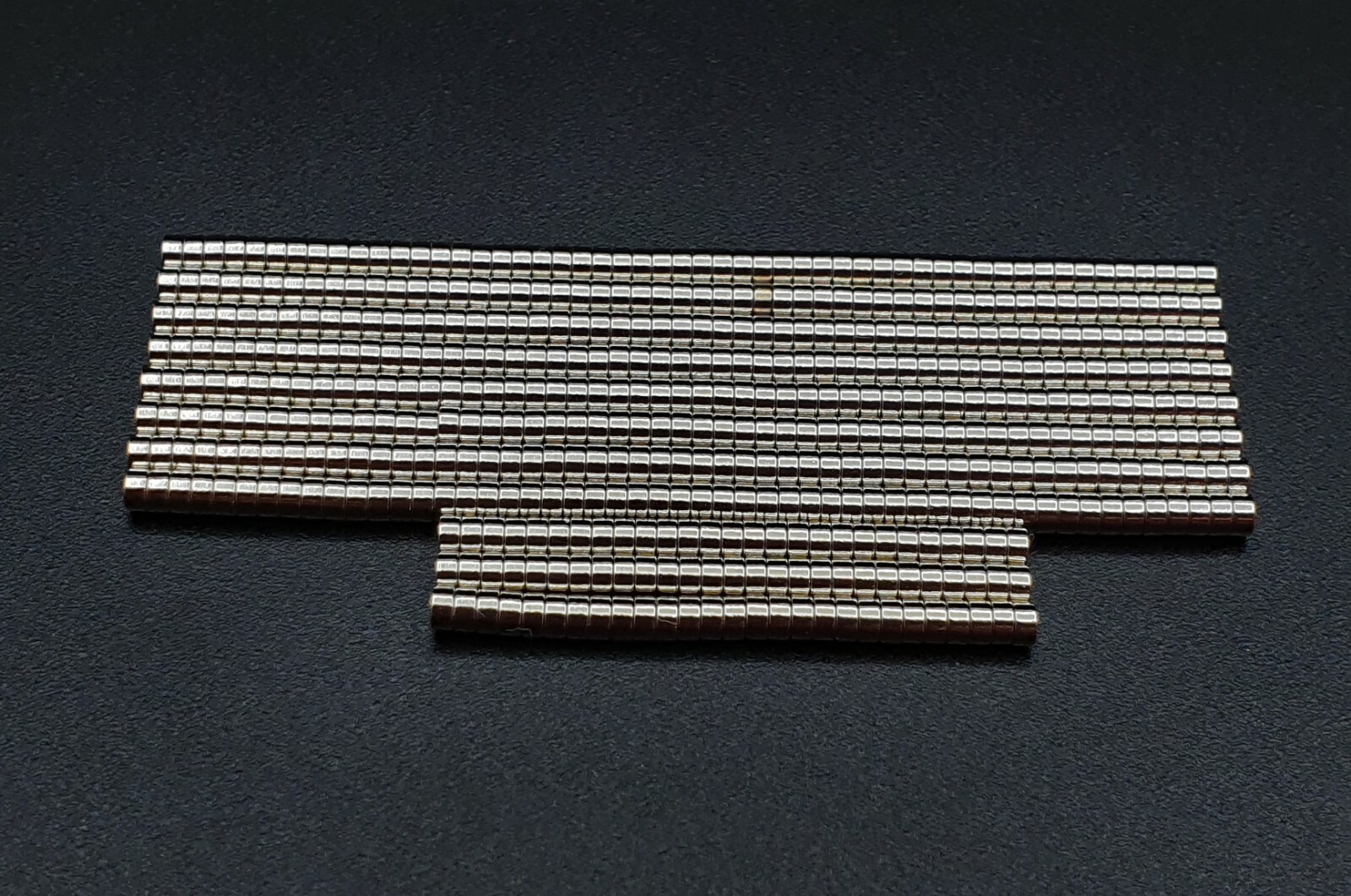
These are supplied as loose magnets in a stack. They arrive already assembled pole-to-pole, which is how you should keep them until you are ready to use them.
Specifications
| Diameter |
2 mm |
| Thickness |
1 mm |
| Material |
Sintered neodymium iron boron (NdFeB) |
| Grade |
N42 |
| Coating |
Nickel-Copper-Nickel (NiCuNi), triple layer |
| Magnetisation |
Axial — poles on the flat faces |
| Pull to steel (calculated) |
50 g / 0.49 N at direct contact, zero gap |
| Magnet-to-magnet pull |
50 g, bare faces in direct contact |
| Shear (sideways) estimate |
Approximately 7 g — sideways load is far weaker than direct pull |
| Drill bit size |
2 mm |
| 3D print hole size |
2.1 mm |
| Maximum working temperature |
Approximately 80°C — standard for N42 |
| Country of manufacture |
China |
Pull figures are calculated reference values for a clean, flat, direct steel contact with no air gap. Paint, primer, glue layers, curved surfaces and any gap at all will reduce holding force, in some cases substantially. Treat these numbers as a way to compare sizes to each other, not as a guaranteed working load.
What you get
▪ The pack size you select from the dropdown: 1, 10, 25, 50 or 100 magnets
▪ Supplied stacked pole-to-pole in a resealable bag
▪ Every magnet is the same 2 x 1 mm N42 disc — the only difference between variants is the count
What this size is for
Well suited to: swappable hands and weapon options on 28mm plastic and resin miniatures • small hatches, doors and aerials on scale model kits • interchangeable heads and shoulder pads • light card and paper craft closures • anywhere the recess has to stay invisible.
Look at a larger size for: arms and torsos (3 mm) • larger parts and vehicle components (4–5 mm) • magnetised bases and transport trays (5–6 mm). Going one size up in diameter gains far more holding force than chasing a higher grade at the same size.
Working with them
Mark the stack before you separate it. Put a dot of permanent marker on one face of the whole stack while it is still assembled. Every magnet then carries the same reference face, and you can glue with confidence instead of guessing. Reversing one magnet is the single most common way a magnetised part ends up pushing itself off.
Slide, do not pull. Separating a stack by pulling straight apart takes the full pull force. Sliding one magnet sideways off the stack takes a fraction of it and is much less likely to chip the plating.
Drill 2 mm, go 1.2 mm deep. Recess depth of magnet thickness plus roughly 0.2 mm leaves room for glue without the magnet standing proud. If you are printing the part, model the hole at 2.1 mm to allow for print tolerance.
Superglue and accelerator, not epoxy. At this size there is very little surface for epoxy to key into, and the magnet will pop out under load. Thin CA wicked into a snug recess holds better.
Keep paint out of the joint. A coat of primer plus two of paint on both mating faces is easily 0.1 mm of gap, and on a 50 g magnet that is a noticeable loss. Mask the faces, or fit the magnets after painting.
Honest limitations
▪ 50 g is genuinely small. That is enough for a plastic or light resin hand or weapon. It is not enough for a heavy metal part, and it is not enough to hold a miniature to a transport tray.
▪ Sideways load is much weaker than straight pull. Around 7 g. Design the joint so the load pulls the faces apart rather than sliding them.
▪ Neodymium is brittle. These are sintered ceramic-like magnets, not soft metal. Letting a stack snap together from a distance can chip or crack them.
▪ Indoor use. NiCuNi plating resists handling and normal indoor humidity, but it is not a marine or outdoor coating. Prolonged damp will eventually get underneath it.
▪ Heat weakens them permanently. Above roughly 80°C an N42 magnet loses strength and does not recover on cooling. Keep them away from ovens, curing lamps and hot cars.
Important safety information
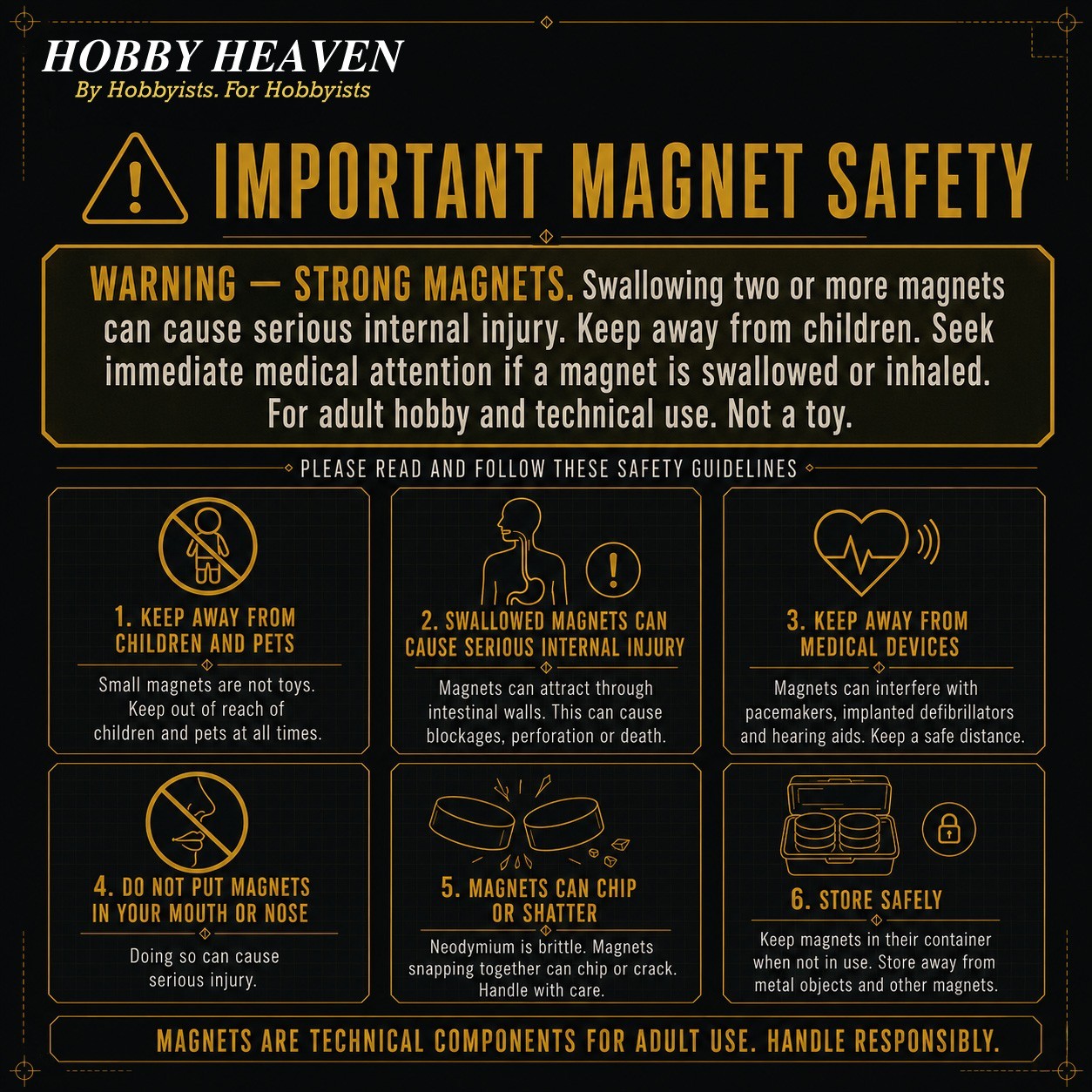
Warning — strong magnets. For adult hobby and technical use. Not a toy.
Swallowing two or more magnets can cause serious internal injury. Magnets can attract to each other through the wall of the intestine, causing blockage or perforation. Seek immediate medical attention if a magnet is swallowed or inhaled. Keep away from children and pets at all times.
Keep magnets away from pacemakers, implanted defibrillators and hearing aids. Keep them away from bank cards, hard drives and other magnetic media.
Handle with care — neodymium is brittle and can chip. Store magnets in their bag, away from loose steel and craft blades.
Dispatch
▪ Same-day dispatch on orders placed before 3 PM, Monday to Friday
▪ Sent from our own unit in Derby — we pick and pack everything ourselves
▪ Magnets are shipped within the UK only
Hobby Heaven
By Hobbyists. For Hobbyists.
We are a small family-run business in Derby, run by people who actually paint, build and convert. We publish the grade we buy and the test conditions behind every pull figure, because that is the information we wanted when we were sourcing magnets for our own projects. If something is not right, message us and we will sort it.
N42 Neodymium Disc Magnets — 2 x 1 mm
Nickel-Copper-Nickel coated • Axially magnetised • Packs of 1, 10, 25, 50 and 100
The smallest disc we stock. Made for micro part-swaps on 28mm miniatures and scale models — hands, weapon options, small hatches and aerials.
Why this size
✓ Honest N42 grade. We state the grade we actually buy. If you see the same disc advertised as N52 at this size, treat the claim with caution.
✓ Calculated pull: 50 g at direct contact. Zero gap, clean flat steel. Magnet-to-magnet also 50 g. Reference value, not a guaranteed working load.
✓ Fits a 2 mm drill bit. No reaming, no filling gaps — drill 2 mm, recess 1.2 mm deep, glue flush.
✓ NiCuNi coating. Three-layer nickel-copper-nickel plating, the standard finish for indoor hobby use. Handles handling and superglue without flaking.
✓ Buy the count you need. Single magnets through to 100 per pack, so you are not forced into a bulk bag for one conversion.
What it is
A sintered neodymium (NdFeB) disc, 2 mm across and 1 mm thick, magnetised through its thickness — the poles are the two flat faces, not the edge. That is what makes discs this size useful for swap-out parts: two magnets meet face to face, the join sits flat, and the part seats in the same position every time.
At 2 mm this is a precision component rather than a general-purpose magnet. It disappears into a wrist, a shoulder socket, a small hatch or a turret pin, and it holds a light resin or plastic part firmly enough for transport in a foam case. It will not hold a metal-bodied vehicle, and it is not the size for magnetising bases — see the honest limitations below.
These are supplied as loose magnets in a stack. They arrive already assembled pole-to-pole, which is how you should keep them until you are ready to use them.
Specifications
Diameter
2 mm
Thickness
1 mm
Material
Sintered neodymium iron boron (NdFeB)
Grade
N42
Coating
Nickel-Copper-Nickel (NiCuNi), triple layer
Magnetisation
Axial — poles on the flat faces
Pull to steel (calculated)
50 g / 0.49 N at direct contact, zero gap
Magnet-to-magnet pull
50 g, bare faces in direct contact
Shear (sideways) estimate
Approximately 7 g — sideways load is far weaker than direct pull
Drill bit size
2 mm
3D print hole size
2.1 mm
Maximum working temperature
Approximately 80°C — standard for N42
Country of manufacture
China
Pull figures are calculated reference values for a clean, flat, direct steel contact with no air gap. Paint, primer, glue layers, curved surfaces and any gap at all will reduce holding force, in some cases substantially. Treat these numbers as a way to compare sizes to each other, not as a guaranteed working load.
What you get
▪ The pack size you select from the dropdown: 1, 10, 25, 50 or 100 magnets
▪ Supplied stacked pole-to-pole in a resealable bag
▪ Every magnet is the same 2 x 1 mm N42 disc — the only difference between variants is the count
What this size is for
Well suited to: swappable hands and weapon options on 28mm plastic and resin miniatures • small hatches, doors and aerials on scale model kits • interchangeable heads and shoulder pads • light card and paper craft closures • anywhere the recess has to stay invisible.
Look at a larger size for: arms and torsos (3 mm) • larger parts and vehicle components (4–5 mm) • magnetised bases and transport trays (5–6 mm). Going one size up in diameter gains far more holding force than chasing a higher grade at the same size.
Working with them
Mark the stack before you separate it. Put a dot of permanent marker on one face of the whole stack while it is still assembled. Every magnet then carries the same reference face, and you can glue with confidence instead of guessing. Reversing one magnet is the single most common way a magnetised part ends up pushing itself off.
Slide, do not pull. Separating a stack by pulling straight apart takes the full pull force. Sliding one magnet sideways off the stack takes a fraction of it and is much less likely to chip the plating.
Drill 2 mm, go 1.2 mm deep. Recess depth of magnet thickness plus roughly 0.2 mm leaves room for glue without the magnet standing proud. If you are printing the part, model the hole at 2.1 mm to allow for print tolerance.
Superglue and accelerator, not epoxy. At this size there is very little surface for epoxy to key into, and the magnet will pop out under load. Thin CA wicked into a snug recess holds better.
Keep paint out of the joint. A coat of primer plus two of paint on both mating faces is easily 0.1 mm of gap, and on a 50 g magnet that is a noticeable loss. Mask the faces, or fit the magnets after painting.
Honest limitations
▪ 50 g is genuinely small. That is enough for a plastic or light resin hand or weapon. It is not enough for a heavy metal part, and it is not enough to hold a miniature to a transport tray.
▪ Sideways load is much weaker than straight pull. Around 7 g. Design the joint so the load pulls the faces apart rather than sliding them.
▪ Neodymium is brittle. These are sintered ceramic-like magnets, not soft metal. Letting a stack snap together from a distance can chip or crack them.
▪ Indoor use. NiCuNi plating resists handling and normal indoor humidity, but it is not a marine or outdoor coating. Prolonged damp will eventually get underneath it.
▪ Heat weakens them permanently. Above roughly 80°C an N42 magnet loses strength and does not recover on cooling. Keep them away from ovens, curing lamps and hot cars.
Important safety information
Warning — strong magnets. For adult hobby and technical use. Not a toy.
Swallowing two or more magnets can cause serious internal injury. Magnets can attract to each other through the wall of the intestine, causing blockage or perforation. Seek immediate medical attention if a magnet is swallowed or inhaled. Keep away from children and pets at all times.
Keep magnets away from pacemakers, implanted defibrillators and hearing aids. Keep them away from bank cards, hard drives and other magnetic media.
Handle with care — neodymium is brittle and can chip. Store magnets in their bag, away from loose steel and craft blades.
Dispatch
▪ Same-day dispatch on orders placed before 3 PM, Monday to Friday
▪ Sent from our own unit in Derby — we pick and pack everything ourselves
▪ Magnets are shipped within the UK only
Hobby Heaven
By Hobbyists. For Hobbyists.
We are a small family-run business in Derby, run by people who actually paint, build and convert. We publish the grade we buy and the test conditions behind every pull figure, because that is the information we wanted when we were sourcing magnets for our own projects. If something is not right, message us and we will sort it.
Specifications
-
Choose Quantity
10
-
Brand
Hobby Heaven
-
Item Thickness
1mm
-
Type
Disc Magnet
-
Shape
Disc / Round
-
Item Diameter
2mm
-
Grade
N42
-
Coating
Nickel-Copper-Nickel (NiCuNi)
-
Magnetisation
Axial
-
Country of Origin
China
-
Colour
Silver