Elagabalus - Emperor: 218-222 A.D.
 Son
of Julia Soaemias | Husband of Julia Paula, Aquilia Severa and Annia
Faustina | Grandson of Julia Maesa | Nephew of Julia Mamaea | Cousin of
Severus Alexander | Second-cousin of Geta and Caracalla (Supposedly a
natural son of Caracalla) | Great-nephew of Septimius Severus and Julia
Domna |
Son
of Julia Soaemias | Husband of Julia Paula, Aquilia Severa and Annia
Faustina | Grandson of Julia Maesa | Nephew of Julia Mamaea | Cousin of
Severus Alexander | Second-cousin of Geta and Caracalla (Supposedly a
natural son of Caracalla) | Great-nephew of Septimius Severus and Julia
Domna |
Elagabalus (Marcus Aurelius Antoninus Augustus, ca. 203 – 11 March 222), also known as Heliogabalus, was Roman Emperor from 218 to 222. A member of the Severan Dynasty, he was Syrian on his mother's side, the son of Julia Soaemias and Sextus Varius Marcellus. In his early youth he served as a priest of the god Elagabal (in Latin, Elagabalus) in the hometown of his mother's family, Emesa.
As a private citizen, he was probably named Sextus Varius Avitus
Bassianus. Upon becoming emperor he took the name Marcus Aurelius
Antoninus Augustus. He was called Elagabalus only after his death.
In 217, the emperor Caracalla was assassinated and replaced by his Praetorian prefect, Marcus Opellius Macrinus. Caracalla's maternal aunt, Julia Maesa, successfully instigated a revolt among the Third Legion to
have her eldest grandson (and Caracalla's cousin), Elagabalus, declared
emperor in his place. Macrinus was defeated on 8 June 218, at the Battle of Antioch. Elagabalus, barely fourteen years old, became emperor, initiating a reign remembered mainly for sexual scandal and religious controversy.
Later
historians suggest Elagabalus showed a disregard for Roman religious
traditions and sexual taboos. He replaced the traditional head of the Roman pantheon, Jupiter, with the deity of whom he was high priest, Elagabal.
He forced leading members of Rome's government to participate in
religious rites celebrating this deity, over which he personally
presided. Elagabalus was married as many as five times, lavished favors
on male courtiers popularly thought to have been his lovers, employed a
prototype of whoopee cushions at dinner parties, and was reported to have prostituted himself in the imperial palace. His behavior estranged the Praetorian Guard, the Senate, and the common people alike.
Amidst growing opposition, Elagabalus, just 18 years old, was assassinated and replaced by his cousin Alexander Severus on
11 March 222, in a plot formulated by his grandmother, Julia Maesa, and
carried out by disaffected members of the Praetorian Guard.
Elagabalus developed a reputation among his contemporaries for extreme eccentricity, decadence and zealotry.
This tradition has persisted, and in writers of the early modern age he
suffers one of the worst reputations among Roman emperors. Edward Gibbon, for example, wrote that Elagabalus "abandoned himself to the grossest pleasures and ungoverned fury." According to B.G. Niebuhr, "The name Elagabalus is branded in history above all others" because of his "unspeakably disgusting life."
Family and priesthood
| Roman imperial dynasties |
| Severan dynasty |
| |
| Chronology |
| Septimius Severus | 193–198 |
| -with Caracalla | 198–209 |
| -with Caracalla and Geta | 209–211 |
| Caracalla and Geta | 211–211 |
| Caracalla | 211–217 |
| Interlude: Macrinus | 217–218 |
| Elagabalus | 218–222 |
| Alexander Severus | 222–235 |
| Dynasty |
Severan dynasty family tree
Category:Severan dynasty
|
| Succession |
Preceded by
Year of the Five Emperors | Followed by
Crisis of the Third Century |
Elagabalus was born around the year 203 to Sextus Varius Marcellus and Julia Soaemias Bassiana. His father was initially a member of the equestrian class, but was later elevated to the rank of senator. His grandmother Julia Maesa was the widow of the Consul Gaius Julius Avitus Alexianus, the sister of Julia Domna, and the sister-in-law of the emperor Septimius Severus.
His mother, Julia Soaemias, was a cousin of the Roman emperor Caracalla. Other relatives included his aunt Julia Avita Mamaea and uncle Marcus Julius Gessius Marcianus, and their son Alexander Severus. Elagabalus's family held hereditary rights to the priesthood of the sun god Elagabal, of whom Elagabalus was the high priest at Emesa (modern Homs) in Syria.
The deity Elagabalus was initially venerated at Emesa. This form of the god's name is a Latinized version of the Syrian Ilāh hag-Gabal, which derives from Ilāh ("god") and gabal ("mountain" (compare Hebrew: גבל gəbul and Arabic: جبل jabal)),
resulting in "the God of the Mountain" the Emesene manifestation of the
deity. The cult of the deity spread to other parts of the Roman Empire
in the 2nd century; a dedication has been found as far away as Woerden (Netherlands). The god was later imported and assimilated with the Roman sun god known as Sol Indiges in republican times and as Sol Invictus during the 2nd and 3rd centuries CE. In Greek the sun god is Helios, hence "Heliogabalus", a variant of "Elagabalus".
Rise to power
When the emperor Macrinus came
to power, Elagabalus' mother suppressed the threat against his reign by
the family of his assassinated predecessor, Caracalla, by exiling
them—Julia Maesa, her two daughters, and her eldest grandson
Elagabalus—to their estate at Emesa in Syria.
Almost upon arrival in Syria she began a plot, with her advisor and
Elagabalus' tutor Gannys, to overthrow Macrinus and elevate the
fourteen-year-old Elagabalus to the imperial throne.
His
mother publicly declared that he was the illegitimate son of Caracalla,
therefore due the loyalties of Roman soldiers and senators who had
sworn allegiance to Caracalla. After Julia Maesa displayed her wealth to
the Third Legion at Raphana they swore allegiance to Elagabalus. At sunrise on 16 May 218, Publius Valerius Comazon Eutychianus,
commander of the legion, declared him emperor. To strengthen his
legitimacy through further propaganda, Elagabalus assumed Caracalla's
names, Marcus Aurelius Antoninus.
In response Macrinus dispatched his Praetorian prefect Ulpius Julianus to the region with a contingent of troops he considered strong enough to crush the rebellion.
However, this force soon joined the faction of Elagabalus when, during
the battle, they turned on their own commanders. The officers were
killed and Julianus' head was sent back to the emperor.
Macrinus now sent letters to the Senate denouncing Elagabalus as the False Antoninus and claiming he was insane. Both consuls and
other high-ranking members of Rome's leadership condemned Elagabalus,
and the Senate subsequently declared war on both Elagabalus and Julia
Maesa.
Macrinus and his son, weakened by the desertion of the Second Legion due to bribes and promises circulated by Julia Maesa, were defeated on 8 June 218 at the Battle of Antioch by troops commanded by Gannys. Macrinus fled toward Italy, disguised as a courier, but was later intercepted near Chalcedon and executed in Cappadocia. His son Diadumenianus, sent for safety to the Parthian court, was captured at Zeugma and also put to death.
Elagabalus
declared the date of the victory at Antioch to be the beginning of his
reign and assumed the imperial titles without prior senatorial approval,
which violated tradition but was a common practice among 3rd-century
emperors nonetheless. Letters of reconciliation were dispatched to Rome extending amnesty to the Senate and recognizing the laws, while also condemning the administration of Macrinus and his son.
The
senators responded by acknowledging Elagabalus as emperor and accepting
his claim to be the son of Caracalla. Caracalla and Julia Domna were
both deified by the Senate, both Julia Maesa and Julia Soaemias were elevated to the rank of Augustae,
and the memory of both Macrinus and Diadumenianus was condemned by the
Senate. The former commander of the Third Legion, Comazon, was appointed
commander of the Praetorian Guard.
Emperor (218–222)
Elagabalus and his entourage spent the winter of 218 in Bithynia at Nicomedia, where the emperor's religious beliefs first presented themselves as a problem. The contemporary historian Cassius Dio suggests
that Gannys was in fact killed by the new emperor because he was
forcing Elagabalus to live "temperately and prudently." To help Romans
adjust to the idea of having an oriental priest as emperor, Julia Maesa
had a painting of Elagabalus in priestly robes sent to Rome and hung
over a statue of the goddess Victoria in the Senate House.
This placed senators in the awkward position of having to make
offerings to Elagabalus whenever they made offerings to Victoria.
The
legions were dismayed by his behaviour and quickly came to regret
having supported his accession. While Elagabalus was still on his way to
Rome, brief revolts broke out by the Fourth Legion at the instigation of Gellius Maximus,
and by the Third Legion, which itself had been responsible for the
elevation of Elagabalus to the throne, under the command of Senator Verus. The rebellion was quickly put down, and the Third Legion disbanded.
When
the entourage reached Rome in the autumn of 219, Comazon and other
allies of Julia Maesa and Elagabalus were given powerful and lucrative
positions, to the outrage of many senators who did not consider them
worthy of such privileges. After his tenure as Praetorian prefect, Comazon would serve as the city prefect of Rome three times, and as consul twice. Elagabalus soon devalued the Roman currency. He decreased the silver purity of the denarius from 58% to 46.5% — the actual silver weight dropping from 1.82 grams to 1.41 grams. He also demonetized the antoninianus during this period in Rome.
Elagabalus tried to have his presumed lover, the charioteer Hierocles, declared Caesar,
while another alleged lover, the athlete Aurelius Zoticus, was
appointed to the non-administrative but influential position of Master
of the Chamber, or Cubicularius. His offer of amnesty for the Roman upper class was largely honored, though the jurist Ulpian was exiled.
The
relationships between Julia Maesa, Julia Soaemias, and Elagabalus were
strong at first. His mother and grandmother became the first women to be
allowed into the Senate, and both received senatorial titles: Soaemias
the established title of Clarissima, and Maesa the more unorthodox Mater Castrorum et Senatus ("Mother
of the army camp and of the Senate"). While Julia Maesa tried to
position herself as the power behind the throne and thus the most
powerful woman in the world, Elagabalus would prove to be highly
independent, set in his ways, and impossible to control.
Religious controversy
Since the reign of Septimius Severus, sun worship had increased throughout the Empire. Elagabalus saw this as an opportunity to install Elagabal as the chief deity of the Roman pantheon. The god was renamed Deus Sol Invictus, meaning God the Undefeated Sun, and honored above Jupiter.
As a token of respect for Roman religion, however, Elagabalus joined either Astarte, Minerva, Urania,
or some combination of the three to Elagabal as wife. Before
constructing a temple in dedication to Elagabal, Elagabalus placed the
meteorite of Elagabal next to the throne of Jupiter at the temple of
Jupiter Optimus Maximus.
He caused further discontent when he himself married the Vestal Virgin Aquilia Severa,
claiming the marriage would produce "godlike children". This was a
flagrant breach of Roman law and tradition, which held that any Vestal
found to have engaged in sexual intercourse was to be buried alive.
A lavish temple called the Elagabalium was built on the east face of the Palatine Hill to house Elagabal, who was represented by a black conical meteorite from Emesa. Herodian wrote
"this stone is worshipped as though it were sent from heaven; on it
there are some small projecting pieces and markings that are pointed
out, which the people would like to believe are a rough picture of the
sun, because this is how they see them".
In
order to become the high priest of his new religion, Elagabalus had
himself circumcised. He forced senators to watch while he danced around
the altar of Deus Sol Invictus to the accompaniment of drums and
cymbals. Each summer solstice he held a
festival dedicated to the god, which became popular with the masses
because of the free food distributed on such occasions. During this
festival, Elagabalus placed the Emesa stone on a chariot adorned with gold and jewels, which he paraded through the city:
A
six horse chariot carried the divinity, the horses huge and flawlessly
white, with expensive gold fittings and rich ornaments. No one held the
reins, and no one rode in the chariot; the vehicle was escorted as if
the god himself were the charioteer. Elagabalus ran backward in front of
the chariot, facing the god and holding the horses' reins. He made the
whole journey in this reverse fashion, looking up into the face of his
god.
The most sacred relics
from the Roman religion were transferred from their respective shrines
to the Elagabalium, including the emblem of the Great Mother, the fire of Vesta, the Shields of the Salii and the Palladium, so that no other god could be worshipped except in company with Elagabal.
Sex/gender controversy

Roman denarius depicting Aquilia Severa, the second wife of Elagabalus. The marriage caused a public outrage because Aquilia was a Vestal Virgin, sworn by Roman law to celibacy for 30 years.
Elagabalus' sexual orientation and gender identity are the subject of much debate. Elagabalus married and divorced five women, three of whom are known. His first wife was Julia Cornelia Paula; the second was the Vestal Virgin Julia Aquilia Severa.
Within a year, he abandoned her and married Annia Aurelia Faustina, a descendant of Marcus Aurelius and
the widow of a man recently executed by Elagabalus. He had returned to
his second wife Severa by the end of the year. According to Cassius Dio,
his most stable relationship seems to have been with his chariot driver, a blond slave from Caria named Hierocles, whom he referred to as his husband.
The Augustan History claims
that he also married a man named Zoticus, an athlete from Smyrna, in a
public ceremony at Rome. Cassius Dio reported that Elagabalus would
paint his eyes, epilate his hair and wear wigs before prostituting himself in taverns, brothels, and even in the imperial palace:
Finally,
he set aside a room in the palace and there committed his indecencies,
always standing nude at the door of the room, as the harlots do, and
shaking the curtain which hung from gold rings, while in a soft and
melting voice he solicited the passers-by. There were, of course, men
who had been specially instructed to play their part. For, as in other
matters, so in this business, too, he had numerous agents who sought out
those who could best please him by their foulness. He would collect
money from his patrons and give himself airs over his gains; he would
also dispute with his associates in this shameful occupation, claiming
that he had more lovers than they and took in more money.
Herodian
commented that Elagabalus enhanced his natural good looks by the
regular application of cosmetics. He was described as having been
"delighted to be called the mistress, the wife, the queen of Hierocles"
and was reported to have offered vast sums of money to any physician who
could equip him with female genitalia. Elagabalus has been
characterized by some modern writers as transgender, perhaps transsexual.
Fall from power
By 221 Elagabalus' eccentricities, particularly his relationship with Hierocles, increasingly provoked the soldiers of the Praetorian Guard.
When Elagabalus' grandmother Julia Maesa perceived that popular support
for the emperor was waning, she decided that he and his mother, who had
encouraged his religious practices, had to be replaced. As
alternatives, she turned to her other daughter, Julia Avita Mamaea, and her daughter's son, the thirteen-year-old Severus Alexander.
Prevailing on Elagabalus, she arranged that he appoint his cousin Alexander as his heir and be given the title of Caesar.
Alexander shared the consulship with the emperor that year. However,
Elagabalus reconsidered this arrangement when he began to suspect that
the Praetorian Guard preferred his cousin above himself.
Following
the failure of various attempts on Alexander's life, Elagabalus
stripped his cousin of his titles, revoked his consulship, and
circulated the news that Alexander was near death, in order to see how
the Praetorians would react. A riot ensued, and the guard demanded to
see Elagabalus and Alexander in the Praetorian camp.
Assassination
The
emperor complied and on 11 March 222 he publicly presented his cousin
along with his own mother, Julia Soaemias. On their arrival the soldiers
started cheering Alexander while ignoring Elagabalus, who ordered the
summary arrest and execution of anyone who had taken part in this
display of insubordination. In response, members of the Praetorian Guard attacked Elagabalus and his mother:
So
he made an attempt to flee, and would have got away somewhere by being
placed in a chest, had he not been discovered and slain, at the age of
18. His mother, who embraced him and clung tightly to him, perished with
him; their heads were cut off and their bodies, after being stripped
naked, were first dragged all over the city, then the mother's body was
cast aside somewhere or other while his was thrown into the [Tiber].
Following
his assassination, many associates of Elagabalus were killed or
deposed, including Hierocles and Comazon. His religious edicts were
reversed and the stone of Elagabal was sent back to Emesa. Women were again barred from attending meetings of the Senate. The practice of damnatio memoriae—erasing from the public record a disgraced personage formerly of note—was systematically applied in his case.
Sources
Augustan History
The source of many of these stories of Elagabalus's depravity is the Augustan History (Historia Augusta), which includes controversial claims. The Historia Augusta was most likely written toward the end of the 4th century during the reign of emperor Theodosius I. The life of Elagabalus as described in the Augustan History is
of uncertain historical merit. Sections 13 to 17, relating to the fall
of Elagabalus, are less controversial among historians.
Cassius Dio
Sources often considered more credible than the Augustan History include the contemporary historians Cassius Dio and Herodian. Cassius Dio lived from the second half of the 2nd century until sometime after 229. Born into a patrician family, he spent the greater part of his life in public service. He was a senator under emperor Commodus and governor of Smyrna after the death of Septimius Severus. Afterwards he served as suffect consul around 205, and as proconsul in Africa and Pannonia.
Alexander Severus held him in high esteem and made him his consul again. His Roman History spans nearly a millennium, from the arrival of Aeneas in
Italy until the year 229. As a contemporary of Elagabalus, Cassius
Dio's account of his reign is generally considered more reliable than
the Augustan History, although by his own admission Dio spent the
greater part of the relevant period outside of Rome and had to rely on
second-hand accounts.
Furthermore, the
political climate in the aftermath of Elagabalus' reign, as well as
Dio's own position within the government of Alexander, likely influenced
the truth of this part of his history for the worse. Dio regularly
refers to Elagabalus as Sardanapalus, partly to distinguish him from his divine namesake, but chiefly to do his part in maintaining the damnatio memoriae enforced after the emperor's death and to associate him with another autocrat notorious for a debauched life.
Herodian

Medal of Elagabalus, Louvre Museum.
Another contemporary of Elagabalus was Herodian, who was a minor Roman civil servant who lived from c. 170 until 240. His work, History of the Roman Empire since Marcus Aurelius, commonly abbreviated as Roman History, is an eyewitness account of the reign of Commodus until the beginning of the reign of Gordian III. His work largely overlaps with Dio's own Roman History, but both texts seem to be independently consistent with each other.
Although
Herodian is not deemed as reliable as Cassius Dio, his lack of literary
and scholarly pretensions make him less biased than senatorial
historians. Herodian is considered the most important source for the
religious reforms which took place during the reign of Elagabalus, which
have been confirmed by numismatic and archaeological evidence.
Edward Gibbon and other, later historians
For readers of the modern age, The History of the Decline and Fall of the Roman Empire by Edward Gibbon (1737–94)
further cemented the scandalous reputation of Elagabalus. Gibbon not
only accepted and expressed outrage at the allegations of the ancient
historians, but might have added some details of his own; he is the
first historian known to state that Gannys was a eunuch, for example.
Gibbon wrote:
To
confound the order of the season and climate, to sport with the
passions and prejudices of his subjects, and to subvert every law of
nature and decency, were in the number of his most delicious amusements.
A long train of concubines, and a rapid succession of wives, among whom
was a vestal virgin, ravished by force from her sacred asylum, were
insufficient to satisfy the impotence of his passions. The master of the
Roman world affected to copy the manners and dress of the female sex,
preferring the distaff to the sceptre, and dishonored the principal
dignities of the empire by distributing them among his numerous lovers;
one of whom was publicly invested with the title and authority of the
emperor's, or, as he more properly styled himself, the empress's
husband. It may seem probable, the vices and follies of Elagabalus have
been adorned by fancy, and blackened by prejudice. Yet, confining
ourselves to the public scenes displayed before the Roman people, and
attested by grave and contemporary historians, their inexpressible
infamy surpasses that of any other age or country.
Two
hundred years after the age of Pliny, the use of pure, or even of mixed
silks, was confined to the female sex, till the opulent citizens of
Rome and the provinces were insensibly familiarized with the example of
Elagabalus, the first who, by this effeminate habit, had sullied the
dignity of an emperor and a man.
Some recent historians argue for a more favorable picture of his life and reign. Martijn Icks in Images of Elagabalus (2008; republished as The Crimes of Elagabalus in
2012) doubts the reliability of the ancient sources and argues that it
was the emperor's unorthodox religious policies that alienated the power
elite of Rome, to the point that his grandmother saw fit to eliminate
him and replace him with his cousin. Leonardo de Arrizabalaga y Prado,
in The Emperor Elagabalus: Fact of Fiction? (2008), is also
critical of the ancient historians and speculates that neither religion
nor sexuality played a role in the fall of the young emperor, who was
simply the loser in a power struggle within the imperial family; the
loyalty of the Praetorian Guards was up for sale, and Julia Maesa had
the resources to outmaneuver and outbribe her grandson. According to
this version, once Elagabalus, his mother, and his immediate circle had
been murdered, a wholesale propaganda war against his memory resulted in
a vicious caricature which has persisted to the present, repeated and
often embellished by later historians displaying their own prejudices
against effeminacy and other vices which Elagabalus had come to
epitomize.
Legacy

Elagabalus on a wall painting at castle Forchtenstein
Due to the ancient tradition about him, Elagabalus became something of an (anti-)hero in the Decadent movement of
the late 19th century. He often appears in literature and other
creative media as the epitome of a young, amoral aesthete. His life and
character have informed or at least inspired many famous works of art,
by Decadents, even by contemporary artists. The most notable of these
works include:
Poems, Novels, and Biographies
- Joris-Karl Huysmans's' À rebours (1884),
one of the literary touchstones of the Decadent movement, describes in
chapter 2 the ingenuity behind a banquet designed by Des Esseintes, the
protagonist, consisting solely of black foodstuffs, intended as a kind
of perverse memorial to his lost virility. The episode is partly
inspired by the highly artificial, monochromatic feasts that Elagabalus
is said to have contrived (Historia Augusta, Life of Elagabalus, chapter 18).
- L'Agonie (Agony) (1888), the best known novel by the French writer Jean Lombard, featuring Elagabulus as the protagonist
- In 1903 Georges Duviquet published what purports to be a faithful biography of the emperor: Héliogabale: Raconté par les historians Grecs et Latins, [avec] dix-huit gravures d'après les monuments original.
- The previous pair of works inspired the Dutch writer Louis Couperus to produce his novel De Berg van Licht (The Mountain of Light) (1905), which presents Elagabalus in a sympathetic light.
- Algabal (1892–1919), a collection of poems by the German poet Stefan George
- The Sun God (1904), a novel by the English writer Arthur Westcott
- The Amazing Emperor Heliogabalus (1911), a biography by the Oxford don John Stuart Hay
- Héliogabale ou l'Anarchiste couronné (Heliogabalus or The Anarchist Crowned) (1934) by Antonin Artaud, combining essay, biography, and fiction
- Family Favourites (1960), a novel by the Anglo-Argentine writer Alfred Duggan in
which Heliogabalus is seen through the eyes of a faithful Gaulish
bodyguard and depicted as a gentle and charming aesthete, personally
lovable but lacking political skills.
- Child of the Sun (1966), a novel by Lance Horner and Kyle Onstott, better known for writing the novel that inspired the movie Mandingo
- Super-Eliogabalo (1969), a novel by the Italian writer Alberto Arbasino
- Boy Caesar (2004), a novel by the English writer Jeremy Reed
- Roman Dusk (2008), a novel in the vampire Count Saint-Germain series by Chelsea Quinn Yarbro
Plays
- Zygmunt Krasiński. "Irydion" (1836), in which Elagabalus is portrayed as a cruel tyrant
- Mencken, H.L. and Nathan, George Jean. Heliogabalus A Buffoonery in Three Acts. New York: Alfred A. Knopf, 1920
- de Escobar Fagundes, C.H. Heliogabalo: O Sol é a Pátria. Ed. Devir. Rio de Janeiro, 1980
- Gilbert, S. Heliogabalus: A Love Story. Toronto, Cabaret Theatre Company, 2002
- Ferreyra, Shawn. Elagabalus, Emperor of Rome, 2008
- Arelis. Heliogabalus (2008)
Paintings
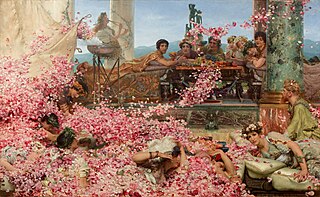
The Roses of Heliogabalus,
Lawrence Alma-Tadema, 1888.
- Heliogabalus, High Priest of the Sun (1866), by the English decadent Simeon Solomon
- One of the most notorious incidents laid to his account is immortalized in the 19th-century painting The Roses of Heliogabalus (1888), by the Anglo-Dutch academician Sir Lawrence Alma-Tadema.
It shows guests at one of his extravagant dinner parties smothered
under a mass of "violets and other flowers" dropped from above.
- Lui (1906), by Gustav-Adolf Mossa
- Heliogabalus (1974), by Anselm Kiefer
- Antonin Artaud Heliogabalus (2010–11), by Anselm Kiefer
Music
- Eliogabalo, an opera by Venetian Baroque composer Francesco Cavalli (1667)
- Heliogabale, an opera by French composer Déodat de Séverac (1910)
- Heliogabalus Imperator (Emperor Heliogabalus), an orchestral work by the German composer Hans Werner Henze (1972)
- Six Litanies for Heliogabalus, by the composer and saxophonist John Zorn (2007)