New without Tags. This gem has never been used/placed/set in a setting.
It is utterly undamaged, unmarred and in perfect condition as expected of NWOTags.
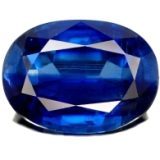
Color: Kashmir Royal-Blue
Shape: Oval-cut
Dimensions: 15.21mm x 9.59mm x 6.43mm
Weight: 8.52 cts
Luster: Excellent
Clarity: VS
Hardness: Variable Hardness 4.5-7.0 rating on the Mohs Scale; this is a defining trait of all Kyanite gems
Treatment: Not Heated, Not Treated, Not Enhanced
Origin: Nepal
And marveled at the deep blue of its ancient ice.
Thereafter this Blue Kyanite was sought in commemoration of
The Blue of Glaciers that is Clear Comforting and Eternal.
Though Glaciers are imperceptibly yet perpetually in-motion,
We have frozen in this gem the essence of the same Blue.
Because thoughts are symbolic, symbols comprise our reality.
Would a beautiful Blue Kyanite symbolize something for you?
We are an eBay eStore enterprise focused on selling mostly Loose Natural Gemstones. Stay here, look around and learn. Via eBay Messaging, ask us questions, make an offer, and otherwise discuss your wishes, concerns and hopes. We pride ourselves as good-spirited folks having fun and doing our best to share the joy of Nature's most beautiful and enduring literal treasure -- Natural Gemstones. Expect to find us cheerful and trustworthy, and we will expect the same of you. For us, Negative FeedBack as a means of coercion is never needed and only degrades everyone's enjoyment in what should otherwise be a fun shopping experience. And finally, please enjoy my work as eBay's First (unofficial) Gemstone Poet. -- captej2012
Kyanite Gemstone Information
Kyanite is a gemstone quality aluminum silicate sometimes referred to as disthene, rhaeticite or cyanite. Its name is derived from the Greek word 'kuanos' or 'kyanos', which means 'deep blue', alluding to its typical blue color. However, in addition to blue, kyanite can also be colorless, white, gray, green, orange or yellow. With kyanite, color is typically not consistent throughout. In fact, most stones exhibit areas of light to dark color zones, along with white streaks or blotches. Kyanite is a polymorph of both andalusite and sillimanite. Polymorph gemstones share similar chemical compositions, but they exhibit different crystal structures. Kyanite forms as triclinic crystals, while andalusite and sillimanite are both orthorhombic.
Kyanite's most distinctive trait is its strong anisotropic properties. Most gems are anisotropic to some extent, but kyanite is the most famous of anisotropic gemstones. Anisotropic gemstones exhibit varying properties, depending on their crystallographic direction. When kyanite is cut parallel to its long axis, its hardness can range from 4 to 4.5 on the Mohs scale, but when cut perpendicularly, its hardness can range from 6 to 7.
 | |
| Kyanite |
Kyanite is a member of the aluminosilicate series and exhibits a distinctive property known as anisotropism. Kyanite can be very easily identified by its dual hardness. Many materials exhibit variable hardness on different crystal faces, but kyanite's variable hardness can be seen in the very same crystal. As a result of its distinct dual hardness and its frequent habit of color streaking and blotching, kyanite can be very easy to identify from other gems.
Kyanite deposits can be found in many locations around the world. Some of the most important sources include Austria, Burma, Brazil, Cambodia, India, Kenya, Myanmar, Nepal, Russia, Serbia, Switzerland, Tanzania, the United States (Connecticut, Pennsylvania, North Carolina and Georgia) and Zimbabwe.
Orange kyanite was recently discovered in Tanzania. Large teal crystals have also recently been found in Kenya's Umba Valley. Nepal is now widely regarded as one of the finest kyanite sources. Nepalese kyanite is said to rival the blue color of fine Ceylon and Madagascar sapphire.
Kyanite Color
Kyanite most often occurs in various shades of blue. It is less commonly colorless, white, gray, green, yellow or orange. The colorless form is the rarest, though not the most valuable form of kyanite. The most desirable color is sapphire-like blue. Color is often inconsistent and unevenly distributed. Color zoning is common with most stones, which means that they exhibit multiple shades of blue in a single specimen. Streaks and blotches are common and typically white, but streaks may also form in other colors.
Kyanite Clarity and Luster
Kyanite can be transparent to translucent. Transparent specimens are most desirable. Almost all kyanite stones will exhibit some visible flaws. Color zoning is often mistaken for internal inclusions. Kyanite stones of over 2 carats are considered rare. Kyanite looks best in daylight and exhibits a vitreous to near-pearly luster when cut and polished.
Kyanite Cut and Shape
Transparent kyanite is typically faceted, whilst translucent materials are most often cut en cabochon. Cat's eye kyanite cabochons are also available. When cutting, proper orientation is essential since kyanite's hardness is directly associated with its cut. The most common shapes include ovals and pears as they preserve the most weight. Fancier shapes are rarer and may demand higher premiums, such as rounds, hearts and trillions, particularly when cut into calibrated sizes.
Kyanite Treatment
Kyanite is typically untreated, though there have been reports of kyanite from certain localities being treated with oil or other synthetic lubricants to enhance luster. Kyanite is sometimes used as an imitation stone and may be falsely traded as more expensive blue sapphire.