New without Tags. This gem has never been used/placed/set in a setting.
It is utterly undamaged, unmarred and in perfect condition as expected of NWOTags.
Type: Natural Clinohumite (personally confirmed as Genuine Clinohumite by digital refractometer (RI=1.667), dichroscope, polariscope, spectroscope, UV short&long-wave light, measured Specific Gravity=3.61) -- captej2012
Color: Orange
Shape: Octagon-cut
Dimensions: 7.32mm x 4.71mm x 3.25mm
Weight: 1.08 ct
Luster: Very Good
Clarity: SI
Hardness: 6.0 rating on the Mohs Scale
Treatment: Not Heated, Not Treated, Not Enhanced
Origin: Pakistan
We are an eBay eStore enterprise focused on selling mostly Loose Natural Gemstones. Stay here, look around and learn. Via eBay Messaging, ask us questions, make an offer, and otherwise discuss your wishes, concerns and hopes. We pride ourselves as good-spirited folks having fun and doing our best to share the joy of Nature's most beautiful and enduring literal treasure -- Natural Gemstones. Expect to find us cheerful and trustworthy, and we will expect the same of you. For us, Negative FeedBack as a means of coercion is never needed and only degrades everyone's enjoyment in what should otherwise be a fun shopping experience. And finally, please enjoy my work as eBay's First (unofficial) Gemstone Poet. -- captej2012
=============================================================
Clinohumite Gemstone Information
Clinohumite is a gemstone quality magnesium silicate with a chemical formula distinguished by silicate and oxide layers. It is an extremely rare mineral and an especially rare gemstone. Clinohumite is a member of the humite group of minerals, which also includes humite, norbergite and chondrodite. Of the humite group, only chondrodite and clinohumite are known to produce gemstone quality deposits. The humite group of minerals was named after Sir Abraham Hume (1749-1838). Hume was a very well-respected English mineralogist, as well as a renowned collector of fine art.
Clinohumite was first discovered in 1876. Until recently, it was thought to be one of the ten rarest gemstones in the world, with only a few thousand carats worth of gemstones known to exist in private collections. The first specimens of clinohumite were discovered in limestone blocks that had erupted from Mount Vesuvius near Naples, Italy. Later, more deposits of clinohumite were discovered in the Pamir Mountains during the early 1980s, and in the early 2000s, another deposit was found in the Taymyr Peninsula in the Far North of Russia. The most recent find was discovered in the Mahenge Plateau in the Ulanga District of the Morogoro Region of Tanzania, Africa in 2005.
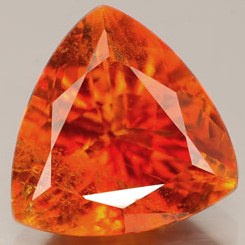 | |
| Clinohumite |
Clinohumite is a magnesium silicate with a color reminiscent of spessartite and hessonite garnet, but garnet is harder than clinohumite, which can help to distinguish between these minerals. Also, since clinohumite is extremely rare and limited only to a few specific regions of the world, in most cases, the mining origin can often help with identification. Gemologically, clinohumite has a hardness of 6 on the Mohs scale; a specific gravity (density) ranging from 3.2 to 3.4, similar to that of diopside; and a refractive index ranging from 1.631 to 1.668, between that of apatite and peridot. Its crystals are monoclinic, usually granular or prismatic in structure, and crystal lamellar twinning is common, which can result in a highly variable habits. Clinohumite's distinct basal cleavage can often help identify it from other similar gems and minerals.
Clinohumite forms through the geological process of contact metamorphism and is commonly found embedded in limestone as indistinct grains. The most famous sources for fine gemstone-quality clinohumite include the Pamir Mountains of Tajikistan, the Taymyr region of Siberia, Russia, and the Mahenge Plateau of Tanzania, Africa. Other notable sources include Mt. Vesuvius near Naples in Italy, Pargas in Finland, Llanos de Juanar in Spain and the USA, including New York, New Jersey, New Mexico, Arizona and California.
Clinohumite Color
Clinohumite color often resembles a cross between hessonite and spessartite garnet. Its color includes various shades of yellow, red and orange accompanied by secondary tones of light to dark-brown. Clinohumite exhibits a moderate level of pleochroism, typically yellow to colorless. Golden yellow to orange material is considered most desirable and can be quite vibrant. The intensity and saturation of color affects clinohumite's value more than its cut or clarity.
Clinohumite Clarity and Luster
Clinohumite can occur transparent to opaque, though only transparent and translucent materials have value as gemstones. Visible inclusions are quite common; eye-clean specimens are especially rare in weights over 1 carat. Clinohumite has a vitreous to slightly resinous luster.
Clinohumite Cut and Shape
Clinohumite is most often faceted for collectors. Some lower quality translucent material may be cut en cabochon. Common shapes include ovals, rounds, cushions and octagons (emerald cuts). Fancy shapes can also be found, including trillions and hearts, though they are extremely rare.
Clinohumite Treatment
Clinohumite is not known to be treated or enhanced in any way.