New without Tags. This gem has never been used/placed/set in a setting.
It is utterly undamaged, unmarred and in perfect condition as expected of NWOTags.
I have included an Apatite article below for your appreciation and enjoyment.
Summary of below: "Identifying chrysocolla by composition can be difficult since it lacks a definitive chemical composition. Its chemical formula can vary depending on included impurities. Essentially, any massive, globular, blue to green copper-bearing silicate which cannot be specifically identified as otherwise, can be identified as chrysocolla. Chrysocolla can often be distinguished by its hardness, unique color and interesting patterns. However, depending on its exact composition, its hardness can range significantly, but in most cases, distinguishing chrysocolla can typically be done through scratch testing. Chrysocolla is slightly softer than turquoise. Smithsonite is similar in appearance, but its color is slightly lighter and its hardness higher. Variscite is also very similar, but its color is usually much greener and it is typically much harder than chrysocolla."
Type: Natural Chrysocolla
Color: Green
Shape: Oval Cabochon-cut
Dimensions: 18.15mm x 13.18mm x 6.72mm
Weight: 10.98 cts
Luster: TopFire
Clarity: Opaque
Hardness: 7.0 rating on the Mohs Scale
Treatment: Not Treated, Not Heated, Not Enhanced
Origin: Africa
Green Chrysocolla gem setting there Alone,
They say you're just a Greenish Stone.
But if so, Why do I feel you?
Why do I hear you?
How Comforting your Presence.
How Close when we Whisper.
Is My Need that you're There?
Or Your Need that I am Here?
Whichever Be, We have One Another.
Whatever Be, We are One Another.
Take you They will,
No Matter If They Do.
They Want What We Are.
So Go Yet We Remain.
Go Share What We Are.
Whatever Be We Remain.
We are an eBay eStore enterprise focused on selling mostly Loose Natural Gemstones. Stay here, look around and learn. Via eBay Messaging, ask us questions, make an offer, and otherwise discuss your wishes, concerns and hopes. We pride ourselves as good-spirited folks having fun and doing our best to share the joy of Nature's most beautiful and enduring literal treasure -- Natural Gemstones. Expect to find us cheerful and trustworthy, and we will expect the same of you. For us, Negative FeedBack as a means of coercion is never needed and only degrades everyone's enjoyment in what should otherwise be a fun shopping experience. And finally, please enjoy my work as eBay's First (unofficial) Gemstone Poet. -- captej2012
=============================================================
Chrysocolla Gemstone Information
About Chrysocolla - History and Introduction
Chrysocolla is a gemstone quality hydrous copper silicate, often forming with copper salts, iron and manganese oxides. Chrysocolla is known to form in oxidation zones of copper ore bodies and is actually considered a minor ore for the mineral copper. Although chrysocolla may be a 'lesser known' gemstone, it is still a very fascinating stone that is highly sought-after by many avid gem and mineral enthusiasts. Chrysocolla is especially prized for its attractive colors and unique multicolored patterns. The name 'chrysocolla' was derived from the Greek words 'chrysos' and 'kolla' which translate as 'gold' and 'glue'. It earned its name because it was often used as a gold soldering agent, but eventually, the term evolved into a generic name essentially referring to any green copper-bearing mineral.
Chrysocolla belongs to a very small group of copper-bearing gems which also includes malachite, azurite, Larimar, Oregon sunstone, Paraiba tourmaline andturquoise. Chrysocolla is most famous for its alluring, vivid blue to green cyan color, which is owed to the presence of copper impurities. Chrysocolla is often confused with turquoise and azurite, owing to their shared visual similarities of color and luster. Chrysocolla commonly forms with other copper-bearing minerals, which results in very interesting and unique mixes of different colors and mottled patterns. Some of the more common mineral mixtures include blue azurite (which chrysocolla often psuedomorphs with), green malachite and turquoise. Chrysocolla may also form with clear druzy layers of glossy quartz, essentially forming a natural doublet. In many cases, quartz crystal may actually be intergrown with the stone and not just as druzy layers. These quartz-hybrid mixtures are harder and much more durable than pure chrysocolla, often rendering them suitable enough for jewelry use.
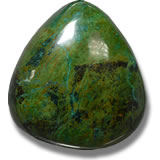 | |
| Natural Chrysocolla |
Identifying chrysocolla by composition can be difficult since it lacks a definitive chemical composition. Its chemical formula can vary depending on included impurities. Essentially, any massive, globular, blue to green copper-bearing silicate which cannot be specifically identified as otherwise, can be identified as chrysocolla. Chrysocolla can often be distinguished by its hardness, unique color and interesting patterns. However, depending on its exact composition, its hardness can range significantly, but in most cases, distinguishing chrysocolla can typically be done through scratch testing. Chrysocolla is slightly softer than turquoise. Smithsonite is similar in appearance, but its color is slightly lighter and its hardness higher. Variscite is also very similar, but its color is usually much greener and it is typically much harder than chrysocolla.
Chrysocolla can be found in copper deposits all around the world. The most notable Chrysocolla sources include Israel, the Congo (Zaire), Chile, England, Kolwezi, Katanga (Shaba), Mexico, Peru, Russia, and the USA (Arizona, Utah, Idaho, New Mexico, Michigan and Pennsylvania). Arizona is known to produce some of the finest chrysocolla available today. The Timna Copper Mines of ancient Israel were famous for mixed chrysocolla specimens. Western Australia is well-known for chrysocolla psuedomorphs of azurite.
Chrysocolla Color
Chrysocolla occurs in vivid and alluring shades of light to dark blue and green, but since it often occurs with other copper-bearing minerals, various other colors can also occur within its interesting patterns.
Chrysocolla occurs in vivid and alluring shades of light to dark blue and green, but since it often occurs with other copper-bearing minerals, various other colors can also occur within its interesting patterns.
Chrysocolla Clarity and Luster
Chrysocolla is almost always opaque, although some rare materials may occur slightly or almost translucent. When cut and polished, chrysocolla has an attractive greasy to vitreous luster.
Chrysocolla is almost always opaque, although some rare materials may occur slightly or almost translucent. When cut and polished, chrysocolla has an attractive greasy to vitreous luster.
Chrysocolla Cut and Shape
Chrysocolla is almost always cut en cabochon. Some materials may be faceted, but this is not very common and is typically done only for collectors, rather than for jewelry use. Most chrysocolla is cut into oval and free-form shapes, but fancy shapes are also quite common. The most popular shapes include rounds, pears, trillions, baguettes and drop-shapes. Calibrated sizes will command higher premiums.
Chrysocolla is almost always cut en cabochon. Some materials may be faceted, but this is not very common and is typically done only for collectors, rather than for jewelry use. Most chrysocolla is cut into oval and free-form shapes, but fancy shapes are also quite common. The most popular shapes include rounds, pears, trillions, baguettes and drop-shapes. Calibrated sizes will command higher premiums.
Chrysocolla Treatment
Chrysocolla is not normally treated or enhanced in any way. However, some materials may be coated and enhanced with a colorless resin.
Chrysocolla is not normally treated or enhanced in any way. However, some materials may be coated and enhanced with a colorless resin.