LOW-NOISE DISCRETE OPERATIONAL AMPLIFIERS

OPM3320x-xx SE: Second Edition; Bass has become richer.

You can choose from all series of OPM*320*.


Do not use on devices with a built-in device that drives the loudspeaker.
(Power amp, integrated amp... etc.)


      (DSC-Opamp : Discrete op amp)

OPM3320D  SE (DUAL, Medium Impedance), Standard shape
OPM3320D-ST19  SE (DUAL, Medium Impedance, Standard Long shape, Effective height: 19mm)
OPM3320D-ST23  SE (DUAL, Medium Impedance, Standard Long shape, Effective height: 23mm)
OPM3320D-E09  SE (DUAL, Medium Impedance, Eagle shape, Effective height: 09mm)
OPM3320D-E19  SE (DUAL, Medium Impedance, Eagle shape, Effective height: 19mm)
OPM3320D-E23  SE (DUAL, Medium Impedance, Eagle shape, Effective height: 23mm)

OPM3320S  SE (SINGLE, Medium Impedance), Standard shape
OPM3320S-ST19  SE (SINGLEMedium Impedance, Standard Long shape, Effective height: 19mm)
OPM3320S-ST23  SE (SINGLEMedium Impedance, Standard Long shape, Effective height: 23mm)
OPM3320S-E19R  SE (SINGLEMedium Impedance, Eagle shape, Effective height: 19mm, Right)
OPM3320S-E19L  SE (SINGLEMedium Impedance, Eagle shape, Effective height: 19mm, Left)
OPM3320S-E23R  SE (SINGLEMedium Impedance, Eagle shape, Effective height: 23mm, Right)
OPM3320S-E23L  SE (SINGLEMedium Impedance, Eagle shape, Effective height: 23mm, Left)

OPM2320D  (DUAL, High Impedance), Standard shape
OPM2320D-ST19  (DUAL, High Impedance, Standard Long shape, Effective height: 19mm)
OPM2320D-ST23  (DUAL, High Impedance, Standard Long shape, Effective height: 23mm)
OPM2320D-E09  (DUAL, High Impedance, Eagle shape, Effective height: 09mm)
OPM2320D-E19  (DUAL, High Impedance, Eagle shape, Effective height: 19mm)
OPM2320D-E23  (DUAL, High  Impedance, Eagle shape, Effective height: 23mm)

OPM2320S  (SINGLE, High Impedance), Standard shape
OPM2320S-ST19  (SINGLEHigh Impedance, Standard Long shape, Effective height: 19mm)
OPM2320S-ST23  (SINGLEHigh Impedance, Standard Long shape, Effective height: 23mm)
OPM2320S-E19R  (SINGLEHigh Impedance, Eagle shape, Effective height: 19mm, Right)
OPM2320S-E19L  (SINGLEHigh Impedance, Eagle shape, Effective height: 19mm, Left)
OPM2320S-E23R  (SINGLEHigh Impedance, Eagle shape, Effective height: 23mm, Right)
OPM2320S-E23L  (SINGLEHigh Impedance, Eagle shape, Effective height: 23mm, Left)


The technology of eliminating the disadvantages of silicon transistor (cold, thin and dry sound) is applied to the signal amplification stage, so it is warm, gentle, clear and transparent like the sound of a tube. In addition, the effect of electromagnetic waves and external noise is small, so the sound is clear, transparent, spacious and open.

The technique of increasing the driving force of the output stage is applied to the output stage to reproduce a clear sound, and there is no loss from a small signal to a large signal. By outputting the same as the input signal, the delicate signal is reproduced as it is, And the expression of emotion is wonderful. Compared to existing op amps, AUDIOFEEL-Discrete-Opamp performs well for audio. AUDIOFEEL-Discrete-Opamp gives you a taste of music in every way.

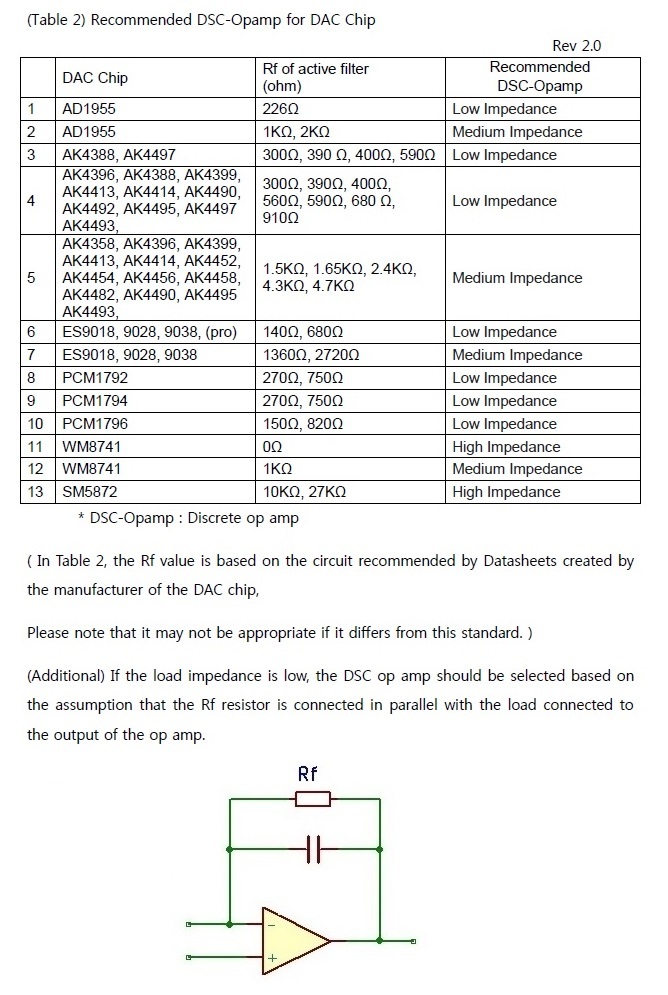
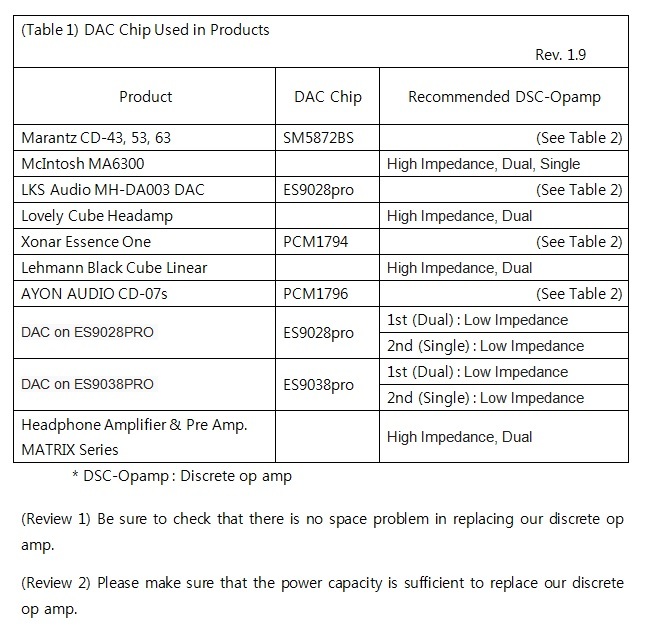
It can be used interchangeably with all existing op amps used for audio (if the final amplifier gain is less than +20dB(x10)). If you know the feedback impedance of the amplifier, you can make a better choice.


FEATURES
Delivers emotional sound. Small size
Slew rate improvement
Optimized for analog audio
Built-in input offset voltage adjustment function
Low Power Quiescent Current
High-Quality Audio-Grade Discrete Operational Amplifiers
Consists of high performance individual parts
High input impedance with JFET
Dip 8 Pin Compatible with the general Op Amp
Clean and Crisp, Rich and Non-Irritating and Relaxing Signal Output
The bottom mounting board area is the same as the size of the IC socket, so there is no restriction in use. (Excluding OPM2320D, OPM2320S, OPM3320D and OPM3320S)
Can be installed in places where the height of peripheral parts of socket is 19mm or less (or 23 mm or less).

Do not use it as a buffer amplifier (Gain = 1, OPM2320x-xxx can be used as a buffer amplifier)
Do not directly drive the power load. (Headphones, earphones, etc.)


APPLICATIONS
Hi-End Audio Pre-Amplifiers
Active-Filter
Differential Current Mode Op-Amp Circuit for Active-Filter
   (Example: Active Filter for ES9018)
Professional Audio


TECHNOLOGY APPLIED
Small Signal Buffer Amplification Circuit
Absolute Current Limit, Overcurrent Limiting Circuit
Electronic Circuits for Preventing Floating


ABSOLUTE MAXIMUM RATINGS
Supply Voltage(Vs) :                                  ±18V or +36V
Input Voltage :                                            ±Vs
Differential Input Voltage :                          ±0.7V
Output Current
   Internal Current Limit (1) :                       ±200mA
      Allow the average current Vs = ±5V :   ±90mA
      Allow the average current Vs = ±10V :  ±50mA
      Allow the average current Vs = ±15V :  ±30mA
Storage Temperature Range :                     -20 ℃ ~ +60 ℃
Operating Temperature Range :                  0 ℃  ~ +40 ℃

Notes:
(1): Be careful not to short-circuit between the output and other terminals (ground, + Vs, -Vs). If it is shorted, the internal output stage parts will be damaged. The reason is set for maximum sound quality.

(Caution) Do not directly drive the power load. (Headphones, earphones, etc.)
Since the OPM320 series is designed for audio signals only, do not directly drive devices that require power such as headphones or earphones.
If you forcefully drive a device that requires power, you may lose delicate performance and sound quality may be degraded.
Be sure not to exceed the conditions of "Internal Current Limit (1)" above.


SPECIFICATIONS
Input offset voltage :  <±0.5mV (@ VS = ±4.5 to ±18V)
Slew Rate:                 5.0V/uS (Vs=±10V, 9Vpp, G=x1, RL= 600 ohm), (Five point zero)
OPEN-LOOP GAIN : 70dB (Vo = ±10V, Rload = 600 ohm)
Gain-Bandwidth Product : 6Mhz (@ G = 1, Vs = ±10V)
Output impedance  :
- OPM3320D, OPM3320S : 0.38 ohm

Output Voltage Swing (Rload = 600 ohm), Vrms (Vpp)
   Vs = ±5V :         2.6 (7.4)
   Vs = ±10V :       5.9 (17.2)
   Vs = ±15V :       9.3 (26.5)

Power Quiescent Current (2)
-OPM3320D
   Vs = ±5V :         26mA
   Vs = ±10V :       28mA
   Vs = ±15V :       30mA
-OPM3320S
   Vs = ±5V :         13mA
   Vs = ±10V :       14mA
   Vs = ±15V :       15mA
-OPM2320D
   Vs = ±5V :         24mA
   Vs = ±10V :       26mA
   Vs = ±15V :       28mA
-OPM2320S
   Vs = ±5V :         12mA
   Vs = ±10V :       13mA
   Vs = ±15V :       14mA

Dimensions :        
-OPM3320D, OPM2320D : 22(W) x 36(H) x 16(D) mm 
-OPM3320S, OPM2320S : 22(W) x 36(H) x 13(D) mm

Notes:
(2) In the power supply circuit, it should be designed so that Quiescent Current (Power Current) can be supplied sufficiently.
It should be used in a circuit that can supply enough quiescent current (power current).


Please use this product under the following conditions.
It is recommended that the final amplifier gain be less than x10 (+ 20dB) in the op amp circuit.
If you use an extension connector for this product, please connect the line length as short as possible.


How to choose OPM3320D(or OPM3320S) and OPM2320D(or OPM2320S)
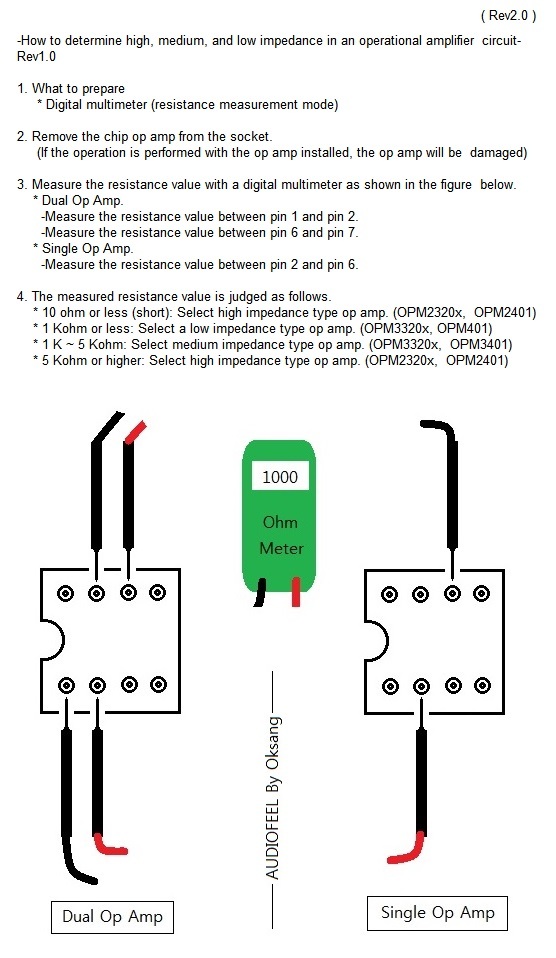
The OPM3320D (or OPM3320S) and OPM2320D (or OPM2320S) can be selected by the value of the feedback resistor in the op amp circuit
1. OPM3320D (or OPM3320S): Suitable for low impedance circuits
    Feedback resistance less than 5K ohms
2. OPM2320D (or OPM2320S): Suitable for high impedance circuits
    Feedback resistance above 5K ohms
3. If you can not find the feedback resistor value, it is recommended to operate 2 types directly. But the difference can be felt slightly. 

The feedback resistor is:
In the op amp circuit - the resistor connected between the input terminal (- or Inv) and the output terminal.


Idea to maintain performance of discrete op amp
Here are some ideas for keeping your discrete op amp up to peak performance.

Our discrete op amp features delicate, rich and powerful sound.
We've been working on a number of new technologies to make sure we get a very good sound.
The components used in the discrete op amp are equipped with precision, delicate, high-performance components.
Performance of this type of discrete op amp can change depending on the environment.
 
Check that the discrete op amp you are using meets the following specifications.
1. Is there any foreign matter on the surface of the discrete op amp? (There are some invisible contaminants, conductive materials, etc.)
2. Is the surface of the discrete op amp exposed to moisture?
3. Is the surface of the discrete op amp exposed to smoke or gas?
4. Is the discrete op amp used for a long time?
5. Do you feel that the sound performance is lacking?
For the above reasons, the surface of the discrete op amp may be contaminated, and as a result, the sound performance may be insufficient.

To maintain the best performance of the discrete op amp;
Periodically check the condition of the discrete op amp and clean the discrete op amp.
We recommend that you periodically clean the discrete op amp.

 A method for cleaning a discrete operational amplifier;
1. Wash with spray cleaner for electronic circuit board. (See how to use the cleaning agent)
2. Clean the eco-friendly cleaner for electronic circuit boards using a brush (such as a toothbrush). (See how to use the
cleaning agent)
3. Clean with ultrasonic cleaner for electronic circuit board. (See how to use the cleaning agent)
 
(Note) If you feel that your newly purchased discrete op amp is not performing well, try to clean it. You can remove the contamination that occurred during transportation.
AUDIOFEEL's technology to improve the cool, thin and dry sound characteristics of silicon transistors

Amplifiers, usually made of transistors, are rated to be cool, thin and dry. To improve this tendency, we add a little capacitor to adjust the sound propensity. As a result of this tuning process, a part of the treble is cut and the feeling of opening is reduced.

So it is very difficult to hear the actual sound being played in a transistor amplifier.


AUDIOFEEL has the technology to solve the disadvantages of these transistors and it is applied to all the products that we produce now. Just like a tube amp, it is warm, gentle, clear and transparent, and all sounds are independently distinguished, full of emotion and power.


How was the technology that complements the disadvantages of silicon transistors implemented?

The principle is simple. The key is to use the current silicon transistor like a germanium transistor.
"The germanium transistor has a leakage current between the collector and the emitter" to add this condition to the silicon transistor circuit.

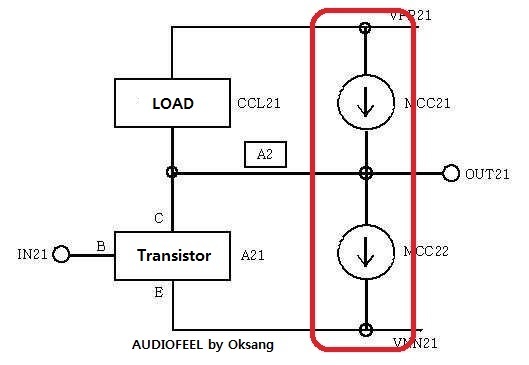
In Figure below, transistor (A21) is a block representing one silicon transistor, and load (CCL21) is a block representing a resistive or constant current load.
No leakage current flows between the collector (C) and the emitter (E) of the silicon transistor.
In other words, a silicon transistor amplifier consisting only of A21 and CCL21 is cold, thin and dry.


To use a silicon transistor amplifier consisting of A21 and CCL21 in Figure as a germanium transistor amplifier, connect the constant current source NCC22 for leakage current in parallel with A21.

The leakage current flows through the NCC21 between the collector and the emitter of the silicon transistor, and the silicon transistor A21 operates like the germanium transistor because the leakage current always flows.

NCC21 is required to always supply current to NCC22.


If NCC21 and NCC22 (red box display) circuits are connected in parallel for leakage current to the collector and emitter of a conventional silicon transistor, even though the silicon transistor is used, it is warm, gentle, clear and transparent like a vacuum tube sound, Each sound is independently distinguished, full of emotion and even power. It also has the advantage of being less influenced by electromagnetic waves and external noise.


(details)
Let's take a look at the AUDIOFEEL technology, which improves the cool, thin and dry characteristics of silicon transistors.

Long ago, vacuum tube radios were produced, followed by germanium transistor radios, and then silicon transistor radios.
 
Germanium transistor radio sound was good.
Silicon transistor radio, however, has the power to sound, but it is cold, thin and dry.

The problem with silicon transistors has not been improved to this day.


So what is the difference between a germanium transistor and a silicon transistor?

The answer lies in the difference in insulation characteristics or insulation between electrodes.

Indicated by Icbo in the transistor specification table.

The leakage current Icbo between the collector and base of the germanium transistor is 8uA ~ 30uA. (AC124, AC125, etc.)
On the other hand, the leakage current Icbo between the collector and base of the silicon transistor is 0.1 uA max. It is about 100 times more different.

Accurately, it is accurate to compare the leakage current Iceo between the collector and the emitter, but the transistor datasheet does not display Iceo well, so we compared it with Icbo.

The leakage current between the collector and the emitter shows that the silicon transistor is much smaller than the germanium transistor and the isolation is better.


Since there is always electrons in the vacuum tube, a fine current flows from the plate to the cathode even at the cutoff, and it is the same as the germanium transistor that the plate current is not blocked.
The FET also has a fine current flow from the drain to the source at the cutoff, and it is the same as the germanium transistor that the drain current is not blocked.
However, because of the high isolation characteristics of silicon transistors, there is a moment when collector current is cut off during cutoff. Therefore, there is a lack of sound quality in the use as an acoustic amplifier.


So why is insulation a problem in the insulating layer of a silicon transistor?

It takes some time until the change of the input signal coming to the base from the amplification circuit composed of transistors is outputted to the collector.

If the input signal voltage applied to the base decreases, the collector current decreases, the collector impedance increases, the moment the load resistance and collector electrodes separate, and the potential of the load resistance becomes a floating state.


At this time, the germanium transistor maintains the connection state with the load resistance because the leakage current always flows. However, since the insulation of the silicon transistor is too good, the collector current is completely cut off and separated from the load resistance. Or is easily exposed to ambient noise or electromagnetic waves. That is, the amplified signal is easily deformed.


Since the isolation between the collector and the emitter of the silicon transistor is good, the moment of break between the collector and the load resistance occurs during the amplification, and at the moment of floating (floating), the voltage is changed to a different voltage from the amplified signal, It is easily affected by noise and changes to a different voltage than the amplified signal.

In other words, when the amplified output signal is deformed and transformed into a pulse voltage, it becomes irritating sound. Also, it does not follow gentle low-band signal level, and can not reproduce mild and deep bass sound.


In today's world, transistors are all silicon transistors, and germanium transistors are rarely produced or used. Both low-end audio and high-end audio are made of silicon transistors, if not vacuum tubes.


************************************************************************************************

Payment
We accept All payments.
Payment must be submitted within 3 days of completing the transaction.
Import duties, taxes and charges are not included in the product price and shipping.

Shipping
Shipping with tracking number.
All items will be shipped after payment is received.
Ships only to addresses registered on Ebay.
Please make sure your shipping address is up date with your ebay before proceeding with the transaction.

Optional service
Standard international shipping with tracking number.
    -Arrive within 14 to 28 business days for delivery.
Expedited international shipping with tracking number. Global Express Mail (EMS).
    -Arrives within 4 to 5 business days.

************************************************************************************************

This is essential information that buyers must read before purchasing any product.
(Must Read 1) The price of all products we ship does not include any costs associated with shipping or customs clearance. Products are shipped based on the shipping fee paid at the time of purchase.
(Must Read 2) Therefore, additional costs or related actions may occur while the product is in transit to the buyer. We are not responsible for these. Only purchase our products if you understand this and will not raise any objections.
Purchasing our products constitutes your understanding and acceptance of the above (Must Read 1) and (Must Read 2).