1.41 tcw Matching Pair of Natural Heart-cut Purple Amethysts (Brazil)
New without Tags. This gem has never been used/placed/set in a setting.
It is utterly undamaged, unmarred and in perfect condition as expected of NWOTags.
I have included an Amethyst article below for your appreciation and enjoyment.
Summary of below: " Amethyst is the most precious and valuable stone belonging to the quartz group of minerals, with exception to rare blue-green gem silica. It is recognized as the official birthstone for the month of February. Amethyst belongs to the macrocrystalline branch of quartz and owes its violet/purple color to iron and aluminum impurities. Without such coloring agents, amethyst would simply be transparent, ordinary colorless quartz. Like other varieties of macrocrystalline quartz, amethyst has transparent to translucent clarity and a vitreous luster. Cryptocrystalline varieties of quartz almost always occur with translucent to opaque clarity."
Type: Natural Purple Amethyst (personally confirmed as a Genuine Amethyst by digital refractometer (RI=1.550), dichroscope, polariscope, spectroscope, UV short&long-wave light, measured Specific Gravity=2.66) -- captej2012
Shape: two Heart-cut gems (the photos are offered in various common lighting for accurate representation in the real-world)
Weight: 1.41 ct (pair of 0.705 ct gems)
Size: pair of [6.10mm x 5.90mm x 4.20mm] gems
Color: Purple
Clarity: VVS
Luster: Flashing Fire
Hardness: 7.0 on the Moh Scale
Origin: Brazil
Treatment: Not Heated, Not Enhanced, Not Treated
Two Purple Hearts -- a gift for two to seal their common purpose.
Symbolic Twins, imbued with meanings held between only The Two.
Two matching gemstones, though formed more than two billion years ago,
Are content as eternal heirlooms of their Agreed Pact thereafter.
And now with the Blessing of a Poem upon Twin Heart Gems,
These are given to Two to Grace with their Promises.
We are an eBay eStore enterprise focused on selling mostly Loose Natural Gemstones. Stay here, look around and learn. Via eBay Messaging, ask us questions, make an offer, and otherwise discuss your wishes, concerns and hopes. We pride ourselves as good-spirited folks having fun and doing our best to share the joy of Nature's most beautiful and enduring literal treasure -- Natural Gemstones. Expect to find us cheerful and trustworthy, and we will expect the same of you. For us, Negative FeedBack as a means of coercion is never needed and only degrades everyone's enjoyment in what should otherwise be a fun shopping experience. And finally, please enjoy my work as eBay's First (unofficial) Gemstone Poet. -- captej2012
====================================================================================
Amethyst Gemstone Information
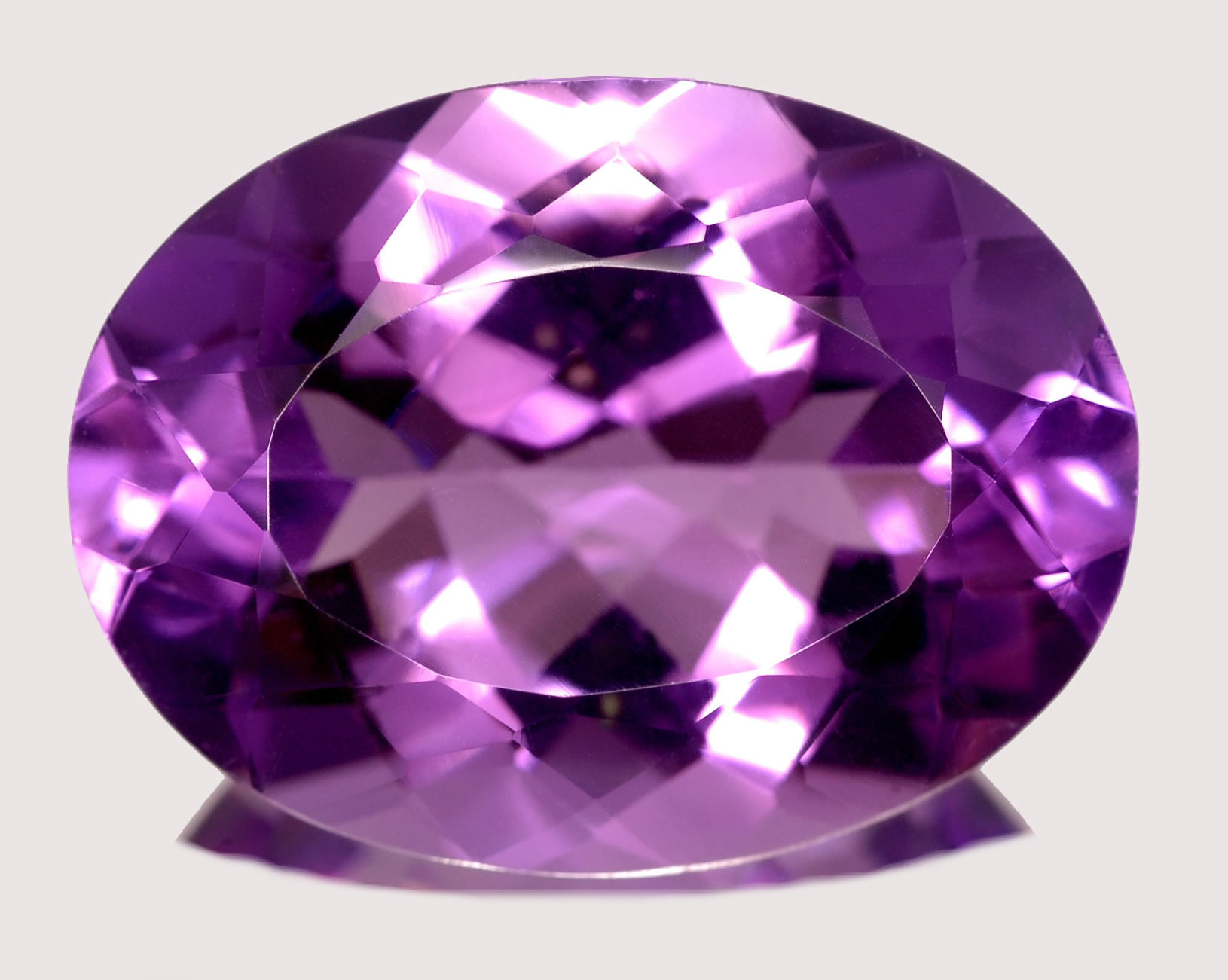
Amethyst is the most precious and valuable stone belonging to the quartz group of minerals, with exception to rare blue-green gem silica. It is recognized as the official birthstone for the month of February. Amethyst belongs to the macrocrystalline branch of quartz and owes its violet/purple color to iron and aluminum impurities. Without such coloring agents, amethyst would simply be transparent, ordinary colorless quartz. Like other varieties of macrocrystalline quartz, amethyst has transparent to translucent clarity and a vitreous luster. Cryptocrystalline varieties of quartz almost always occur with translucent to opaque clarity.
Amethyst Versus Citrine
Amethyst is the violet-colored sister stone of golden citrine quartz. Color-zoneametrine is the bicolored combination of both amethyst and citrine. The only difference between amethyst and citrine is the level of iron impurities in amethyst. When amethyst is heated at high temperatures of around 470ºC to 750ºC, iron impurities are reduced and can turn violet amethyst into golden 'heated' citrine. Lower grade amethyst stones are often heated to produce golden colored citrine stones. Heated citrine will typically appear more reddish when compared to unheated citrine.
Since purple is considered to be one of the royal colors, amethyst has a historical importance as an insignia of power. Fine amethysts are featured in the British Crown Jewels and they were also a favorite of Catherine the Great and Egyptian royalty. Amethyst also holds a high place in the ranks of the Christian church and was referred to as "the stone of bishops". The Greek word "amethystos" translates into "not drunken" and it was often worn as an amulet to protect against intoxication. Since amethyst was considered an antidote against drunkenness, many wine goblets were carved from amethyst stone. Still to this day, violet-purple amethyst is a symbol of sobriety.
 | |
| Natural Amethyst Gemstone |
In artificial light, amethyst does not display its best color. Amethyst looks best in daylight; more precisely, slightly after sunrise or just before sunset when the light is soft and warm. Amethyst is distinguished by its violet-purple colors. The best specimens should have a deep purple color and good saturation with minimal color zoning.
The most important amethyst deposits are in Brazil, namely the "Palmeira" amethysts of Rio Grande do Sul and the "Maraba" amethysts of Para. Other significant amethyst deposits are located in Bolivia, Canada, India, Madagascar, Mexico, Myanmar (Burma), Namibia, Russia, Sri Lanka, United States (Arizona), Uruguay and Zambia.
Amethyst Color
Amethyst owes its color to iron and aluminum impurities. The colors range from purple and violet to pale red-violet. The deep colors are the most valuable, particularly a rich purple with rose flashes. "Siberian" deep purple amethyst with red and blue flashes commands the highest prices. So-called green amethyst is produced by heat treatment, but since amethyst is defined by its purple color, green amethyst is not considered to be a true amethyst.
Amethyst Clarity and Luster
Fine amethyst is transparent, which means that the light passes through the stone unhindered. In translucent amethyst, the passage of light is slightly weakened as it travels through the stone. The best quality amethyst is "clean" and free of visible inclusions of any kind. Since amethyst is quite plentiful, there is little reason to buy stones with visible inclusions.
Amethyst Cut and Shape
Due to the variability of the color distribution in the amethyst crystals, it is often cut as brilliant rounds or ovals to maximize the color. Very rarely will amethyst be cut en cabochon. Other shapes and modified cutting styles are quite popular, but typically, only amethyst specimens with good color distribution are cut into fancy stones. Amethyst is available in just about every shape, cut and size. Calibrated sizes are easily found and fancy shapes such as trillions, hearts and shields are very common. Many artisans prefer to cut ornamental carvings with amethyst stone and so there are many amethyst carvings available on the market today.
Amethyst Treatment
Amethyst quartz is typically untreated. Some amethyst stones may be enhanced though heating, but heating of amethyst will reduce coloring agents and result in 'heated citrine'. Gemstone suppliers should always disclose any enhancements. Heat treatment of 878ºF to 1382ºF will typically yield light-yellow, red-brown, green or colorless results.