

Romano-Gallic Empire
Postumus
(260-269 AD)
Struck 262 AD at mint of Cologne
Billon BI Antoninianus (Double-Denarius) - 21.5 mm ~ 3.50 grams
Reference: AGK (corr.) 102; Cunetio 2400; Elmer 190; RIC V.2 207
Certification: NGC Choice XF 8213305-003
Obverse: IMP C POSTVMVS P F AVG, Radiate, draped and cuirassed bust of Postumus facing right
Reverse: VIRTVS AVG, Mars standing front, head to right, holding spear with his right hand and resting his left on shield set on ground
Arrives with specifications page for your reference.
See the Genuine History Collection
Marcus Cassianius Latinius Postumus (fl. 259–269) was a Roman commander of Batavian origin, who ruled as emperor of the splinter state of the Roman Empire known to modern historians as the Gallic Empire. The Roman army in Gaul threw off its allegiance to emperor Gallienus around the year 260, and Postumus assumed the title and powers of Emperor in the provinces of Gaul, Germania, Britannia, and Hispania. He ruled for the better part of ten years before he was murdered by his own troops.
Little is known about the early life of Postumus. He has been claimed as being of Batavian origin; certainly his coinage honors deities—Hercules Magusanus and Hercules Deusoniensis—who would have been popular among the Batavians. Hercules Magusanus was probably an interpretatio romana translation of the Germanic deity Þunraz. Deusoniensis may refer to the town of Deuso, located in or near Batavian territory and likely to be identified with modern-day Diessen; it has been hypothesized that Postumus himself was born in Deuso. From these relatively obscure provincial origins, Postumus would have risen through the ranks of the army until he held command of the Roman forces "... among the Celts." What his precise title was is not definitely known, though he may plausibly have been promoted by the emperor Valerian to the position of imperial legate of Germania Inferior. Postumus was evidently in favour at court, and, according to König, was granted an honorary consulship.
By 259, Valerian was campaigning in the east against the Persians, while his son and co-emperor Gallienus was preoccupied with the situation on the Danubian frontier. Consequently, Gallienus left his son, Saloninus, and military commanders, including Postumus, to protect the Rhine. Amid the chaos of an invasion by the Alamanni and Franks, and spurred on by news of the defeat and capture of Valerian, the army in Gaul revolted and proclaimed Postumus emperor.
The trigger was their defeat in 260 of a Juthungian army which was returning from Italy laden with prisoners, even though they had been repulsed by Gallienus at Mediolanum (Milan). Under the command of Postumus and Marcus Simplicinius Genialis, the Roman army crushed the Juthungi, and Postumus proceeded to distribute the captured spoils to the legions he commanded. Saloninus, on the advice of his praetorian prefect Silvanus (who had coordinated Roman policy in Gaul alongside Postumus), demanded the transfer of the recovered booty to his residence at Colonia Claudia Ara Agrippinensium (Cologne). Postumus assembled his army and made a show of reluctantly enforcing this command, thus inviting his troops to instead throw off their allegiance to Gallienus. The troops accordingly proclaimed Postumus emperor and besieged Colonia, trapping Saloninus and Silvanus. After breaching the walls of the city, Postumus had Silvanus and Saloninus killed, although his supporters later claimed that it was the native Gauls who were responsible for the murders. Later he erected a triumphal arch to celebrate his victory.
Postumus was immediately recognized as emperor in Gaul (except perhaps for the province of Gallia Narbonensis), Germania Superior and Inferior, and Raetia. By 261, Britannia, Narbonensis and Hispania also acknowledged him as emperor, possibly after an expedition to Britain in the winter of 260–261. He established his capital in northern Gaul, probably at Colonia Claudia Ara Agrippinensium or Augusta Treverorum (Trier), and furnished his government with many of the traditional Roman legislative and executive structures. Apart from the position of emperor, he immediately assumed the office of consul alongside a colleague, Honoratianus. Like his imperial predecessors, he became the pontifex maximus of the state and assumed tribunician power each year. He is thought to have established a senate, perhaps on the basis of the Council of the Three Gauls or provincial councils, and a Pretorian Guard, one of whose officers was the future Gallic emperor Victorinus. The chief members of Postumus's administration, such as Victorinus and Tetricus, appear to have been drawn from his power base in northern Gaul, and indeed the entire administration rapidly became Gallicized.
Postumus represented himself as the restorer of Gaul (Restitutor Galliarum) and the bringer of security to the provinces (Salus Provinciarum) on some of his coins; prior to 10 December 261, he also took the title of Germanicus maximus, a title he earned after successfully defending Gaul against the Germans. His principal objective in assuming the purple appeared to be the restoration and defence of the Rhine frontier and the surrounding area, a task that he approached with vigour, earning the admiration of the ancient authors, who declared that he restored the security that the provinces had enjoyed in the past. So successful was he in the task of stabilizing his domain that the coins issued by Postumus were of better workmanship and higher precious metal content than coins issued by Gallienus. His control of the Spanish and British mining regions was presumably crucial in this regard, as was his employment of master minters who would have come into Gaul with Gallienus. Postumus fought successful campaigns against the Franks and Alemanni in 262 and 263; following his victory over them in 263, his coin-types celebrated peaceful themes such as Felicitas Augusti for some time. After having spent much of the last four years pushing the Franks out of Gaul, Postumus then recruited Frankish troops to fight against other Franks, probably dispersed within existing Roman army units. An issue of aureus that celebrates the emperor's aeternitas which features a triple portrait might depict his wife and two sons.
Scholars continue to debate whether Postumus originally intended to dislodge Gallienus from Rome or was content to rule only the western provinces. From the beginning of his usurpation, Postumus had made it clear that his priority was for Gaul, and that he had no immediate intentions to make a bid for Rome. Postumus's power base was Gaul and his main responsibility was the defense of the Rhine provinces. If he marched against Gallienus, then he would be exposing his heartland not only to the Germanic tribes but also potentially to any number of usurpers. Perhaps he hoped to achieve some official recognition from Gallienus; what is clear, however, is that Postumus was not overtly separatist and did not revive the 1st-century dream of an independent Galliarum imperium. The forms, titles, and administrative structures of Postumus's principate remained conventionally Roman.
For four years Gallienus was too distracted by Germanic invasions and other usurpers in the east to address the situation to his north and west, but in 265 he launched a campaign to defeat Postumus. His first attempt failed when Postumus managed to escape from a precarious situation due to the carelessness of Gallienus's cavalry commander Aureolus. Aureolus was punished with demotion, eventually leading him to turn against Gallienus in 267.
A second campaign, led by Gallienus himself, also seemed to have the advantage over Postumus, but while Gallienus was besieging a city in Gaul (perhaps Augusta Treverorum), he was wounded and forced to withdraw. After this, Gallienus was occupied with crises in the rest of his empire and did not confront Postumus again.
By the end of 265, Postumus's coin issues were triumphantly commemorating the victory over Gallienus, and the festivities celebrating his quinquennalia continued into the following year. Very little troubled the reign of Postumus from 265 to 268; archaeological evidence, such as it is, points to a general return to peace and normalcy. In 266, Postumus became consul for the fourth time, taking as his colleague Marcus Piavonius Victorinus, a Gallic noble who was also a senior military officer; his selection to such a high-profile position may be seen as an attempt to broaden Postumus's base of support. The year 268 saw the issuing of the 'Labours of Hercules' series of gold coins in honour of Postumus's favourite god. A sudden debasement of the coinage later that year shows that Postumus was facing increasing financial difficulties, due perhaps to a disruption of silver production in the Spanish mines or the need to buy off an increasingly discontented army.
Such discontent was probably due to Postumus's failure to take advantage of a golden opportunity to move against Gallienus in 268. Aureolus, the general who was in command of Mediolanum (Milan) in Gallienus's interest, rebelled and ultimately declared for Postumus. The city of Mediolanum and its north Italian and Raetian hinterland would have been critical to Postumus if he planned to march on Rome. For whatever reason, Postumus failed to support Aureolus, who was defeated by Gallienus and besieged inside Mediolanum. Before the end of summer in 268, Gallienus was assassinated, and his successor, Claudius II, captured and killed Aureolus. At the same time, a sequence of events began which would end Postumus's rule in Gaul.
Postumus assumed his fifth consulship on 1 January 269, but the army in Germania Superior raised a usurper in early 269. Laelianus, one of Postumus's top military leaders and the governor of Germania Superior, was declared emperor in Mogontiacum (now Mainz) by the local garrison and surrounding troops (Legio XXII Primigenia). Within a few months, Postumus was able to capture Mogontiacum and kill Laelianus. His army wanted to sack the defeated city, and when Postumus tried to restrain them, the soldiers turned on him and killed him.
The mutineers set up Marius, a common soldier, as emperor. Marius held sway for a short while before being overthrown by Victorinus, Postumus's erstwhile colleague in the consulship and tribune of the praetorian guard. In the meantime, the Gallic Empire lost Hispania.
Postumus's coinage has been of particular interest to numismatists, in light of the high quality and relative abundance of his coin issues. His 'Labours of Hercules' series is particularly renowned, as are several aurei which carry full-face portraits of Postumus instead of the usual profile view.
Most of the ancient literary references to Postumus come from the works thought to be based on the Enmannsche Kaisergeschichte (Aurelius Victor, Epitome de Caesaribus, Eutropius, and the Historia Augusta, in the last of which Postumus is listed among the Thirty Tyrants). He also figures in the works of Zosimus and Zonaras.

Milestone of Postumus c.261-269 found in Vitoria-Gasteiz, Spain
It bears the inscription: [I]MP(ERATORI) CAE[S(ARI)] [M]ARCO CA[SSIJANO] LAT[IN]IO POSTUMO AUG(USTO)
In ancient Roman religion and mythology, Mars is the god of war and also an agricultural guardian, a combination characteristic of early Rome. He is the son of Jupiter and Juno, and was pre-eminent among the Roman army's military gods. Most of his festivals were held in March, the month named for him (Latin Martius), and in October, the months which traditionally began and ended the season for both military campaigning and farming.
Under the influence of Greek culture, Mars was identified with the Greek god Ares, whose myths were reinterpreted in Roman literature and art under the name of Mars. The character and dignity of Mars differs in fundamental ways from that of his Greek counterpart, who is often treated with contempt and revulsion in Greek literature. Mars's altar in the Campus Martius, the area of Rome that took its name from him, was supposed to have been dedicated by Numa, the peace-loving semi-legendary second king of Rome; in Republican times it was a focus of electoral activities. Augustus shifted the focus of Mars's cult to within the pomerium (Rome's ritual boundary), and built a temple to Mars Ultor as a key religious feature of his new forum.
Unlike Ares, who was viewed primarily as a destructive and destabilizing force, Mars represented military power as a way to secure peace, and was a father (pater) of the Roman people. In Rome's mythic genealogy and founding, Mars fathered Romulus and Remus through his rape of Rhea Silvia. The wolf was the sacred animal of Mars, with the she-wolf nursing the two founders as children. His love affair with Venus symbolically reconciled two different traditions of Rome's founding; Venus was the divine mother of the hero Aeneas, credited by Vergil as an earlier founder of Rome.
The union of Venus and Mars held greater appeal for poets and philosophers, and the couple were a frequent subject of art. In Greek myth, the adultery of Ares and Aphrodite had been exposed to ridicule when her husband Hephaestus caught them in the act by means of a magical snare. Although not originally part of the Roman tradition, in 217 BCE Venus and Mars were presented as a complementary pair in the lectisternium, a public banquet at which images of twelve major gods of the Roman state were presented on couches as if present and participating.
Scenes of Venus and Mars in Roman art often ignore the adulterous implications of their union, and take pleasure in the good-looking couple attended by Cupid or multiple Loves (amores). Some scenes may imply marriage, and the relationship was romanticized in funerary or domestic art in which husbands and wives had themselves portrayed as the passionate divine couple. The uniting of deities representing Love and War lent itself to allegory, especially since the lovers were the parents of Concordia. The Renaissance philosopher Marsilio Ficino notes that "only Venus dominates Mars, and he never dominates her." In ancient Roman and Renaissance art, Mars is often shown disarmed and relaxed, or even sleeping, but the extramarital nature of their affair can also suggest that this peace is impermanent.
Virility as a kind of life force (vis) or virtue (virtus) is an essential characteristic of Mars. During the Middle Republican period, the consul Marcus Claudius Marcellus vowed to construct a temple to Honos and Virtus, though it was only completed posthumously by his son, who also left an inscription commemorating the god Mars. In the earliest Roman writings, the term "virtus" applied to battlefield courage: Artotrogus, a character in the play The Braggart Soldier by the 3rd-century BCE author Plautus, addresses the boastful soldier Pyrgopolynices, stating "Mars wouldn't dare to call himself such a warrior or compare his exploits to yours." Furthermore, during the prologue to the Plautine play Casina, the speaker exclaims "be victorious through true bravery." Later in Roman history, the concept of "virtus" expanded to incorporate the idea of wisdom, possibly due to the influence of the Greek association between military prowess and intelligence, a Hellenic cultural concept embodied by the deity Athena. The transformation of the idea of "virtus" itself altered the underlying character of Mars, who developed into a god of generalship alongside warrior skill. According to the classicist John Serrati, Mars—as the personification of virtus—exemplified ideal Roman masculinity. By the 3rd-century CE, Mars was primarily worshipped by Roman military legions.
Various festivals associated with Mars, such as the Tubilustrium and Armilustrium, were themselves connected with lustration, a type of Roman religious practice intended to ward off evil. The lustral connotations of Mars may imply that he fulfilled a type of protector or guardian in Roman mythology. The conceptualization of Mars as a protector deity may have facilitated his associations with war. According to the 4th-century author Servius the Grammarian, during wartime, a spear was shaken in the Regia and Mars was called upon to watch over the Roman people with the words "Mars vigila." As a war god, Mars was associated a series of festivals occurring around March at the beginning of the Roman campaigning season, such as a ritualistic dance of the Salian priests, and ceremonies belonging to the month of October, such as the October Horse or the Armilustrium, all of which were connected with the end of the campaign season. Chronologically, the rituals associated with the beginning and end of the campaigning season were also concurrent with the ideal time frame for agriculture, which perhaps relates to the dual characterization of Mars as a rustic and warlike divinity. However, by the 2nd and 3rd centuries CE, Roman soldiers no longer departed for campaign during particular months of the year but instead remained permanently stationed at various forts and military installations throughout the empire. Consequently, the original connection between the military and farming season became irrelevant.
In Classical Roman religion, Mars was invoked under several titles, and the first Roman emperor Augustus thoroughly integrated Mars into Imperial cult. The 4th-century Latin historian Ammianus Marcellinus treats Mars as one of several classical Roman deities who remained "cultic realities" up to his own time. Mars, and specifically Mars Ultor, was among the gods who received sacrifices from Julian, the only emperor to reject Christianity after the conversion of Constantine I. In 363 AD, in preparation for the Siege of Ctesiphon, Julian sacrificed ten "very fine" bulls to Mars Ultor. The tenth bull violated ritual protocol by attempting to break free, and when killed and examined, produced ill omens, among the many that were read at the end of Julian's reign. As represented by Ammianus, Julian swore never to make sacrifice to Mars again—a vow kept with his death a month later.
Gradivus was one of the gods by whom a general or soldiers might swear an oath to be valorous in battle. His temple outside the Porta Capena was where armies gathered. The archaic priesthood of Mars Gradivus was the Salii, the "leaping priests" who danced ritually in armor as a prelude to war. His cult title is most often taken to mean "the Strider" or "the Marching God", from gradus, "step, march."
The poet Statius addresses him as "the most implacable of the gods," but Valerius Maximus concludes his history by invoking Mars Gradivus as "author and support of the name 'Roman'": Gradivus is asked – along with Capitoline Jupiter and Vesta, as the keeper of Rome's perpetual flame – to "guard, preserve, and protect" the state of Rome, the peace, and the princeps (the emperor Tiberius at the time).
A source from Late Antiquity says that the wife of Gradivus was Nereia, the daughter of Nereus, and that he loved her passionately.
Mars Quirinus was the protector of the Quirites ("citizens" or "civilians") as divided into curiae (citizen assemblies), whose oaths were required to make a treaty. As a guarantor of treaties, Mars Quirinus is thus a god of peace: "When he rampages, Mars is called Gradivus, but when he's at peace Quirinus."
The deified Romulus was identified with Mars Quirinus. In the Capitoline Triad of Jupiter, Mars, and Quirinus, however, Mars and Quirinus were two separate deities, though not perhaps in origin. Each of the three had his own flamen (specialized priest), but the functions of the Flamen Martialis and Flamen Quirinalis are hard to distinguish.
Mars is invoked as Grabovius in the Iguvine Tablets, bronze tablets written in Umbrian that record ritual protocols for carrying out public ceremonies on behalf of the city and community of Iguvium. The same title is given to Jupiter and to the Umbrian deity Vofionus. This triad has been compared to the Archaic Triad, with Vofionus equivalent to Quirinus. Tables I and VI describe a complex ritual that took place at the three gates of the city. After the auspices were taken, two groups of three victims were sacrificed at each gate. Mars Grabovius received three oxen.
"Father Mars" or "Mars the Father" is the form in which the god is invoked in the agricultural prayer of Cato, and he appears with this title in several other literary texts and inscriptions. Mars Pater is among the several gods invoked in the ritual of devotio, by means of which a general sacrificed himself and the lives of the enemy to secure a Roman victory.
Father Mars is the regular recipient of the suovetaurilia, the sacrifice of a pig (sus), ram (ovis) and bull (taurus), or often a bull alone. To Mars Pater other epithets were sometimes appended, such as Mars Pater Victor ("Father Mars the Victorious"), to whom the Roman army sacrificed a bull on March 1.
Although pater and mater were fairly common as honorifics for a deity, any special claim for Mars as father of the Roman people lies in the mythic genealogy that makes him the divine father of Romulus and Remus.
In the section of his farming book that offers recipes and medical preparations, Cato describes a votum to promote the health of cattle: Make an offering to Mars Silvanus in the forest (in silva) during the daytime for each head of cattle: 3 pounds of meal, 4½ pounds of bacon, 4½ pounds of meat, and 3 pints of wine. You may place the viands in one vessel, and the wine likewise in one vessel. Either a slave or a free man may make this offering. After the ceremony is over, consume the offering on the spot at once. A woman may not take part in this offering or see how it is performed. You may vow the vow every year if you wish.
That Mars Silvanus is a single entity has been doubted. Invocations of deities are often list-like, without connecting words, and the phrase should perhaps be understood as "Mars and Silvanus." Women were explicitly excluded from some cult practices of Silvanus, but not necessarily of Mars. William Warde Fowler, however, thought that the wild god of the wood Silvanus may have been "an emanation or offshoot" of Mars.
Augustus created the cult of "Mars the Avenger" to mark two occasions: his defeat of the assassins of Caesar at Philippi in 42 BCE, and the negotiated return of the Roman battle standards that had been lost to the Parthians at the Battle of Carrhae in 53 BCE. The god is depicted wearing a cuirass and helmet and standing in a "martial pose," leaning on a lance he holds in his right hand. He holds a shield in his left hand. The goddess Ultio, a divine personification of vengeance, had an altar and golden statue in his temple.
The Temple of Mars Ultor, dedicated in 2 BCE in the center of the Forum of Augustus, gave the god a new place of honor. Some rituals previously conducted within the cult of Capitoline Jupiter were transferred to the new temple, which became the point of departure for magistrates as they left for military campaigns abroad. Augustus required the Senate to meet at the temple when deliberating questions of war and peace. The temple also became the site at which sacrifice was made to conclude the rite of passage of young men assuming the toga virilis ("man's toga") around age 14.
On various Imperial holidays, Mars Ultor was the first god to receive a sacrifice, followed by the Genius of the emperor. An inscription from the 2nd century records a vow to offer Mars Ultor a bull with gilded horns.
Augustus or Augusta was appended far and wide, "on monuments great and small," to the name of gods or goddesses, including Mars. The honorific marks the affiliation of a deity with Imperial cult. In Hispania, many of the statues and dedications to Mars Augustus were presented by members of the priesthood or sodality called the Sodales Augustales. These vows (vota) were usually fulfilled within a sanctuary of Imperial cult, or in a temple or precinct (templum) consecrated specifically to Mars. As with other deities invoked as Augustus, altars to Mars Augustus might be set up to further the well-being (salus) of the emperor, but some inscriptions suggest personal devotion. An inscription in the Alps records the gratitude of a slave who dedicated a statue to Mars Augustus as conservator corporis sui, the preserver of his own body, said to have been vowed ex iussu numinis ipsius, "by the order of the numen himself."
Mars Augustus appears in inscriptions at sites throughout the Empire, such as Hispania Baetica, Saguntum, and Emerita (Lusitania) in Roman Spain; Leptis Magna (with a date of 6–7 AD) in present-day Libya; and Sarmizegetusa in the province of Dacia.
In addition to his cult titles at Rome, Mars appears in a large number of inscriptions in the provinces of the Roman Empire, and more rarely in literary texts, identified with a local deity by means of an epithet. Mars appears with great frequency in Gaul among the Continental Celts, as well as in Roman Spain and Britain. In Celtic settings, he is often invoked as a healer. The inscriptions indicate that Mars's ability to dispel the enemy on the battlefield was transferred to the sick person's struggle against illness; healing is expressed in terms of warding off and rescue.
Mars is identified with a number of Celtic deities, some of whom are not attested independently. Mars Alator is attested in Roman Britain by an inscription found on an altar at South Shields, and a silver-gilt votive plaque that was part of the Barkway hoard from Hertfordshire. Alator has been interpreted variously as "Huntsman" or "Cherisher." Mars Albiorix appears in an inscription from modern-day Sablet, in the province of Gallia Narbonensis. Albiorix probably means "King of the Land" or "King of the World", with the first element related to the geographical name Albion and Middle Welsh elfydd, "world, land." The Saturnian moon Albiorix is named after this epithet. Mars Barrex is attested by a single dedicatory inscription found at Carlisle, England. Barrex or Barrecis probably means "Supreme One" (Gaulish barro-, "head"). Mars Belatucadrus is named in five inscriptions in the area of Hadrian's Wall. The Celtic god Belatucadros, with various spellings, is attested independently in twenty additional inscriptions in northern England. Mars Braciaca appears in a single votive inscription at Bakewell, Derbyshire. The Celtic epithet may refer to malt or beer, though intoxication in Greco-Roman religion is associated with Dionysus. A reference in Pliny suggests a connection to Mars's agricultural function, with the Gaulish word bracis referring to a type of wheat; a medieval Latin gloss says it was used to make beer.
Mars Camulus is found in five inscriptions scattered over a fairly wide geographical area. The Celtic god Camulus appears independently in one votive inscription from Rome. Mars Cocidius is found in five inscriptions from northern England. About twenty dedications in all are known for the Celtic god Cocidius, mainly made by Roman military personnel, and confined to northwest Cumbria and along Hadrian's Wall. He is once identified with Silvanus. He is depicted on two votive plaques as a warrior bearing shield and spear, and on an altar as a huntsman accompanied by a dog and stag. Mars Condatis occurs in several inscriptions from Roman Britain. The cult title is probably related to the place name Condate, often used in Gaul for settlements at the confluence of rivers. The Celtic god Condatis is thought to have functions pertaining to water and healing. Mars Corotiacus is an equestrian Mars attested only on a votive from Martlesham in Suffolk. A bronze statuette depicts him as a cavalryman, armed and riding a horse which tramples a prostrate enemy beneath its hooves. Mars Lenus, or more often Lenus Mars, had a major healing cult at the capital of the Treveri (present-day Trier). Among the votives are images of children offering doves. His consort Ancamna is also found with the Celtic god Smertrios.
Mars Loucetius. The Celtic god Loucetios, Latinized as -ius, appears in nine inscriptions in present-day Germany and France and one in Britain, and in three as Leucetius. The Gaulish and Brythonic theonyms likely derive from Proto-Celtic *louk(k)et-, "bright, shining, flashing," hence also "lightning," alluding to either a Celtic commonplace metaphor between battles and thunderstorms (Old Irish torannchless, the "thunder feat"), or the aura of a divinized hero (the lúan of Cú Chulainn). The name is given as an epithet of Mars. The consort of Mars Loucetius is Nemetona, whose name may be understood as pertaining either to "sacred privilege" or to the sacred grove (nemeton), and who is also identified with the goddess Victoria. At the Romano-British site in Bath, a dedication to Mars Loucetius as part of this divine couple was made by a pilgrim who had come from the continental Treveri of Gallia Belgica to seek healing.
Mars Medocius Campesium appears on a bronze plaque at a Romano-Celtic temple at Camulodunum (modern Colchester). The dedication was made between 222 and 235 CE by a self-identified Caledonian, jointly honoring Mars and the Victoria (Victory) of Severus Alexander. A Celto-Latin name Medocius or Medocus is known, and a link between Mars's epithet and the Irish legendary surgeon Miodhach has been conjectured. Campesium may be an error for Campestrium, "of the Campestres", the divinities who oversaw the parade ground, or "of the Compeses" may refer to a local place name or ethnonym. Mars Mullo is invoked in two Armorican inscriptions pertaining to Imperial cult. The name of the Celtic god Mullo, which appears in a few additional inscriptions, has been analyzed variously as "mule" and "hill, heap." Mars Neton or Neto was a Celtiberian god at Acci (modern Guadix). According to Macrobius, he wore a radiant crown like a sun god, because the passion to act with valor was a kind of heat. He may be connected to Irish Neit. Mars Nodens has a possible connection to the Irish mythological figure Nuada Airgetlám. The Celtic god Nodens was also interpreted as equivalent to several other Roman gods, including Mercury and Neptune. The name may have meant "catcher", hence a fisher or hunter. Mars Ocelus had an altar dedicated by a junior army officer at Caerwent, and possibly a temple. He may be a local counterpart to Lenus. Mars Olloudius was depicted in a relief from Roman Britain without armor, in the guise of a Genius carrying a double cornucopia and holding a libation bowl (patera). Olloudius is found also at Ollioules in southern Gaul. Mars Rigisamus is found in two inscriptions, the earliest most likely the one at Avaricum (present-day Bourges, France) in the territory of the Bituriges. At the site of a villa at West Coker, Somerset, he received a bronze plaque votum. The Gaulish element rig- (very common at the end of names as -rix), found in later Celtic languages as rí, is cognate with Latin rex, "king" or more precisely "ruler". Rigisamus or Rigisamos is "supreme ruler" or "king of kings." Mars Rigonemetis ("King of the Sacred Grove"). A dedication to Rigonemetis and the numen (spirit) of the Emperor inscribed on a stone was discovered at Nettleham (Lincolnshire) in 1961. Rigonemetis is only known from this site, and it seems he may have been a god belonging to the tribe of the Corieltauvi. Mars Segomo. "Mars the Victorious" appears among the Celtic Sequani. Mars Smertrius. At a site within the territory of the Treveri, Ancamna was the consort of Mars Smertrius. Mars Teutates. A fusion of Mars with the Celtic god Teutates (Toutatis). Mars Thincsus. A form of Mars invoked at Housesteads Roman Fort at Hadrian's Wall, where his name is linked with two goddesses called the Alaisiagae. Anne Ross associated Thincsus with a sculpture, also from the fort, which shows a god flanked by goddesses and accompanied by a goose – a frequent companion of war gods. Mars Visucius. A fusion of Mars with the Celtic god Visucius. Mars Vorocius. A Celtic healer-god invoked at the curative spring shrine at Vichy (Allier) as a curer of eye afflictions. On images, the god is depicted as a Celtic warrior.
"Mars Balearicus" is a name used in modern scholarship for small bronze warrior figures from Majorca (one of the Balearic Islands) that are interpreted as representing the local Mars cult. These statuettes have been found within talayotic sanctuaries with extensive evidence of burnt offerings. "Mars" is fashioned as a lean, athletic nude lifting a lance and wearing a helmet, often conical; the genitals are perhaps semi-erect in some examples.
Other bronzes at the sites represent the heads or horns of bulls, but the bones in the ash layers indicate that sheep, goats, and pigs were the sacrificial victims. Bronze horse-hooves were found in one sanctuary. Another site held an imported statue of Imhotep, the legendary Egyptian physician. These sacred precincts were still in active use when the Roman occupation began in 123 BCE. They seem to have been astronomically oriented toward the rising or setting of the constellation Centaurus.
Mars gave his name to the third month in the Roman calendar, Martius, from which English March derives. In the most ancient Roman calendar, Martius was the first month. The planet Mars was named for him, and in some allegorical and philosophical writings, the planet and the god are endowed with shared characteristics. In many languages, Tuesday is named for the planet Mars or the god of war: In Latin, martis dies (literally, 'Mars's Day'), survived in Romance languages as marte (Portuguese), martes (Spanish), mardi (French), martedì (Italian), marți (Romanian), and dimarts (Catalan). In Irish (Gaelic), the day is An Mháirt, while in Albanian it is e Marta. The English word Tuesday derives from Old English Tiwesdæg and means 'Tiw's Day', Tiw being the Old English form of the Proto-Germanic war god *Tîwaz, or Týr in Norse.
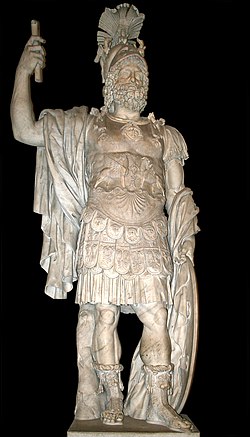
Statue of Mars from the Forum of Nerva in Rome, 2nd century CE