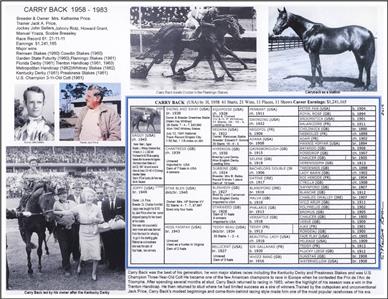
This is a pedigree with pictures of Kentucky Derby winner Carry Back. It measures 8 1/2 X 11 inches and is printed on premium card stock. Researched, put together and signed by myself.
I also do custom pedigree's with pictures please see my website www.picturepedigree.com for more information about me and what I do. I have been a pedigree maker since 2003, and have sold over two thousand pedigrees all over the world to horse enthusiasts and collectors
Carry Back, a dark brown horse, raced in the blue and silver colors of retired manufacturer Jack Price, who bred the colt at the Ocala Stud in Marion County, Florida. Price trained the colt for his wife, Katherine. In early 1958, Price took over ownership of an obscure mare named Joppy for a fee of $150 plus a $150 overdue board bill at his Ohio farm. Joppy's racing record was poor. In seven starts, she finished second twice and earned only $325. Joppy was eventually banned from racing, a result of her frequent refusals to leave the starting gate. For a modest $400 stud fee, Price bred Joppy to a stallion named Saggy. Saggy's only real claim to fame was that in April 1948 he handed Citation the only loss of his Triple Crown winning season with a one length win in the Chesapeake Trial at Havre de Grace Racetrack.
As a two-year-old, Carry Back ran twenty-one times, emerging as one of the best juveniles in America with a series of important victories late in the season including the Garden State Futurity.
As a three-year-old, Carry Back was described by an Associated Press reporter as a "little, scrawny" horse who weighed no more than 970 pounds. The horse was sometimes referred to by the nicknames "C. B." and "The People's Choice". He was the best of his generation in the United States, winning several major stakes races including the Kentucky Derby and Preakness Stakes and being unanimously voted U.S. Champion Three-Year-Old Colt
Racing as a four-year-old, Carry Back had disappointing early form but returned to his best with wins in the Metropolitan Handicap, Monmouth Handicap and the Whitney Stakes to establish himself as one of the leaders of an exceptionally strong handicap division headed by Kelso. In October, he became one of the few American champions to race in Europe when he contested the Prix de l'Arc de Triomphe in which he finished 10th.. In the same year, he became the fourth horse, after Citation, Nashua and Round Table, to earn $1M in prize money.
After spending several months at stud, Carry Back returned to racing in 1963, when the highlight of his season was a win in the Trenton Handicap. He then returned to stud where he had limited success as a sire of winners. Trained by the outspoken and unconventional Jack Price, Carry Back's modest beginnings and come-from-behind racing style made him one of the most popular racehorses of his era.
Carry Back produced twelve stakes winners and the dams of thirty more. His progeny included Back in Paris (Gallorette Handicap), Sharp Gary (Illinois Derby, Display Handicap, Gallant Fox Handicap) and Toter Back (dam of the Group One winner and sire Bob Back).
Carry Back was voted into the American Hall of Fame in 1975.
After his breeding career ended, he was pensioned at the Ocala Jockey Club farm in Florida. In 1983, preparations were under way for a joint birthday celebration for Carry Back and his fellow Florida-bred Needles, who were then the two oldest surviving Kentucky Derby winners. A month before the "birthday party", however, Carry Back was diagnosed with cancer and euthanized on March 24 at the age of twenty-five. His ashes were originally interred at Ocala Racecourse but were later moved to the Kentucky Derby Museum at Churchill Downs in Louisville, home of his greatest victory. His grave marker carried the words "The People's Choice."