

Roman Empire Coin of Emperor Valerian I
Sole Reign (253-260 AD)
Struck 255-256 AD at mint of Rome
Billon BI Antoninianus - Double Denarius - 20.5 mm, ~3 grams -
Reference: RIC 87, MIR 73c
Certified: NGC Choice XF 8211575-092
Obverse: IMP C P LIC VALERIANVS P F AVG, Draped, radiate and cuirassed bust of Valerian facing right
Reverse: FELICITAS AVGG, Felicitas standing left, holding cornucopia and caduceus
Arrives with specifications page for your reference
See the Genuine History Collection
Valerian I (Publius Licinius Valerianus; c. 199 – 260 or 264) was Roman emperor from 253 to spring 260 AD. He rose to power during a particularly unstable period during the Crisis of the Third Century and appointed his son Gallienus as co-emperor. Valerian is known as the first Roman emperor to have been taken captive in battle, captured by the Persian emperor Shapur I after the Battle of Edessa, causing shock and instability throughout the Roman Empire. The unprecedented event and rumors of his humiliation at the hands of the Persian emperor generated a variety of different reactions and new narratives about the Roman Empire in diverse contexts.
Unlike many of the would-be emperors and rebels who vied for imperial power during the Crisis of the Third Century, Valerian was of a noble and traditional senatorial family. Details of his early life are sparse, except for his marriage to Egnatia Mariniana, with whom he had two sons: Publius Licinius Egnatius Gallienus (his co-emperor and later successor) and Licinius Valerianus. Valerian was consul for the first time either before AD 238 as a Suffectus or in 238 as an Ordinarius. In 238 he was princeps senatus, and Gordian I negotiated through him for senatorial acknowledgement for his claim as emperor. In 251 AD, when Decius revived the censorship with legislative and executive powers so extensive that it practically embraced the civil authority of the emperor, Valerian was chosen censor by the Senate, though he declined to accept the post. During the reign of Decius he was left in charge of affairs in Rome when that prince left for his ill-fated last campaign in Illyricum. Under Trebonianus Gallus, Valerian was appointed dux of an army probably drawn from the garrisons of the German provinces which seems to have been ultimately intended for use in a war against the Persians.
However, when Trebonianus Gallus had to deal with the rebellion of Aemilianus in 253 AD, he turned to Valerian for assistance in crushing the attempted usurpation. Valerian headed south but was too late: Gallus was killed by his own troops, who joined Aemilianus before Valerian arrived. The Raetian soldiers then proclaimed Valerian emperor and continued their march towards Rome. Upon his arrival in September, Aemilianus's legions defected, killed him and proclaimed Valerian emperor. In Rome, the Senate quickly acknowledged Valerian.
Valerian's first act as emperor was to appoint his son Gallienus augustus, thus making him co-emperor. Early in his reign, affairs in Europe went from bad to worse, and the whole West fell into disorder. In the East, Antioch had fallen into the hands of a Sassanid vassal and Armenia was occupied by Shapur I (Sapor). Valerian and Gallienus split the problems of the empire between them, with the son taking the West, and the father heading East to face the Persian threat. In 254, 255, and 257, Valerian again became Consul Ordinarius. By 257, he had recovered Antioch and returned the province of Syria to Roman control. The following year, the Goths ravaged Asia Minor. In 259, Valerian moved on to Edessa, but an outbreak of plague killed a critical number of legionaries, weakening the Roman position, and the town was besieged by the Persians. In 260, probably in June, Valerian was decisively defeated in the Battle of Edessa and held prisoner for the remainder of his life. Valerian's capture was a tremendous defeat for the Romans.
While fighting the Persians, Valerian sent two letters to the Senate ordering that firm steps be taken against Christians. The first, sent in 257, commanded Christian clergy to perform sacrifices to the Roman gods or face banishment. The second, the following year, ordered the execution of Christian leaders. It also required Christian senators and equites to perform acts of worship to the Roman gods or lose their titles and property, and directed that they be executed if they continued to refuse. It also decreed that Roman matrons who would not apostatize should lose their property and be banished, and that civil servants and members of the Imperial household who would not worship the Roman gods should be reduced to slavery and sent to work on the Imperial estates. This indicates that Christians were well-established at that time, some in very high positions. The execution of Saint Prudent at Narbonne is taken to have occurred in 257. Prominent Christians executed in 258 included Pope Sixtus II (6 August), Saint Romanus Ostiarius (9 August) and Saint Lawrence (10 August). Others executed in 258 included the saints Denis in Paris, Pontius in Cimiez, Cyprian and others in Carthage and Eugenia in Rome. In 259 Saint Patroclus was executed at Troyes and Saint Fructuosus at Tarragona. When Valerian's son Gallienus became emperor in 260, the decree was rescinded.
Eutropius, writing between 364 and 378 AD, stated that Valerian was overthrown by Shapur king of Persia, and being soon after made prisoner, grew old in ignominious slavery among the Parthians. An early Christian source, Lactantius, maintained that, for some time prior to his death, Valerian was subjected to the greatest insults by his captors, like being used as a human footstool by Shapur when mounting his horse. According to this version of events, after a long period of such treatment, Valerian offered Shapur a huge ransom for his release. In reply (according to one version), Shapur was said to have forced Valerian to swallow molten gold (the other version of his death is almost the same but it says that Valerian was killed by being flayed alive) and then had Valerian skinned and his skin stuffed with straw and preserved as a trophy in the main Persian temple. It was further alleged that it was only after a later Persian defeat against Rome that his skin was given a cremation and burial. The captivity and death of Valerian has been frequently debated by historians without any definitive conclusion.
According to the modern scholar Touraj Daryaee, contrary to the account of Lactantius, Shapur I sent Valerian and some of his army to the city of Bishapur or Gundishapur where they lived in relatively good conditions. Shapur used the remaining soldiers in engineering and development plans. Band-e Kaisar (Caesar's dam) is one of the remnants of Roman engineering located near the ancient city of Susa. In all the stone carvings on Naghshe-Rostam, in Iran, Valerian is represented holding hands with Shapur I, a sign of submission. According to the early Persian Muslim scholar Abu Hanifa Dinawari, Shapur settled the prisoners of war in Gundishapur and released Valerian, as promised, after the construction of Band-e Kaisar. It has been alleged that the account of Lactantius is coloured by his desire to establish that persecutors of the Christians died fitting deaths; the story was repeated then and later by authors in the Roman Near East fiercely hostile to Persia. The joint rule of Valerian and Gallienus was threatened several times by usurpers. Nevertheless, Gallienus held the throne until his own assassination in 268 AD.
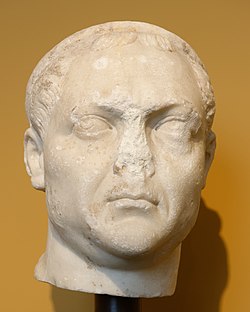
Bust of Valerian I, at the The New Carlsberg Sculpture Museum (Ny Carlsberg Glyptotek) in Copenhagen, Denmark
In ancient Roman culture, felicitas (from the Latin adjective felix, "fruitful, blessed, happy, lucky") is a condition of divinely inspired productivity, blessedness, or happiness. Felicitas could encompass both a woman's fertility and a general's luck or good fortune. The divine personification of Felicitas was cultivated as a Roman goddess, wherein she is a goddess not just of good fortune but also happiness, wealth and success. Although felicitas may be translated as "good luck," and the goddess Felicitas shares some characteristics and attributes with Fortuna, the two were distinguished in Roman religion. Fortuna was unpredictable and her effects could be negative, as the existence of an altar to Mala Fortuna ("Bad Luck") acknowledges. Felicitas, however, always had a positive significance. She appears with several epithets that focus on aspects of her divine power.
Felicitas had a temple in Rome as early as the mid-2nd century BC, and during the Republican era was honored at two official festivals of Roman state religion, on July 1 in conjunction with Juno and October 9 as Fausta Felicitas. Felicitas continued to play an important role in Imperial cult, and was frequently portrayed on coins as a symbol of the wealth and prosperity of the Roman Empire. Her primary attributes are the caduceus and cornucopia. The English word "felicity" derives from felicitas.
The cult of Felicitas is first recorded in the mid-2nd century BC, when a temple was dedicated to her by Lucius Licinius Lucullus, grandfather of the famous Lucullus, using booty from his military campaigns in Spain in 151–150 BC. Predecessor to a noted connoisseur of art, Lucullus obtained and dedicated several statues looted by Mummius from Greece, including works by Praxiteles: the Thespiades, a statue group of the Muses brought from Thespiae, and a Venus. This Temple of Felicitas was among several that had a secondary function as art museums, and was recommended by Cicero along with the Temple of Fortuna Huiusce Diei for those who enjoyed viewing art but lacked the means to amass private collections. The temple was located in the Velabrum in the Vicus Tuscus of the Campus Martius, along a route associated with triumphs: the axle of Julius Caesar's triumphal chariot in 46 BC is supposed to have broken in front of it. The temple was destroyed by a fire during the reign of Claudius, though the Muses were rescued. It was not rebuilt at this site.
Sulla identified himself so closely with the quality of felicitas that he adopted the agnomen (nickname) Felix. His domination as dictator resulted from civil war and unprecedented military violence within the city of Rome itself, but he legitimated his authority by claiming that the mere fact of his victory was proof he was felix and enjoyed the divine favor of the gods. Republican precedent was to regard a victory as belonging to the Roman people as a whole, as represented by the triumphal procession at which the honored general submitted public offerings at the Temple of Jupiter Optimus Maximus at the Capitol, and Sulla thus established an important theological element for the later authority of the emperor. Although he established no new temple for Felicitas, he venerated her with a Ludi circenses to close the Sullan Victory games on the Kalends of November, and Ovid writes of a lavish prosperity feast day for Felicitas which he celebrated thereafter.
On July 1 and October 9, Felicitas received a sacrifice in Capitolio, on the Capitoline Hill, on the latter date as Fausta Felicitas in conjunction with the Genius Publicus ("Public Genius") and Venus Victrix. These observances probably took place at an altar or small shrine (aedicula), not a separate temple precinct. The Acts of the Arval Brothers (1st century AD) prescribe a cow as the sacrifice for Felicitas. Pompey established a shrine for Felicitas at his new theater and temple complex, which used the steps to the Temple of Venus Victrix as seating. Felicitas was cultivated with Honor and Virtue, and she may have shared her shrine there with Victory, as she did in the Imperial era as Felicitas Caesaris (Caesar's Felicitas) at Ameria. Pompey's collocation of deities may have been intended to parallel the Capitoline grouping.
A fourth cult site for Felicitas in Rome had been planned by Caesar, and possibly begun before his death. Work on the temple was finished by Lepidus on the site of the Curia Hostilia, which had been restored by Sulla, destroyed by fire in 52 BC, and demolished by Caesar in 44 BC. This temple seems not to have existed by the time of Hadrian. Its site probably lies under the church of Santi Luca e Martina. It has been suggested that an Ionic capital and a tufa wall uncovered at the site are the only known remains of the temple.
Felicitas was a watchword used by Julius Caesar's troops at the Battle of Thapsus, the names of deities and divine personifications being often recorded for this purpose in the late Republic. Felicitas Iulia ("Julian Felicitas") was the name of a colony in Hispania that was refounded under Caesar and known also as Olisipo, present-day Lisbon, Portugal.
During the Republic, only divine personifications known to have had a temple or public altar were featured on coins, among them Felicitas. On the only extant Republican coin type, Felicitas appears as a bust and wearing a diadem.
A calendar from Cumae records that a supplicatio was celebrated on April 16 for the Felicitas of the Empire, in honor of the day Augustus was first acclaimed imperator. In extant Roman coinage, Felicitas appears with a caduceus only during the Imperial period. The earliest known example is Felicitas Publica on a dupondius issued under Galba. Felicitas Temporum ("Prosperity of the Times"), reflecting a Golden Age ideology, was among the innovative virtues that began to appear during the reigns of Trajan and Antoninus Pius. Septimius Severus, whose reign followed the exceedingly brief tenure of Pertinax and unsatisfactory conditions under Commodus, used coinage to express his efforts toward restoring the Pax Romana, with themes such as Felicitas Temporum and Felicitas Saeculi, "Prosperity of the Age" (saeculum), prevalent in the years 200 to 202. Some Imperial coins use these phrases with images of women and children in the emperor's family.
When the Empire came under Christian rule, the personified virtues that had been cultivated as deities could be treated as abstract concepts, though the later Empire of Nicaea adopted many Hellenic traditions including a version of the prosperity feast day Felicitanalia allegedly described by Ovid in the missing 11th book of the Fasti (poem). Felicitas Perpetua Saeculi ("Perpetual Blessedness of the Age") appears on a coin issued under Constantine, the first emperor to convert to Christianity.
Felicitas was also the basis of the Roman theology of victory adopted during Augustus' reign. The concept, which constituted the foundation of the imperial Roman propaganda, legitimized power or a claimant's right to rule through victory in the absence of traditional institutions. It held that earthly authority depended on heavenly accord and that the successful conquest projected felicitas and excessive virtus indicating divine sanction of sovereignty and authority.
The Christian bishop and scholar St. Augustine of Hippo used the concept of felicitas prominently in his City of God, in which he claims that felicitas is the only virtue that is ultimately worth seeking. He follows that by saying that the Romans should, instead of worshipping a personified deity of this virtue, worship instead the One True God who is the only deity who can truly grant felicitas.