

Roman Empire Coin
Emperor Constantine the Great (Constantine I : 307-337 AD)
Struck 330-335 AD at Mint in Antioch
Bronze AE Follis - 18 mm, 2.4 grams
Reference: RIC VII 86
Obverse: CONSTANTINVS MAX AVG, Rosette-diademed, draped and cuirassed bust of Constantine the Great facing right
Reverse: GLORIA EXERCITVS SMANΓ, Two soldiers standing facing each other, each holding spear and resting shield on ground, two standards between, mintmark SMANΓ in exergue
Arrives with specifications page for your reference
See the Genuine History Collection
Constantine I, or Constantine the Great (Latin: Flavius Valerius Constantinus; 27 February c. 272 – 22 May 337) was a Roman emperor from AD 306 to 337 and the first Roman emperor to convert to Christianity. He played a pivotal role in elevating the status of Christianity in Rome, decriminalizing Christian practice and ceasing Christian persecution in a period referred to as the Constantinian shift. This initiated the Christianization of the Roman Empire. Constantine is associated with the religiopolitical ideology known as Caesaropapism, which epitomizes the unity of church and state. He founded the city of Constantinople and made it the capital of the Empire, which remained so for over a millennium.
Upon his ascension, Constantine enacted numerous reforms to strengthen the empire. He restructured the government, separating civil and military authorities. To combat inflation, he introduced the solidus, a new gold coin that became the standard for Byzantine and European currencies for more than a thousand years. The Roman army was reorganised to consist of mobile units (comitatenses), often around the Emperor, to serve on campaigns against external enemies or Roman rebels, and frontier-garrison troops (limitanei) which were capable of countering barbarian raids, but less and less capable, over time, of countering full-scale barbarian invasions. Constantine pursued successful campaigns against the tribes on the Roman frontiers—such as the Franks, the Alemanni, the Goths, and the Sarmatians—and resettled territories abandoned by his predecessors during the Crisis of the Third Century with citizens of Roman culture.
Although Constantine lived much of his life as a pagan and later as a catechumen, he began to favour Christianity beginning in 312, finally becoming a Christian and being baptised by Eusebius of Nicomedia, an Arian bishop, although the Catholic Church and the Coptic Orthodox Church maintain that he was baptised by Pope Sylvester I. He played an influential role in the proclamation of the Edict of Milan in 313, which declared tolerance for Christianity in the Roman Empire. He convoked the First Council of Nicaea in 325 which produced the statement of Christian belief known as the Nicene Creed. The Church of the Holy Sepulchre was built on his orders at the claimed site of Jesus' tomb in Jerusalem and was deemed the holiest place in all of Christendom. The papal claim to temporal power in the High Middle Ages was based on the fabricated Donation of Constantine. He has historically been referred to as the "First Christian Emperor", but while he did favour the Christian Church, some modern scholars debate his beliefs and even his comprehension of Christianity. Nevertheless, he is venerated as a saint in Eastern Christianity, and he did much to push Christianity towards the mainstream of Roman culture.
The age of Constantine marked a distinct epoch in the history of the Roman Empire and a pivotal moment in the transition from classical antiquity to the Middle Ages. He built a new imperial residence in the city of Byzantium and renamed it New Rome, later adopting the name Constantinople after himself, where it was located in modern Istanbul. It subsequently became the capital of the empire for more than a thousand years, the later Eastern Roman Empire often being referred to in English as the Byzantine Empire, a term never used by the Empire, invented by German historian Hieronymus Wolf. His more immediate political legacy was that he replaced Diocletian's Tetrarchy with the de facto principle of dynastic succession by leaving the empire to his sons and other members of the Constantinian dynasty. His reputation flourished during the lifetime of his children and for centuries after his reign. The medieval church held him up as a paragon of virtue, while secular rulers invoked him as a prototype, a point of reference, and the symbol of imperial legitimacy and identity. At the beginning of the Renaissance, there were more critical appraisals of his reign with the rediscovery of anti-Constantinian sources. Trends in modern and recent scholarship have attempted to balance the extremes of previous scholarship.

Head of the Colossus of Constantine, Capitoline Museums
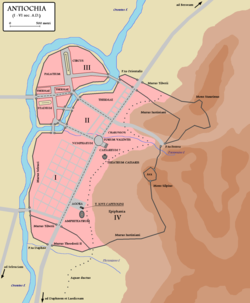
Map of Antioch in Ancient and early Medieval times under Roman rule